
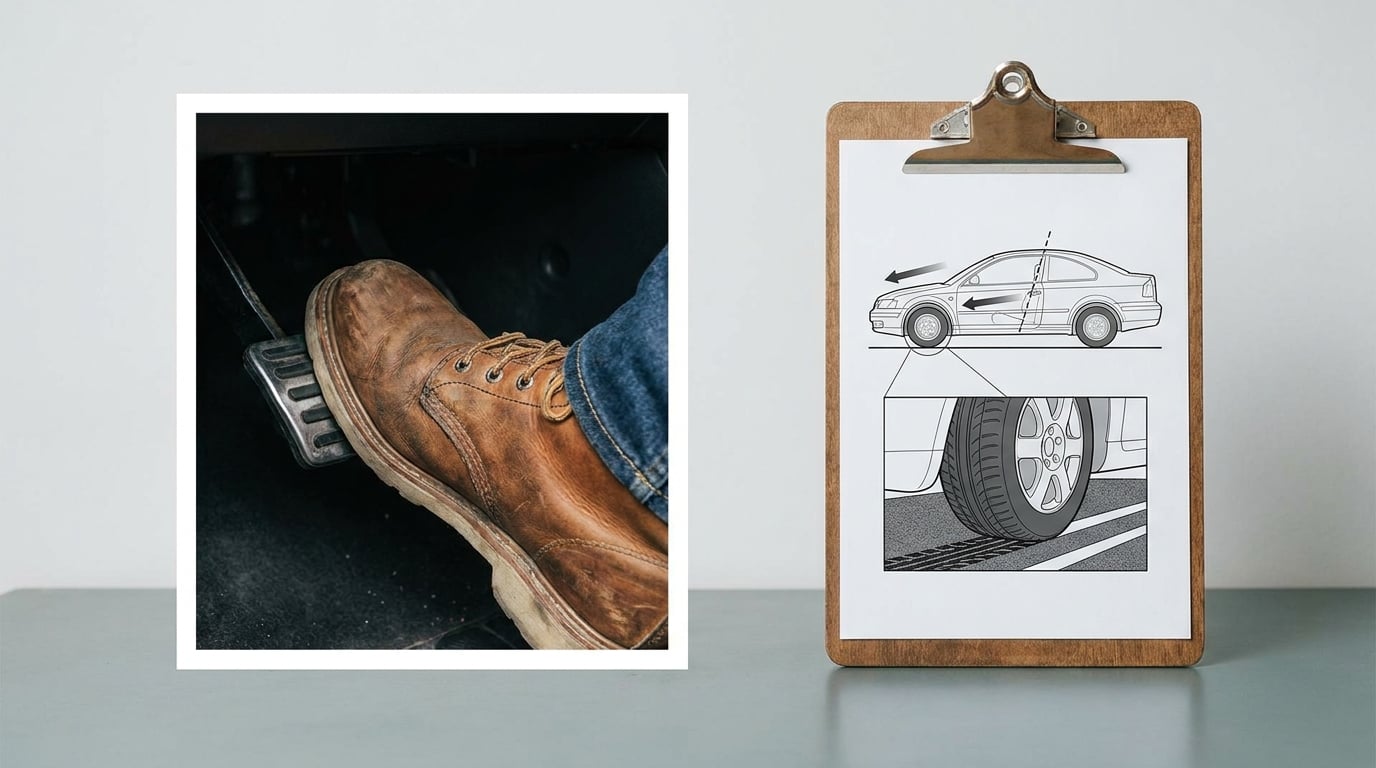
Threshold braking explained in one line: you apply the most brake pressure your tires can support, right at the instant they start to slip, and stop as short as possible without locking a wheel. Drivers also call it limit braking, and the whole technique turns on one fact from physics, which is that a tire rolling on the road grips far better than the same tire locked and sliding.
Used in motor racing for decades, threshold braking is now something a lot of everyday drivers want to understand, partly because their own car makes it confusing. Some cars lock their wheels the instant you stand on the pedal, others buzz the pedal at you, and the two behaviours come from completely different physics.
This guide covers what threshold braking is, how it works, how to sense the limit, and when you should absolutely stay away from it. Nothing here is advice to practice hard braking in traffic. Some of it is a knowledge topic, and some of it is genuinely a closed-course skill.
Table of Contents
What Is Threshold Braking?
Threshold braking is the practice of applying brake pressure up to the point where the tire reaches its maximum grip, then holding or easing off just enough to stay at that point for as long as you need. Maximum brake pressure without the tires slipping is the goal.
Ordinary braking, the kind you use to pull into a parking space, never gets anywhere near this. Neither does stabbing the pedal out of panic. Threshold braking is a single, sustained, controlled squeeze that ramps up over a couple of seconds, arrives at the grip limit, and stays there.
Two things separate it from ordinary braking. First, the pressure is high enough to matter, near what the pads and fluid can deliver rather than a light touch. Second, the driver is actively modulating to stay just under the wheel lock-up point instead of just pushing and hoping.
On a public road, this is a knowledge topic rather than a driving habit. Deliberately reaching the limit in traffic leaves you a fraction of a second from a locked wheel, and there is no safe way to practice it between two moving cars. The technique belongs to a closed course, a skid pad, an empty wet parking lot inside a low speed limit, or an instructor-led emergency maneuvers course.
How Threshold Braking Works
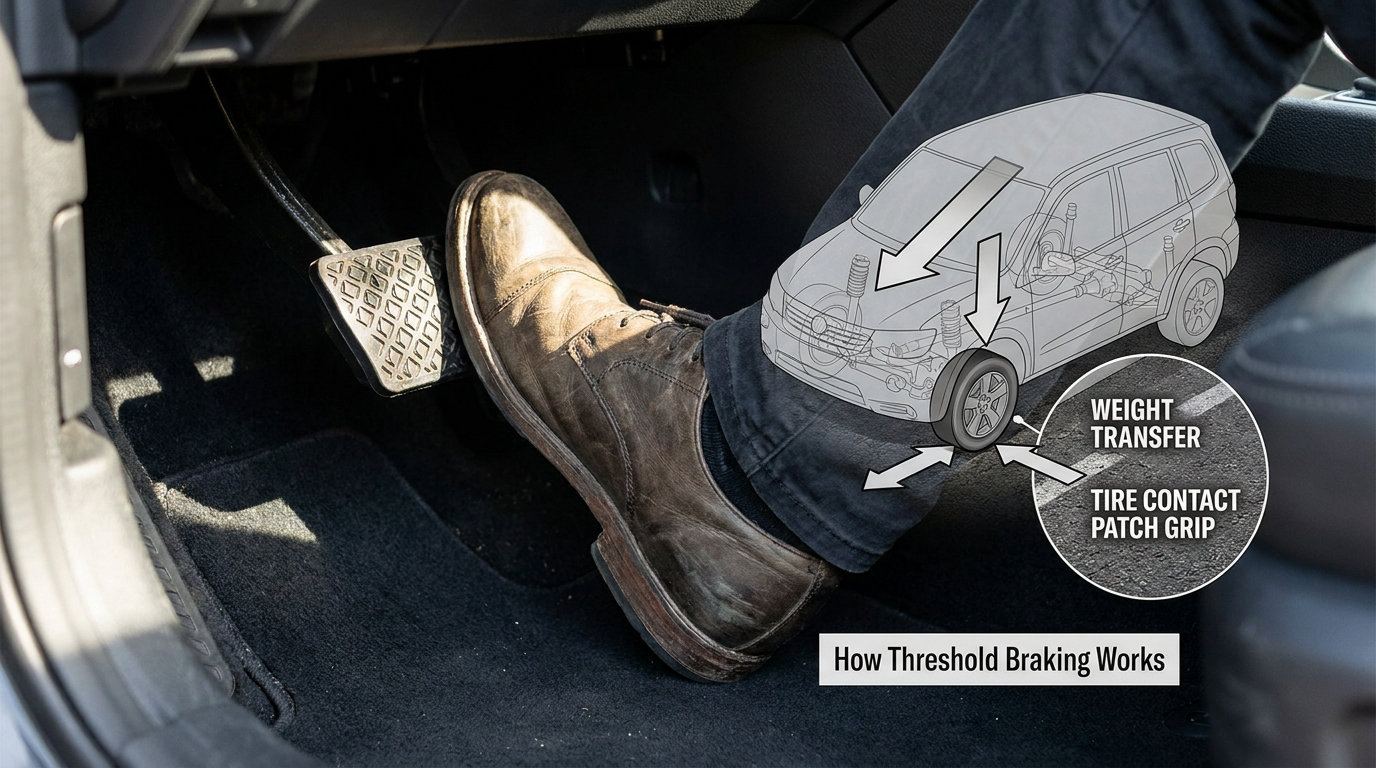
A tire rolling on pavement grips through static friction, the grip of two surfaces that are still moving together. The moment the wheel starts sliding, that grip drops to kinetic friction, and kinetic friction is meaningfully lower. Friction climbs as brake pressure rises, peaks at the exact instant the wheel begins to slip, and then falls off a cliff the moment slip develops.
That peak is the threshold. Hold pressure at the slip boundary and the tire generates the maximum braking force the contact patch can produce. Push past it and every extra pound of pedal pressure buys you less grip, not more, because a sliding tire scrubs rather than sticks.
Weight transfer is the other half of it. Braking pitches the car’s mass forward onto the front tires, which is where nearly all the braking work happens anyway, and that front-end load is what lets the pedal feel like it has more travel before the limit arrives.
Tire load sensitivity is what makes the tail end feel vague. A heavily loaded tire does not return proportionally more grip for proportionally more load, so the front axle reaches its limit while the rear is still doing useful work. Once the fronts are at peak, the remaining braking capacity shrinks fast, and that is the moment the pedal goes light and the car starts to feel loose.
The math is unfriendly and short. Braking distance is d = v squared divided by 2 mu g, so speed matters far more than anything else, and it matters exponentially.
| Starting speed | Reaction distance at 1 second | Braking distance, dry (mu 0.7) | Braking distance, wet (mu 0.35) | Total stopping distance, dry |
|---|---|---|---|---|
| 30 mph | 44 ft | 43 ft | 86 ft | 87 ft |
| 40 mph | 59 ft | 76 ft | 153 ft | 135 ft |
| 50 mph | 73 ft | 119 ft | 239 ft | 192 ft |
| 60 mph | 88 ft | 172 ft | 344 ft | 260 ft |
Those numbers are idealised figures on level ground with a reacting driver, but the shape is right. Halving the grip roughly doubles the braking distance. Locking the wheels, which drops you well into the kinetic side of the curve, pushes it further still and hands you a locked car that goes straight regardless of where the wheel is pointed.
While your car is absorbing all of that energy, the brakes are cooking. Kinetic energy converts to heat at the rotors, and a single hard stop from highway speed puts more heat into a front rotor in a few seconds than a week of gentle stops. Repeated threshold braking is the fastest way to cook pads and warp rotors, and once the pads go past their operating temperature range, you get brake fade, which is a long slow stop with a pedal that has gone soft and useless.
That heat load is also why the modern trend toward lower-grip tires is kinder to your brakes. Less grip means you cannot generate as much braking force, which means less energy converted to heat, which means the technique self-limits. The counter-intuitive version of that is that a worn-out tire gives you less threshold braking and less brake wear at the same time. If you want to read more about how a car’s systems move energy around, our guide to regenerative braking explained for beginners covers the electric side of the same idea.
How to Use Threshold Braking Safely
On a closed course, the sequence is short and it is all in the feet and eyes. Keep your eyes up and on your stopping point the whole time, because a driver looking at the pedal has lost the ability to correct anything.
- Settle the car first. Straighten the wheel, get the car settled, and only then start. Braking while the car is still rotating wastes grip in a corner instead of using it for the stop.
- Ramp the pressure smoothly. Squeeze the pedal with steadily increasing force over a second or two. A stab of the pedal locks a non-ABS car far more often than a smooth ramp.
- Watch and listen for the break point. The pedal travel suddenly gets shorter, your body moves forward, the nose dives, and the tires begin to chirp. That combination is your cue that you have arrived.
- Do not add more. The instinct at the limit is to press harder, and that is exactly the input that pushes you past the peak. Keep the pressure steady instead.
- Hold, do not stab. Bouncing or pumping the pedal drops you off the peak and onto the falling side of the curve repeatedly, which lengthens the stop and is the single most common beginner error.
- Follow with a smooth release. Come off the brake as the car reaches a crawl, not before. Trail-off, where brake pressure fades as you steer into a corner, is a different technique and a good next lesson.
Before any of that is worth attempting, the car has to be honest. Tires with reasonable tread and pressure, pads and fluid that are not near the end of their life, and no warning lights on the dash. While you are under the car checking brake hardware anyway, the metric vs SAE sockets explained guide covers why a wrench that almost fits is its own kind of problem.
Threshold Braking vs. Maximum Braking
Maximum braking, sometimes described as mashing or stomping, means pushing the pedal to the floor and accepting whatever the car does. On a car with no anti-lock braking, that usually means locked wheels: a longer stop, no steering, and a much higher chance of a spin if you have to change direction.
Maximum braking is what you want in a genuine panic on a car with no ABS and no alternative, because a locked wheel still slows you down. Threshold braking is what you want when you also need to arrive on target, or steer around something, or drive away cleanly.
The differences show up in how the pedal is handled and what the car is doing second by second.
| Technique | Pedal action | Wheel lock risk | Best for | Main drawback |
|---|---|---|---|---|
| Normal braking | Light to moderate pressure, whatever feels right | Very low | Everyday driving, traffic, wet roads | Uses only a fraction of available grip |
| Threshold or limit braking | Sustained ramp to the grip limit, then hold steady | Low with skill, moderate without | Closed courses, track sessions, non-ABS emergency stops | Demands pedal feel and practice |
| Cadence braking | Pumping the pedal to build pressure between near-lock-ups | Deliberate, repeated | Older cars, some non-ABS emergency situations | Slower than holding a clean threshold on modern tires |
| ABS braking | Full pedal force, system releases and re-applies by itself | Prevented by design | Almost every modern daily driver | Pedal pulse and noise that unsettle some drivers |
Cadence braking is the technique most often confused with threshold braking because both are pedal-management tricks. They are opposites in practice. Cadence braking deliberately breaks grip and rebuilds it, while threshold braking deliberately holds the peak and never lets go.
For a daily driver the answer is conditional, and the forum arguments miss it by treating the two camps as enemies. If your car has working ABS, stand firmly on the pedal and let the system modulate, and do not fight it, because releasing the pedal as the system works actually lengthens the stop. If your car has no ABS, learning to threshold brake is genuinely worthwhile, since a locked wheel is your worst outcome and the threshold is your best one.
Trail braking, the other constant source of confusion, overlaps with threshold braking in that both live at the limit. The difference is the job. Threshold braking stops the car. Trail braking slows the car while you keep steering into the corner, spending the grip on direction change instead of pure deceleration.
What Surface Conditions Change the Technique?
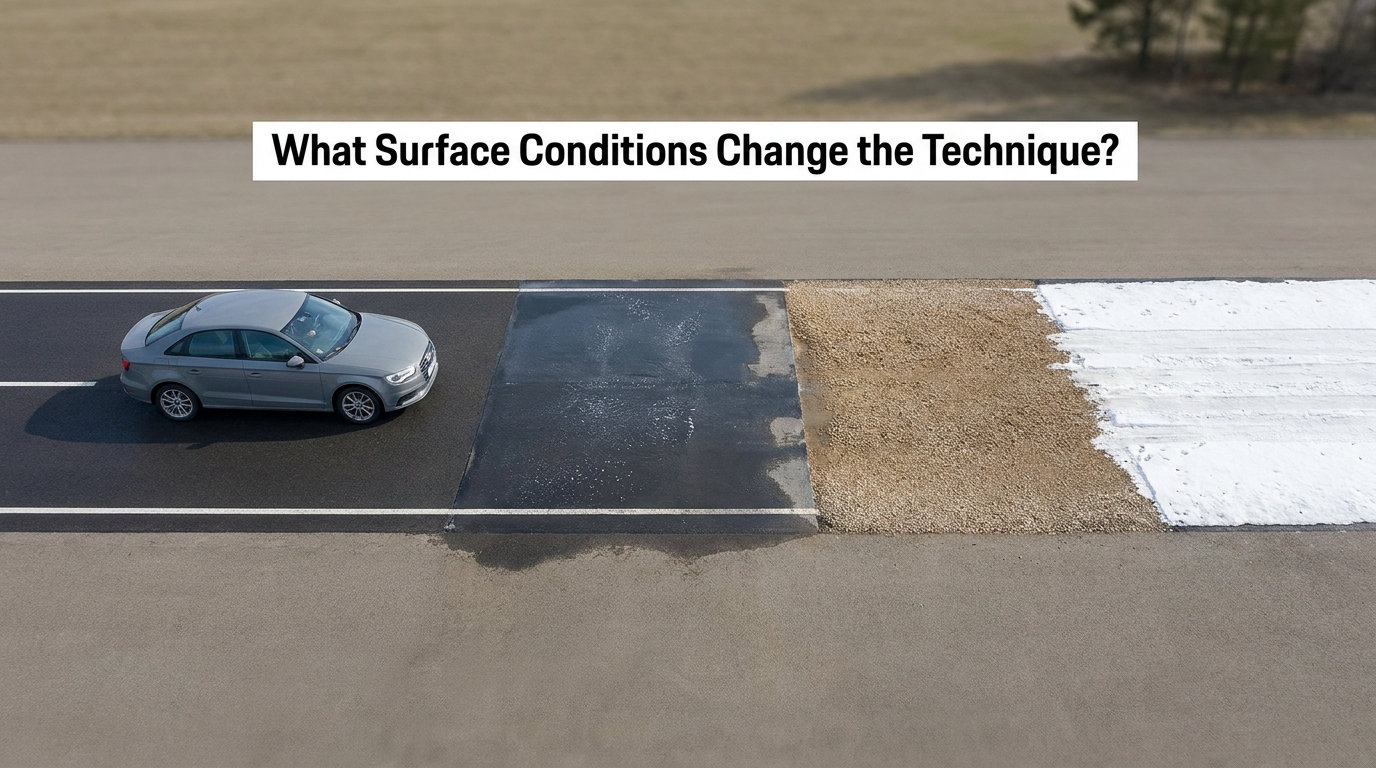
Dry pavement is the reference case, and the numbers in the table above assume it. Everything else moves the threshold, and mostly it moves it down and makes it harder to find.
On wet pavement, grip drops by roughly half, which doubles braking distance at the same speed. Water also delays the build of grip as you press, and the wheel can reach lock-up on a road that feels fine. The threshold still exists, but it arrives sooner and it arrives with less warning.
Gravel and loose dirt behave differently again. A loose surface lets the tire dig and build a small wedge in front of the contact patch, so the stop is long but more progressive, and lock-up is much less likely. On sand, grip is low and consistent, and steering changes matter more than pedal pressure.
Snow and ice are where the honest answer is to slow down long before you reach the limit. On ice you may have no usable threshold to find at all, and the first sign you have found one is that you have already lost it.
Two other factors move the threshold that catch people out. On a long descent, repeated heavy braking drives brake temperatures past the friction material’s working range and gives you fade, which feels like the brakes going soft while you need them most. Adding load, passengers, cargo, or a trailer behind you increases both the stopping distance and the heat going into the brakes.
Long descents are better handled with engine braking and a lower gear. If you want the difference between friction brakes and other ways of slowing a car spelled out, the regenerative braking piece linked above covers the electric version of the same idea.
How Do You Know When You Are at the Threshold?
You feel it before you hear it, and the order is consistent enough that drivers learn it quickly. The first sign is a break point in the pedal: the pedal that was moving smoothly toward the floor suddenly feels like it has run out of travel, as though something solid has been reached.
Next is the head-bob. The forward weight transfer that started when you began braking becomes obvious and settles into a steady lean, and your body usually tips slightly forward as the car stops pitching.
Then comes sound. A tire right at the limit chirps or squeals intermittently, a short sharp scrub on each pulse. A soft repeated chirp means you are at the peak and holding it correctly. A continuous loud shriek means you are past it and the tire is sliding, and the fix is to reduce pressure, not add it.
On a car with ABS, the system announces itself with a rapid pulse or buzz in the pedal and a ticking from the pump, often accompanied by a small dip in forward motion as each release and reapply cycle takes a fraction of the available grip. Drivers regularly ask whether something is broken. Nothing is broken. That is the system doing the threshold braking for you, faster and more accurately than a human can feel it, and the correct response is to hold the pedal down and ignore the noise.
Steering response is the last signal, and the most important one. At the limit the car still answers the wheel, with maybe a little less precision than a moment earlier. Once the fronts are past the peak, the response goes vague and delayed, and any correction you make takes longer to arrive than you expect. That is the moment to back off, not the moment to try saving it with more steering input.
Common Threshold Braking Mistakes
Stabbing the pedal. A quick stab overwhelms a non-ABS car and locks the wheels. Fix it by ramping pressure smoothly over a second or two instead.
Adding pressure after the limit arrives. That extra input is what turns peak grip into a slide. Hold the pressure steady once the break point shows up.
Pumping or bouncing the pedal. Every release drops the tire off the peak, and the stop gets longer each time. Squeeze once and hold.
Looking at the pedal. You need your eyes on the road and your target the whole time you are braking hard. Glance down mid-stop and you lose the ability to steer out of a problem.
Releasing and grabbing again in a panic. Many drivers stomp, release in fright, then stomp harder. Both stomp events happen at a higher pedal rate than the grip can follow, and the vehicle slows unevenly.
Trying it in traffic to find out where the limit is. Find it on a closed course, at a speed where a locked wheel is an inconvenience rather than a crash. If you want the skills without a track, an emergency maneuvers course is the cheapest and fastest route.
Ignoring wear. Living at the limit is hard on tires and pads. Hard braking on a daily driver chews the front of the tire tread and shortens pad life noticeably, and hard braking also builds brake dust, which is not exactly street-friendly. If you do not need the technique, the honest answer for a road car is that occasional threshold braking is fine, but making a habit of it is expensive.
Frequently Asked Questions
When should I use threshold braking?
Use threshold braking on a closed course, at a track, on a skid pad, or during an emergency in a car without ABS where you must stop as short as possible. On a public road with normal traffic, do not aim for the limit deliberately. Some drivers wonder whether it makes sense on a dry back road with no one around; the honest answer is that the technique belongs somewhere you cannot accidentally rear-end someone, not somewhere that merely seems empty at the time.
How do I apply the brakes for threshold braking?
Ramp brake pressure smoothly and evenly over a second or two rather than stabbing the pedal. As pressure builds, watch for the break point where pedal travel shortens, the nose dives, and the tires begin to chirp. Hold that pressure steady rather than pushing further, keep your eyes up and on your target, and release the brake smoothly as the car comes to a crawl. Bouncing or pumping the pedal lengthens the stop.
How should I brake if my car has ABS?
On a car with working ABS, stand firmly on the pedal and let the system work. ABS releases and re-applies brake pressure many times per second to hold the tire at the peak of the grip curve, which is faster and more accurate than a driver can feel. The pulsing pedal and buzzing noise are the system working, not a fault, and the most common mistake is releasing the pedal when it starts, which lengthens the stopping distance.
What are the main types of braking?
Four techniques cover most driving. Normal braking uses light to moderate pressure for everyday stops. Threshold or limit braking holds maximum usable pressure right at the point the tire begins to slip. Cadence braking pumps the pedal to build and release pressure, and is mostly relevant to older cars without ABS. ABS braking means full pedal pressure while the anti-lock system modulates pressure for you, keeping the wheel from locking.
What is brake fade, and can it happen on the road?
Brake fade is the loss of braking performance after repeated heavy braking heats the pads and rotors beyond the friction material’s working range. On a track it follows a long cornering sequence; on the road it follows a long descent, a long line of traffic, or several consecutive emergency stops. The pedal goes soft and the stopping distance grows, and the fix is to let the brakes cool, use a lower gear and engine braking on descents, and never rely on cooled-down brakes for the next emergency.
Does threshold braking wear out brake pads and tires faster?
Yes, and it is the main cost of doing it as a habit rather than an occasional tool. Threshold braking converts the car’s kinetic energy into heat at the rotors quickly and repeatedly, which shortens pad life and can lead to warped rotors. Hard braking also wears the front of the tire tread faster than the rear. On a car that mostly drives in traffic, using threshold braking occasionally costs you very little; making it a habit shows up in tire and pad life.
Conclusion
The safest first step is not to brake harder. It is to slow down earlier, keep the car settled and straight, then apply a single smooth increase in pressure and hold it. From there the honest guidance is simple: on a car with ABS, stand on the pedal and trust it; on a car without ABS, learn where the threshold is somewhere you cannot cause a crash.
Wherever you learn it, do it deliberately. Threshold braking is a knowledge topic for most drivers and a genuine skill for a few, and both of those are better served by understanding the grip than by testing the limit in traffic.