
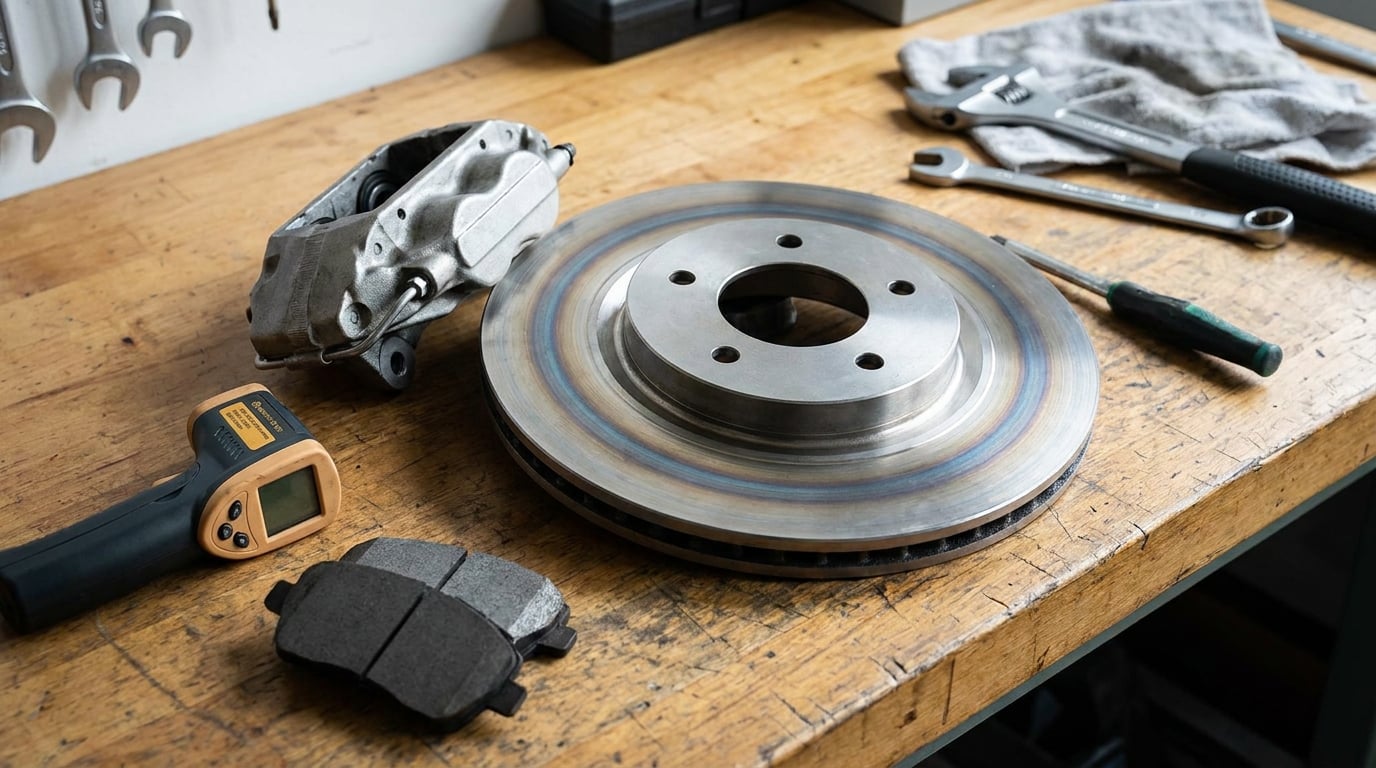
Brake fade is the temporary loss of braking performance that happens when your brakes get too hot. The pads, rotor and fluid soak up the heat created by slowing the car, friction drops, and your pedal travels farther while the car takes longer to stop. It usually goes away on its own once things cool down, which is why it gets mistaken for a worn part.
The confusing part is that fade feels exactly like a hydraulic failure, and the two get mixed up constantly. Both give you a soft pedal. One is temporary and normal after a hard descent; the other means air, moisture or a leak, and it does not fix itself. Sorting those two apart is the first thing worth learning, and we will get to it below.
Table of Contents
What Is Brake Fade and Why Does It Happen?
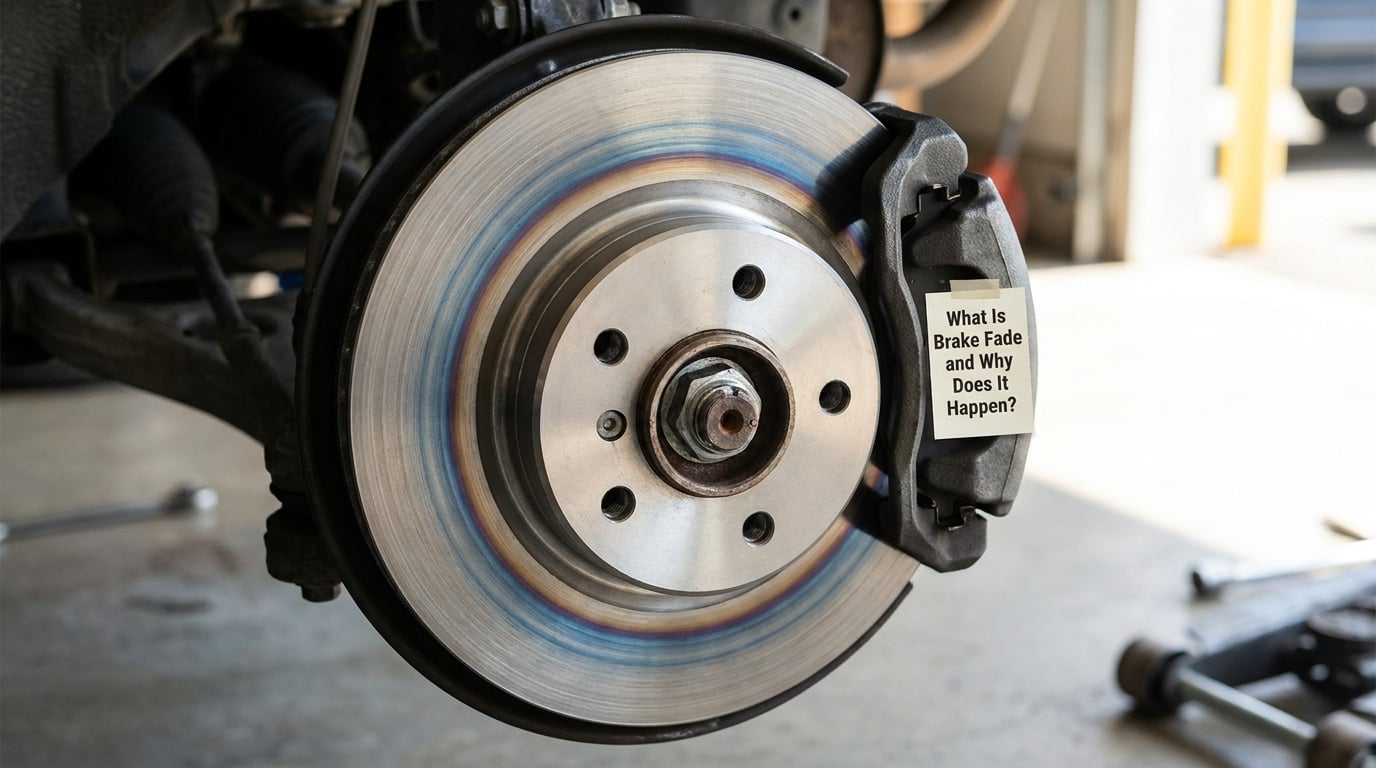
Every stop converts the car’s movement into heat. That is how a brake works. What most people never think about is that this happens constantly, in small amounts, on every single stop you have ever made.
Under normal driving the rotor and pads shed that heat to the surrounding air faster than it builds. Under repeated hard braking, the heat arrives faster than it can leave. The friction material’s coefficient of friction, the number that describes how well pad and rotor grab each other, falls off a cliff past a certain temperature. So does the pressure your foot feels.
Then there is the fluid side of the story. Brake fluid is hygroscopic, which is a polite way of saying it drinks moisture from the air. That lowers its boiling point. Get the fluid hot enough and it flashes to vapor, and vapor compresses rather than transmits pressure. That is vapor lock, and it is why a fading pedal sometimes goes to the floor instead of just getting long. Our guide to how to tell if brake fluid is contaminated covers the checks worth making when the pedal goes soft on a car that has been parked for a while.
Heat also warps rotors, glazes pad faces and cooks the resin binder out of the friction compound. The result is the same from the driver’s seat: less stopping power for the effort you are putting in.
Owners on car forums describe fade almost the same way every time. The pedal goes long after several hard stops, feels normal again after a few minutes of gentle driving, and there is no fluid on the ground. That recovery pattern is the tell.
What Causes Brake Fade?
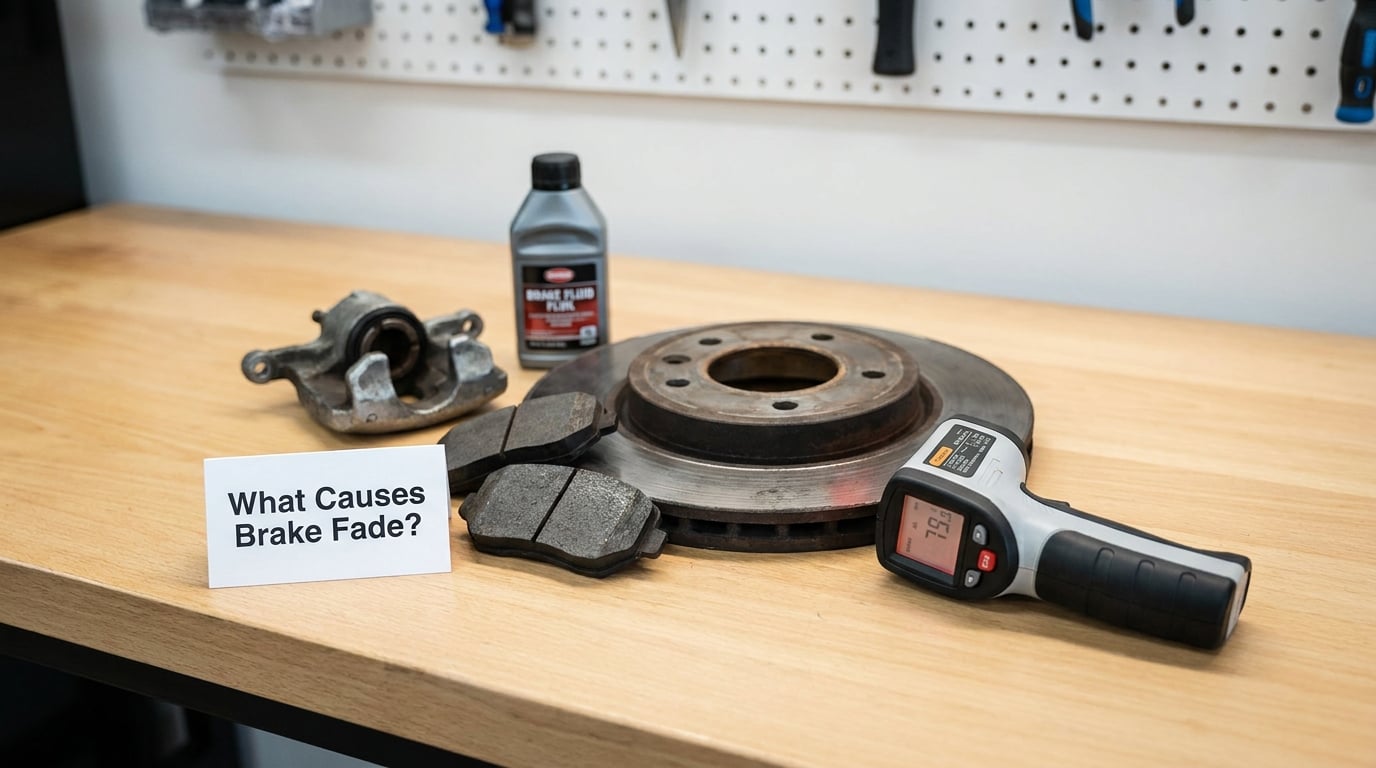
Heat is the common denominator, but the situations that produce it are predictable. Here are the ones we see most often, with the symptom each one tends to produce.
| What causes it | When it happens | What you notice |
|---|---|---|
| Repeated hard braking | Several firm stops close together, or stop-and-go highway traffic | Pedal gets long and vague, stopping distance grows a little each stop |
| Long downhill driving | Mountain grades, canyon roads, long descent with the trailer on the hitch | Pedal firms up on the hill and goes soft after the third or fourth sustained application |
| Overloaded or towing | Heavy payload, full passengers, a trailer the brakes were never sized for | Rotors run hot with no obvious cause; rear brake pedal travel grows more than front |
| Unsuitable pad compound | Cheap organic pads, or a pad choice the manufacturer never specified | Fade onset arrives earlier than it should, sometimes on a single stop |
| Old or contaminated fluid | Fluid past its service life, a long-stored vehicle, a partly drained reservoir | Soft pedal that appears after the car warms up and improves once it cools |
| Sticking caliper or parking brake | A caliper that does not fully retract, or a parking brake left slightly on | One wheel is hot to the touch after an ordinary drive, car pulls to one side |
| Worn hardware | Missing clips, shims or anti-rattle pins, worn slide pins | Rattling, uneven pad wear, judder that changes as the brakes heat up |
| Bed-in never done | New pads within the first few hundred miles | Judder, uneven pedal feel and a glazed pad face on the first stops |
Two of those deserve a note. The sticking caliper is the one people miss, because a single hot wheel after a normal drive is not something anyone is looking for. Park with the brake lightly held and then touch the wheel; if one is dramatically warmer than the other three, something is dragging.
The bed-in row matters too. If your brakes felt odd in the first 100 miles after new pads went on, that was not a defect and it was not really fade. It was an unbedded pad face.
How Can You Tell Brake Fade From Other Problems?
Fade is recoverable, comes with heat, and fades away with time. A fault is none of those things. That is the whole diagnosis in one sentence, and everything below is just how to apply it.
Does the pedal recover, or does it stay soft?
This is the single most useful test and it costs nothing. Drive gently for five to ten minutes after the soft pedal appears. If the pedal comes back and the braking feels normal again, you had thermal fade or fluid vaporization. If the pedal stays long or spongy with the car cold and parked, you have a hydraulic fault and the brakes need work.
A pedal that stays soft is the classic reason a car gets a master cylinder, booster or air-in-the-line diagnosis. Air in the system and a worn master cylinder both do that, and neither one recovers on its own.
Is the fade tied to heat and load, or to no reason at all?
Thermal fade always has a cause you can point to: three hard stops, a descent, a loaded car, a track session. Fade that shows up on a lazy drive home with no prior heat is a different animal. That usually means fluid condition, air in the lines, or a mechanical problem with the caliper or actuator.
Which other symptoms get mistaken for fade?
Glazing is a smooth, shiny, mirror-like pad surface from repeated light braking on a hot rotor. It feels like reduced bite with no pedal change. Pulsation is a vibration through the pedal or the floor, almost always from rotor thickness variation, and it usually shows up right after new pads or after the rotors have been painted. Pulling to one side is a drag or a seized caliper, not fade. Sponginess that never recovers is fluid or air, covered above.
| Symptom | Most likely cause | What you can check yourself |
|---|---|---|
| Soft pedal after several hard stops, recovers when cool | Thermal fade or vaporized fluid | Compare pedal feel cold vs warm, and again after ten minutes of gentle driving |
| Soft pedal even when cold, never recovers | Air in lines, worn master cylinder, low fluid | Fluid level in the reservoir, fluid condition and colour, pedal travel when parked |
| Pedal travel grew and stays grown | Worn pads, thin pad sensor, worn hardware | Pad thickness through the wheel spoke, rotor edge lip |
| Vibration through the pedal after new pads | Rotor thickness variation, unbedded pads | Rotor surface for grooves, rust on the braking face, bed-in procedure |
| Car pulls under braking | Seized caliper, stuck slider, worn slide pins | Wheel temperature after the drive, pad wear pattern across the rotor |
| Brake smell with no hard driving | Dragging brake or a wheel bearing | Touch each wheel after a normal drive, look for a hot hub |
On a car with ABS, one more thing changes. ABS modulates pressure many times per stop and its behaviour is not a useful clue on its own. If the pedal pulses under heavy braking on a dry road, that is the system doing its job.
How Do You Avoid Brake Fade While Driving?
Most fade is a driving habit, not a parts problem. Seven changes cover nearly every case, and none of them cost anything.
1. Downshift before the descent, not halfway down it
Put the transmission in a low enough gear that the engine, not the brakes, is slowing the car. On a manual, drop two gears at a time and stay in one gear for the length of the grade rather than shifting repeatedly. On an automatic, use the lower drive range or manual mode and hold a low gear.
2. Snub brake in controlled increments
If the descent is too steep for one gear, brake in short applications of 10 to 15 km/h of speed reduction, then release completely and let the components cool. Repeated light applications dump heat into the pads without giving them a chance to shed it. Small steps are what let the rotor act as a heat sink between stops.
3. Never ride the brake pedal downhill
Holding the pedal applies light pressure continuously. That is exactly the input that glazes pads and builds residual heat without ever producing a meaningful stop. If you catch yourself feathering the pedal down a hill, change gear instead.
4. Leave real following distance in traffic
The slowdown in a queue is where most drivers meet fade without ever noticing. More space means fewer near-maximum stops, and fewer hard stops means far less heat. Slowing earlier costs nothing.
5. Manage load on a trip
Towing a trailer or running a fully loaded pickup down a sustained grade is the hardest braking job a road car gets. Take a lower gear earlier, plan the route around the steepest grades, and never assume the brakes can soak up that much energy for as long as you need them.
6. Cool the brakes deliberately when you need to
After a hard stop, a track session or a descent, drive gently at low speed for a few minutes. Air moving past the rotors does more for them than anything else you can do, and it is free. Never park immediately after sustained hard braking; sitting still traps heat in the components.
7. Take the first stop of the drive easy on new pads
The first ten or twenty stops after fitting pads are the bedding stops, and hard braking during them is what locks in a bad friction surface. Give the new pads three or four moderate stops from moderate speed, then leave them alone.
What Maintenance Helps Prevent Brake Fade?
Brakes are one of the few systems where the manufacturer’s specification beats anything you have read online. Follow the service manual for fluid type, pad compound and inspection intervals. Outside of that, these are the items that actually reduce heat-related problems.
Use the pad compound the vehicle was designed around
Organic pads are quiet and cheap but their resin binder starts to soften and smear at relatively low temperatures. Semi-metallic pads hold their coefficient of friction further up the temperature range and take more heat before fading, at the cost of noise and rotor wear. Sintered metallic handles repeated hard stops and towing but is loud, wears discs quickly and needs far more pressure to bite. Running a heavier-duty compound on a car set up for a softer one gets you noise and premature rotor wear rather than fade resistance.
Bed new pads in properly
The bed-in builds an even transfer layer on the pad face, which is what gives you consistent bite later. The commonly cited version is 30/30/30: roughly 30 stops, from around 30 mph, applying around 30 percent pedal pressure, letting the car come to a near stop and then repeating without ever coming to a complete halt on the first few.
Afterwards, let the brakes cool for a few minutes and then make two or three firm stops from moderate speed on a straight road with no traffic behind you. That final cooling phase sets the pad surface. Skipping the cooldown is the most common mistake in the whole procedure.
Keep rotor faces clean and true
Corrosion on the braking face prevents pads from seating properly, and a rotor with a heavy lip or grooves holds heat in places it should not. Rotor thickness variation shows up as a pedal pulse after fitting pads over old discs. If the rotors are at minimum thickness with grooves or warping, they are finished, not worth cleaning.
Check the calipers and hardware
A caliper that slides on grease-coated pins instead of sealed pins needs those pins cleaned and greased, not the caliper replaced. Missing anti-rattle clips and shims let the pad move under load, which rattles, wears unevenly and generates heat in the wrong places. Feel that the caliper releases fully when you lift the pedal. If fluid is weeping at one corner, how to check brake calipers for leaks is the next step before you go looking for a fade explanation.
Keep the fluid to the right specification
| Fluid | Typical dry boiling point | Typical wet boiling point | Good for |
|---|---|---|---|
| DOT 3 | Around 205C | Around 140C | Most everyday driving in temperate climates |
| DOT 4 | Around 230C | Around 155C | Towing, loaded vehicles, repeated hard stops, hot climates |
| DOT 5.1 | Around 260C | Around 180C | Track and competition use, the widest moisture margin |
Wet boiling point is the number that matters for daily use, because it tells you what the fluid will tolerate once it has absorbed water. Owners who flush old fluid to DOT 4 frequently report a firmer pedal and fewer soft-pedal complaints, which matches what the spec sheet predicts. DOT 5 and 5.1 silicone-based fluids must never be mixed with glycol-based fluid, so check what the reservoir cap or your manual specifies before changing anything.
Keep the wheels unloaded and check for drag
A brake that stays slightly applied with the pedal released cooks itself quietly. After an ordinary drive, check that no wheel is noticeably hotter than the others and that the car rolls freely when you push it in gear on level ground. If it has to be shoved, you have a sticking caliper or a parking brake that is not fully releasing.
What to Do If Brake Fade Happens
Fade on the road is a change in the car’s behaviour, so treat it like any other sudden change: reduce the demands on the car and get it somewhere safe.
Ease off the brake progressively and let the car slow through engine braking in a low gear. Do not stand on the pedal trying to claw back the lost bite, and do not pump it. Repeated applications add heat without clearing it, and on a car with ABS the pedal pulse that comes with pumping is the system correcting you rather than a fault.
Pull over somewhere out of the traffic flow before the situation forces your hand. Once stopped with the brake released, leave the car in gear and let it idle so airflow reaches the rotors. Then drive gently for a few minutes at low speed, which is far more effective than sitting still with the brake on.
Do not put cold water on hot rotors. Thermal shock can crack a disc outright, and it warps the friction surface that was otherwise fine.
Once the pedal feels normal, the car is drivable but the brakes have told you something. Get them inspected before you rely on them for another descent, another full load or a track day. If the pedal never recovers, treat the drive home as a minimum and do not tow anything.
Frequently Asked Questions
Does brake fade damage my brakes?
Not usually. Thermal fade is a temporary loss of performance and it does not consume pads or warp rotors on its own. What does cause wear is the pattern that produces fade: holding the pedal downhill, glazing pad faces through repeated light braking, and running a hard-loaded car repeatedly over the same descent. A brake that fades cleanly and recovers leaves no lasting damage. A brake that fades and does not recover means something else is wrong and needs an inspection before you drive it normally.
Can brake fade happen in the rain?
Yes, but usually for a different reason. Wet roads can lay a film of water on the rotor that temporarily reduces bite on the very first stop, which fades away after one or two applications. Wet weather also raises the chance of corrosion on the rotor surface, and a corroded rotor will not bed pads properly. In heavy rain you will also be stopping more often in slower traffic, which is where heat-based fade builds. The same habits apply: real following distance, firm single applications, no riding the pedal.
How long does it take for brakes to cool down?
Most fade clears within a few minutes of light driving. Drive gently at low speed so air moves across the rotors, and the pedal usually firms back up within five to ten minutes. Heat soaked into the pad material and the fluid takes longer to shed than the rotor surface, which is why a car can still feel slightly long well after the pedal first came back. After a hard descent or a track session, give it a proper cool-down of around fifteen minutes before you park or load the car.
Do new brake pads fix brake fade?
Only if the fade is the pads. New pads help when the old ones were glazed, contaminated with oil, or the wrong compound for the driving. They do nothing if the softness comes from old fluid, air in the lines, or a caliper that is not retracting. There is also a trap here: brand new pads feel inconsistent until they are bedded in, so early judder and a vague pedal after a fresh fit are normal for the first few hundred miles. Bed them in before you judge them.
When should a driver stop driving and get the brakes checked?
Stop and get the brakes inspected if the pedal stays soft after the car has cooled, if it goes to the floor, if the car pulls to one side under braking, if you see fluid under the car, or if any single wheel is much hotter than the others after an ordinary drive. Those symptoms point to a hydraulic fault, a leak or a dragging caliper rather than to fade, and none of them get better on their own. Drive gently to a shop, keep the load light, and do not tow anything on the way.
Brake fade explained in one line: your brakes are fine, they are just too hot to work, and heat comes from how you drive. Start by fixing the driving habit that produced it, because on a descent or in slow traffic that is almost always the cause. If the pedal does not come back once things cool down, stop treating it as fade and get the brakes inspected.