
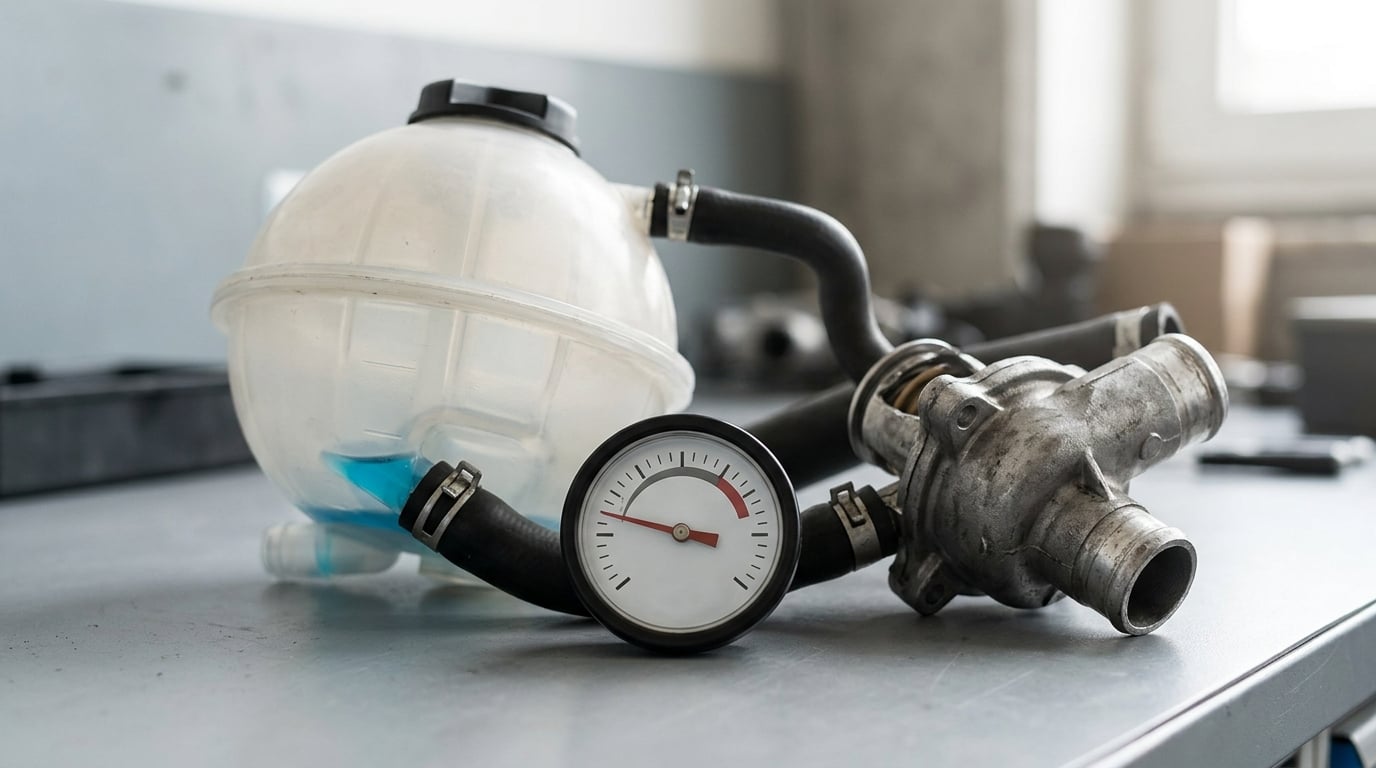
A BMW thermostat fails in one of two ways, and the symptoms follow. Stuck open, the engine runs cold: the temperature gauge barely leaves its lowest mark, warm-up drags on for ages and the cabin heater blows cool air. Stuck closed, coolant never reaches the radiator, the gauge climbs, and the engine can overheat enough to warp a head in minutes.
This guide walks through the eight symptoms BMW owners report most, then separates the ones that point at the thermostat from the ones that usually point somewhere else. Reading BMW thermostat failure symptoms as a pattern is far more useful than chasing a single clue. If your temperature needle is already creeping into the red, skip to the driving section first.
Updated for October 2026.
Table of Contents
- What Are the Most Common BMW Thermostat Failure Symptoms?
- Why Is My BMW Taking So Long to Warm Up?
- Is Low Coolant a Sign of a BMW Thermostat Problem?
- What Causes BMW Thermostat Failure?
- How Can You Check a BMW Thermostat Without Removing It?
- Can You Drive With a BMW Thermostat Failure?
- How Is a BMW Thermostat Replaced and What Does It Involve?
- Frequently Asked Questions
- Conclusion
What Are the Most Common BMW Thermostat Failure Symptoms?
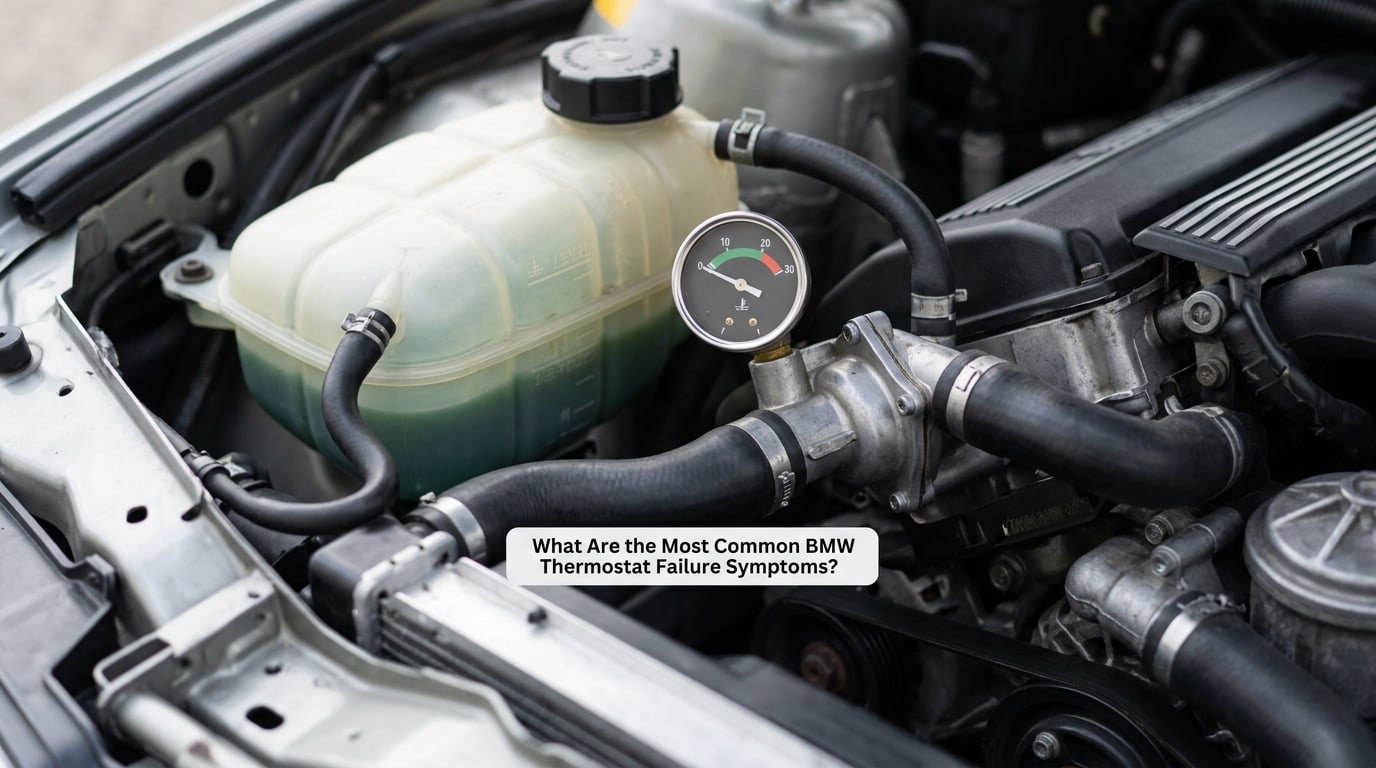
Here is the short list. The first four point at a stuck-open thermostat, the last four at a stuck-closed one.
- The temperature gauge never leaves its lowest position, or sits far below where it normally sits.
- Slow or incomplete warm-up, especially on a cold start in winter.
- Weak cabin heat or no heat at all from the vents at full temperature.
- A check engine light with a stored code of P0128, which reads as coolant temperature below thermostat regulating temperature.
- Repeated or intermittent overheating, sometimes only in traffic or in hot weather.
- A coolant temperature warning light or a message on the display.
- Noticeable loss of engine power, often mistaken for a fuel or turbo problem.
- A cooling fan that runs constantly, or a radiator hose that stays cool while the engine is hot.
Here is the honest caveat: almost none of these belong to the thermostat alone. A bad coolant temperature sensor, a failing electric water pump, trapped air or a low coolant level can produce a nearly identical set of clues. That is why the pattern across several symptoms matters more than any single one.
For a benchmark to compare against, most BMWs sit in an 88-92C operating range once fully warm. One owner on xBimmers described a diesel X5 that would reach roughly 76C and rarely go higher, with a radiator that felt cool to the touch at that temperature, then confirmed a thermostat fault after testing. A BimmerFest thread described the opposite end of the scale: a console gauge that did not budge from the lowest position, paired with power loss while climbing hills.
How Do You Know If a BMW Thermostat Is Stuck Open?
A stuck-open thermostat lets coolant bypass the radiator the whole time, so the engine never reaches full temperature. The gauge climbs part way and then just stays there, or barely twitches.
The four stuck-open BMW thermostat failure symptoms tend to arrive together: a low-reading gauge, a warm-up that never finishes, weak cabin heat and a P0128 code. See them all line up in the same drive and the diagnosis gets much easier to defend.
Because the engine is cold, the heater core never gets hot, so the cabin blower moves plenty of air and almost no warmth. Cold starts in cold weather are where owners notice it first, and fuel economy often drops too as the engine runs rich chasing a temperature it never reaches.
One distinction worth knowing: many modern BMW thermostats are electronically controlled map thermostats that fail open by design, so a car that runs cold is usually in the safer failure mode. An open thermostat is annoying and expensive, not usually catastrophic.
What Does a Stuck-Closed BMW Thermostat Cause?
Closed means coolant stays trapped in the engine and never circulates to the radiator. The gauge rises, sometimes steadily and sometimes only under load, and the engine can go from fine to critical within a few miles.
Many BMWs cut power when coolant temperature gets too high, so the car may feel sluggish or enter a reduced-power mode. Continued driving in that state risks warped cylinder heads, a failed head gasket, and internal engine damage that turns a small part into a rebuild.
Treat an overheating warning as a stop sign rather than a diagnosis. Once the needle is past normal and climbing, confirming whether the thermostat is at fault matters far less than getting the car off the road and letting it cool.
Why Is My BMW Taking So Long to Warm Up?
Slow warm-up is a symptom, not a verdict, and several other parts can fake it convincingly.
- Stuck-open thermostat: the engine runs cold permanently, and the cabin stays chilly no matter how long you drive.
- Stuck cabin heater control valve: the engine reaches normal temperature and the gauge sits mid-scale, but hot air still never arrives. This one gets misdiagnosed constantly because the engine-side numbers look fine.
- Coolant temperature sensor: the engine may warm up normally while the gauge lies to you. P0117 and P0118 are the codes that point here rather than at the thermostat.
- Chattering or slow-acting thermostat: the needle hunts up and down, or warms up in fits and starts, instead of settling.
The question that separates them is simple: does the engine reach normal temperature, and does the cabin get warm? Both failing points to the thermostat. Cabin cold but engine normal points to the heater valve or heater core. Neither reaching normal points at the thermostat or a cooling system that is not circulating at all.
That confusion between the thermostat and the coolant temperature sensor runs through every BMW owner forum. The e46Fanatics threads are full of owners who replaced the wrong part twice before a scan tool settled it, and hesitation, rough idle and misfires are usually blamed on the thermostat when a sensor or ignition issue is the real culprit.
Is Low Coolant a Sign of a BMW Thermostat Problem?
No. A thermostat does not consume coolant, so a low expansion tank points somewhere else.
In practice, low coolant usually means a leak, a failed seal or gasket, a cracked plastic thermostat housing that weeps slowly, or air that got trapped in the system during a previous service. On many BMW engines the thermostat housing is itself a common failure point, and it can lose coolant without leaving an obvious puddle.
Checking the level is straightforward and safe when the engine is cold. Open the cap on the expansion tank, look at the level against the marked lines, and check the coolant colour and smell. Note that some expansion tanks are translucent, which makes the level easier to read from the side in daylight.
Do not open a cooling system cap while the engine is hot. Pressurised coolant at temperature scalds, and the BMW manual spells out the cold-engine condition for a reason. If the level drops between services, treat it as a leak to be found, not a top-up to be forgotten.
What Causes BMW Thermostat Failure?
Most failures come down to age, contamination or installation, and a surprising share of repeat symptoms come from a fitting problem rather than a bad part.
- Age and seal failure. The gasket sealing the thermostat to its housing hardens, cracks or takes a set over time, and coolant seeps past it.
- Internal damage. The wax element, spring or valve inside can break down so the valve never opens or never shuts.
- Corrosion and debris. Wrong coolant, mixed coolant types or a system that was never flushed leave deposits that gum up the valve and distort the sealing surface.
- Cracked housing. Plastic housings on several N-series and B-series engines are known to crack or weep, and the leak is easy to mistake for a low-coolant problem.
- Installation error. Overtightened bolts, a new housing reused with an old gasket, or a thermostat fitted the wrong way round will fail quickly.
- Prior overheating. Once an engine has cooked itself, the damage it caused can take out a freshly fitted thermostat too.
Exact parts and procedures vary by model and engine, and BMW has published service bulletins covering specific thermostat and electric water pump issues on certain vehicles. Check the bulletin number that applies to your VIN, model year and market before assuming any part or campaign applies to you.
A related failure worth knowing about: you may see what happens when a bolt is overtightened come up during this work, since cramped threads and a leaking thermostat housing often have the same root cause. And if your car has other symptoms that are not cooling-related at all, it is worth ruling out something like a floating brake rotor so you are not chasing two problems at once.
How Can You Check a BMW Thermostat Without Removing It?
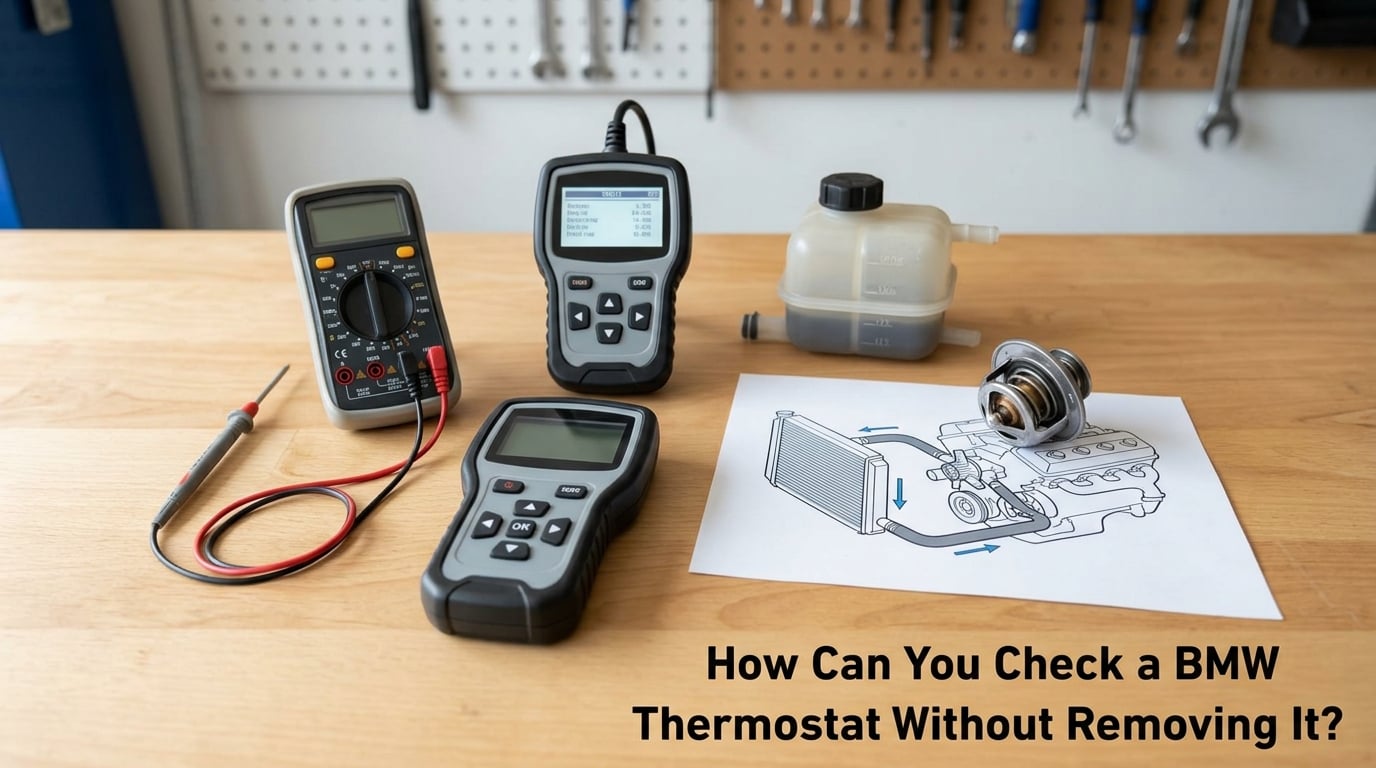
You can narrow it down without taking anything apart, though you cannot confirm it without a scan tool or a temperature reading on both sides of the thermostat.
- Watch a full warm-up from a cold start. Note how long the gauge takes to reach normal and whether it settles or keeps hunting.
- Check the cabin. Full blower, full temperature setting, and still cool air after a normal-length warm-up is a classic stuck-open picture.
- Compare hose temperatures by hand, carefully. With the engine at normal temperature, the upper radiator hose should feel hot and the lower one cooler. If both are similar, coolant is bypassing the radiator. If the lower hose stays cool while the engine is hot, flow is the problem. Touch briefly and only when the engine is at normal operating temperature, never during a hot engine warning.
- Read the coolant level and condition. Low level or a change in colour points away from the thermostat and toward a leak or wrong coolant.
- Scan for stored codes. P0128 relates to coolant temperature below what the thermostat should be regulating. P0117 and P0118 are sensor circuit and sensor range faults instead, and pointing at the sensor rather than the thermostat.
- Look for leaks. Fresh coolant residue around the thermostat housing, at the water pump, or along the top tank is a more reliable find than any gauge reading.
These checks are clues, not proof. A visual inspection cannot tell you whether a thermostat is opening at the right temperature, which is exactly why owners end up replacing the wrong part. Follow the procedure in your owner manual, and let a qualified technician handle anything that means opening a pressurised cooling system.
Can You Drive With a BMW Thermostat Failure?
Sometimes, but only when the failure is the cool-running kind and nothing is escalating.
A mildly delayed warm-up with no warning, no coolant loss and a normal cabin heater is a nuisance you can drive carefully while you book the repair. Those are the conditions under which most owners keep using the car for a short while.
Stop driving immediately if any of these show up: a rising temperature needle, a coolant temperature warning light or message, a puddle of coolant under the car, steam from under the bonnet, a sweet coolant smell, or the engine going into reduced power while hot. A stuck-closed thermostat can go from normal to critical faster than most people expect, especially in slow traffic on a hot day, and a low coolant level plus a temperature climb is a combination you do not want to gamble on.
If you do need to stop, pull over somewhere safe and level, switch off the engine, and leave the bonnet closed. Do not open the expansion tank cap to speed up cooling, and do not pour cold water over a hot engine. Sit with the hazard lights on until things settle, then arrange a tow rather than restarting and driving on.
How Is a BMW Thermostat Replaced and What Does It Involve?
On most BMWs the job is contained: drain part of the cooling system, unbolt the thermostat housing, swap the thermostat and the seal or gasket, refill, and bleed the system properly. On some engines the whole coolant circuit, the expansion tank or additional coolant drains come off with it, and on others the electric water pump and coolant temperature sensor are right next to the housing and get replaced at the same time.
The part people skip is the refill and bleed. A system with trapped air can send a perfectly good new thermostat into a temperature reading that looks like a failure, which is why repeat overheating after a replacement is so common. Air locks show up as a gauge that swings wildly, a level in the expansion tank that keeps dropping, or a heater that stays cold.
Coolant handling matters too. BMW specifies particular coolant by model and year, and mixing specifications or reusing old coolant causes deposits that bring the whole problem back. Many of these fasteners are single-use, meaning they get replaced rather than reinstalled, and a housing that was torqued incorrectly can leak right away. If you are not comfortable managing a hot, pressurised cooling system, have a technician do it and follow the maintenance schedule they recommend.
Frequently Asked Questions
How do I test whether my BMW thermostat is stuck?
Start cold and watch the whole warm-up. A gauge that never leaves its lowest position, a warm-up that drags on for far longer than usual, and cabin air that stays cool at full heat all point to a thermostat stuck open. For a stuck-closed case, watch for a rising needle and overheating under load. A scan tool reading of P0128 supports the thermostat branch, while P0117 or P0118 point at the coolant temperature sensor instead. Confirming it properly needs a temperature reading on both sides of the housing.
Does a bad BMW thermostat cause coolant loss?
A thermostat does not consume coolant, so a low expansion tank is a separate symptom. Low coolant on a BMW usually means a leak, a failed seal or gasket, a cracked plastic thermostat housing that weeps slowly, or air trapped in the system after previous service. Check the level on a cold engine, look at the colour of the coolant, and trace fresh residue around the housing and water pump. A level that keeps dropping is a leak to find, not a top-up to forget.
How long can a BMW drive with a bad thermostat?
It depends entirely on which way it has failed. A stuck-open thermostat that runs cold with no warning and no coolant loss can usually be driven carefully for a short time while you book the repair. A stuck-closed thermostat cannot. If the temperature needle is climbing, a coolant warning is lit, coolant is disappearing, or the engine loses power while hot, stop driving, pull over level, switch off and arrange a tow. That failure mode can damage a head gasket within minutes.
What is the difference between a stuck-open and stuck-closed thermostat?
A stuck-open thermostat never blocks coolant to the radiator, so the engine runs cold: the gauge sits low, warm-up is slow, the cabin heater stays cool and a check engine light may store P0128. A stuck-closed thermostat never opens, so coolant stays trapped in the engine: the gauge climbs, overheating warnings appear, engine power drops and continued driving risks a warped head gasket. Stuck open is the annoying failure. Stuck closed is the one that costs an engine.
Can a new BMW thermostat fail after replacement?
It can, and the part is usually not the reason. The usual culprit is air left in the system after the refill, which reads like a failing thermostat: a wild gauge swing, a level in the expansion tank that keeps dropping, or a heater that stays cold. Other causes include reusing an old gasket, tightening the housing bolts too hard, fitting the wrong coolant or mixing specifications, or damage from a previous overheating event. A correct bleed and a fresh coolant of the specified type prevent most repeat symptoms.
Conclusion
Start with the pattern, not the part. Watch a full warm-up from cold and note how the gauge behaves, check the coolant level and look for fresh leaks around the housing and water pump, and write down which codes the car is storing. Those three things tell a technician far more than a guess, and they take less than ten minutes.
If the temperature is climbing, coolant is disappearing or a warning is lit, stop driving and let the engine cool rather than trying to confirm the diagnosis yourself. A technician can then tell you whether the thermostat is responsible, or whether the coolant temperature sensor, the water pump, trapped air or a leak is the real culprit behind these BMW thermostat failure symptoms.