
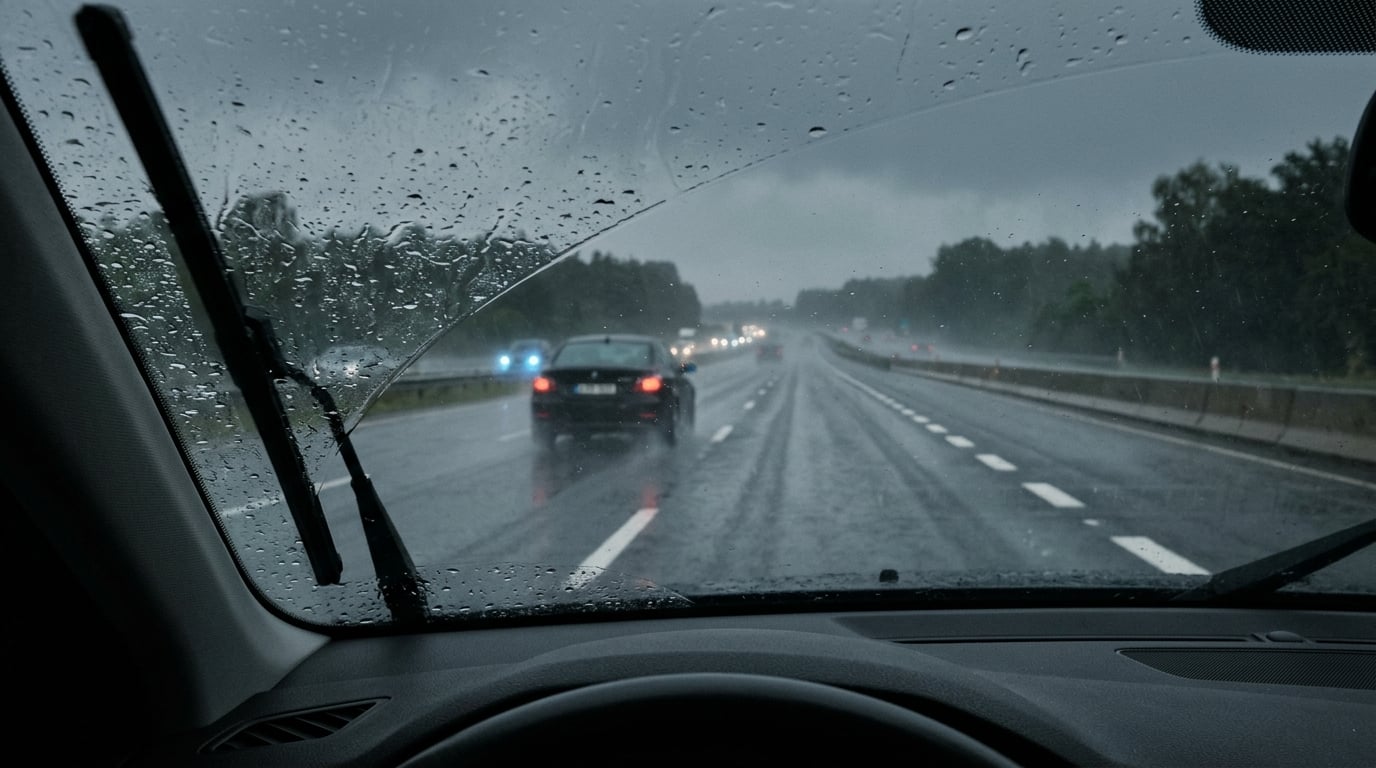
Learning how to drive safely in heavy rain comes down to four things: see more, go slower, leave more room, and make every input to the car smaller and smoother. Slow down before the curve, switch on your low-beam headlights, keep at least a five-second gap to the car ahead, turn off cruise control, and never drive through moving water you cannot judge.
That is the whole method, and it takes about ten seconds of thought before you leave the driveway. The rest of this guide breaks it into eight steps, including exactly what to do with your hands and feet the moment the car starts to skate on standing water.
Rain is not the only hazard, of course. Wind, downed wires and stalled cars in the lane all get worse when nobody can see clearly.
Table of Contents
- What You Need
- Step-by-Step: How to Drive Safely in Heavy Rain
- How to Drive Safely in Heavy Rain: Start With Visibility
- Step 2: Slow Down Before the Road Requires It
- Step 3: Leave a Much Larger Following Distance
- Step 4: Smooth Out Every Steering and Braking Input
- Step 5: Handle Standing Water and Hydroplaning
- Step 6: Drive Around Deep Water and Dangerous Road Features
- Step 7: Watch for Hazards That Rain Conceals
- Step 8: Reassess Conditions Throughout the Trip
- Common Mistakes Drivers Make in Heavy Rain
- Frequently Asked Questions
- Conclusion
What You Need
Most wet-weather crashes trace back to something that was already wrong or already known before the storm arrived. Ten minutes in the driveway fixes most of it.
You need a car with sound tires, working wipers and a full washer reservoir, functioning lights, clear visibility through the glass, enough fuel for your detours, and a plan B route in case the road you planned on floods out.
| Check before you leave | Why it matters in heavy rain | Warning sign |
|---|---|---|
| Tire tread and pressure | Tread depth decides how much water the tire can push aside before it lifts off the road | Tread worn near the 2/32 inch limit, or tires looking underinflated |
| Wiper blades | A streaked windshield in a downpour is the same as driving with your eyes shut | Blades that streak, chatter or curl at the edge of the sweep |
| Washer fluid | Wipers only clear what the fluid loosens, especially when bugs and road film are involved | Empty bottle or a jet that barely reaches the glass |
| Defroster and air conditioning | Cabin humidity is what fogs the inside of the windshield at highway speed | Vents that blow but do not dehumidify, or a rear defroster grid that stays cold |
| Headlights, taillights, brake lights | Drivers behind you need to see your brake lights before they can react to them | A bulb out, or lenses so dirty the light barely carries |
| Brake feel | Brakes that are soft or pull to one side turn a normal stop into a problem on wet pavement | Pedal travel that feels spongy or fades after a few stops |
| Fuel or charge | Traffic stops and detours burn more than you expect when you are crawling | Below a quarter tank, or a low battery warning light |
One more thing worth doing: glance at the weather radar or your local alerts before you start. Knowing the storm arrives in twenty minutes changes the route you pick, and knowing it does not arrive at all means you can wait.
Step-by-Step: How to Drive Safely in Heavy Rain
The eight steps below run in order because they build on each other. Visibility first, then speed, then the gap, then smooth inputs, then water, then hazards, then a decision about whether to keep going. Working on them in that order means each one makes the next one easier.
How to Drive Safely in Heavy Rain: Start With Visibility
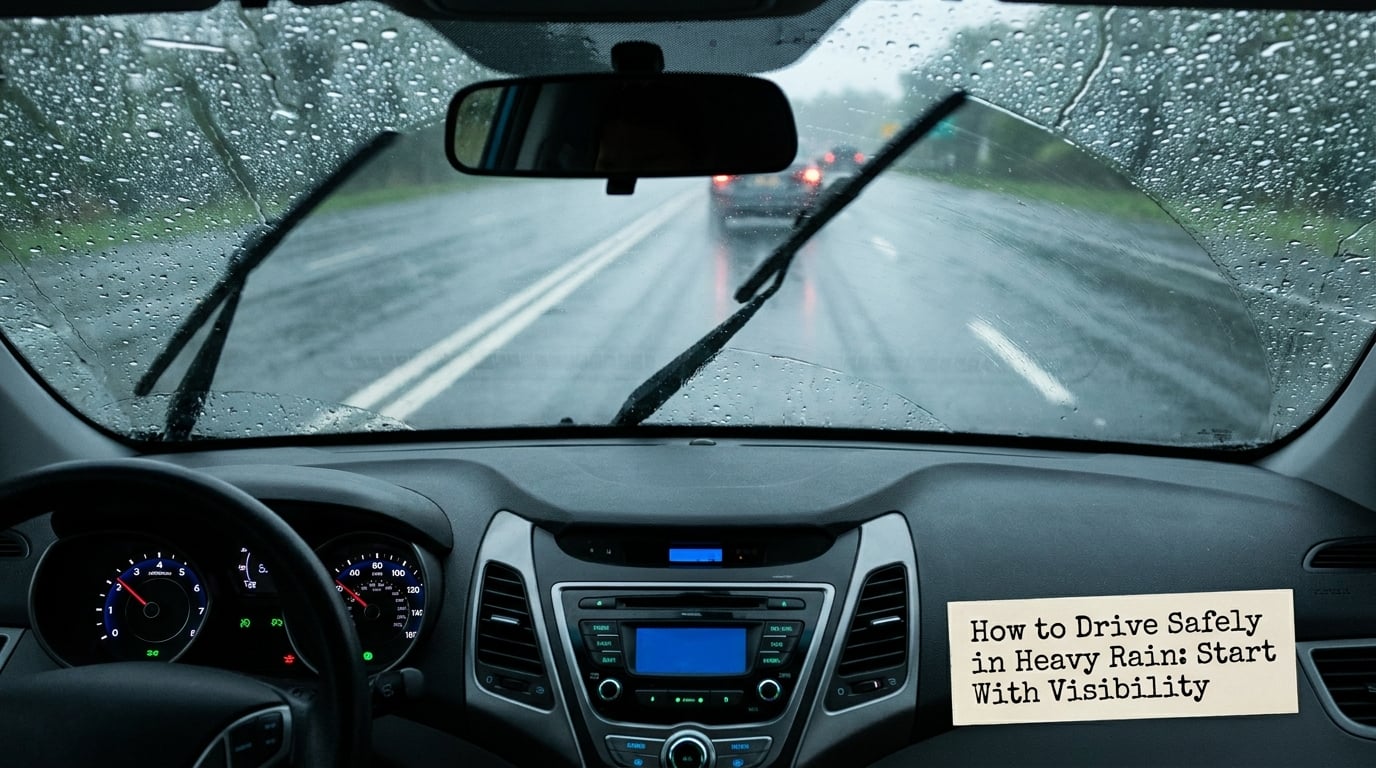
Clean the glass before you pull out, not after the rain starts. Grime, road film and dried washer residue turn a light shower into a blindfold, because every drop of water beads on the surface and breaks the light into glare.
Run both wipers, then the washer, then the wipers again. A second pass clears what the first one only smeared. Check the defroster before you need it, and if the inside glass starts fogging, aim the air conditioning at it with the fan on medium or high.
Then clean the mirror situation. Wipe the mirrors and the camera lens on a modern car, because a hazed mirror erases your blind spot. Set the mirror so you can see through the cleared arc of the windshield rather than around it, and keep your eyes moving between the road ahead, the mirrors and the shoulder line.
Switch on your low-beam headlights whenever visibility drops. Do not use high beams. Brights bounce straight back off wet pavement and turn the windshield into a mirror, which blinds you and everyone coming the other way. In many states the headlight law is written as lights on with the wipers, or any time you cannot see roughly 500 feet ahead, so you may already be required to have them on.
Step 2: Slow Down Before the Road Requires It
Wet pavement cuts traction, and the reduction shows up well before you feel it. A tire that rolls on a damp road has less to push against, and the shallower the water film, the more the tire skims rather than grips.
That is why you should slow down before the curve, the ramp or the intersection instead of braking on the way into it. Pick a speed you can hold through the worst part of the storm and stay there. If you have to brake hard to make a speed you should have chosen earlier, you have already lost the margin that would have made the turn.
Slower also buys you more time to see. At 30 mph in a downpour you are scanning maybe twice the road ahead that you are at 60, and that extra seconds is what keeps you out of the back of the car in front.
Step 3: Leave a Much Larger Following Distance
Double your normal gap. The familiar three-second rule becomes at least five seconds in heavy rain, which means you should be able to count slowly from one to five after the car ahead passes a fixed object before the road under you gets there.
The reason is stopping distance. On dry pavement a car at highway speed typically needs roughly the distance of a football field to stop from highway speed on clear pavement; on wet pavement that can double or triple. The driver in front of you has the same problem, plus whatever their own view is blocked by.
Wet traffic also compresses. Everyone slows, so gaps shrink without anyone meaning to close them, and the first person to tap the brakes sets off a chain. A five-second gap is what breaks that chain.
Step 4: Smooth Out Every Steering and Braking Input
The tires are the only parts of the car touching the road, and a tire holds less grip in the rain. Everything you do through the pedals and the wheel comes through that reduced grip, so the smaller the input, the more of your command actually arrives.
That means small steering corrections instead of big ones, pressure on the brake instead of stomping it, and smooth throttle. Feed in a little gas to keep the nose from dipping under hard braking, which shifts weight forward and unloads the rear tires where you need them.
Turn cruise control off. A cruise system holds a set speed with no idea what the road looks like, and when a wheel breaks loose it may keep feeding in throttle at exactly the wrong moment.
Step 5: Handle Standing Water and Hydroplaning
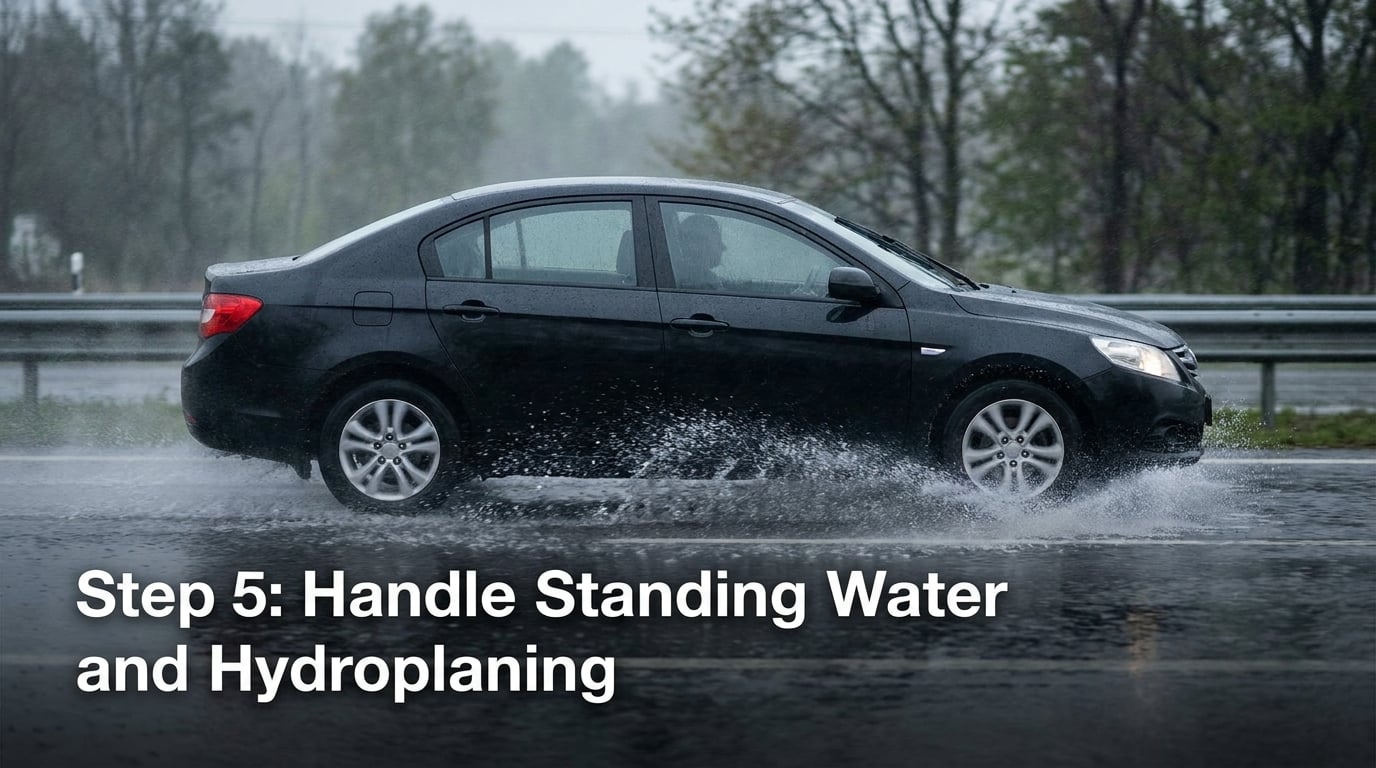
Hydroplaning, also called aquaplaning, is a loss of traction where a wedge of water builds in front of the tires faster than the weight of the car can push it away. The tires lift off the surface and you keep steering and braking inputs going nowhere. Steering goes light, the car stops answering, and braking does nothing.
It takes far less water than most drivers assume. As little as one-tenth of an inch of standing water can start the process at highway speed, because a tire rolling through deep water at speed pushes a gallon or more of it aside every second. Worn tread and underinflated tires hydroplane sooner than healthy ones.
Know the difference between spray and a hydroplane. Spray is a rooster tail behind the vehicle ahead, and you are following it. A hydroplane is your own car going quiet and light, with no sound of tires on pavement and no steering response. Only the second one means the tires have lifted.
Recover in this order. Ease off the accelerator, do not brake. Hold the wheel straight and do not turn it. Keep the throttle light and let the car slow down on its own. Grip lightly, because a death grip on the wheel feeds every twitch straight into the tires. Steering will come back as speed drops, and once it does, make small corrections.
What makes it worse is panic. Drivers who yank the wheel or stab the brake in the middle of a slide turn a gentle skid into a spin. Slow first, turn second, brake last.
One useful habit from drivers on r/triangle: stay in the ruts your own tires have already cut rather than crossing into a lane of untouched water. Other drivers report the same thing, including accounts on the Miata forum of a car that felt stable at about 65 mph and settled down once the speed came back under that.
Step 6: Drive Around Deep Water and Dangerous Road Features
Standing water is where the day’s decisions get expensive. The tiers below are the numbers to judge by, and they come from how quickly water can take away steering, then traction, then the car itself.
| Water depth | What happens | What to do |
|---|---|---|
| 1/10 inch | Tires begin to hydroplane at highway speed as the water film thickens | Lift off the throttle and slow before the water deepens |
| About 1 inch | Partial loss of steering feel, most noticeable in ruts and wheel tracks | Hold the wheel steady and stay in the ruts |
| About 3 inches | Loss of control for most cars, including tall SUVs and pickups | Do not enter. Find another route |
| About 6 inches | A small car can begin to float, and the engine can ingest water and stall | Turn around. This is the water vehicle threshold |
| About 12 inches | Most vehicles are swept away, including pickups and SUVs | Never attempt. Call emergency services instead |
The test is simple: if you cannot see the road markings or the far edge of the water, the depth is unknown, and unknown means turn around. Note that a pickup floats later than a sedan but carries away just as easily once it is moving.
Watch where water collects and where surfaces change. Painted crosswalks, turn arrows and lane lines get slick. So does metal plate and any painted surface. Stay back from storm drains, where the flow can be strong enough to move a vehicle, and give underpasses and low-water crossings a wide berth in a storm.
Rushing water and water that is brown, moving or covering a curb are the two clear no-go signs. If the road under it is not visible anywhere, you are guessing, and guessing wrong with a car is expensive.
Step 7: Watch for Hazards That Rain Conceals
Rain does not create the hazard, it hides it. That means your scan needs to be wider and slower than usual, and you should assume something is there even when you cannot see it.
Potholes, debris, branches, gravel and even small animals are much harder to spot on dark wet pavement. Water over a pothole hides the edge, which is exactly the part that takes out a tire. Look further ahead on a straight road and scan the shoulder and the verge on a curve, where anything that walked off the road tends to gather.
Pedestrians under umbrellas, cyclists in dark clothing and children near schools are all harder to read at speed. So is a vehicle ahead with a dead headlight or no working brake lights, which is why a wide gap matters: it gives you the time to notice and the room to react.
Do not sit in someone’s blind spot beside an SUV, and do not linger beside a truck. Drivers on r/triangle put it simply, never match a truck driver’s speed in a downpour, because the moment that truck changes lanes you have nowhere to go.
Step 8: Reassess Conditions Throughout the Trip
Conditions change, and the plan you made in the driveway stops being the right plan. Rain gets heavier, the spray from other cars turns the air into fog, and standing water appears where the road looked clear ten minutes ago.
If you reach the point where you cannot see the road edge or the lane markings, pull completely off in a well-lit safe place, switch on your hazard flashers, and wait. Do not creep along in the emergency lane hoping the visibility comes back. A parked car with flashers is far easier for other drivers to see than a slow car in spray.
At the same time, do not abandon a trip that is merely wet. Most heavy rain in the United States passes. The difference between caution and giving up is whether you are reacting to a change you can see or to the first minute of the storm.
If visibility is fine but the route ahead includes a low-water crossing or a known flood-prone underpass, change the route. Gas stations, parking lots along main roads, and rest areas make decent waiting spots when the trip can wait twenty minutes.
Common Mistakes Drivers Make in Heavy Rain
Nearly every wet-weather crash comes down to one of a handful of habits, and every one of them has a simple correction.
Driving at dry-road speed. The limit is set for dry pavement with good visibility. In a downpour, the correct speed is whatever lets you see far enough to stop inside what you can see, and that is usually well below the posted number.
Following too closely. Traffic compresses in rain, so the car in front is closer than it was. Fix it by widening the gap to five seconds and rechecking it every few minutes as traffic speed changes.
Using cruise control. It holds throttle through a skid and adds speed exactly when you need less. Turn it off before the rain starts and leave it off until the road dries.
Slamming the brakes or stabbing the throttle. Both shift weight and unloads the tires that need to grip. Brake earlier, brake smoothly, and add throttle in small amounts rather than waiting until the car is bogging down.
Oversteering out of a slide. The instinct to snap the wheel toward the trouble makes it worse. Ease off the gas, hold the wheel, and let the car slow until the tires touch down again.
Running high beams. The light comes straight back off the wet road and blinds you first. Low beams light the road and let other drivers see your brake lights.
Driving through flooded areas. This is the mistake with the worst consequences. Turn around at any water you cannot measure, especially if it is moving or hiding the road surface.
Ignoring changing visibility. The rain got heavier and you kept your speed. Reassess as you drive, and pull over completely when the road edge disappears.
One habit I would add: cleaning the windshield before you leave, not after the first drops. It is the cheapest safety improvement available and it is the one most often skipped.
Frequently Asked Questions
How fast should I drive in heavy rain?
Match your speed to what you can see. In a downpour where you cannot make out lane markings more than a few car lengths ahead, 30 to 40 mph is realistic on a highway, and lower on a road with standing water. The posted limit is set for dry pavement, so treating it as a ceiling in the rain is the mistake. If slowing means a truck behind you has to pass in the rain, that is a small price for a reaction margin.
Should I use cruise control when driving in heavy rain?
No. Cruise control holds a set throttle without any read on road conditions, so when a tire breaks loose it can keep feeding in power at the worst possible moment. It also encourages you to stop paying attention to speed, which is the one variable that matters most in the rain. Use it only once the road is dry again.
What should I do if my car starts hydroplaning?
Ease off the accelerator, do not brake, and hold the wheel straight without turning it. Grip the rim lightly so a twitch in your hands does not become a steering input. Let the car slow on its own until the tires reestablish contact, then make small corrections. Braking or turning hard mid-slide is what turns a mild skid into a spin.
Is it safe to drive through a large puddle during heavy rain?
Only if it is shallow and you can see the road markings and the far edge of the water under it. If you cannot, the depth is unknown and you should turn around. Roughly 3 inches of moving water can take control away from most cars, about 6 inches puts a small car at risk of floating, and a foot or more carries away most vehicles, pickups included.
Do I need to turn on my headlights when it rains?
Yes, as soon as visibility drops. Low beams are what you want, and in many states the law is written as lights on whenever the wipers are running or when you cannot see roughly 500 feet ahead. Low beams also make your brake lights easier for the driver behind you to see, which is the real reason to have them on beyond seeing the road yourself.
When should I pull over during a heavy rainstorm?
Pull over completely when you can no longer see the road edge or the lane markings, when a truck is throwing enough spray to hide the car ahead, or when visibility is dropping faster than the wipers can clear it. Use a well-lit spot away from the lane and away from the emergency lane, switch on your hazard flashers, and wait for a gap in the storm.
Conclusion
If the rain is already heavy where you are reading this, the order is the same every time. Clean the glass and get the defroster going, switch on your low beams, drop your speed to match what you can see, and open the gap to at least five seconds.
From there, make every input small, and the moment a tire goes light on standing water, lift off the gas, hold the wheel straight, and let the car slow down. Treat any water you cannot measure as a reason to turn around.
Rain is the least dangerous part of a storm for a prepared car and the most dangerous part for a distracted one. Ten minutes in the driveway handles the car. The remaining choices are all made at the wheel.