
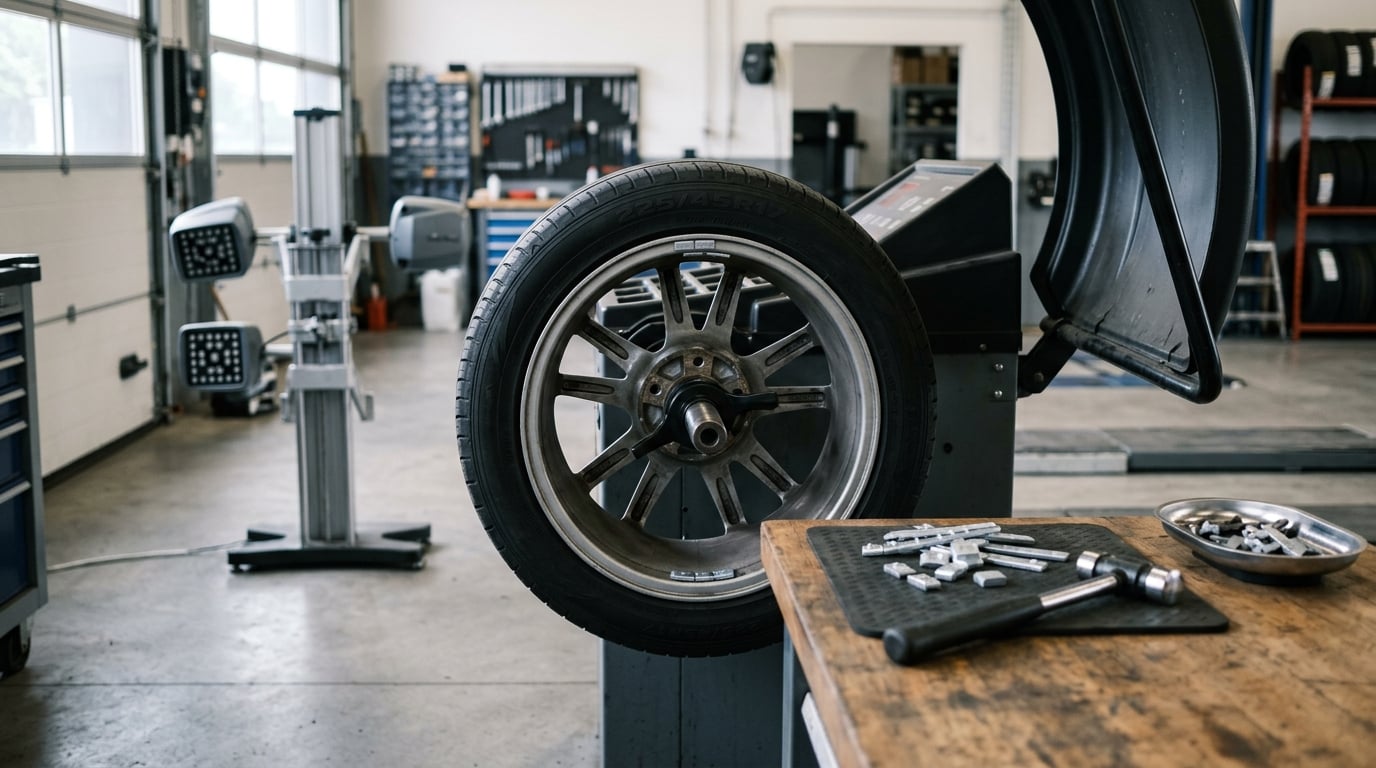
The wheel balancing vs alignment difference is simple: balancing evens out the weight around a tire and wheel so it spins smoothly, while alignment sets the angles of your wheels relative to the car and the road. A vibration in one narrow speed band points to balancing. A car that drifts toward one side, or a steering wheel that sits crooked, points to alignment.
Both get lumped together because they happen at the same service visit and both touch your wheels. They are not the same job, and one does not fix the other. If a shop sells you the wrong one, the symptom comes back within a few hundred miles and you have paid twice.
Here is the honest breakdown, including what actually happens on the lift in each case and how to tell which service your car needs before you book anything.
Table of Contents
- Wheel Balancing vs Alignment Difference at a Glance
- What Does Wheel Balancing Do?
- What Does Wheel Alignment Correct?
- Which Problem Are You Experiencing?
- How a Shop Diagnoses the Correct Service
- Do You Need Both Services?
- Can You Do Wheel Balancing or Alignment at Home?
- Which Should You Choose?
- Frequently Asked Questions
- Do I need wheel balancing and alignment at the same time?
- Should I get my wheels balanced before getting an alignment?
- What are the warning signs that a car needs balancing or alignment?
- Can correct tire pressure fix vibration or wheel alignment problems?
- Do modern driver-assistance systems require a wheel alignment?
- Conclusion
Wheel Balancing vs Alignment Difference at a Glance
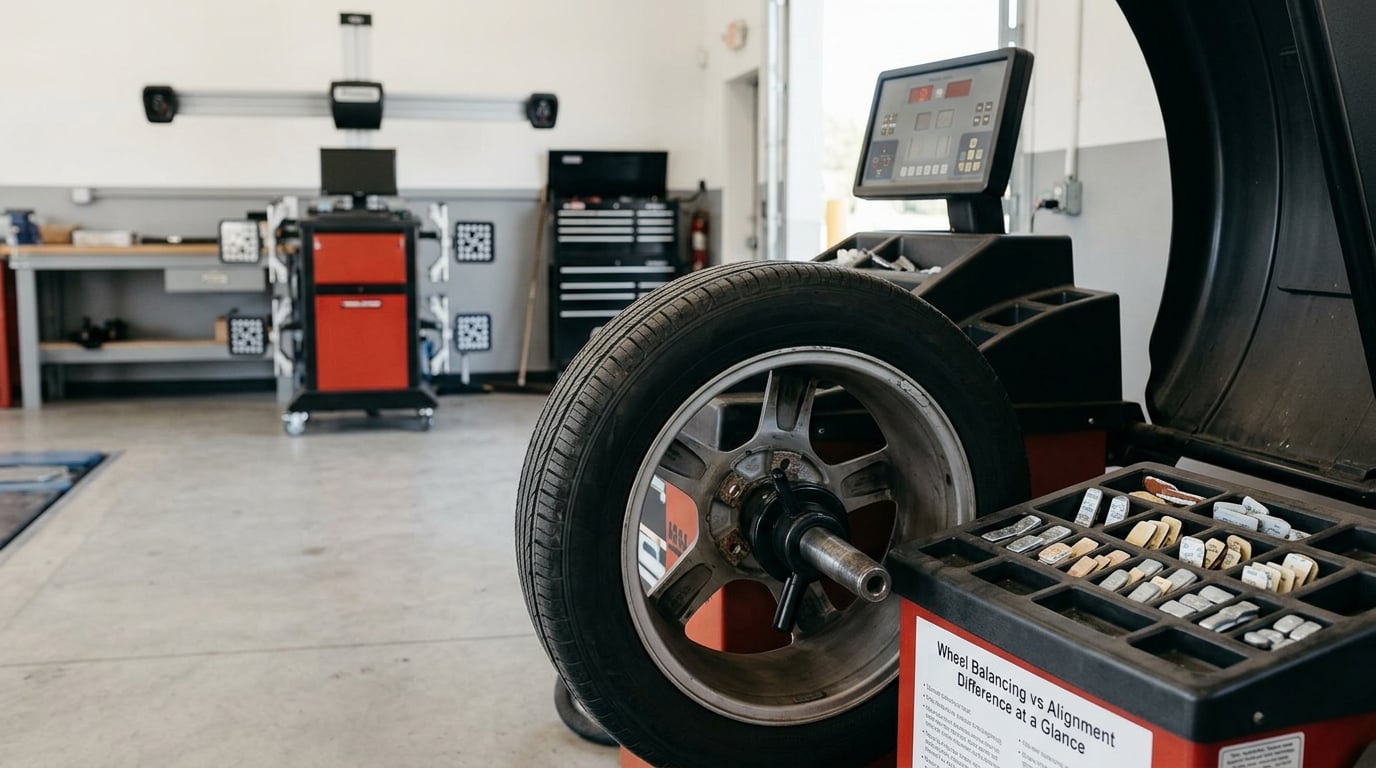
| What to compare | Wheel balancing | Wheel alignment |
|---|---|---|
| What gets corrected | Uneven weight distribution around the tire and wheel | Incorrect camber, caster and toe angles |
| Main symptom | Vibration through the steering wheel or seat in a speed band | Pulling to one side, crooked steering wheel, uneven edge wear |
| What the tech adjusts | Adds small weights to the rim until it spins evenly | Suspension and steering parts until readings match factory spec |
| Typical interval | At every new tire install and every rotation | Event-driven: impact, suspension work, visible wear pattern |
| Tool used | Tire balancer with a spinning spindle | Alignment rack with wheel-mounted sensors |
| Does it require taking the wheel off | Yes, the wheel comes off the car | No, the wheel stays mounted while readings are taken |
| What it will not fix | Pulling, feathering, or a bent rim | A heavy spot, a lost weight, or a tire with a big flat spot |
The cheapest possible misread is treating these as interchangeable. They correct completely different faults, and the table above is the version to screenshot.
What Does Wheel Balancing Do?
Balancing makes a tire and wheel assembly rotate evenly. Every tire has manufacturing variations, and every wheel rim is slightly off-round or off-center. On top of that, a tire can pick up a heavy spot from a pothole, a long parking spot, or a slow leak that leaves one section of the tread compressed.
That uneven mass creates a force that rises and falls once per revolution. At low speed you would not notice it. As speed builds, the force grows with the square of speed, and it peaks at the point where the wheel’s imbalance matches the natural frequency of the tire. That is why a shake can appear suddenly at a particular speed and then disappear once you get past it.
Here is the diagnostic detail people miss: an unbalanced wheel usually shakes hardest in a band, often somewhere between 50 and 70 mph, and calms down above that. Vibration that grows steadily with speed and never lets up points elsewhere, usually a bent rim or a worn wheel bearing.
The fix is small weights. A technician mounts the wheel on a balancer, spins it, watches where it wobble-blips, and adds tape or clip-on weights on the rim until the machine reads near zero. A properly balanced wheel is not a repair, it is a reset of a consumable service item.
What balancing cannot do is change a single angle. It will not stop a car drifting, straighten a wheel sitting crooked in the arch, or undo feathered wear across the tread. Nor will it save a rim with a hard bend; the balancer just chases a reading that will not settle.
Wheel Balancing vs Alignment Difference in Plain Terms
Think of it as a circle versus a ruler. Balancing distributes weight evenly around a circle, so the wheel spins without thumping. Alignment measures angles against a ruler, so each wheel points the same direction and sits at the right lean relative to the car.
That is also why they never cancel each other out. Removing and refitting a wheel for balancing does not move an alignment setting. Neither service quietly causes the other to go out of spec, which is a persistent myth in owner forums.
What Does Wheel Alignment Correct?
Alignment sets three angles that suspension geometry controls, and a shop measures all of them against the manufacturer’s spec sheet for your specific make, model, and trim.
- Camber is the wheel’s lean, viewed from the front. Too much negative camber and the tire rubs the inner edge on turns. Too little and it wears the outer edge.
- Caster is how far the steering axis tilts from vertical, viewed from the side. Too little and the wheel can feel vague and wander over bumps. Too much and the car becomes nervous and twitchy in lane changes.
- Toe is the difference in front-to-back angle between the two front wheels, viewed from above. Toe out makes a car veer; toe in makes it feel like it wants to cross the centerline. Unequal toe across an axle is the classic reason a steering wheel sits crooked while the car tracks straight.
When those angles drift, the tire no longer meets the road squarely. One edge works harder than the other, water and grit get swept to one side, and the car develops a standing pull. Tire life drops because the tread wears across rather than down.
A word of caution about spec language. Front alignment values are symmetric, meaning the two sides should be equal but can both point in the same direction. Rear alignment values are usually individual per side, because a rear toe is set to a number for that corner, not mirrored. A skilled alignment tech is reading which of those rules applies to your car, not copying one number across the back.
Which Problem Are You Experiencing?
There is a 60-second test that gets most people into the right category before they ever call a shop.
First, find a straight, flat stretch of road and drive it slowly. If the car needs constant correction to hold a line, or the steering wheel sits noticeably off-center while the car tracks straight, that is an alignment symptom. If it tracks straight and the wheel is centered, rule alignment out for now.
Second, accelerate slowly from about 40 mph upward and note the speed band where vibration appears, and the speed where it fades. A shake that comes in around 55 and disappears by 75 is almost always a heavy spot, a lost weight, or a tire with a flat spot from a long stop.
Now the things that look similar but are neither service. Cupped or scalloped tread, where sections wear high and low in a repeating pattern around the circumference, points to a wheel that was out of balance for a long stretch. Feathered tread, where the tread blocks taper like a saw blade, points to alignment. A steady hum that rises with speed and comes back on gentle curves is often a wheel bearing, not a balance problem.
That last one causes a lot of wasted money. Owners have replaced a wheel bearing, kept the old vibration, and then been told to go back for a balance. Sometimes the bearing really was the cause. Sometimes the bearing was the first thing that got blamed, and the actual imbalance had been there all along. If the vibration is in a narrow speed band, start with balancing.
How a Shop Diagnoses the Correct Service

A good inspection follows a set order. The tire and wheel come off and go up on the balancer first, because that also lets the tech see the tread shoulder and sidewall at close range. A tire with a visible sidewall bulge, a cord showing through the rubber, or a bead area damaged by an impact should not be balanced at all; it needs replacing.
Next comes the rotation. Whether you rotate at all is a judgement call, and one worth asking about, because a front-to-back rotation can mask or resolve a speed-band vibration on a car that was fine before.
For alignment, the car goes up on a level rack with sensors clamped to each wheel. The camera or laser heads read the current camber, caster, and toe, then the technician adjusts the parts that set those angles: tie rod ends, lower control arms, steering knuckles, and in some cases camber bolts or eccentric adjusters. On a car that uses solid rear axle and leaf springs, rear toe is often set with an adjustable shim or wedge, and a lot of shops will not touch it.
Ask for the printed sheet with numbers before and after. Any shop with a real alignment rack produces one, and the before column is what tells you whether the car was actually out of spec or someone just wanted the job. Specs are not universal, so the number on your sheet only means something against your own car’s chart, not against another make’s.
Modern vehicles add one more reason to be careful with the printout. On cars with adaptive cruise, lane keeping, or camera-based parking, the alignment numbers feed a calibration step. A rack that has only just been moved onto a new floor surface will show every wheel as out of spec until the camera target plate is recalibrated, so a shop that has never aligned your model in that bay may need to reference the geometry before touching an adjuster.
Do You Need Both Services?
Often yes, and usually in a fixed order. Balancing comes first, because a wheel that is out of balance will never read correctly on the alignment rack. The sensor picks up a vibrating target and the numbers become noise. Once the wheel spins evenly, the alignment readings mean something.
Some common triggers for both at the same visit:
- A pothole or a fast curb strike. One impact can bend a rim, upset an alignment angle, and knock weights off, all at once.
- A tire repair or a plug in the shoulder, which adds a heavy spot even after the repair.
- Suspension work, such as replacing a control arm, tie rod, or ball joint. Geometry gets disturbed in the process.
- Uneven tread wear showing a pattern on a single tire, which is the visual argument for both services.
- New tires all round. A set is nearly always balanced at install, and an alignment is a reasonable add-on if the old tires showed any wear pattern.
One caution worth stating: some shops will refuse to balance or align old tires because the rubber is worn past the point where the readings would mean anything. It sounds like a sales trick, and readers on r/AskMechanics have called it one. The honest reason is narrower, though. A worn tire that will not hold air or has a compromised sidewall is genuinely not safe to run on a rack, and there is no technician override for a visible sidewall crack.
Can You Do Wheel Balancing or Alignment at Home?
Balancing at home is realistic with a garage balancer and a jack, and it is one of those jobs where the equipment is the entire barrier. Without a balancer you are guessing at weight placement by feel, and a hand-rolled balance is usually worse than the imbalance it replaced.
Alignment at home is a different category. A four-wheel alignment needs a level floor, a rack, sensor clamps, and access to the reference geometry for your car. If your car has adjustable rear toe through shims or eccentric bolts, you can physically make the change, but hitting the factory number without the sensors and a spec chart is luck. Adjustment work on a stand built for it, with the car supported at the manufacturer-specified points, is the part that matters for safety.
Safety basics either way. Never work under a car held up by a jack alone, use rated jack stands on the specified lift points, and if the wheels come off, torque them to the factory specification with a torque wrench in a star pattern. Undertorqued lugs on a modern car with alloy wheels can stretch studs, and that turns a simple service into a hub problem.
There are two situations where the garage is the wrong place even with decent tools: any wheel with a visible bend or sidewall damage, and any car with a vibration that also comes through the brake pedal under deceleration. That combination is worth a diagnosis before you touch anything.
Which Should You Choose?
Choose balancing when the complaint is a vibration, a hum that comes and goes with speed, cupping on the tread, or any tire that has just been mounted or repaired. Choose alignment when the complaint is directional: a standing pull, a crooked steering wheel, or a tire worn to a feather on one side.
Get an inspection instead of a guess when the symptoms overlap, and especially when a wheel, tire, or suspension part may be damaged. That is the honest answer for a car that both pulls and shakes, and it is the situation where a written estimate across all four corners is worth more than either service on its own.
One last habit that pays off: ask whether balance is included with the tires, and ask for a rebalance guarantee for the life of the tire. Shops that give both have no reason to sell you the wrong service. A shop that argues an annual alignment is required despite your manual saying adjustments are not necessary on a regular basis, which many owners manuals still state, is selling you a subscription rather than a repair.
Frequently Asked Questions
Do I need wheel balancing and alignment at the same time?
Often, yes, and in that order. Any tire or wheel that is off-balance will make an alignment rack read badly, so the shop balances first, then takes the alignment readings and adjusts to the factory spec. You need both when a tire was just installed, after a pothole or curb strike, after suspension work, or when tread wear is uneven. You usually need only one when the symptom is purely a speed-band vibration or purely a pull to one side.
Should I get my wheels balanced before getting an alignment?
Yes, always balance first. A vibrating wheel gives the alignment sensors a moving target, so the readings are unreliable and the tech ends up chasing numbers instead of your car’s actual factory geometry. The order also matters for the printout: once the wheel spins evenly, the before-and-after camber, caster, and toe values are numbers you can trust against the spec sheet for your make and model.
What are the warning signs that a car needs balancing or alignment?
Balancing: a steering wheel or seat vibration that appears inside a narrow speed band and fades above it, a hum at highway speed, or cupped tread. Alignment: the car pulls toward one side, the steering wheel sits crooked while the car tracks straight, or the tread is feathered like a saw blade or worn to one edge. Feathering and edge wear point to alignment. Cupping and a speed-limited shake point to balancing.
Can correct tire pressure fix vibration or wheel alignment problems?
No, not the underlying problem. Correct pressure matters for tire life, fuel economy, and how firmly the sidewall supports the tread, and an underinflated tire can add a vibration of its own that masks a real imbalance. But pressure will not move a heavy spot, restore a worn edge on the tread, or change camber, caster, and toe. Set the pressures to the door-jamb spec, then deal with the symptom you still have.
Do modern driver-assistance systems require a wheel alignment?
They are a strong reason to insist on one done properly. Adaptive cruise, lane keeping, and camera-based parking read the road through sensors that assume the manufacturer geometry. When angles drift, those systems see a road that curves when it does not, and you get false warnings, reduced following distance, or features that switch off. After any alignment on a car with these systems, ask whether the camera and radar need recalibration on the same visit.
Conclusion
Wheel balancing evens out the weight so a wheel spins smoothly; alignment sets the angles so all four wheels sit square to the road. Tell the shop when the vibration or the pull happens, at what speed, and whether the steering wheel is crooked, then ask for an inspection covering balancing, alignment, or both, with the before-and-after printout in hand.