
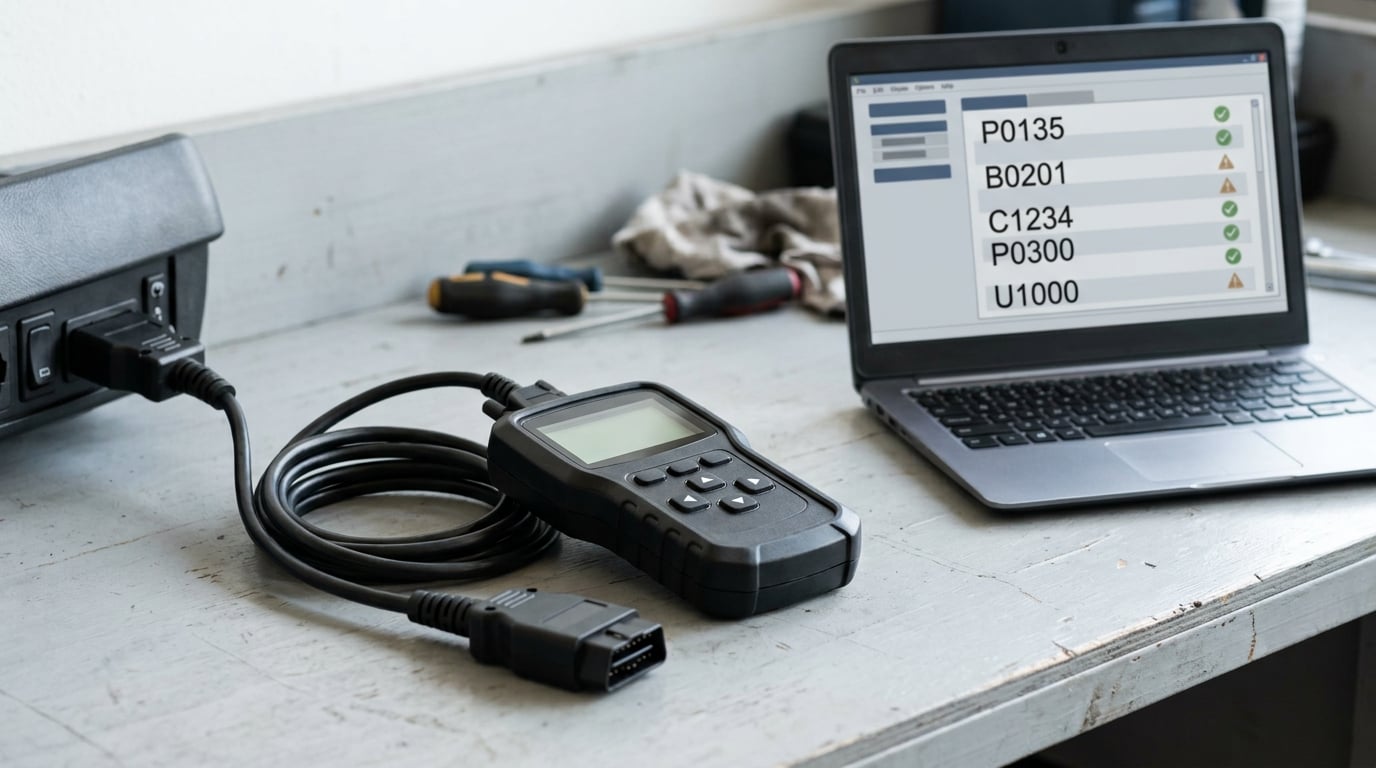
An OBD2 code is a five-character diagnostic trouble code stored by your car’s control unit when a sensor reading or a self-check falls outside its expected range. The code tells you which system reported a problem, not which specific part failed, so it is a starting point for a diagnosis rather than a verdict.
That distinction matters more than most people expect. A code narrows an open-ended problem down to a handful of suspects, which is exactly what you want before you start buying parts. It also stops you from throwing a catalytic converter at a loose gas cap.
Below I cover the codes that come up most often, how to read the letters and numbers, and the order in which I’d check things. If you are doing your own work for the first time, read the last two sections before you buy anything.
Table of Contents
- What Are OBD2 Codes and Why Do They Matter?
- The Most Common OBD2 Codes and What They Mean
- How to Read an OBD2 Code Before You Replace Parts
- Which OBD2 Codes Are Most Common on BMWs?
- What Should You Do After Reading a Code?
- Can You Drive With an OBD2 Code?
- Frequently Asked Questions
- Is it normal to have P0420 and P0171 at the same time?
- Why does my check engine light come back after I cleared the code?
- Can I clear codes by disconnecting the battery?
- How long does it take for the check engine light to reset after a gas cap?
- Is P0420 bank 1 or bank 2?
- Can a vacuum leak cause a check engine light?
- Where to Start: The First Three Moves
What Are OBD2 Codes and Why Do They Matter?
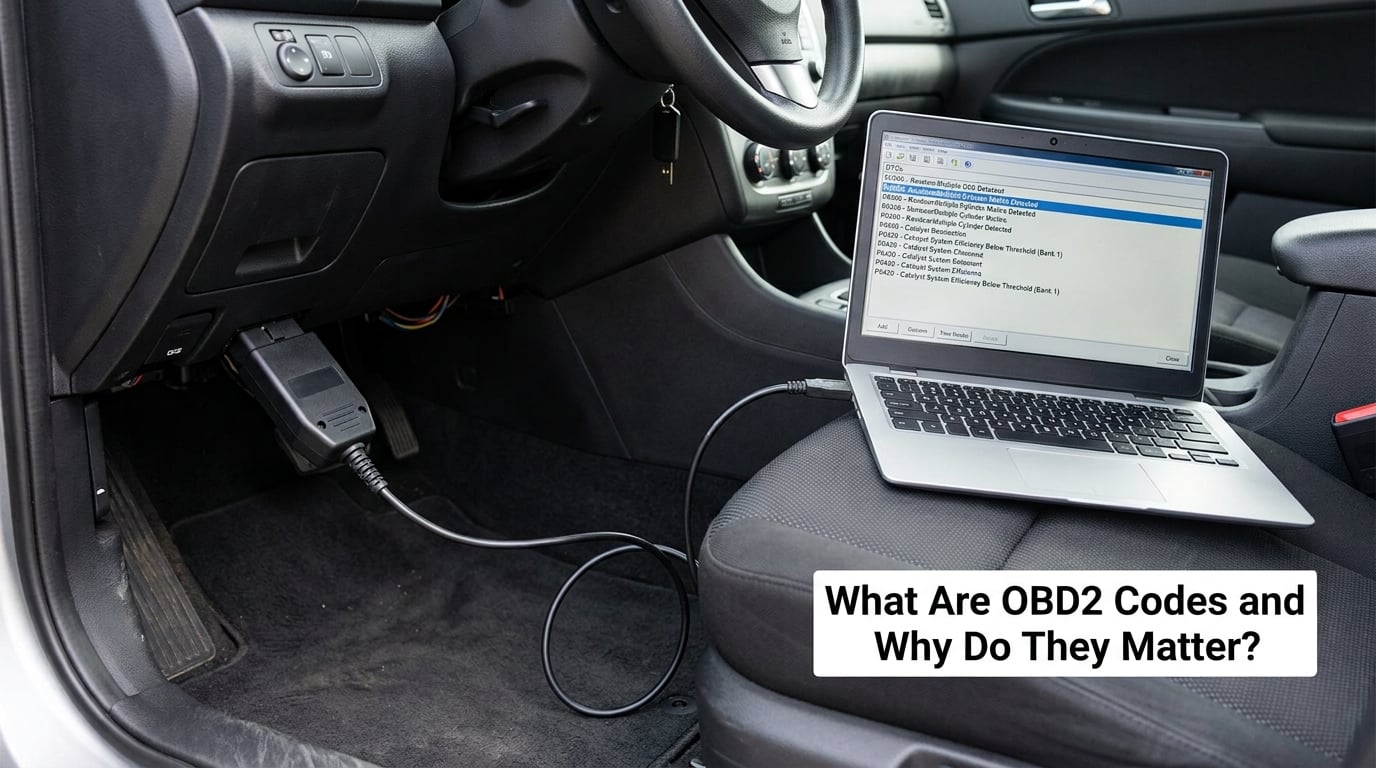
OBD2 stands for On-Board Diagnostics, second generation, a standardised system every gasoline-powered car sold since 1996 has to support. When a sensor contradicts what the engine control unit expects, the control unit logs a code and lights the malfunction indicator lamp, better known as the check engine light.
One thing the system does not do is name the failed component. It knows the oxygen sensor voltage did not match the exhaust oxygen it predicted. It does not know whether the cause is the sensor, a vacuum hose, a leaking injector or exhaust pipe.
Codes also behave differently depending on how sure the car is about the fault, and that difference explains why codes sometimes come back after you clear them.
| Code type | What it means | Why it matters |
|---|---|---|
| Stored (confirmed) | The fault happened and the drive cycle finished without the system seeing it again | The light is on and will stay on until the fault stops repeating |
| Pending | The fault happened once, often during start-up or a warm-up cycle | No light yet, but it is a warning that a code is forming |
| Permanent | A confirmed code the memory is not allowed to erase on its own | It clears only after a repair plus a successful drive cycle, or a scan tool erases it |
On most cars of this era a permanent code and a stored code look identical on a generic scan tool. The difference is what the emissions system will accept at inspection time, and a car can fail a test with the check engine light off.
Read the codes before you touch anything else, and write them down or photograph them. A cleared code is gone evidence, and a technician loses the one piece of information that narrows the search fastest.
The Most Common OBD2 Codes and What They Mean
The codes below cover most of what walks through a diagnostic scanner on cars I have worked on. The cause list is ordered roughly by how often I have seen it, not by cost, which is usually the wrong way round.
| Code | Meaning | Most common causes | Severity | Drive it? |
|---|---|---|---|---|
| P0300 | Random or multiple cylinder misfire detected | Vacuum leak, worn plugs, failing coil, low fuel pressure | High | Only if smooth, and not far |
| P0171 | System too lean, bank 1 | Vacuum leak, dirty MAF, low fuel pressure, injector | Medium | Yes, gently |
| P0174 | System too lean, bank 2 | Same as P0171, bank 2 | Medium | Yes, gently |
| P0301 | Cylinder 1 misfire detected | Coil on that cylinder, plug, injector, compression | High | Only if smooth |
| P0302 | Cylinder 2 misfire detected | Coil on that cylinder, plug, injector, compression | High | Only if smooth |
| P0420 | Catalyst system efficiency below threshold, bank 1 | Exhaust leak, upstream sensor, worn cat, running rich | Medium | Yes |
| P0430 | Catalyst system efficiency below threshold, bank 2 | Same as P0420, bank 2 | Medium | Yes |
| P0441 | Evaporative emission system incorrect airflow | Purge valve, vent valve, cracked canister hose | Low | Yes |
| P0442 | Evaporative emission system leak detected, small | Loose or worn gas cap, small hose crack | Low | Yes |
| P0455 | Evaporative emission system leak detected, gross | Gas cap not sealed, missing cap, large hose or canister leak | Low | Yes |
| P0456 | Evaporative emission system leak detected, very small | Hairline fuel cap seal, pinhole in EVAP hose | Low | Yes |
| P0128 | Coolant thermostat below regulating temperature | Thermostat stuck open, coolant level, cooling fan | Medium | Yes, watch the gauge |
| P0135 | Oxygen sensor heater circuit malfunction, bank 1 sensor 1 | Failed sensor heater, blown fuse, wiring | Medium | Yes |
| P0401 | Exhaust gas recirculation flow insufficient | Carbon-clogged EGR valve or passages, EGR gasket | Medium | Yes |
| P0100 | Mass air flow circuit range or performance | Contaminated MAF element, intake leak past the MAF | Medium | Yes |
Notice how many of those causes are hose, cap or valve rather than a big expensive assembly. On a petrol engine the cheapest and most common first fix is nearly always the one you can see or hear with a torch.
Severity here means how quickly the fault can damage something or leave you stranded, not how much the repair costs. A P0455 is a low-severity code you can drive around for weeks. A flashing misfire can wreck a catalytic converter in a few miles of driving.
The two codes that get misdiagnosed most often are P0420 and P0171, and they are worth extra attention because owners routinely replace a catalytic converter to fix a problem that was never in the converter.
How to Read an OBD2 Code Before You Replace Parts
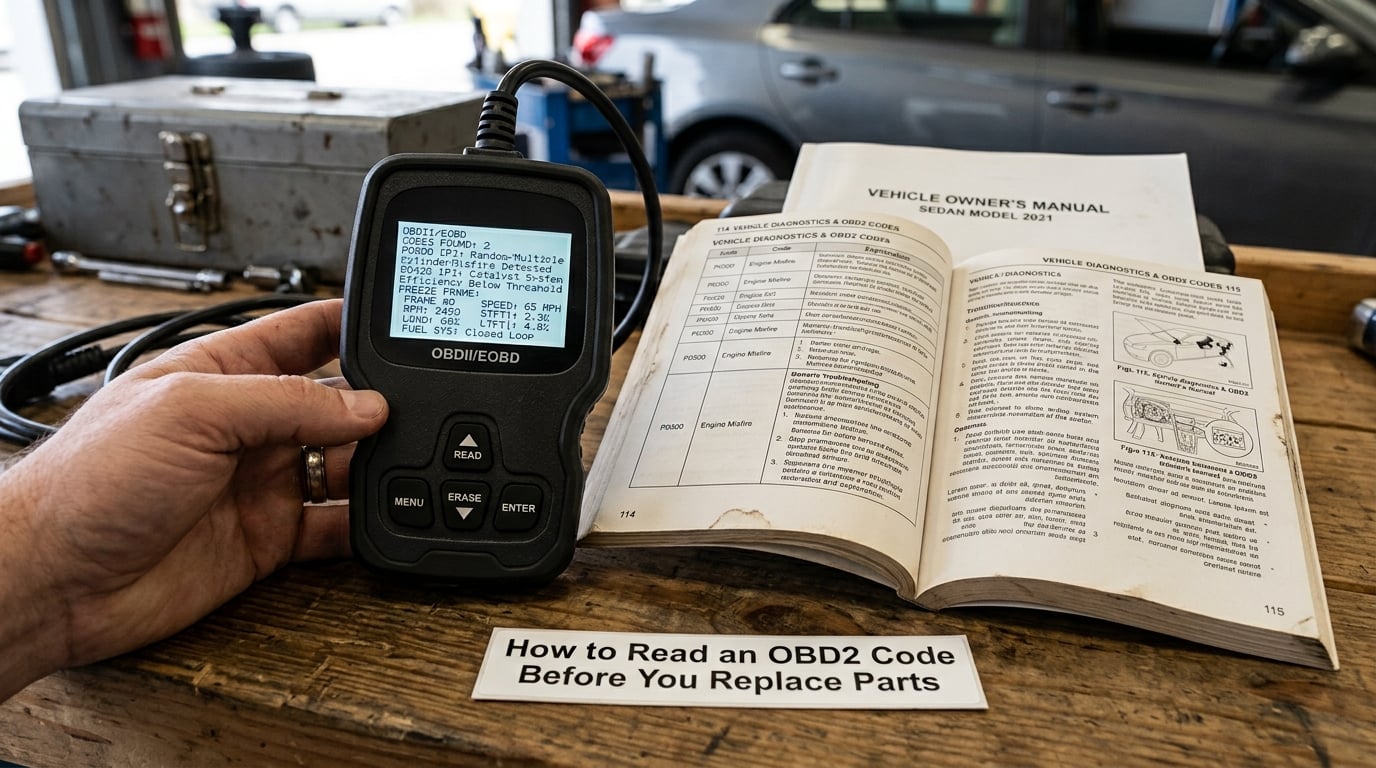
Every diagnostic trouble code is five characters, and the first character tells you which system flagged it. The second character tells you whether the code is a standard industry definition or a manufacturer-specific one.
| First letter | System | Examples |
|---|---|---|
| P | Powertrain: engine, transmission, exhaust, fuel and air | P0171, P0420, P0300 |
| B | Body: airbag, seatbelt, doors, A/C | B0010, B1342 |
| C | Chassis: ABS, traction control, steering, suspension | C0035, C1145 |
| U | Network: communication between control modules | U0100, U0121 |
A basic scan tool reads powertrain codes only. ABS, airbag and network codes often need a bidirectional scanner with the enhanced categories switched on, which is why a shop tool can show four codes where a cheap reader shows one.
A second digit of 0 usually marks a generic SAE-defined code that means the same thing on any car, while a 1, 2 or 3 in that position marks a manufacturer-specific code. P0301 is generic and means cylinder 1 misfire on every car that reports it. A BMW-specific DME code means something entirely different, and the only correct way to decode it is the manufacturer’s own service information.
The remaining digits narrow it further. The number families are tidy enough to guess at: P01xx covers fuel and air, P02xx ignition and fuel injection, P03xx misfire, P04xx auxiliary emission controls, and so on. That is a useful cross-check when a reader gives you something that does not fit.
Freeze-frame data is the other thing a scan gives you, and most people skip it. The control unit records engine speed, load, coolant temperature and fuel trim at the exact moment the fault appeared, which tells a technician whether the misfire happened cold, at idle or under load. Read and photograph it before clearing.
Finally, verify the exact code in your vehicle service information before acting on it. Manufacturer codes overlap in appearance but rarely in meaning, and two cars of the same year can describe completely different faults under the same digits.
Which OBD2 Codes Are Most Common on BMWs?
BMW owners tend to see the same handful of fault areas again and again, partly because these are ageing cars and partly because the DME holds manufacturer-specific detail a generic reader does not translate well.
Evaporative emission faults lead the list. P0455 and P0442 on older four-cylinder and six-cylinder models usually trace back to a fuel cap seal, a purge valve or a cracked vent hose, and owners on forums consistently report that the cap is the first thing worth trying before anyone spends money on a valve.
Misfire codes come next. P0300 on an inline-six often points at ignition coils on one bank, a vacuum leak in the intake manifold runners, or a plug that has been in service too long. Cylinder-specific codes such as P0301 or P0304 are useful because they tell you exactly which coil to suspect rather than telling you to test all six.
When misfire and lean codes appear together, vacuum leaks deserve a look first. A cracked intake runner or failed PCV valve pulls unmetered air past the mass air flow sensor, and the fuel trims go lean while the MAF reports an air quantity it never measured. For more on what the oily film in a dipstick actually tells you, read what metal in engine oil means.
Oxygen sensor codes show up in clusters. P0135 points at the heater circuit on the upstream sensor of bank 1, while a downstream sensor on a high-mileage car often shows up as an efficiency code rather than a wiring code. If the car also runs rich, smokes or has a fuel smell, check what causes black smoke from the exhaust before ordering parts.
Catalyst efficiency codes such as P0420 and P0430 are frequently blamed on a failed converter, but on these cars an exhaust leak ahead of the downstream sensor, a lazy oxygen sensor, or a misfire upstream of the converter produces the identical code. P0430 is bank 2, and the two can both appear when the problem is common to both sides, like exhaust or fuel.
Cooling-related codes such as P0128 point to a thermostat that never reaches regulating temperature, often with a temperature gauge that reads low or a heater that stays lukewarm. A stuck cooling fan can set coolant-related codes too, so check the fan before condemning the thermostat.
ABS codes beginning with C come from the ABS module, and a manufacturer-specific DME code may need BMW-specific diagnostic information to decode at all. That is the point where a general scan tool runs out of road, and the code needs the manufacturer reference or a shop with the right software.
What Should You Do After Reading a Code?
Here is the order I work in. It is deliberately unglamorous, because most problems are found in the first few steps and skipping to the last one costs money.
1. Write the code down before doing anything, including the freeze-frame data. Photograph the screen if you can.
2. Look at the car. Pop the hood, check the oil and coolant levels, look for a disconnected hose, a broken connector, a visible gap or a fuel smell. A missing oil cap will quietly throw a lean code on plenty of cars.
3. Check the gas cap if the code is EVAP-related. It should click and seal with a positive resistance, not slide in loose. If a code appears right after fuelling, the cap is the first suspect, and this is the single cheapest fix on the list.
4. Look up the exact code in the vehicle service information, especially for a manufacturer-specific code. Confirm the vehicle matches the code definition before ordering anything.
5. Test the suspected component rather than replacing it. Watch live data if your scanner can show it: fuel trims, sensor voltage, and what the oxygen sensor is actually doing under load. Swap a suspect sensor for a known good one only if you plan to move it back after the test.
6. Clear the code only when you have a reason to. Clearing a code that has not been fixed just resets the lamp and erases the data. If you do disconnect the battery, expect the readiness monitors to reset and the car to run oddly for a few days while they re-run.
7. Verify the repair with a road test of enough length to complete a drive cycle: several cold starts, some highway time, and a mix of city driving. A code that is genuinely gone stays gone. If it returns, you have not found the cause yet.
Anyone with a scanner in the glovebox and a few hours on a driveway can do steps one through six. Beyond that, work involving fuel lines, pressurised systems or a lift belongs to a shop. If you want the tool side sorted, what tools you need for basic car maintenance covers the sensible starter set.
Can You Drive With an OBD2 Code?
Most of the time, yes. A stored code with a light that stays solid and a car that runs normally is a scheduled repair, not an emergency. The exceptions are a flashing light and a small set of symptoms.
| What you see | What it suggests | What to do |
|---|---|---|
| Solid light, smooth running | Confirmed fault, engine managing around it | Drive to a shop soon |
| Solid light, rough idle or shake | Misfire, lean condition or sensor fault | Drive gently, avoid load, book it in |
| Flashing light | Active misfire dumping unburned fuel | Stop as soon as it is safe |
| Light plus overheating | Thermostat, coolant level, fan or water pump | Stop and let it cool |
| Light plus smoke or fuel smell | Rich mixture or leak | Stop, park away from anything flammable |
| ABS or stability light, pedal feels odd | Brake-related fault | Drive slowly, brake gently, treat as safety-critical |
A flashing check engine light is the one to act on immediately. Unburned fuel passing the catalytic converter can overheat it in a short drive, turning a modest repair into an expensive one.
A single bank of four cylinders misfiring at highway speed is close to the same situation. The catalytic converter relies on exhaust temperature to hold a reaction, and sustained misfire removes that.
Loss of power, knocking, an engine that will not idle, or an ABS light accompanied by a change in pedal feel should end the trip. The same goes for a temperature gauge climbing with the light on. In those cases, tow it or call a shop and ask whether they offer pickup.
One more rule that catches people out: a cleared code can hide a problem during a road test. If the light is off because you cleared it and the fault is still there, you have less warning, not more. Fix the cause first, then use a cleared lamp as confirmation.
Frequently Asked Questions
Is it normal to have P0420 and P0171 at the same time?
It is common, and the two often share one cause. A vacuum leak or a running-rich condition upstream of the sensors can trigger both a lean code and a catalyst efficiency code. Check the leak, the fuel trims and the exhaust before assuming the catalytic converter is the problem, because owners regularly replace a converter to fix a fault that was never in it.
Why does my check engine light come back after I cleared the code?
Because clearing a code resets the lamp, not the fault. If the underlying cause is still there, the control unit sees the same sensor reading on the next drive cycle and stores the code again. A permanent code behaves this way by design. Find and fix the cause, then complete enough cold starts and mixed driving for the readiness monitors to run.
Can I clear codes by disconnecting the battery?
It works on most cars, but it is the least useful way to do it. Disconnecting the battery erases freeze-frame data, resets the readiness monitors so the car may fail an emissions test right afterwards, and on some models it wipes radio presets, window memory and adaptive settings. A scan tool that reads and clears codes does the same job while keeping the evidence a technician needs.
How long does it take for the check engine light to reset after a gas cap?
A good cap usually stops new EVAP codes immediately, and the stored code clears on its own after a few drive cycles, often within several days of normal driving including a cold start. If the light is still on after that, the leak is somewhere else in the EVAP system, such as the purge valve, the vent valve or a cracked canister hose.
Is P0420 bank 1 or bank 2?
P0420 is bank 1 and P0430 is bank 2. Bank 1 is the side of the engine containing cylinder one, which is the front of the engine on most layouts. If a scan shows P0420 and P0430 together, look for a cause common to both sides, such as an exhaust leak or a fuel delivery problem, rather than a single failed sensor.
Can a vacuum leak cause a check engine light?
Yes, and it is one of the most common causes of a lean code such as P0171. Unmetered air past the mass air flow sensor makes fuel trims lean, which can also pull a misfire or a catalyst efficiency code on top. Common sources are cracked intake manifold runners, a failed PCV valve, worn brake booster hoses and disconnected fittings. A smoke test finds them faster than swapping sensors.
Where to Start: The First Three Moves
Read the code, photograph the freeze-frame data, and check the things you can see before the car is on a lift. Most common OBD2 codes trace back to a cap, a hose, a valve or a vacuum leak, and those are the ones you can find with a torch and a smoke machine.
Replace parts in order of probability, not price. The most expensive component in the system is the last thing to suspect, and the cheapest fix is usually the one still sitting on the shelf in front of you.