
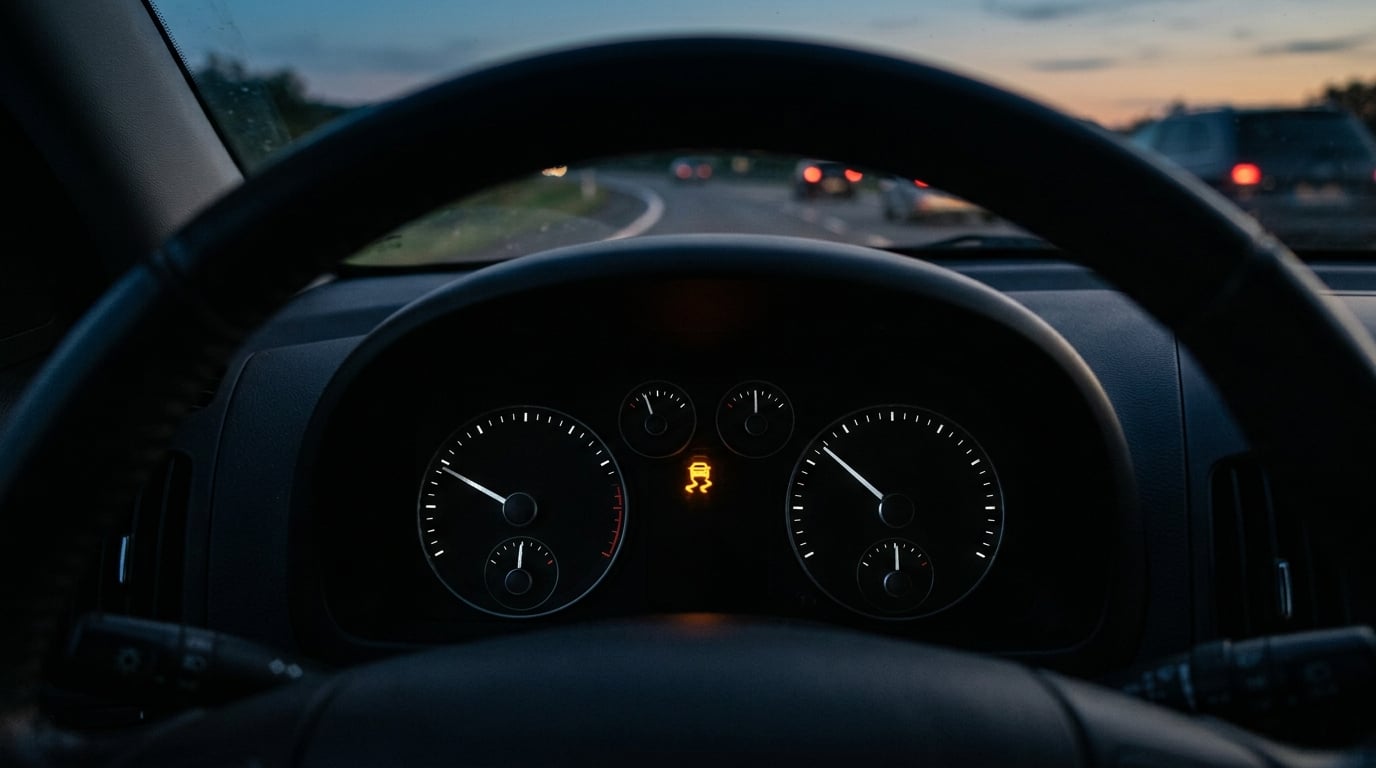
Short answer: the light is telling you your car’s traction and stability control system is doing something with your grip. It flashes while the system is actively pulling the car back from a slide, and it stays solid when the system has been switched off or has found a fault in itself. A brief flash in the rain is normal. A solid light on dry pavement is a repair appointment, not an emergency.
That is the whole decision rule, and most confusion comes from not knowing which of the two you are looking at. If you typed what does a traction control light mean into your phone while parked in a grocery lot, the flashing-versus-solid split below is the first thing to sort out. This guide walks through what the light means, what causes it, which parts of the job you can safely check yourself, and when a shop is the smarter call.
Last updated: October 2026
Table of Contents
- What Does a Traction Control Light Mean?
- How Your Car Uses Traction Control
- What Can Make the Traction Control Light Come On?
- Is It Safe to Drive With the Light On?
- How to Check the Light on a BMW
- Traction Control Light vs. Other Warning Lights
- When to Have a Mechanic Diagnose the Problem
- Frequently Asked Questions
- Can I drive with the traction control light on?
- Why does my traction control light come on in the snow?
- Is the traction control light the same as the ABS light?
- What causes a traction control light to stay on after starting the car?
- Do I need new tires if my traction control light is on?
- How much does it cost to diagnose a traction control warning light?
- What to Do First
What Does a Traction Control Light Mean?
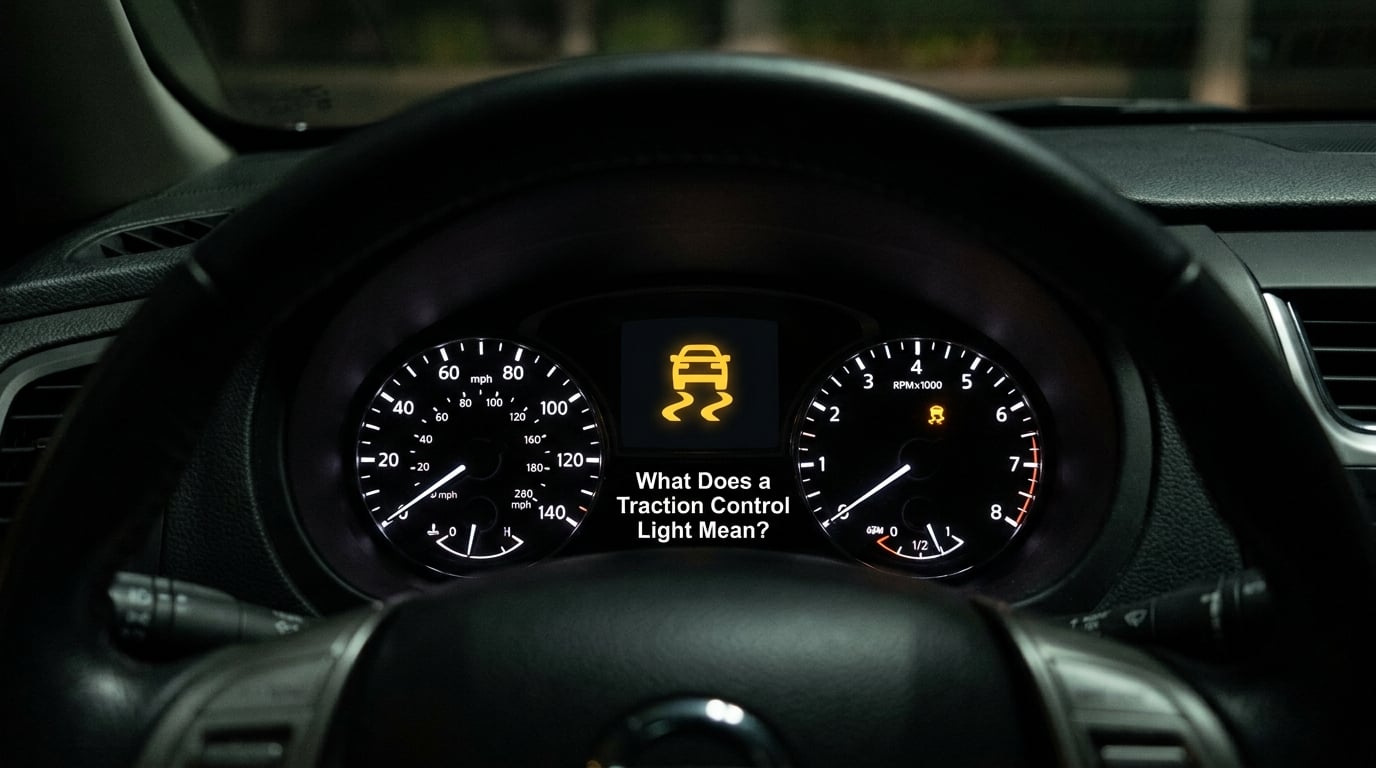
The amber warning symbol is usually a small car with two wavy skid lines under it, sometimes with the letters T or T/C inside the car. When the same icon is paired with the word OFF, that is a different message entirely. Owners on the r/ask boards describe it as an orange horseshoe, which is a fair description of a blinking T/C.
Here is what the light is telling you at a glance, and how urgently to react.
| What you see | What it means | What to do |
|---|---|---|
| Flashes briefly, then goes out | System is actively limiting wheel slip | Nothing. Normal in rain, snow, gravel or on a sharp corner |
| Stays solid while driving | Fault detected, or the system is switched off | Check tire pressures, then book a diagnostic |
| Solid icon with the word OFF | You (or someone else) pressed the traction control button | Press the button again to re-enable |
| Solid plus an ABS light | Shared sensor or ABS module fault | Drive gently to a shop, avoid hard braking |
| Solid plus a check engine light | Broader fault, often a communication or sensor circuit problem | Get it scanned this week |
One more thing worth naming: traction control and electronic stability control are the same hardware under two marketing names. BMW calls it DSC, most other brands call it ESC or ESP, and the light can carry any of those labels depending on the market the car was built for.
How Your Car Uses Traction Control
The system relies on the same wheel speed sensors the anti-lock brakes already use. Each sensor reports how fast its wheel is turning, four times per second or better, and the car computer compares the four readings against each other and against your steering and throttle inputs.
When one wheel spins faster than the others, the car has detected wheel slip. It responds in two ways: it cuts or trims engine torque so the spinning wheel stops being fed, and it pulses the brake on that single wheel to slow it down. The pulse is fast, often just a few applications per second, and it is felt as a fast vibration in the pedal rather than a hard stop.
The moment that correction is underway, the dashboard light flashes. When the wheels agree with each other again, it goes out. This is why the light behaves the same way a check engine light never does: it is an active report, not a stored one.
What this means practically is that a flashing light is the system working exactly as designed. Technicians describe it as the module pumping the brake on the spinning wheel to kill slip, and that is genuinely all that is happening.
What Can Make the Traction Control Light Come On?
Causes fall into two camps: things happening outside the car right now, and things wrong with the car itself. Work down this list in order, because the first camp is far more common and far cheaper.
Causes you can clear yourself
Wheel slip on a loose surface. Snow, ice, standing water, gravel, mud, wet leaves, a painted bridge deck, a steep hill in first gear. This produces a flash that goes away on its own.
Uneven tire pressure. The system reads pressure indirectly through wheel speed. A tire 15 psi low behaves like a different tire size, and the module gets a confusing signal. Check all four, including the spare’s printed placard, before blaming anything electronic.
Mismatched or worn tires. Mixing a winter tire, a summer tire and a worn tire on the same axle is a common cause of a light that appears in cold weather only. Uneven tread depth across the axle produces the same symptom.
A weak battery or a low voltage event. Owners on the chevyhhr.net forums trace the warning to a dying battery that needed charging or replacing, and mechanic forums report a low-voltage spike clearing the light on some vehicles. A voltage drop while cranking is enough to confuse the ABS module long enough to light the cluster, and it stays latched afterward.
Water or debris thrown up into the wheel well. Salt, mud, road film, and a bent splash shield can all soak the sensor connector and the wiring that runs down to it.
Causes that need a shop
Failed wheel speed sensor. The most common single component failure. One sensor reading nonsense tells the ABS and traction control module that a wheel is locked or spinning when nothing is happening.
Damaged reluctor ring. The toothed ring pressed onto the hub that the sensor reads. Bend one wheel hard in a parking lot, or hit a pothole, and the gap widens until the signal drops out. The sensor gets replaced and the ring gets turned or replaced, and the sensor is blamed again.
Corroded wiring or connector. These live in the splash area near the wheels, under the carpet at the sills, or inside the engine bay harness. Road salt does exactly what you would expect to it. Forum owners are routinely quoted for a full module swap when the actual cause was one corroded plug and a bad crimp.
Steering angle sensor out of calibration. After an alignment, a wheel and tire change, or any work that moves a wheel or a suspension component, the sensor that tells the module where the wheels are pointing may be reading off-center. This is why the light sometimes shows up right after a shop visit.
ABS module or traction control module fault. The unit that processes all of this, sometimes called the stability control module. It fails from internal damage or fluid intrusion, and it is the most expensive thing on the list by a wide margin.
ABS or ESC fault codes stored in the car computer. A code can survive a battery disconnect on some vehicles and keep the light on with no active fault present. On others it clears. Owners report parking the car overnight and finding the light gone in the morning, and nobody can always tell you why.
Intermittent faults deserve their own mention. r/MechanicAdvice threads are full of owners describing ABS and traction control lights that appear when the car warms up and vanish once it cools, or appear in rain and never on a dry road. Those are real faults in a real component that fails at a specific temperature, and they are much harder to catch than a light that is on all the time. A shop that cannot reproduce the condition may honestly tell you to come back when it acts up.
Is It Safe to Drive With the Light On?
A solid traction control light means one of two things, and the difference matters. Either the system is switched off, in which case you have simply lost an aid you rarely miss on dry pavement, or the system has faulted, in which case you do not know how much of the ABS and stability control is still working.
Driving carefully is reasonable in some combinations. Stopping and arranging a tow is the right call in others.
| Which lights are on | Verdict | Why |
|---|---|---|
| Traction control flashing | Keep driving normally | The system is doing its job |
| Traction control solid, nothing else | Drive gently to a shop | Brakes still work, but the slip protection may be gone |
| Traction control plus ABS | Drive gently, avoid hard braking | Anti-lock may be affected too, and both share sensors |
| Traction control plus ABS plus check engine | Tow it | Multiple systems reporting at once |
| Traction control plus brake warning | Stop and address the brakes first | Brake system condition overrides the traction fault |
Whatever the lights say, slow down, leave more following distance, and stop using inputs that ask a lot of grip: hard cornering, sudden lane changes, and flooring it out of a turn. If the pedal starts pulsing under normal pressure on dry pavement, the ABS is working and something is wrong with how it is measuring the wheels.
How to Check the Light on a BMW
BMW drivers see this most often as a DSC message, since Dynamic Stability Control is the badge on most of the range. The underlying system is the same one described above, so the owner-side checks apply here too. Work through them in this order and stop before anything involving disassembly.
1. Read the exact message. Hold the check button or use the onboard menu to pull stored messages before they roll off. DSC, ABS, a fault code number, or a tire pressure warning each point at a different place, and the code narrows the search enormously.
2. Check all four tire pressures cold. The placard is on the driver door jamb and the fuel filler flap. BMWs are sensitive to pressure spread across the axle, and a 20 psi gap is enough to trigger a warning on some models.
3. Look at tire condition and match. Compare tread depth across each axle with a penny. If one tire is a different compound or much shallower than its partner, that explains a light that only shows up in the cold.
4. Look for physical damage. Walk around each wheel and look for a wheel bent by a pothole, a tire with a sidewall cut, or road grime packed around the hub area. Do not poke at the sensor wiring with the car in the air or with the wheel off; the wires are short and the connector is easy to break.
5. Restart the car. Turn the ignition off, leave the car for a few minutes, and start it again. This clears a latched message on many models and gives you a clean read on whether the fault is active or stored.
6. Read the tire pressure monitor. A TPMS message alongside a DSC light usually means the low pressure is the cause, not a fault in the stability system.
7. Have the codes scanned. A basic scan reads stored and pending codes and tells you which module is complaining. Most shops do this as a short diagnostic step, and the printout is the single most useful thing you can have in your hand when comparing quotes.
What you should not do: bridge sensors, poke at wiring under the car, or spray anything into a connector. The steering angle sensor in particular is calibrated with a dealer-grade tool, and guessing at it turns a cheap fix into an expensive one.
Traction Control Light vs. Other Warning Lights
Several lights can appear at the same time, and the combination tells you more than any single lamp. Use this table to work out what you are actually looking at.
| Light or message | What it generally means | How urgent |
|---|---|---|
| Traction control (T/C, ESC, DSC) flashing | Wheel slip detected, system correcting | None, informational |
| Traction control solid | System off or faulted | Book a diagnostic this week |
| ABS light | Anti-lock braking has a fault or is disabled | Prompt, normal braking still works |
| ESC OFF indicator | Stability control deliberately switched off | Press the button to re-enable |
| Check engine | A powertrain or emissions fault code is stored | Prompt, and it can be the cause |
| Brake system warning | Low brake fluid, worn sensor, or pad wear depending on model | Stop and inspect before driving on |
| Tire pressure monitor | Pressure below threshold or a sensor fault | Check pressures now |
The pairing that owners ask about most is traction control plus ABS. The two systems share the wheel speed sensors and often the same module, so one damaged sensor or one corroded connector can light both at once. Seeing them together narrows the diagnosis considerably and works against a brake-only or traction-only guess.
When to Have a Mechanic Diagnose the Problem
Book a diagnostic if any of these apply, and describe the driving conditions when the light appeared rather than just saying it is on.
- The light is solid and does not clear after a restart.
- It activates on dry, level pavement with no wheelspin involved.
- It comes on right after a wheel alignment, tire change, or brake work.
- Braking feels different, the pedal pulses, or the car pulls to one side.
- You hear grinding, humming, or a ticking that changes with speed.
- You can see fluid under the car or around a wheel.
- A wheel is visibly bent or a tire has a sidewall cut.
- Both the ABS and traction control lights came on together.
- The fault is weather-correlated, appearing in rain, snow, or once the engine is fully warm.
Here is the sequence a technician usually runs, which is useful to know so you can tell whether you are being methodical or being sold a part.
1. Scan for codes. Stored, pending, and freeze-frame data across the ABS, stability control, and engine modules, plus a scan-tool snapshot of live wheel speed readings.
2. Check the wheel speed sensors. Live data compared against what each wheel is actually doing, plus a physical and connector inspection at every corner.
3. Inspect the wiring. Harnesses at the sills, behind the kick panels, and around the engine bay, looking for salt damage, chafing, and water intrusion.
4. Verify steering angle sensor calibration. Especially if there has been alignment, suspension, or tire work since the light first appeared.
5. Test the module. Communication between the stability control unit, the engine computer, and the instrument cluster. Communication faults are the ones that produce codes on several modules at once.
Ask for the scan printout and the labor estimate broken down by part before agreeing to anything. The spread here is enormous: a corroded connector, a replacement sensor lead, or a wheel bearing can be a small job, while a module replacement runs many times more. Owners on mechanic forums are burned repeatedly by quotes that skip straight to the module without testing the cheap causes first.
If a shop does quote a module, ask what evidence ruled out the sensors, the wiring, and the steering angle sensor. That one question does more than anything else to keep the bill honest.
Frequently Asked Questions
Can I drive with the traction control light on?
Yes, in most cases, and it depends on whether the light is flashing or solid. A flashing light means the system is actively correcting wheel slip, so keep driving normally. A solid light means the system is off or faulted, which is worth a diagnostic within the week. Stop and arrange a tow if the traction control light appears with the ABS light, the brake warning, or a check engine light at the same time.
Why does my traction control light come on in the snow?
Because the system is doing its job. Snow and ice let a wheel spin faster than the others, the wheel speed sensors report the difference, and the stability control cuts engine torque and pulses that wheel’s brake to restore grip. The light flashes while that correction is happening. If it stays solid on cleared, dry pavement, the snow is not the cause and something needs checking.
Is the traction control light the same as the ABS light?
No, they are separate warnings that share hardware. ABS covers the anti-lock braking function, and traction or stability control covers how the car manages throttle and braking during a slide. They use the same wheel speed sensors and often the same module, so one failed sensor or one corroded connector can light both at once. When both come on together, start the diagnosis at the sensors and wiring rather than at either system separately.
What causes a traction control light to stay on after starting the car?
Usually a stored fault code that the module latched, or a system that has genuinely failed a self-check at startup. Weak battery voltage, a low or mismatched tire pressure, a damaged wheel speed sensor, a bent reluctor ring, corroded wiring, and an out-of-calibration steering angle sensor all produce the same symptom. Read the stored message first, then check pressures and battery voltage before booking anything further.
Do I need new tires if my traction control light is on?
Not automatically, but tires are worth checking before anything else. Uneven pressure across the axle, a big difference in tread depth, or a mix of winter and summer tires can trigger the light on their own, especially in cold weather. If the tires are worn, mismatched, or damaged, replacing or matching them may clear the warning entirely. If they are in good shape, the cause is elsewhere in the system.
How much does it cost to diagnose a traction control warning light?
Diagnosis is usually billed as a short flat-rate scan rather than an open-ended repair, and the range of actual repairs underneath it is enormous. A corroded connector, a sensor lead, or a wheel bearing can be a modest job, while a module replacement is many times more. Get the code scan printout and a written estimate with the part named before agreeing to work, and ask what ruled out the sensors and wiring.
What to Do First
Decide flashing versus solid, because everything else follows from that. Flashing in bad weather means the system is working, so leave it alone and read nothing more into it.
If the light is solid, check all four tire pressures cold, look at the tires for wear and mismatched pairs, and restart the car to see whether the message latched or is active. Those three checks take ten minutes and rule out the most common cheap causes.
Still on after that, get the codes scanned and printed before you agree to any repair. Ask what ruled out the wheel speed sensors, the wiring, and the steering angle sensor, because that is the question that keeps a corroded connector from turning into a module replacement.