
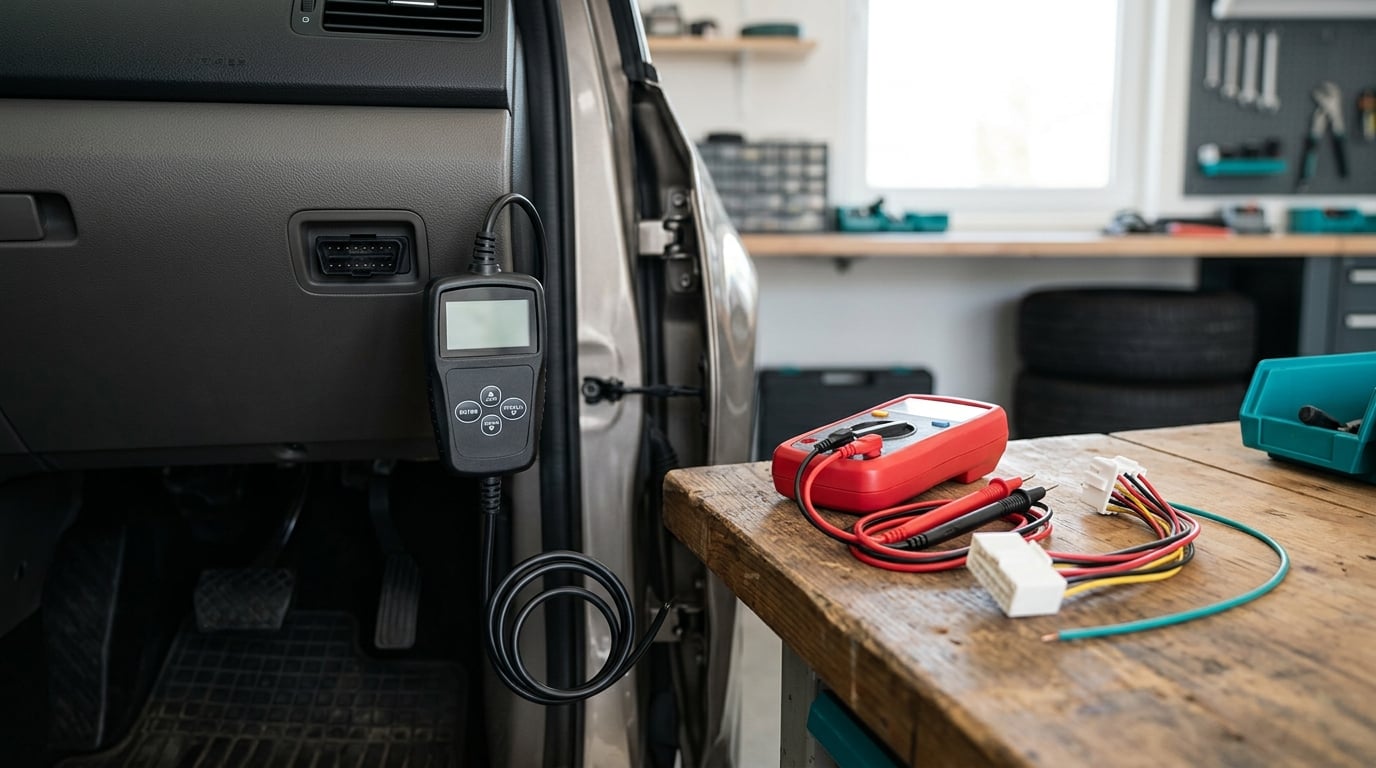
A pending code on a scan tool is a fault your car’s control module has recorded once but not yet confirmed over enough drive cycles to store as a real code or light the check engine light. It is an early warning, not a verdict. The car noticed something odd, watched it happen again, and is still deciding.
Most owners find a pending code by accident. They borrow a code reader, tap Read Codes after a warning light, or plug in before selling a car and see a line they do not recognise. The wording varies by tool: some say Pending, others say Intermittent, Historic or Not Yet Confirmed. Underneath the labels, the idea is the same.
Here is what each status means, why a fault gets flagged in the first place, and the order I would work through before touching the erase button on a scan tool.
Table of Contents
- What Does a Pending Code on a Scan Tool Mean?
- Pending vs. Stored vs. Permanent Codes
- What Causes a Code to Become Pending?
- How Does Your BMW Mark a Fault as Pending?
- Is It Safe to Drive With a Pending Code?
- What Should You Do Before Clearing a Pending Code?
- How to Clear and Recheck a Pending Code
- What If the Pending Code Comes Back?
- Frequently Asked Questions
- Conclusion
What Does a Pending Code on a Scan Tool Mean?
A pending code is a diagnostic trouble code the vehicle’s control module has logged after detecting a fault once, but which has not yet repeated often enough to be confirmed and stored. The check engine light stays off. It is a heads-up that something deserves a look, not proof of an emergency.
Think of the module running a short checklist every time you drive. One sensor reading falls outside its expected range, so the module records the fault and starts a counter. If the same fault shows up on a later trip, the code gets promoted to stored and the malfunction indicator lamp comes on. If it never shows up again, the pending entry quietly ages out on its own.
That is why a pending code matters even with a clean dashboard. It is often the only trace of an intermittent fault, and intermittent faults are the ones that turn into a check engine light on the motorway three weeks later.
Pending vs. Stored vs. Permanent Codes
These four statuses confuse more people than the codes themselves. The differences come down to how much evidence the module has, what the dashboard does, and whether your scan tool is allowed to erase it.
| Status | What it means | Check engine light | Drive-cycle behaviour | Can a scan tool erase it? |
|---|---|---|---|---|
| Pending | Fault seen once, not confirmed | Stays off | Reverts on its own after a few clean cycles | Yes, though fixing the cause is better |
| Stored / confirmed / current | Fault met the confirmation threshold and is active or was active this session | On, or recently commanded on | Stays until cleared and stays clear only if the cause is gone | Yes |
| History / past | Fault that stopped or was cleared, kept as a record | Off | Stays until erased, no longer re-tests | Yes |
| Permanent | Confirmed fault that ran a full drive cycle after clearing | On, back on within a few cycles of clearing | Only clears when the same code completes a full drive cycle with no fault | Not with a standard erase; needs the OEM permanent-code procedure |
One detail trips people up. On many cars, a stored code can sit there with the check engine light off, because the light was commanded on earlier in the same drive and then the fault went away, or because the bulb was swapped. A stored code with no light usually means the problem was present at some point but is not present right now.
Permanent codes are the odd one out. A normal code reader will tell you it cleared it, and the dashboard will go dark, and then the same code reappears because it survived a complete drive cycle without the fault going away. That is the module telling you the problem is still there. Manufacturer-specific tools and procedures handle permanent codes; a generic erase does not.
What Causes a Code to Become Pending?
Anything that makes a monitor see a value it does not expect, once. Most pending codes fall into a handful of buckets.
- Intermittent electrical faults. A chafed wire, a connector that only makes contact when the body flexes, a corroded terminal. These produce a pending code more often than anything else, which is why the code keeps reappearing after a clear.
- A sensor that never changes as expected. Monitors watch for change, not just a value. An oxygen sensor sitting at a plausible-but-static number can trip a monitor without the reading looking wrong on a scan tool.
- Loose or damaged connections. Battery terminals, ground points, sensor plugs, and the mass air flow sensor connector are all common offenders.
- Low battery voltage. A weak battery or a bad alternator can log module communication codes that have nothing to do with the engine itself.
- Contamination or wear. Oil or coolant in an ignition plug well, a cracked intake hose, dirt on a mass air flow element.
- EVAP events that have not settled. A loose or slow gas cap, a fuel cap left off during refuelling, a recently filled tank that has not completed its leak check.
- Work you just had done. Codes are commonly pending right after a battery disconnect, a part replacement or a refuel. The monitor is still gathering evidence.
That last group matters most for peace of mind. If the pending code appeared immediately after the battery was disconnected, or right after you filled up, or a day after a shop replaced a sensor, that is expected behaviour. Clear it, drive properly, and re-scan.
How Does Your BMW Mark a Fault as Pending?
Every module on the car runs self-tests, and the powertrain and emissions monitors follow rules set by the SAE J2012 standard rather than by each manufacturer’s taste. A monitor that fails once sets the code as pending. It fails again on a later drive cycle and the code becomes confirmed, stored, and the light comes on. A manufacturer may run its own confirmation strategy on top of that, and the exact thresholds differ by model year and engine, so treat any specific number you read as a starting point rather than a rule.
What is a pending code on a scan tool screen?
Most scanners group their menu into the same four buckets but label them in their own words. This is the mapping you will see on nearly any device or app.
| Screen label | Real status | Notes |
|---|---|---|
| Pending / Not Yet Confirmed / Intermittent | Pending | Fault seen once. Light stays off. |
| Stored / Current / Confirmed | Stored, active this session | This is the one that commands the light. |
| History / Past / Erased | Historical record | Kept after the fault stopped or was cleared. |
| Permanent | Permanent | Survived a full drive cycle after a clear. |
| MIL commanded on / off | Lamp status | Not a code, just the dashboard light state. |
| DTC count | Number of stored codes | Ignores pending and permanent entries on most tools. |
| Readiness / I/M monitors | Monitor status | Shows not ready, ready or not complete per monitor. |
Cheapest code readers often show only stored codes. If your tool has no Pending or Permanent menu, you are seeing a fraction of what the car knows, and a quiet dashboard does not mean a clean memory.
The service mode behind each status
Under the interface, the tool asks the module for specific data. Mode $03 returns currently stored and pending codes from 1996 and later. Mode $07 returns pending codes on its own. Mode $0A returns permanent codes. The distinction is why a two-dollar reader and a full-featured scanner can disagree about what is wrong with the same car on the same day.
Where the plan calls for BMW specifics, the honest answer is that N52, N54, N55 and B-series engines each behave a little differently with vacuum leaks, ignition coils and evaporative system complaints, and that generation-level detail is worth checking in BMW’s own service information rather than a general article.
Is It Safe to Drive With a Pending Code?
A pending code by itself is not an emergency. The lamp is off, the monitor has not confirmed the fault, and many pending entries never become anything. But a pending code is a hint about a system, and some hints are worth respecting.
Start with your owner’s manual, then triage like this.
- Monitor it if the light is off, the car drives normally, and the code points at something non-critical. Write down the code and re-scan after a week of normal driving.
- Act soon if the code is pending and also shows up in history, or it keeps reappearing after you clear it. A repeating code is an intermittent fault, and intermittent faults do not stay intermittent forever.
- Drive carefully and get it looked at if you also have a warning lamp on, a warning message on the display, a fluid leak, brake or steering symptoms, a smell of fuel, a misfire code such as P0300 or P0301, or any fuel-system or catalyst-related code. Power loss or rough running alongside a code is a reason to stop and diagnose, not to keep commuting.
Do not ignore warning lights other than the check engine light, and do not let a scan tool talk you out of a problem the dashboard is describing. The tool reports what the module knows; the dashboard reports what the driver needs to know right now.
What Should You Do Before Clearing a Pending Code?
Clearing is the last step, not the first. A scan tool can erase a code in three seconds, and the evidence in that code was the only evidence you had. Work through this order and you will usually find the actual fault.
- Record it properly. Write down the exact code, the status, and the freeze frame data: engine speed, load, coolant temperature, vehicle speed and fuel trim at the moment the fault was seen. Freeze frame is a snapshot of conditions, and it tells you whether the fault showed up cold, at idle or under load.
- Look up the definition and the freeze frame together. The code gives the system, the freeze frame gives you the conditions. A lean condition code means something very different under acceleration than at idle.
- Check battery voltage and the fuses for that circuit. Anything under about 12.4 volts at rest will set codes on its own. Check the main grounds too.
- Inspect the wiring and connectors for that system. Look at the sensor plug, the harness routing near the hot exhaust area, and any recently disturbed connections.
- Complete a proper drive cycle. Cold start, idle, warm-up, a stretch of city driving with varied speeds, then a highway segment at steady speed, then coast-down. The drive cycle is the sequence the monitors need to run their tests; a five-minute trip around the block runs almost none of them.
- Re-scan before touching anything. If the pending code is gone after a real drive cycle and nothing new appeared, you very likely had a benign or one-off event.
If the code comes back as stored after a proper drive cycle, you now have a confirmed fault worth chasing with targeted tests rather than guess-and-replace parts.
How to Clear and Recheck a Pending Code
When you are ready to clear, the process is short, and so is the list of things it does not do.
- Warm the engine to operating temperature and make sure the car is outdoors or well ventilated.
- Connect the scan tool to the 16-pin diagnostic port, usually under the dash on the driver’s side, and turn the ignition on without starting the engine.
- Open the Stored Codes or Erase Codes menu and confirm the clear. Note any freeze frame first, and only confirm the erase once you have it written down.
- Turn the ignition off, start the car, and drive a complete drive cycle: cold start, warm-up, city driving with stop-and-go, a highway run at steady speed, and a coast-down.
- Re-scan. If the code is gone and no new codes appear, either the event was one-off or the cause is fixed.
Two things to expect. Clearing resets the I/M readiness monitors, and they will read not ready until each monitor has run a full drive cycle of its own. That matters at an emissions test, where rules vary by state and by test type. And clearing a code does not repair anything: it deletes the record of a fault, not the fault itself.
On a modern BMW, an aggressive erase can also drop the radio, seat and window settings and force an idle-window relearn on some models, so read the car owner’s manual before you start.
What If the Pending Code Comes Back?
A code that returns is information, not a failure. Two different things can be happening, and the difference is in what status it came back as.
If it came back as pending, the monitor saw the fault again but has not confirmed it. That is the confirmation process working as designed. If it came back as stored after a full drive cycle, the fault survived a clear, which usually means the cause is still there.
This is the piece nobody explains well. After you clear a code, the monitor has to see the fault again during a complete drive cycle before it can set it. If it was never really fixed, the light coming back is the system working, not a sign your repair failed. On a genuinely repaired fault, the monitor runs, sees correct values, and the code never returns.
Reach for a qualified technician when the same code returns three or more times, when several different codes keep appearing in the same system, when the code is fuel-system or misfire related, or when the car is burning oil, overheating or running rough. Manufacturer service information and a proper diagnostic sequence beat a parts cannon, and clearing the code again just resets the evidence.
Frequently Asked Questions
Will a pending code turn on the check engine light?
It can, but not automatically. A pending code is the first stage, where the module has seen a fault once. If the same fault shows up again on a later drive cycle, the code is promoted to stored and the check engine light is commanded on. If the fault never repeats, the pending entry ages out and the light never comes on. That is why reading codes before a long trip or before a sale is worth a couple of minutes.
Can I drive my car with a pending code?
Usually yes, with the check engine light off and the car driving normally. A pending code means a monitor saw something once and has not confirmed it. Drive normally rather than trying to reproduce the fault, and re-scan after a proper drive cycle. If the check engine light is on, a warning message is displayed, or you have a misfire or fuel-system code, get it diagnosed first and follow the owner’s manual.
Does clearing a pending code fix the problem?
No. Clearing a code with a scan tool only deletes the record of a fault. If the cause is still there, the monitors will simply detect it again during the next complete drive cycle and the code will return, often promoted to stored with the check engine light on. The only real fix is repairing whatever made the monitor fail, whether that is a loose connector, a failing sensor, a wiring fault or a contaminated connection.
Should I disconnect the battery to clear diagnostic codes?
It clears codes, memory and settings in one motion, but it is a blunt tool. On many cars it also resets radio presets, seat and window memory, throttle or idle relearn values, and it can cost you more time than a scan tool does. Battery disconnection can itself cause new communication codes to appear while the module reboots. Use the scan tool’s erase function, and reconnecting a battery also has safety implications around alarm and key programming.
Why did my pending code disappear after driving?
Because a drive cycle gave the monitor enough evidence to make a decision. If the fault was a one-off event, such as a slow gas cap right after refuelling, a battery voltage dip, or a loose connection that briefly lost contact, the monitor ran its test, saw correct values, and discarded the pending entry. That is the system working. A code that disappears after a full drive cycle without other symptoms is generally good news, though it is still worth noting which code it was.
Do I need to fix every code listed on my scan tool?
Not every entry, but do not ignore them either. Historic and past codes describe something that already happened and often need no work. A pending code deserves a proper drive cycle and a re-scan. A stored code that is active right now, especially a misfire, fuel-system or catalyst code, should be diagnosed. The practical rule is triage: monitor, act soon, or stop and diagnose, based on the light, the symptoms and how many codes are in the same system.
Conclusion
A pending code on a scan tool is the car telling you it saw something once and is still watching. Save the code and the freeze frame before you do anything else, and do not assume the code names the failed part, because it names the system and the conditions instead. Run a proper drive cycle and re-scan, repair the cause rather than erasing the record, and take the car in when a fuel-system or misfire code shows up alongside warning lights or rough running.