
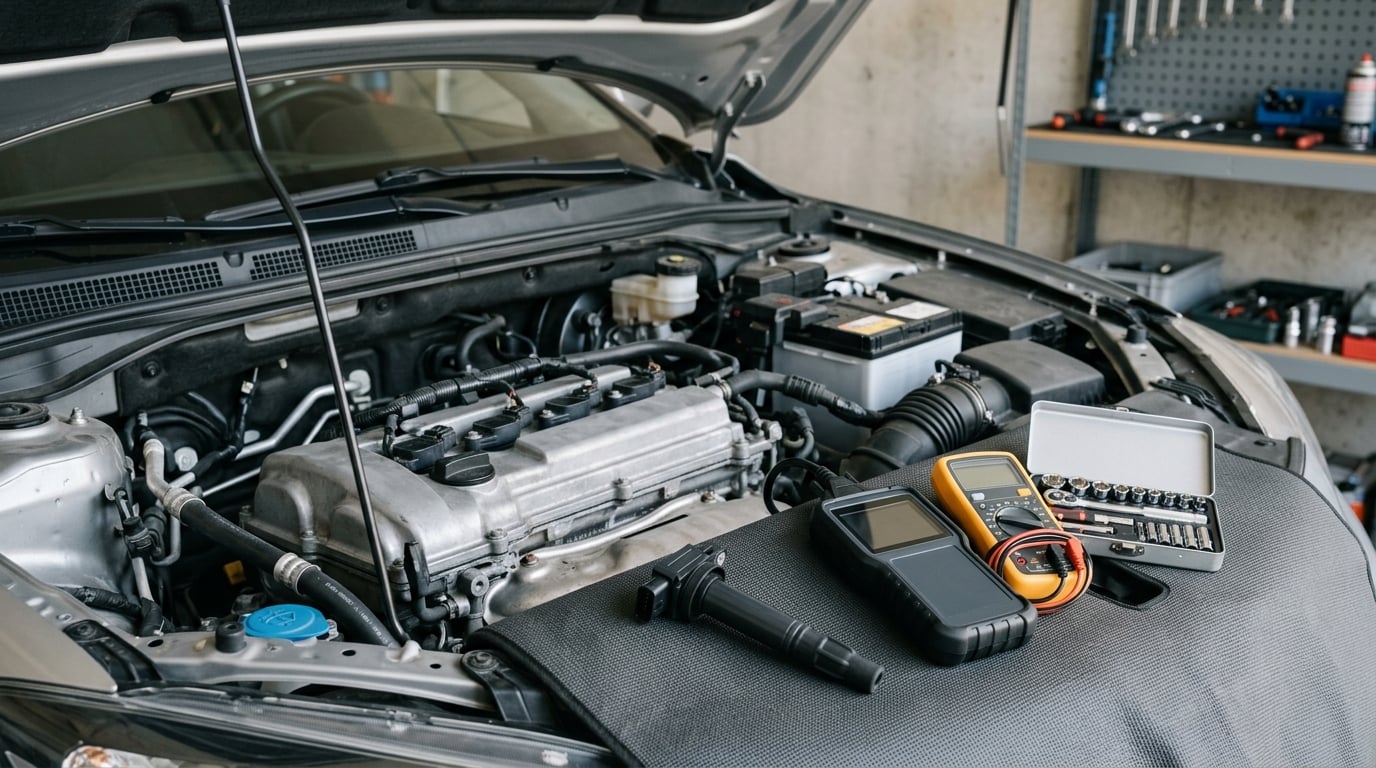
To diagnose a misfire by cylinder number, read the stored OBD-II code first, find which cylinder the engine computer is flagging, then isolate that cylinder with a coil swap, a plug inspection, and an injector test before you blame the engine internals. A code like P0302 tells you cylinder 2 is not burning its charge as commanded; the work is proving which part on that cylinder failed.
Most intermittent misfires take an hour to narrow down and a whole afternoon to fix. Give yourself a weekend the first time, keep the factory service information open on a screen, and never start with parts. On this site I write mostly for BMW owners, and the same logic holds on a 318i or a Corolla: read first, test second, replace third.
This guide is written for a four-cylinder through V8 gasoline engine with coil-on-plug ignition. If your car runs a distributor, waste-spark coil pack, rotary engine, or a hybrid system, the same logic applies but the access and safety steps differ, so use your service manual.
Table of Contents
- Tools and Documents You Need to Diagnose a Misfire by Cylinder Number
- How to Diagnose a Misfire by Cylinder Number, Step by Step
- Common Misfire Diagnosis Mistakes and How to Fix Them
- Frequently Asked Questions
- Is it safe to drive with a misfire in one cylinder?
- Why does the misfire code come back after replacing a spark plug or coil?
- What does a random cylinder misfire mean?
- Can I test an ignition coil at home with a multimeter?
- Can engine misfires damage the catalytic converter?
- Should I replace all the spark plugs and coils if one cylinder is misfiring?
Tools and Documents You Need to Diagnose a Misfire by Cylinder Number
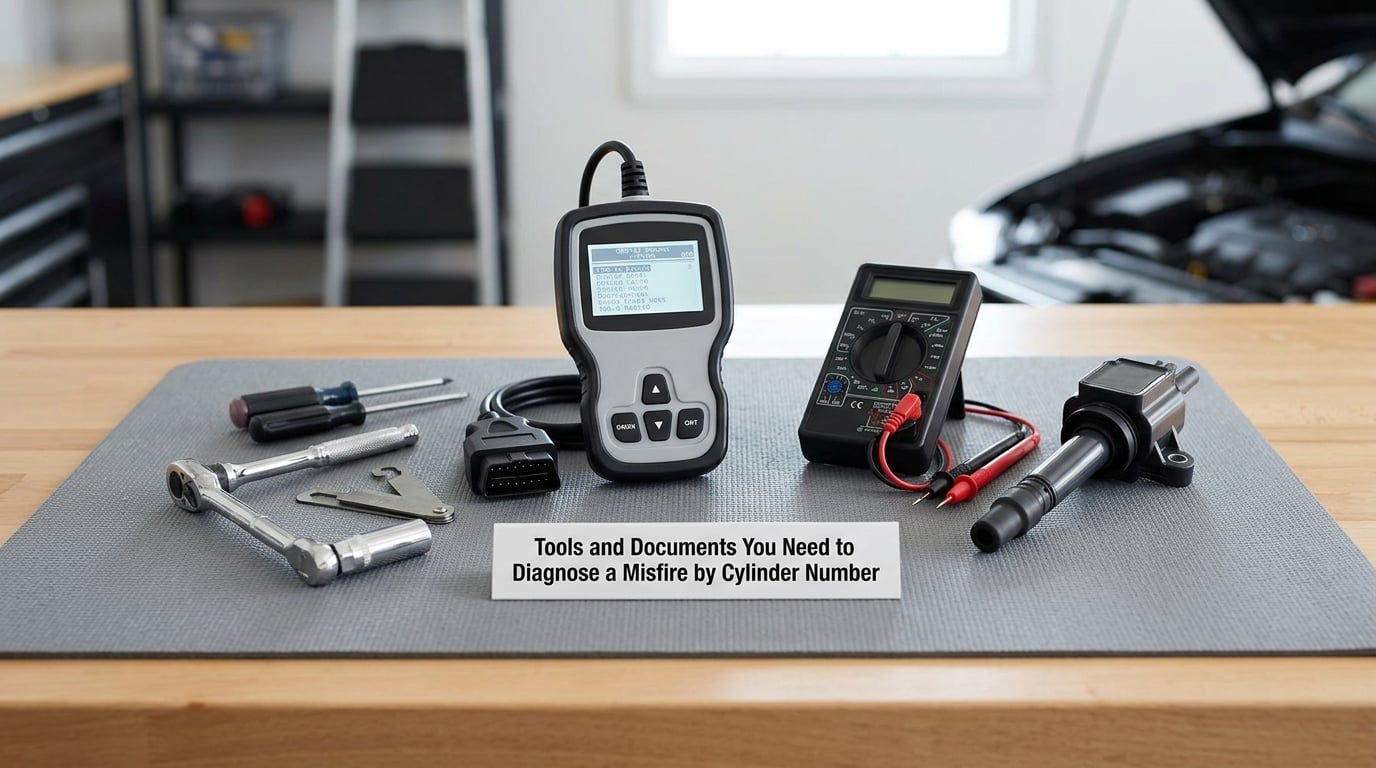
You need less than a shop bay, but you do need a scanner that reports per-cylinder misfire counts rather than a single generic code. A phone app paired with a cheap Bluetooth dongle will read stored and pending codes on most cars built since 2001, and that is enough to start.
- OBD-II scanner with stored, pending and freeze-frame data, plus live engine RPM and, ideally, per-cylinder misfire counters.
- Multimeter for coil primary and secondary resistance and injector resistance.
- Spark plug socket of the correct size, a torque wrench, and the plug gap from the service manual.
- Inspection light and clean nitrile gloves, since oil on a plug boot or connector will give you a false reading.
- Compression tester and leak-down tester for the mechanical branch, if your vehicle supports either on the cylinder in question.
- Service information for your exact engine: cylinder numbering, firing order, coil resistance specifications, injector resistance specifications, plug gap and plug torque.
On safety, work on a cold engine, transmission in park with the parking brake set, and the key away from the ignition while your hands are in the bay. Disable ignition or disconnect the battery only where your owner’s manual tells you to, because airbags and door locks can behave unpredictably otherwise. Do not open a fuel rail or a high-voltage system unless you are trained and qualified for it.
How to Diagnose a Misfire by Cylinder Number, Step by Step
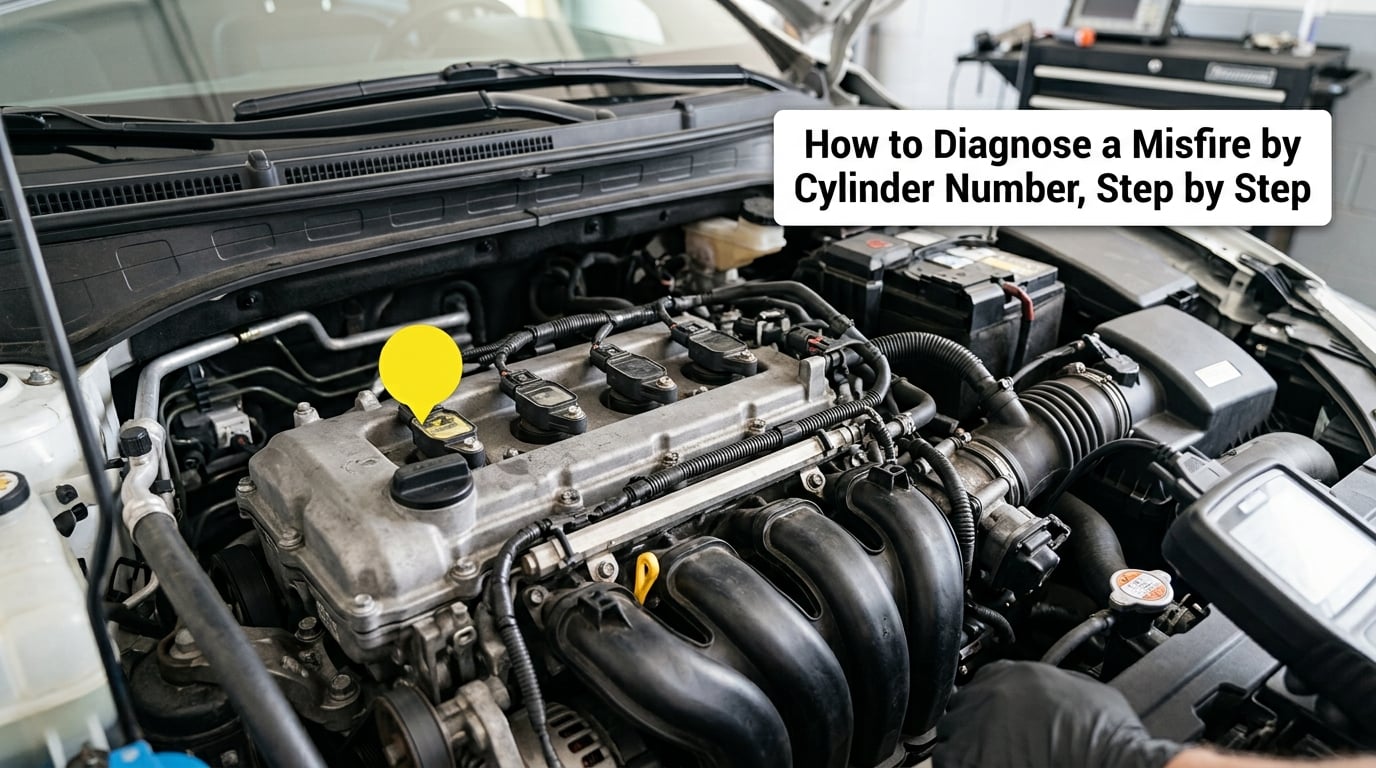
Work in this order because each step is cheaper and faster than the one after it, and each one rules out a whole group of causes. Do not skip to the compression test because the engine feels rough, and do not replace all four coils because a video told you it is faster.
Read the scan tool to diagnose a misfire by cylinder number
Start with stored codes, then pending codes, then freeze-frame data. A stored code means the failure has completed a drive cycle; a pending code means the engine computer has seen it once and is watching. Freeze-frame data captures RPM, load, temperature and fuel trim at the moment the misfire registered, and it is often the difference between a warm-only fault and a random one.
| Code | Meaning | What to check next |
|---|---|---|
| P0300 | Random or multiple cylinder misfire detected | Pattern analysis, then ignition, fuel, mechanical |
| P0301 | Cylinder 1 misfire detected | Coil, plug, injector on cylinder 1, then compression |
| P0302 | Cylinder 2 misfire detected | Coil, plug, injector on cylinder 2, then compression |
| P0303 | Cylinder 3 misfire detected | Coil, plug, injector on cylinder 3, then compression |
| P0304 | Cylinder 4 misfire detected | Coil, plug, injector on cylinder 4, then compression |
| P0305 | Cylinder 5 misfire detected | Coil, plug, injector on cylinder 5, then compression |
| P0306 | Cylinder 6 misfire detected | Coil, plug, injector on cylinder 6, then compression |
| P0307 | Cylinder 7 misfire detected | Coil, plug, injector on cylinder 7, then compression |
| P0308 | Cylinder 8 misfire detected | Coil, plug, injector on cylinder 8, then compression |
| P0309 | Cylinder 9 misfire detected | Coil, plug, injector on cylinder 9, then compression |
| P0310 | Cylinder 10 misfire detected | Coil, plug, injector on cylinder 10, then compression |
| P0311 | Cylinder 11 misfire detected | Coil, plug, injector on cylinder 11, then compression |
| P0312 | Cylinder 12 misfire detected | Coil, plug, injector on cylinder 12, then compression |
Bank numbers only appear on V-type engines. Bank 1 is the bank that contains cylinder 1, bank 2 is the other one, and a code such as P0302 means cylinder 2 in bank 1. Knowing which side of the engine is bank 1 stops you from working on the wrong cylinder. On most engines cylinder 1 sits at the front, at the end opposite the flywheel, and the numbering runs in the direction the crankshaft turns; check your manual because flat engines and some V6 layouts do not follow the pattern you expect.
Next, look at the pattern rather than the code. A single cylinder that always fails points at that cylinder’s plug, coil, injector, or a mechanical fault in its chamber. A P0300 with no single cylinder repeated means look for something shared: one bank, one fuel rail, one wiring harness branch, a vacuum leak, or a crankshaft position sensor giving a marginal signal. A code that walks from cylinder 2 to cylinder 8 to P0300 usually means a shared cause, not four failed parts. Technicians call this pattern analysis, and it is the single most useful habit for diagnosing a misfire by cylinder number.
Check the ignition system on that cylinder
Ignition causes account for most single-cylinder misfires, so this is where the diagnosis usually ends. With the engine cold, remove the coil or coil pack on the flagged cylinder and look at the plug before you touch anything else. Hold it up to light and check the ceramic for a hairline crack, a dark oily coating, greenish corrosion, or grey fuel residue. Check the coil boot inside for a fine black line of carbon tracking, which means the spark has been jumping to the plug tube instead of the plug.
Read the plug as a report card from the last few thousand miles:
| What the plug shows | What it points to |
|---|---|
| Tan or light grey deposit, clean electrode | Normal combustion, nothing to chase |
| Sooty black, wet or fuel-soaked | Rich mixture, weak spark, or an injector not closing |
| Dry white or chalky ash, blistered electrode | Detonation check, lean condition, or wrong plug heat range |
| Oil coating on the ceramic | Valve stem seal, worn guides, or an oil-fouled plug tube |
| Chipped or eroded electrode, worn to the thread | Plug is at end of life, replace it and check the gap |
On the electrical side, disconnect the coil connector and inspect for green corrosion, water, a loose terminal, or a connector not fully latched. Wiggle-test the harness with the engine running and watch for a change in idle. For a coil-on-plug unit, measure primary and secondary resistance and compare against the manufacturer’s specification, not against another coil in your hand. Published figures for many coil packs fall in the range of roughly 0.7 to 1 ohm across the primary winding and 9,000 to 16,000 ohms across the secondary, but treat those as examples and use your own spec as the pass or fail line. A small-socket coil may not read through a standard meter at all, which is a measurement limit, not a verdict.
On a car with plug wires rather than coil-on-plug, a spark-light technique in a dark space or a fine mist of water over the wire will show you where an arc is escaping. Those tests belong to a car with wires, and the mist method is not appropriate near a coil-on-plug boot. Set plug gap and torque to the service manual values, never to a generic figure, and use a torque wrench rather than the feel-good limit stop on the plug box.
Check fuel delivery and air-fuel conditions
If the coil, connector and plug all look right, move to fuel. A cylinder that is being commanded lean or rich will misfire with a perfectly good spark, so read the fuel trims alongside the misfire counts. Long-term trims well above spec on a gas engine mean too little fuel is getting in, and that points to an air metering problem, an unmetered air leak, or weak fuel delivery rather than to the spark.
Unplug one injector at a time with the engine idling and listen to the idle note. On most engines the idle pitch and smoothness will barely change, and the cylinder that makes the engine stumble noticeably when disconnected is the one worth investigating. The swap test, described next, is the stronger version of the same idea. Check injector resistance where your manual specifies a figure, commonly in the 12 to 16 ohm range for port-injected engines, and remember that low impedance injectors are not meant to be measured at all. Look for a fuel trim pattern that leans out under load, which on a cold engine can point to a vacuum leak, a failing intake gasket, or a cracked intake runner rather than an injector.
Do not run injector cleaner as a diagnostic step. It is a maintenance habit, and on a high-mileage engine it can dislodge varnish that a proper test would have told you about. If fuel pressure is a suspect, test it with the correct gauge at the rail per the manual, not by ear and not with a generic test port.
Use a swap test carefully
The swap test is the confirmation step that ends most diagnoses. Move the ignition coil from the suspect cylinder to a known-good cylinder, or move a known-good coil onto the suspect cylinder, and clear the codes, then re-read. If the misfire followed the coil, that coil is the fault. If the misfire stayed on the same cylinder number, the coil is fine and you keep looking at the plug, injector, or the chamber itself.
Do the same with spark plugs, and with injectors once you have ruled out ignition. Swapping a good coil into a dead cylinder makes the engine sound noticeably better, which is the moment a swap test earns its keep.
| Swap result | What it means |
|---|---|
| Misfire moved to the old cylinder | The component you moved is faulty |
| Misfire stayed on the same cylinder | Component is good, stay on that cylinder |
| Misfire cleared entirely | Intermittent fault, often wiring or a marginal coil |
| Misfire got worse or new codes appeared | Stop, a part is incompatible or the wiring is now exposed |
Two warnings. On a waste-spark engine, one coil pack fires plugs in two cylinders, so moving that pack moves two misfires at once and a single-cylinder code can point at the other cylinder in the pair; the pairing is engine-specific, so confirm it in the manual before drawing conclusions. And only swap parts that are genuinely compatible with your engine, because moving a coil with different dwell time or an injector with a different impedance will produce results that look like proof and prove nothing. On engines with shared rails, complex electronics, or manufacturer-specific routing, leave the swap to a technician.
Confirm the root cause before replacing parts
When ignition and fuel both come back clean on the flagged cylinder, the fault is mechanical and you need a compression test. A dry compression reading far below the others, or a result that climbs on the second pull, points at rings, valves, or a head gasket problem. A leak-down test tells you which: hold the piston just past top dead centre on the compression stroke, pressurise the chamber, and watch where the air escapes. Air at the exhaust port points to a burnt or stuck exhaust valve, air at the intake port points to an intake valve or seat, bubbles in the radiator or a rising coolant temperature point to a head gasket, and weak bubbles at the plug hole point back to the rings.
Confirming the fault matters for one reason: a compression or valve clearance problem does not get fixed by a coil. Before buying anything, write down what you measured, the freeze-frame conditions, and which tests cleared the fault. Only then clear the codes, and only then run a full drive cycle that includes a cold start, a warm idle, and a load pull at highway speed. Re-read the codes and the per-cylinder misfire counters afterwards. A code that comes straight back means the repair did not address the cause, and a code that stays cleared with zero misfire counts means it did.
What the misfire sounds and feels like
Symptoms narrow the fault before you even touch a tool. A rough, hunting idle that is worst when the engine is cold points at ignition or fuel delivery, since a weak spark and a fouled plug both get worse as the combustion temperature drops. A stumble or hesitation only at part throttle and under load usually means a plug, a coil, or an injector that cannot keep up. A misfire that appears only once the engine is fully warm narrows toward a heat-soaked coil, an ignition module, or a wiring harness that fails when things get hot. A misfire at any rpm with a hard metallic knock is a mechanical signal, and that is when you skip to the compression test.
Diagnosing without a scanner
Plenty of owners have no scanner and still narrow this down. With the engine idling steady, unplug one coil at a time and listen to the idle note. A healthy cylinder adds a small, even change; a dead one makes almost no difference when disconnected, because it was not contributing anything anyway. That is the same logic as a cylinder drop test, and it is why the method works on a curb in a parking lot. Be careful working around a running engine in loose clothing, and never do it with the key in your hand near the pedals.
A second no-scanner check is a spark-light test on a car with a distributor or plug wires, done in a dark space so you can see an arc escaping the wire. A third is a careful visual inspection of the coil boots for carbon tracking and water in the plug tubes, which covers the two wiring failures that most often get misdiagnosed as bad coils.
Common Misfire Diagnosis Mistakes and How to Fix Them
Almost every wasted weekend I have seen traces back to one of the same mistakes, and every one of them is free to avoid.
- Replacing parts without evidence. Four coils, four plugs and a fuel rail because the video said so. Fix: run the swap test first, then replace only what failed it. If a component genuinely has reached the end of its life, replace the matching set as a planned job, not as a diagnostic step.
- Miscounting or mislocating the cylinder. Guessing cylinder 1 is at the front of a flat engine. Fix: confirm the numbering and bank assignment in the service manual before removing anything.
- Judging a coil by appearance alone. A coil that looks clean can still have a cracked internal winding, and a cosmetically awful coil can test fine. Fix: use the resistance spec or the swap test, not the eyeball.
- Ignoring pending codes. The stored code is cleared, the car runs well for a week, and the same cylinder fails again. Fix: read pending codes and freeze-frame data before clearing anything.
- Clearing codes before writing them down. You lose the freeze-frame conditions and the misfire counts, which were the most useful data you had. Fix: record codes, freeze frame, live data and repeat counts in your notes, or take a photo, before you reset.
- Working hot and rushed. Burns, dropped plugs into the cylinder head, and bent threads. Fix: let the engine cool, keep the plug socket and extensions clean, and work on a light.
- Driving a badly misfiring engine. A steady check engine light with a confirmed misfire is one thing; a flashing light is an emergency signal. Stop driving and get it diagnosed. Unburned fuel reaching the catalytic converter can overheat and melt it, and a struggling coil can fail outright.
Two safety lines worth keeping. If the check engine light is flashing, the engine is shaking hard, or there is a knock, do not drive it to the parts store, stop and arrange a tow or a mobile diagnostic. And if your tests point at low compression on one cylinder, that is the point where internal work begins, which is shop territory rather than a driveway job.
Start with one action tonight: read the codes and write down the cylinder number, then photograph the scan screen. That single step usually tells you whether you are chasing one cylinder or a shared cause, and it decides everything you do next.
Frequently Asked Questions
Is it safe to drive with a misfire in one cylinder?
A mild, steady misfire with no flashing check engine light can usually be driven gently to a repair shop, keeping the trip short. A flashing check engine light means the failure is severe enough to destroy the catalytic converter, so stop driving and arrange a tow. Same rule if the engine shakes hard, bangs, or loses power under load. Note the mileage and conditions when the misfire occurs, because that record helps whoever diagnoses it.
Why does the misfire code come back after replacing a spark plug or coil?
Because the part you replaced was not the cause, or because the fault is intermittent and had not failed during your test drive. If the same cylinder keeps reporting a misfire with a brand new plug and coil, move to the next checks: injector swap, fuel trim and intake leak inspection, then a compression and leak-down test. A misfire that only appears when the engine is hot needs a heat-soak retest, not more parts.
What does a random cylinder misfire mean?
A P0300 means the engine computer detected misfires that did not settle on one cylinder, or that it saw them on more than one. That pattern points at something shared rather than a single failed part: an air leak, a fuel supply or injector issue, a marginal crankshaft position signal, a vacuum leak, or a mechanical fault affecting the whole engine. Look for what the misfiring cylinders have in common before replacing anything.
Can I test an ignition coil at home with a multimeter?
You can, with limits. Set the meter to ohms and measure across the primary and secondary terminals, then compare the reading with your service manual specification. A reading near zero on the primary or infinitely high on the secondary usually means an open circuit. Small-socket coil-on-plug units often will not read through a standard meter, so a resistance failure to register is not proof the coil is good. The swap test settles it.
Can engine misfires damage the catalytic converter?
Yes, and it is the most expensive common consequence of ignoring a misfire. Fuel that does not burn sends raw fuel and oxygen into the converter, which can overheat the substrate and melt or crack it. The coil driving the failed cylinder can also fail from repeated hard starting, and the fault keeps adding fuel to the exhaust. Fix the cause before the converter, not the other way around.
Should I replace all the spark plugs and coils if one cylinder is misfiring?
Not as a first move. A single flagged cylinder usually has a single failed component, and the swap test identifies it in minutes. Replacing everything at once hides the evidence and can leave the real cause in place. If the plugs and coils are all near the end of their service life, replacing them as planned maintenance makes sense, but do the diagnostic swap test first so you know which cylinder to re-check afterwards.
Diagnose a misfire by cylinder number in one sentence: read the code, confirm which cylinder it names, swap the coil to find out whether the fault moves, then escalate down the list until something stops the misfire. Do that in order and the expensive mistakes disappear, because you never buy a part you have not proven. When the tests point at low compression or a mechanical fault, that is when a shop earns its fee.