
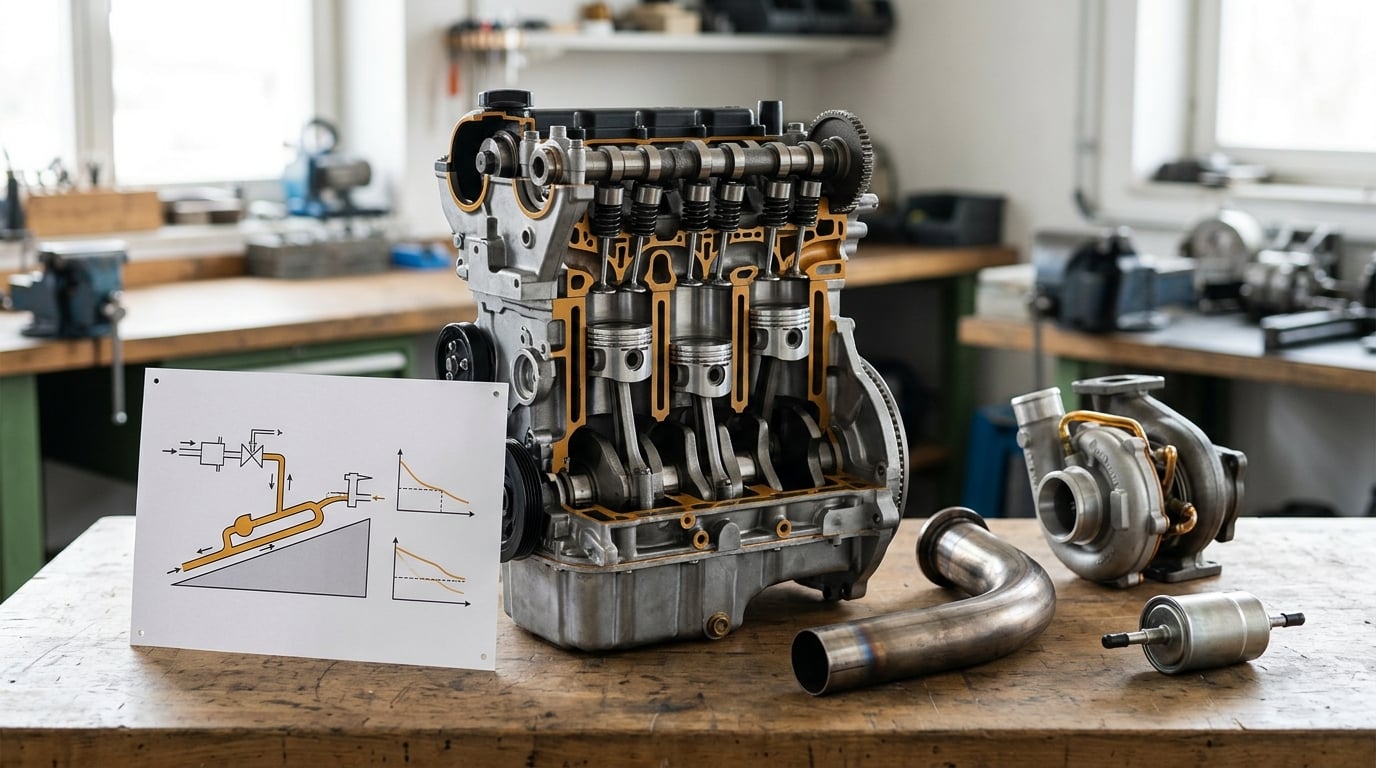
What causes a car to lose power going uphill? In most cases the engine is being asked for full output all at once, and the one marginal link in the chain — fuel supply, exhaust flow, ignition, or the drivetrain — gives up first. A hill does not break anything new; it just exposes what was already close to its limit.
That makes the symptom unusually useful. If your car pulls fine on the flat and dies on the climb, you are not looking for a dead engine. You are looking for something that fails under load, which narrows the search dramatically.
I have seen this pattern play out over and over, most often on older BMWs with a tired fuel pump or a catalytic converter that finally started holding back. A few checks separate the usual suspects without throwing parts at the car.
Table of Contents
- What Causes a Car to Lose Power Going Uphill?
- Gasoline Engine Causes
- Diesel and Turbocharged BMW Causes
- Fuel System and Ignition Problems
- Exhaust, Cooling, and Mechanical Failures
- Transmission or Torque Converter Symptoms
- Warning Signs That Mean You Should Stop Driving
- How to Diagnose the Problem Safely
- What Your BMW May Be Telling You
- Frequently Asked Questions
- What to Do First
What Causes a Car to Lose Power Going Uphill?
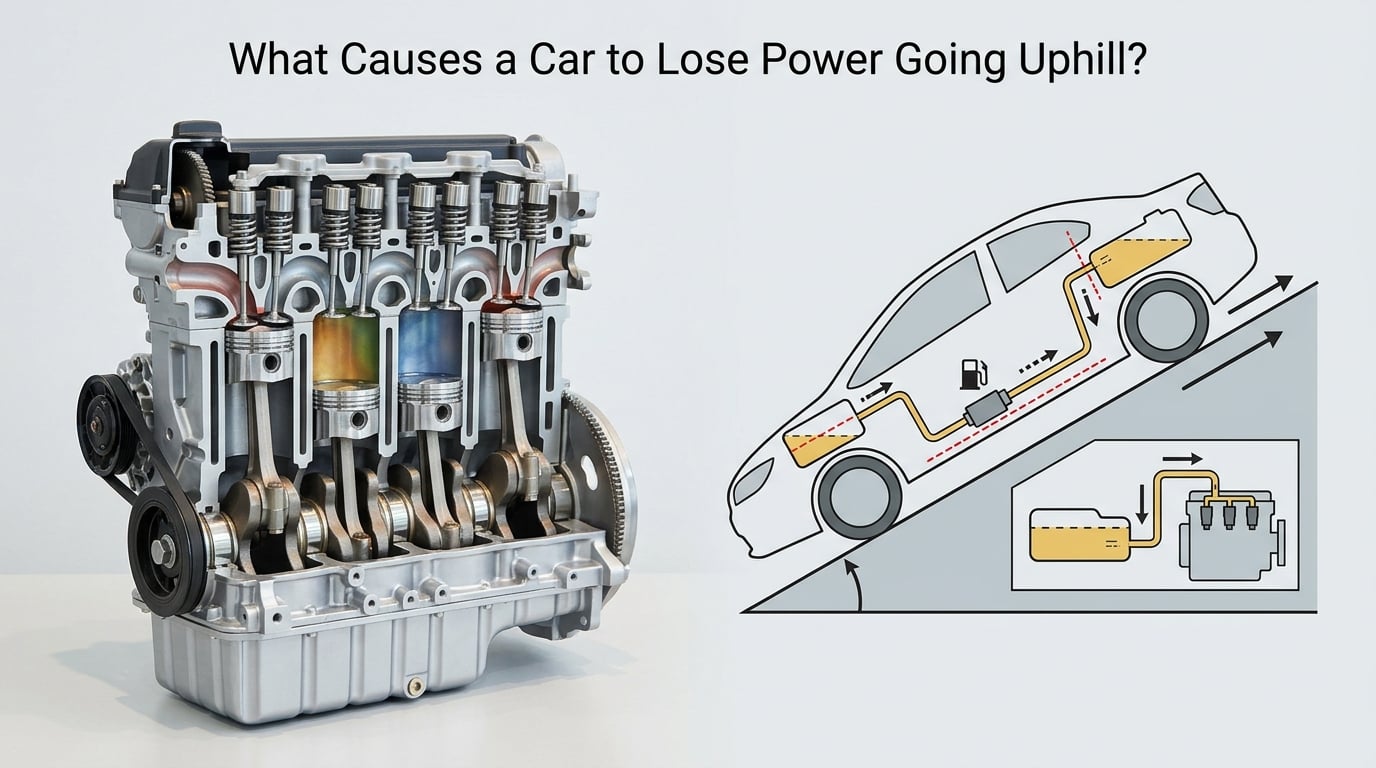
Short answer: the throttle opens wide, the engine demands far more fuel and air than it does while cruising, and the weakest link in the chain gives up. On a gasoline engine that link is usually the fuel supply, the exhaust, or the ignition. If the revs climb but the speed does not, the transmission or torque converter is the link instead.
| What you notice | Likely cause | How urgent |
|---|---|---|
| RPM drops, engine sounds flat, speed falls | Fuel starvation, ignition fault or exhaust restriction | Fix soon, drivable in the meantime |
| RPM flares high, speed stays low, no gear change | Transmission slip or torque converter issue | Fix soon, stop hard climbing |
| Stall under load, restarts and drives normally | Heat-soak fuel delivery fault or failing pump | Urgent if it happens suddenly |
| Power fine, cruise control drops speed on a long climb | Normal at full output, or weak cooling on sustained load | Monitor closely |
| Check-engine light flashing or solid, knocking or smoke | Misfire, running lean, or mechanical damage | Stop driving |
One important point before anything else: some of this is normal. A small engine, a loaded car, a hot day and a steep grade will use the air conditioning, the transmission and the engine at once, and plenty of honest cars simply run out of margin. The difference between normal and a fault is whether the car recovers cleanly and whether anything is warning you.
Gasoline Engine Causes
Weak fuel delivery under high load
A healthy fuel pump makes more pressure as throttle load rises, and a clogged filter or tired pump may manage that on the flat and fail on the climb. On many cars the pump is fed straight from the tank, so a hot tank or a low tank level can starve it too.
Ignition that quits under load
Plugs with worn gaps, ageing coils and leaking plug wires often hold up at idle and cruise but cannot keep a spark through a full-throttle climb. The tell is a stumble or hesitation that only appears when you ask for real power, sometimes with a flash of the check-engine light.
Restricted exhaust flow and backpressure
A catalytic converter or bent pipe that has partly blocked chokes the engine from the back side. The car feels slow but the engine is otherwise quiet and smooth, which is exactly why this one gets misdiagnosed for months.
Vacuum leaks, sensors and overheating
A cracked intake hose or a failing mass airflow sensor delivers less air than the engine thinks it has, so the mixture goes lean under load. Rising temperature adds its own penalty, and a cooling system that cannot shed heat on a long climb will bring power down on its own.
Diesel and Turbocharged BMW Causes
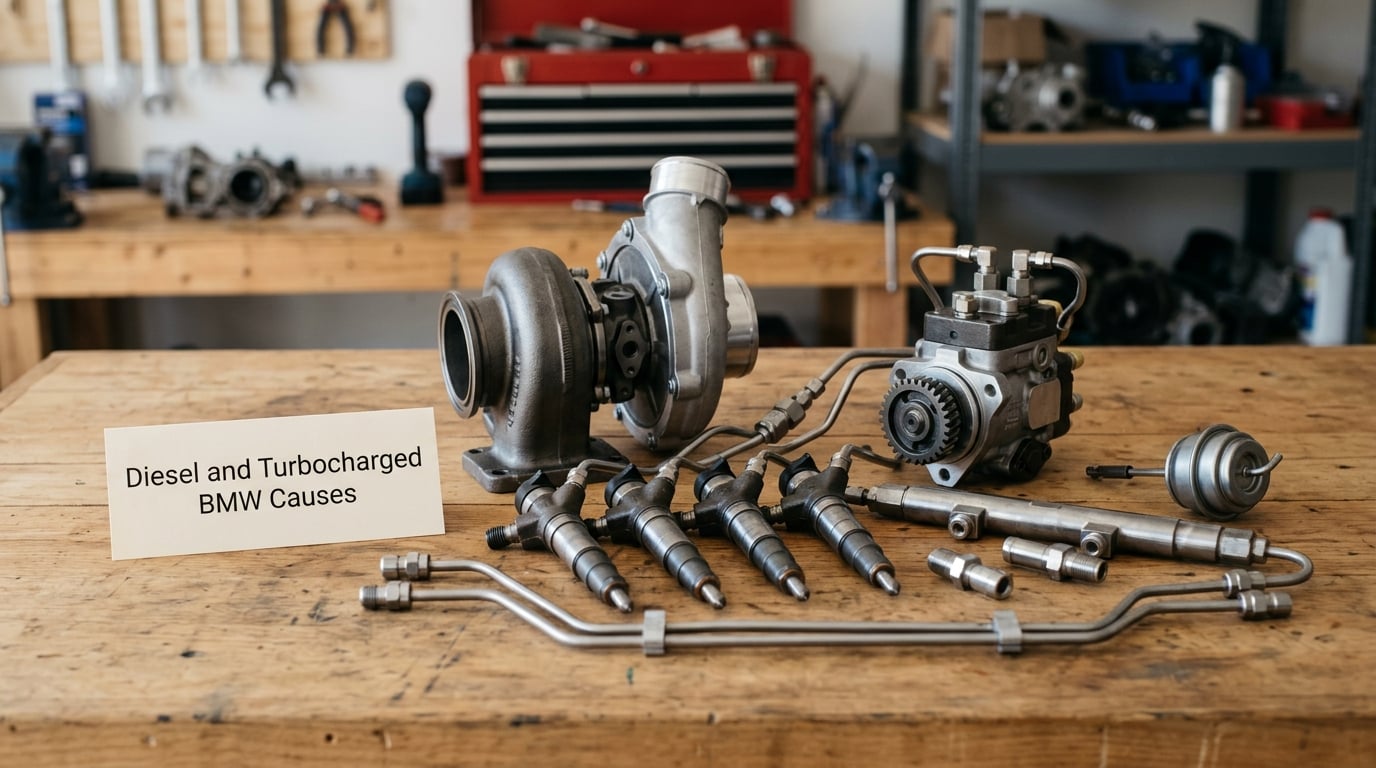
Diesel and turbo models fail differently under load, and the symptoms look more alarming because the power usually arrives suddenly once the fault clears.
- Turbocharger — a failed wastegate actuator, a sticking turbo or a cracked intake pipe lets the engine breathe and lose boost. You feel it as a surge or a sudden loss of thrust at higher revs, not a smooth taper.
- Boost control solenoid or valve — the engine may overboost, hit its limiter, or go to no boost. On many BMW diesels that reads as a power cut with a boost-pressure code rather than a dramatic failure.
- EGR cooler fouling — carbon builds up, the cooler leaks or sticks, and power drops under sustained load. Smoke from the exhaust and a heavy fuel smell on a cold start often come with it.
- Diesel particulate filter — a filter packed with soot from short trips and idle time slows exhaust flow badly. A regeneration cycle that never completes, strong smoke, and a stored efficiency code all point here.
- Injection issues — worn injectors or an over-fuelling event from a failed temperature sensor can produce smoke, shaking and power loss that appear only on a climb.
Diesels also tend to give you more warning than petrol engines: smoke, a glow plug light, a rattling turbo, or a code that describes boost or emissions rather than general misfire. A stalled gasoline engine and a stalled diesel should be diagnosed differently.
Fuel System and Ignition Problems
Fuel system faults are the single most common answer to what causes a car to lose power going uphill, so they are worth ruling out first. Many owners spend hundreds replacing spark plugs and sensors when the actual problem was a filter or a regulator the whole time.
- Clogged fuel filter — flow drops exactly when demand rises. Symptoms get worse with a low tank, and a pump drawing air can make the car recover after a ten-minute rest.
- Failing fuel pump — often near its limit on the flat, hopeless at full throttle. Look for a whining sound that changes pitch with engine speed, and check that the relay and connector are not simply corroded.
- Fuel pressure regulator — the classic symptom is a strong rich smell and black smoke on hard acceleration, because fuel is being dumped into an intake that is also taking more air.
- Dirty or leaking injectors — a dribbling injector can wash a cylinder wall and stop that cylinder firing under load, so the car runs smoothly and then shakes when you climb.
- Plugs, coils and wires — an engine that misfires only above a certain rpm has a weak ignition system. Pull a plug and read it: a fuel wash, heavy carbon, or a burnt electrode all point somewhere specific.
What you hear, smell and see narrows this down fast. A rich fuel smell means a pressure or injection problem. A sharp exhaust pop on lift-off means unburned fuel. A stumble at a set engine speed, regardless of load, points at ignition or a vacuum leak rather than fuel supply.
Exhaust, Cooling, and Mechanical Failures
A restricted exhaust is the fault owners argue about longest, because the car feels like it is simply weak rather than broken. A catalytic converter that has melted or shifted internally, a crushed pipe after a parking bump, or a plugged resonator will all do it, and the check is backpressure rather than guesswork.
Cooling problems show up the same way. On a long climb at sustained high load the engine needs more airflow over a radiator that is already warm, and a weak fan, a tired water pump, a failing thermostat or low coolant can pull power down before the temperature gauge reaches the red. Air conditioning adds to that, and towing a loaded car up a grade takes more cooling again.
Low oil pressure and internal mechanical wear are the serious end of the list. A knocking that deepens with rpm, metal in the oil or coolant, or a sudden clunk on a load change are not diagnostic exercises. Stop, shut it down and have it inspected.
Transmission or Torque Converter Symptoms
Watch the tachometer, because it tells you which system gave up in about two seconds. If the rpm falls or stays flat while the car slows, the engine itself is producing less power. If the rpm flares to the same high number on every hill while the speed stays low, the engine is fine and the torque converter or transmission is not holding.
That high-revving-on-climb signature came up repeatedly in owner reports, and it is one of the most useful clues an owner can capture before going to a shop. A transmission that slips under load will also shudder, take a moment to engage, flare on downshifts, or refuse to downshift at all on a steep grade.
Fluid level and condition are worth checking first, because a low or burnt transmission is cheap to find and expensive to ignore. Heat degrades friction material, and a slipping clutch is what wears it out. If the fluid smells burnt, has metal particles, or the dipstick shows a level below the cold mark, stop climbing and get it looked at properly.
On a manual car, a bogging engine feels different again: the clutch stays engaged, the revs drop, and releasing the clutch mid-pull on a grade is a firm test for whether the engine or the drivetrain is at fault.
Warning Signs That Mean You Should Stop Driving
Pull over safely, engine off, and treat these as hard stops rather than items for the weekend list.
- A flashing check-engine light, which means a severe misfire is dumping unburned fuel into the exhaust and can wreck a catalytic converter fast.
- Temperature climbing into the warning zone, or a strong sweet coolant smell with a falling level.
- A fuel smell, pooling liquid under the car, or dripping fuel.
- Loud knocking, grinding or clunking that changes with rpm or load.
- White, blue or thick black smoke from the exhaust under load.
- A stall at speed, on a ramp, or anywhere you cannot safely restart.
- Any sudden change in how the brakes feel, or a brake pedal that goes hard and firm.
If any of those appear on a grade, get to the nearest flat shoulder or turnout in the nearest safe way, switch off, and call for a tow. A car that loses power on a blind mountain bend is a far bigger risk than the repair.
How to Diagnose the Problem Safely
Work in this order. Each step is cheap and rules out whole categories, and stopping as soon as the symptom disappears keeps you from replacing parts that were never involved.
- Read the owner’s manual and note the conditions. Write down the grade, the outside temperature, the fuel level, whether the air conditioning was on, whether a trailer was attached, and how long the car had been running.
- Scan for codes, including pending and stored history. Look at the short trip and the O2 sensor tests, not just the headline code. Also check freeze-frame data, which records load and rpm at the moment the fault was set.
- Look at the fuel and fluid levels. Confirm the fuel tank has a proper fill, the oil is at level and not gritty, the coolant is topped up, and the transmission fluid is between the cold marks. A water-contaminated tank or a thirsty cooling system explains a lot.
- Inspect what you can safely see. Air intake hoses and clamps, vacuum hoses around the intake manifold, the fuel line, exhaust hangers and visible pipes, and anything hanging off the underbody.
- Watch rpm, smoke and sound during the next climb. Falling rpm means the engine. Rising rpm that will not translate into speed means the transmission. A stumble that repeats at a fixed rpm means ignition or a vacuum leak.
- Let a technician handle the loaded tests. A fuel pressure test under load and an exhaust backpressure measurement at an upstream sensor port both need a gauge, a helper and a way to read the result properly. Doing these cold tells you nothing, because the faults only show under load.
Owner-doable checks are the dipstick, the scan tool, the visual inspection and the rpm test. Backpressure, fuel pressure under load, transmission line pressure and compression checks belong in a workshop. Knowing which is which saves you both money and a wasted afternoon.
What Your BMW May Be Telling You
BMW electronics are good at describing their own symptoms, but a code is a report, not a diagnosis. A fuel or exhaust code tells you a system saw something outside its expected range; it does not name the failed part.
Separate three things on the scan tool. Stored history is a fault from a previous drive. Pending codes are conditions counted but not yet confirmed. Live data is what the sensors read right now, and on a load-dependent fault that is the only one that settles the argument.
Watch calculated engine load, the fuel trim percentages, and short-term versus long-term trims. Sustained positive trims mean the engine is adding fuel to compensate for something lean, which points to a vacuum leak, a weak fuel pump under low pressure, or a dirty mass airflow sensor. Watch lambda values before and after the hill: a sensor that only misbehaves under load is the useful one.
On diesel models, read boost-requested against boost-actual and note turbocharger speed. A healthy system reaches its target quickly. On petrol models, check whether the O2 sensors are switching as they should or sitting still, since a lazy sensor can be mistaken for a mixture problem that is not there.
One more BMW habit worth knowing: after clearing codes, the adaptive values reset and the car may run slightly differently for a short drive. If you clear a code and the symptom is genuinely gone, drive normally and check again after a full cycle. If it comes back, the code is a real clue and worth reading properly.
Frequently Asked Questions
Is it normal for a car to lose some power going uphill?
Some loss of acceleration is normal. A climb plus a loaded car, hot weather, air conditioning and a steep grade can use up the engine’s remaining margin, especially on a small-displacement or older model. The car should still pull smoothly and recover at the top. If it bogs, hesitates, misfires, runs rough or stalls, that is a fault rather than a limitation.
Why does my car only lose power on steep hills?
Because hills are the only time your engine is asked for full output. Fuel supply, exhaust flow, ignition and cooling components all sit comfortably at cruising load and reach their limit on a climb. A part that is only slightly worn handles the flat fine and gives up at maximum demand, which is why the fault is hill-specific and often intermittent.
Can a clogged catalytic converter make a car lose power uphill?
Yes, and it is one of the most commonly missed causes. A blocked honeycomb chokes the engine from the exhaust side, so it feels weak and slow even though the engine sounds smooth and runs without warning lights at low rpm. The check is a backpressure measurement taken at an upstream oxygen sensor port while the engine is at high load, not a road test alone.
What does it mean if the engine stalls when I accelerate uphill?
It means the engine lost the ability to sustain combustion under load, so it is a serious symptom rather than a comfort issue. Common causes include fuel starvation, a severe misfire, a vacuum leak that goes lean, or overheating. A stall that happens suddenly at speed should end the drive, and a stall that only repeats on grades needs a load test in a workshop.
Should I drive uphill if my check-engine light is on?
A steady light usually means a fault is stored and the car is running in a reduced mode, so driving is possible but power may be limited. A flashing light means a severe misfire and can destroy a catalytic converter quickly, so stop driving and have it checked. Steep climbs put the most load on the weakest parts, so avoid them until the code is read and cleared properly.
What to Do First
Start by writing down when the power loss happens: which hill, what the temperature and fuel level were, how long the car had been running, whether the air conditioning was on, and what the tachometer was doing. That single note saves a technician a lot of guessing and helps you notice whether the fault is heat related.
Then scan for codes and pending codes, check the oil, coolant, transmission fluid and fuel level, and inspect the air intake hoses and visible exhaust for damage. Watch the rpm on the next climb to decide whether the engine or the transmission gave up. If warning lights, smoke, knocking or a stall show up at all, leave the driving to a tow truck.
For confirmed mechanical, fuel-system or exhaust faults, have a qualified technician run the loaded tests that a driveway cannot reproduce. That is the whole answer to what causes a car to lose power going uphill: find the flow that fails under maximum demand, and you have found the fault.