
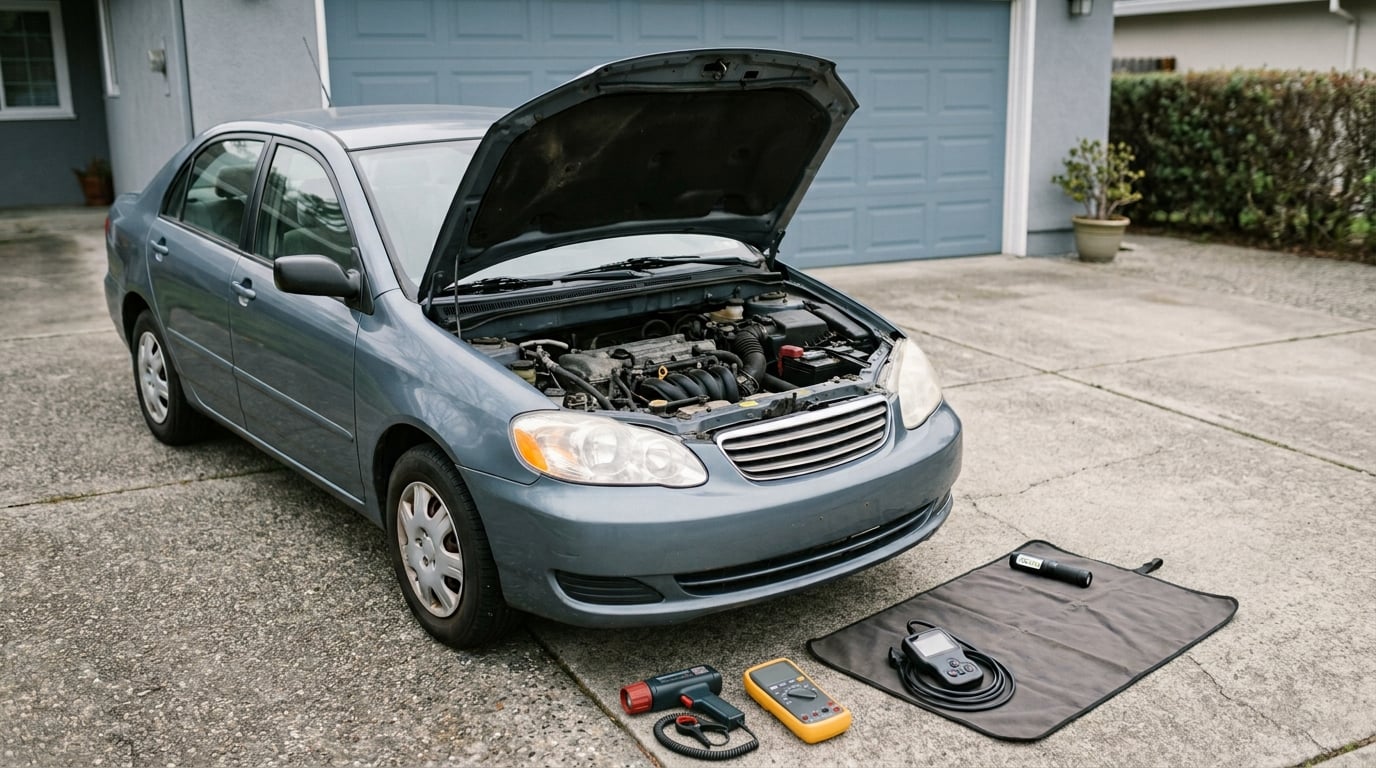
A car hesitates on acceleration when the engine isn’t getting the right mix of air, fuel and spark at the exact moment you ask for power. The pedal goes down, the engine balking pause lasts a beat, and then it pulls like nothing happened. That pause is a symptom, not a diagnosis, and it usually traces back to one of five systems: fuel delivery, air intake, ignition, the computer’s throttle control, or the exhaust.
Before you read further, one safety note. If the check engine light is flashing rather than steady, stop driving the car and get it looked at. A steady light with a small stumble is a different conversation from a flashing light with a hard stumble, and the second one burns through a catalytic converter in minutes.
Table of Contents
- What Does Acceleration Hesitation Mean?
- Common Reasons a Car Hesitates on Acceleration
- Fuel-System Problems That Can Cause Hesitation
- Ignition Problems That Interrupt Engine Power
- Sensors, Computer Controls, and Hesitation
- Exhaust and Mechanical Issues to Check
- How to Diagnose the Problem Safely
- When to Stop Driving and Get Help
- Frequently Asked Questions
- Conclusion: Start With the Symptom Pattern
What Does Acceleration Hesitation Mean?
Acceleration hesitation is a delayed response between your foot and the engine. You ask for power, the engine takes a half-second to answer, and sometimes it answers in stages rather than all at once.
It is worth separating from four similar complaints, because each one points somewhere different. Stalling is the engine dying and restarting, usually a fuel or charge problem. Surging is the car speeding up and slowing at a steady pedal position, which is usually air or fuel metering. Rough idle is present when the car is parked, and it says more about vacuum, plugs or injectors than about throttle response. Bucking or jerking is rhythmic, a repeated hitch rather than a single pause, and it is often a misfire or a transmission problem rather than hesitation.
There is one more distinction that saves people real money. Some hesitation is programmed. Modern engines have a throttle body, a pedal sensor and a torque manager, and the factory calibrates a deliberate pause into software for traction, transmission protection and emissions. A light, smooth, repeatable half-beat that shows up every single time is often the calibration doing its job. Hesitation that comes and goes, that arrived with a mileage, or that shakes the car is not calibration. That is the difference between a drivability setting and a fault.
Common Reasons a Car Hesitates on Acceleration
These five buckets cover nearly every case, and they are in the order worth working through.
- Fuel delivery. A tired lift pump, a clogged filter, a blocked fuel rail pickup or dirty injectors cannot supply the sudden extra demand a throttle opening creates. You feel it as a stumble from a stop or a bloat when passing.
- Ignition under load. Worn plugs, a weak coil or a corroded plug wire can fire reliably at idle and fail when cylinder pressure climbs. The tell is a hard stumble at high demand.
- Air intake and vacuum. A cracked intake manifold gasket, a loose throttle body or a bad brake booster hose adds air the computer never asked for. The mixture goes lean and the engine corrects late.
- Sensors and electronic throttle control. A contaminated mass airflow sensor, a failing throttle position sensor or a pedal sensor telling the computer the wrong thing can delay the response by a fraction of a second.
- Transmission, exhaust or mechanical wear. Low compression, a restricted catalytic converter, a slipping gear or a torque converter that won’t lock up all look like a lack of power from the driver’s seat.
How to Tell the Difference by the Symptoms
The single most useful thing you can do is describe when it happens. Timing narrows ten possible causes to one or two faster than any part name.
| When it hesitates | Look here first |
|---|---|
| Only on a cold start, clears once warm | Coolant temperature sensor, cold-start fuelling, or a leak that only shows when the rubber is cold and stiff |
| From a stop, roughly 0 to 15 mph | Throttle body carbon, accelerator pedal or throttle position sensor, ignition at low speed |
| Only when you floor it, passing or climbing | Fuel delivery under load: pump, filter, pickup, injectors |
| At every speed, with a rough or hunting idle | Vacuum leak or unmetered air, dirty mass airflow sensor | At one specific engine speed, whatever the road speed | RPM-dependent: ignition under load, knock retard on low-octane fuel, a vacuum leak that opens up at that pull |
| Revs climb but the car stops gaining speed | Transmission, torque converter or clutch rather than the engine |
| Straight after a battery disconnect, throttle body clean or software reflash | Uncompleted throttle position relearn, not a failed part |
Owners working on their own cars in the r/mechanic and r/Cartalk threads tend to get stuck once because they search by part name instead of by moment. One thread there described a stutter that appeared at a set engine speed rather than a set road speed, which is a different fault entirely from a stumble that shows up in traffic. Another owner had already cleaned grounds, checked the variable valve timing filter and wiggle-tested the wiring while the engine idled, and was still stuck. If the cheap checks are done and it persists, the answer is usually a measurement, not another part.
Fuel-System Problems That Can Cause Hesitation
An engine at part throttle is asking for a modest amount of fuel. Stamp on the pedal and the same hardware has to deliver several times that within a fraction of a second, and anything marginal shows itself right there.
The usual suspects start with the fuel filter and the lift pump inside the tank. A filter that has collected debris can starve the system under load while still supplying enough at idle. So can a pickup sock that has partially blocked, or a pump that has worn and can no longer maintain pressure at the rail. Where the engine has a fuel pressure sensor, a code like P0087 or P0191 tells you the computer saw the pressure fall away from target.
Injectors fail in a subtler way. Carbon and varnish build up around the pintle, so the injector delivers slightly less than commanded and the computer has to trim fuel up to compensate. That works fine until the trim runs out of room, which is typically at a wide-open throttle. A balance test on a bench, or swapping two injectors and seeing whether the stumble moves cylinder, settles the question quickly.
Two more causes catch people out. A tank running below a quarter can starve the pickup on a badly shaped tank, and a tank full of water or the wrong fuel will do the same thing after a fill-up. Then there is octane. On an engine that knocks, low-octane fuel makes the computer pull spark timing to prevent damage, and the moment timing is pulled at low load you get a soft, mushy pull-away from a stop. That one is genuinely under-served by most advice and comes up again and again in owner threads.
Plenty of this is checkable without cracking anything open. Read the fuel trims: a large positive correction at idle means the engine is adding fuel to correct a lean condition, and a big correction at 2,500 rpm in neutral suggests a vacuum leak rather than a fuel restriction. Watch the fuel gauge and compare it to a full tank. Listen to the lift pump at key-on; a silent pump or a whine that fades after a second is a clue. Actual pressure testing is a job for a gauge on the test port, and the fuel system on a modern car is pressurised, so that part belongs to a shop unless you have the equipment.
Ignition Problems That Interrupt Engine Power
Yes, a bad spark plug can absolutely make a car hesitate on acceleration, and it is one of the more common answers.
The reason comes down to physics. When the piston is high in its stroke under hard acceleration, cylinder pressure rises, and pressure is an electrical insulator. The voltage a coil has to push through to make a spark jump goes up with it. A plug with worn electrodes, a widened gap or fouled deposits may fire all day at idle, where pressure is low and the coil has margin, and then fail at the moment you merge onto the highway. If your ignition is coil-on-plug, the same reasoning applies to the coil itself, and a coil that is weak gets worse as it heats up.
Misfires are the symptom the computer sees. Random misfires across the engine set a P0300, a misfire on a specific cylinder sets P0301 through P0308, and Mode $06 misfire counters on a scan tool show which cylinder lost the most combustion events. A knock or a mechanical noise, a plug with a black oily deposit, a plug that looks melted or blistered, or a plug gap that measures nothing like the specification are all worth a look.
The coil swap is the cheapest decisive test there is. Move one coil to a different cylinder, clear the codes, drive the same road. If the stumble follows the coil, that coil was the problem. If the code simply follows the cylinder, the problem is the plug, the injector or that cylinder’s compression. It costs nothing and it stops people from buying a full set of coils on suspicion.
Sensors, Computer Controls, and Hesitation
On a modern car the pedal is a sensor, not a cable. Pressing the accelerator moves the pedal position sensor, the engine computer decides how far to open the throttle body, the mass airflow sensor measures the new air, the injectors add fuel and the spark is advanced. Hesitation happens when one of those steps is late, short or wrong, and the codes tell you which one.
A mass airflow sensor that has picked up oil from an aftermarket air filter reports a lower-than-real air volume. The computer then gives less fuel than the engine needs, sees the oxygen sensor complain, and corrects in steps, and that correction is the hesitation. A throttle position or pedal sensor with a dead spot, or two of them disagreeing with each other, produces the classic sets a P0120 through P0124 or the P2135 to P2138 correlation range. A failed oxygen sensor or a leaking one ahead of the converter feeds the computer a flat signal and it falls back to a fixed fuel table, which feels like a stumble under load.
Read the trims as a pair, not a single number. Small trims under ten percent across the board means the engine is happy. Large positive short-term trim at idle that shrinks at 2,500 rpm points to a vacuum leak. Large trims at both points points more toward a weak fuel supply or a sensor. Wire and ground faults produce the same symptom as a failed sensor and cost a fraction as much to find, so check the connectors before condemning anything.
One pattern deserves its own mention: hesitation that started right after a service. Disconnecting the battery, cleaning the throttle body, replacing the accelerator pedal or flashing the software all reset the throttle position relearn. Until that relearn runs through its cycles, the computer guesses where the closed throttle is, and you get exactly this symptom. A scan tool or a dealer will run the idle and throttle relearn procedure, and the problem disappears without a single part being bought. Several owner threads describe precisely this, and the instinctive reaction to buy a part here is exactly how people waste money.
Exhaust and Mechanical Issues to Check
The exhaust has to be able to move the gas out. A catalytic converter that has melted inside, a crushed pipe or a blocked muffler raises backpressure, and the engine cannot breathe at high flow. You will notice it most when you ask for high RPM, on a long uphill or at wide-open throttle, and it is often accompanied by a hot catalytic converter or a sulfur smell.
A leak before the oxygen sensor is a different problem with a similar feel. Air escaping before the sensor is an unmetered air leak, the sensor sees a leaner exhaust than reality, and the computer adds fuel it does not need. A hissing noise that rises and falls with engine speed, a hole visible under the car, or a hissing brake booster that goes quiet when the brake is released are all quick checks. An exhaust leak after the sensor is mostly a noise problem and usually does not affect power.
Low compression does the same thing from the mechanical side. Worn piston rings, a tired valve seat or a head gasket leak means less of the fuel you paid for actually burns on the power stroke, so the same pedal produces less acceleration. Transmission and driveline faults get mistaken for engine hesitation too. A slipping clutch, a torque converter that stays in flare, a gear that takes a moment to engage or a worn U-joint all feel like a power-delivery problem from the seat. If the revs climb and the road speed does not, the engine is fine and the problem is behind the transmission.
How to Diagnose the Problem Safely
Work in order. Most people who get this wrong start at the end with the most expensive part, and the expensive part is rarely the fault.
- Write the symptom down before you touch anything. Cold or warm, from a stop or at speed, light pedal or full, and at what engine speed. Also note whether it only appears under load, whether the check engine light is on, and whether anything happened just before it started.
- Read the codes, both stored and pending. An OBD-II scanner is the highest-value ten minutes you can spend, and a pending code is often the one that set the light you are looking at. Clear the codes, drive until it returns, and read them again.
- Look at the obvious things. A loose or disconnected intake hose, a broken throttle body link or gasket, a wire with a chewed section near the hinge, oil or a dead bug nest around a mass airflow element. The airflow comes through these and they cost nothing to inspect.
- Listen for unmetered air. With the engine running, a hose off the throttle body that hisses, or a brake booster that hisses until you touch the pedal, points straight at a vacuum leak. A smoke test on a low-pressure smoke machine finds the small ones, including intake manifold gasket leaks that no hiss will reveal.
- Compare the fuel trims at idle and at 2,500 rpm. Most scan tools show both. The difference between the two readings separates a vacuum leak from a fuel supply problem, and that one measurement saves hours.
- Do the coil swap and a visual plug check. Free, fast, and it either finds the misfire or rules ignition out.
- Hand over a fault the technician can reproduce. This is where most attempts fail. Shops regularly write off an acceleration hesitation as no fault found because the car behaved perfectly on the test drive. Tell the technician the road, the speed, the pedal pressure, the engine speed and the temperature. Note the time of day and whether it happens on the first drive of the morning, and offer to bring the car back on exactly that drive.
Follow the owner’s manual for anything involving the fuel system, the throttle body or the battery, and note that the same diagnostic sequence works on a 2026 model as it did twenty years ago. Pressed pedal sensors, coil-on-plug ignition and a scan port are the norm now, so this is not a car-specific skill. If the diagnosis needs a lift, a fuel pressure gauge, a smoke machine or an oscilloscope, that is the point to hand it to a qualified technician rather than push a car up a driveway ramp.
When to Stop Driving and Get Help
Some hesitation is a drivability complaint. Some of it is a safety problem, and the difference is worth being blunt about, because hesitation shows up exactly when you are merging into a gap or completing a pass.
Stop driving and arrange service if any of these apply. The check engine light is flashing rather than steady. You can smell fuel, raw gasoline or burning plastic. There is smoke, blue or white, from anywhere other than a cold start. The temperature gauge climbs and stays up, or you see coolant under the car. The engine misfires hard enough to shake the car, which means unburned fuel is heading into the converter and can destroy it in a very short drive. You lose steering or braking, feel the transmission surge, or the engine cuts out suddenly while moving.
A steady check engine light with a small stumble is not in that list. That is a scheduled repair, not an emergency, and a careful drive to a shop is reasonable. The missing half-second of response is the real everyday risk there, so leave more following distance than you would normally, and do not plan to make the gap on a two-lane road until the car is fixed.
Frequently Asked Questions
Can a bad spark plug make a car hesitate on acceleration?
Yes, and it is one of the most common answers. When you demand power, cylinder pressure rises and the voltage needed to make the plug fire goes up with it. A plug with worn electrodes, a widened gap or fouled deposits may spark reliably at idle and fail under load, which shows up as a stumble or a buck during hard acceleration. Misfire counters in Mode $06 and a P0300-family code confirm it.
Why does my car hesitate only when I press the gas hard?
Because hard throttle is the only condition that asks the fuel and ignition systems for everything at once. At part throttle a tired pump, a plugged filter or a weak coil can still keep up. At full demand they run out of margin and the engine briefly gets too little fuel or spark. A stumble that appears only under load, or only above one set engine speed, points toward fuel delivery or ignition rather than sensors.
Is acceleration hesitation the same as a transmission problem?
No, and confusing the two costs a lot of money. Engine hesitation is a pause before the revs climb, with the engine balking. Transmission slip feels like the engine revving normally while the car stops gaining road speed, often with a shudder at a shift point. Watch the tachometer during the stumble. Stalled or falling revs point at the engine, rising revs with no road speed point at the transmission.
Should I drive if my car hesitates but has no warning light?
Usually, at a gentle pace, and only after you have read the codes. A steady check engine light with a small stumble is a scheduled repair rather than an emergency. Stop driving if the light flashes, you smell fuel or burning plastic, you see smoke, the temperature climbs, or the engine loses power suddenly. Those point to a severe misfire or a fuel leak that can destroy the catalytic converter in minutes.
How do I find out why my car is hesitating?
Start by writing down when it happens: cold or warm, from a stop or at speed, light pedal or full, and at what engine speed. Then read the stored and pending codes with an OBD-II scanner. That timing plus the code set usually narrows ten possible causes down to one or two. After that, a vacuum leak check, a pair of fuel trim readings and a coil swap separate the rest without guessing at parts.
Conclusion: Start With the Symptom Pattern
If you are asking what causes a car to hesitate on acceleration, the honest answer is that it is a power-delivery problem, and the power has to travel through air, fuel and spark in the right ratio at the right instant. Which of the three failed is the question, and the symptom timing answers it faster than any guess.
So do this first. Write down when the hesitation happens, whether the light is on, and whether anything changed just before it started. Read the codes, including the pending ones. Then work through the cheap causes in order: vacuum and intake leaks, the mass airflow sensor, the trims at idle versus at 2,500 rpm, the plugs and a coil swap, and finally fuel pressure and the exhaust. Most owners who get a quick answer stop within a handful of those steps, and most owners who get an expensive answer started at the wrong end.
One last thing worth repeating. If the pause feels perfectly repeatable, smooth and identical every single time, your car’s torque management may simply be built that way. If it arrived with a mileage, shakes the car, or varies from one drive to the next, that is a fault worth chasing down rather than getting used to.