
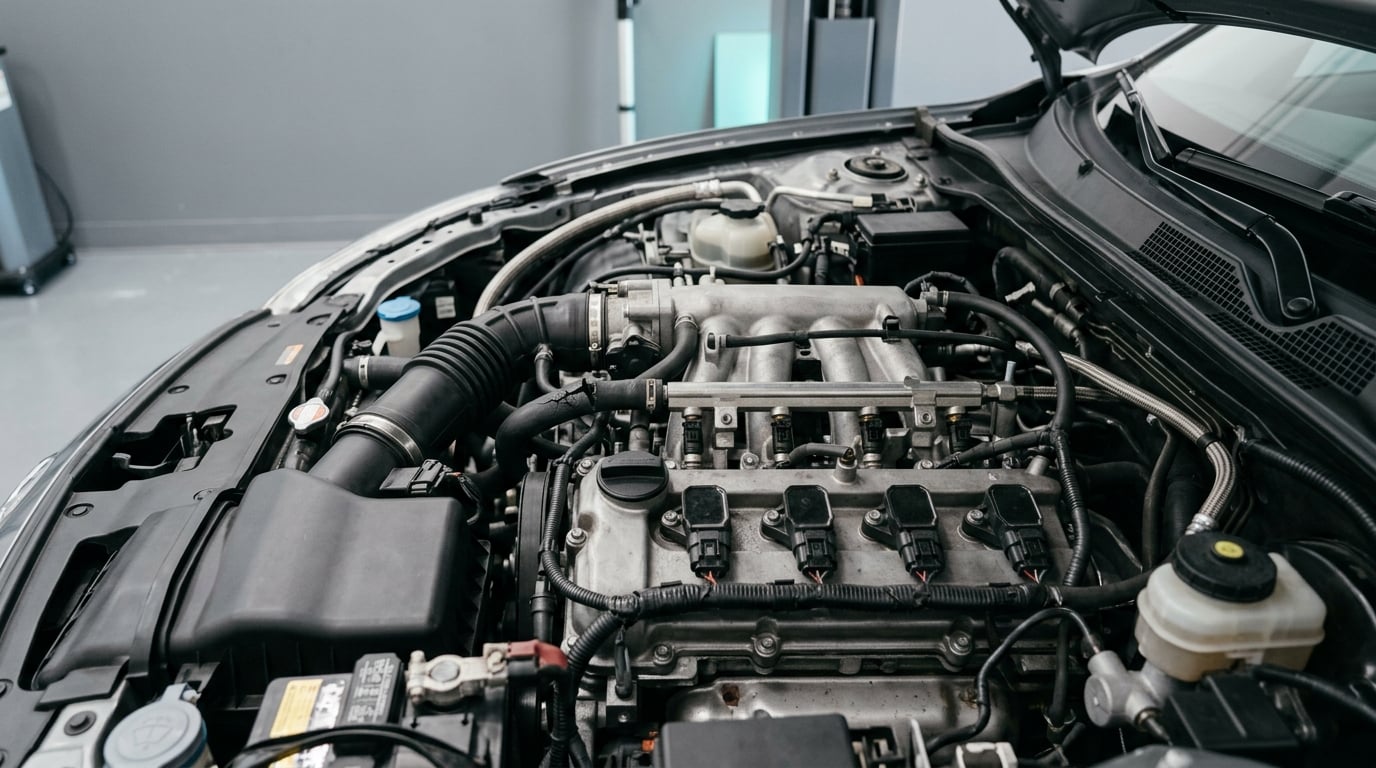
A car stalls at idle because the engine can no longer hold the right balance of air, fuel and spark once your foot comes off the accelerator. At idle the throttle plate is nearly shut, so the engine is running on the smallest amount of air it will ever breathe and has almost no margin left. Something in the intake, the fuel system, the ignition or the sensors that report engine speed is drifting out of spec, and at that point the engine quits.
Idling is genuinely the least forgiving thing a car does. Under load at 2,000 rpm the engine has plenty of air, fuel and ignition energy to spare, so a marginal part hides. Drop to idle and the same marginal part is the difference between running and dying. That is why idle stalls cluster around a small set of components, and why the fix is usually a hose, a cleaning job or a sensor rather than an engine rebuild.
Here are the ten culprits behind most idle stalls, written so each one stands on its own.
- Dirty throttle body – Carbon builds up on the throttle plate and bore so the idle air bypass no longer meters the extra air the engine needs at rest, and idle RPM wanders or drops to zero.
- Failed idle air control valve (IAC) – The valve that meters idle air sticks, seizes or is out of adjustment, so the engine gets too much or too little air when the throttle is closed.
- Unmetered air from a vacuum leak – A cracked intake manifold gasket, perished brake booster hose or disconnected PCV line pulls air in that the engine computer never sees, so the mixture goes lean exactly when it is thinnest.
- Mass airflow or manifold pressure sensor fault – The MAF or MAP sensor reports the wrong amount of air, and the computer trims fuel to match a number that was never real.
- Weak fuel pump or clogged fuel filter – Low fuel pressure starves the injectors at low RPM, because the engine needs a higher pressure to keep flow steady when it is barely turning.
- Dirty or leaking fuel injectors – Injectors that do not spray correctly deliver too little, too much or uneven fuel, and the engine cannot idle smoothly on an uneven supply.
- Worn spark plugs or failing ignition coils – A weak or missing spark is easy to tolerate at 2,000 rpm and fatal at 600 rpm, where there is less energy left to complete the burn.
- Crankshaft or camshaft position sensor fault – The engine computer loses track of where the crank is, cuts or retards the spark, and the motor shuts down at low speed.
- Electrical ground or charging fault – Corroded grounds, a tired alternator or a battery that sags under load cause the same symptom as a fuel fault, and the stall often comes with a battery or charging light first.
- Transmission or clutch drag – A dragging torque converter in an automatic, or a clutch that never fully releases in a manual, loads the engine so heavily at idle that it stalls.
Almost none of these produce a random failure. A car nearly always dies in a repeatable pattern, and finding that pattern is most of the diagnosis. Write down when it happens before you read any further, because the step-by-step sequence later in this guide is the version most owners end up using.
Table of Contents
- What Causes a Car to Stall at Idle?
- How to Tell Which Idle-Stall Problem You Have
- Air-Intake and Mixture Problems That Cause Idle Stalls
- Why some stalls happen only when you press the brake
- Ignition Problems That Make the Engine Stall
- Fuel-System Faults That Cause Idle Stalling
- Sensor, Electrical, and Computer Failures
- Why Some Cars Stall Only When They Warm Up
- A Safe Step-by-Step Diagnostic Process
- Common Mistakes That Make Idle Stalls Hard to Diagnose
- When Is an Idle Stall Serious Enough to Stop Driving?
- Frequently Asked Questions
- Can a car stall at idle because of a vacuum leak?
- Why does my car stall when I release the gas?
- Should I replace the idle air control valve first?
- What does it mean if my car stalls only when it is warm?
- Is it safe to drive a car that repeatedly stalls at idle?
- Can a dirty throttle body cause intermittent stalling?
- What to Check First
What Causes a Car to Stall at Idle?
Ask any mechanic the question and you will usually get the same short list back: the throttle body, the idle air control valve, a vacuum leak, an airflow sensor, fuel delivery or ignition. That is not a dodge, it is genuinely the answer nine times out of ten. The reason those six lead is that they all sit on the critical path for holding idle speed, and every one of them has a way to fail quietly.
Why idling is where weak parts give up
At 2,500 rpm an engine sweeps a lot of air through the cylinders and the spark has plenty of margin. At idle it is drawing the bare minimum, and the computer is constantly trimming fuel to hold a target speed. A component that is 10 percent off does not matter at speed and will not let the engine idle.
That is also why stalling in traffic keeps happening. The stall does not appear on the motorway, where everything has margin. It appears at the stoplight, at the give-way line, in park, and in neutral, which is where you spend most of your time and where a stall is most dangerous.
One more thing worth saying plainly: intermittent idle stalls almost always get worse. Nothing on this list fixes itself, so an engine that stumbles once a week in the rain is telling you something, not being quirky.
How to Tell Which Idle-Stall Problem You Have
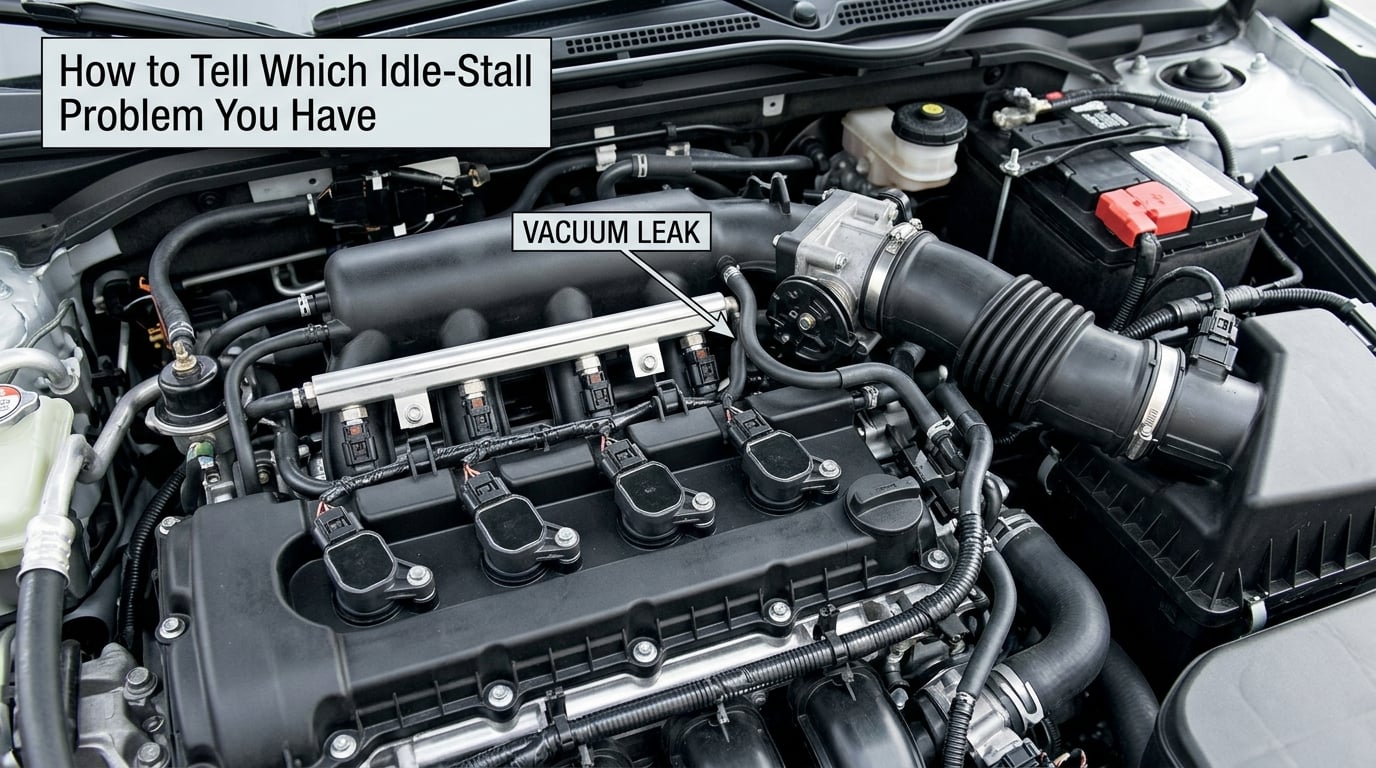
Start by writing down the pattern, not the cause. Whether the stall happens cold, hot, under braking, with the air conditioning on or while shifting gears tells a mechanic more than any guessing at parts does, and it costs you nothing to observe.
Drive the car twice and note which of these it matches. Cold-only means something that works once warm has failed, such as a leaking injector or a marginal coil. Braking-only almost always means the brake booster vacuum hose. Load-only, when the air conditioning kicks in, points to a mechanical drag rather than a mixture problem.
| What you notice | Most likely cause | Quick check |
|---|---|---|
| Stalls the moment you come to a stop, every time | Vacuum leak or dirty throttle body | Listen for a hiss with the engine idling; inspect the intake and PCV hoses |
| Stalls only when you press the brake | Brake booster hose or diaphragm leak | Inspect the large hose running from the intake to the brake booster |
| Rough idle, check engine light on, stall when you lift off | Mass airflow sensor or throttle position sensor | Read stored codes and live sensor data with a scan tool |
| Idles high, hunts up and down, occasionally dies | Dirty throttle body or idle air control valve | Look for carbon around the throttle bore and the IAC passages |
| Fine for weeks, then dies at idle and cranks but will not fire | Fuel pump, fuel filter or fuel pressure loss | Listen for the pump prime when the key is turned; check the fuel light and gauge |
| Stalls only when the air conditioning switches on | Compressor clutch or excessive refrigerant | Watch the clutch engage at idle and note any sudden RPM drop |
| Stalls when selecting drive or reverse, jerks in traffic | Torque converter or clutch drag | Compare the stall in park against the stall in gear |
| Battery or alternator light on before the stall | Charging system or poor ground | Measure voltage across the battery terminals with the engine running |
That table is the fastest route to a useful answer because it starts from an observation you can make for free, then narrows the search instead of widening it.
Air-Intake and Mixture Problems That Cause Idle Stalls
The throttle body sits at the front of the intake and is responsible for the smallest detail in driving: how much extra air gets past a nearly closed plate. That job is why idle faults cluster there, and it is also why a dirty throttle body is the first thing most people try.
Carbon accumulates around the bore and the plate over tens of thousands of cycles. The passage the idle air travels through narrows, the idle creeps upward, and the mixture gets progressively richer until the engine stumbles or stalls. On cars with a separate idle air control valve, the same carbon builds on the valve and its passages, and a valve that cannot move freely either chokes the idle or floods it.
Symptoms to watch for: a rev counter that drifts up and down, a rough idle that never settles, and a dip in RPM every time you lift off the gas. The check is a look at the throttle bore and IAC area for a black, greasy film.
Airflow sensors fail in a similar way. A mass airflow sensor with a contaminated hot-wire element under-reports, the computer then commands less fuel than the engine needs, and the engine runs lean and dies at idle while you coast. A manifold absolute pressure sensor has a similar effect through a different measurement. A throttle position sensor that drifts or fails outright leaves the computer with no idea whether you are on or off the gas, which is fatal at rest.
Why some stalls happen only when you press the brake
When you press the brake pedal, the brake booster diaphragm uses engine vacuum to give you power assist. On most cars that vacuum comes through one large hose from the intake manifold, and the diaphragm is holding engine vacuum to keep the pedal assistance up.
If that hose cracks, or the diaphragm tears, the vacuum bleeds away as soon as you brake. The leak is unmetered, so the engine suddenly gets extra air, the mixture goes lean, and the engine dies right as you slow down. Owners describe this one constantly: stalls only when braking, at junctions, whenever the pedal goes down.
The fix is usually a hose and a clamp, which makes it one of the cheapest idle-stall repairs there is, and one of the most satisfying. It is also the case most often missed, because nothing looks wrong until you know where to look.
Ignition Problems That Make the Engine Stall
Plug fouling from short trips, worn plug gaps, failing coil packs and corroded coil connectors all weaken the spark. The engine will happily pull through a weak spark when it is working hard, because there is more energy in the combustion chamber and a longer burn time. At idle, the same weak spark fails to light the charge consistently and the cylinder drops out.
Plug fouling and worn plug gaps are the most common and least expensive version. Plug fouling usually shows on the inside of the plug tip, and worn plug gaps mean the coil has to push further to jump the distance.
Cracked distributor or coil wiring, a failing ignition switch, or an aftermarket alarm or stereo wired into an ignition circuit can all cut the spark intermittently. Look for chafed wiring near the steering column and heat-moved connectors behind the dash.
Badly out-of-timing ignition is rarer, and it usually shakes badly under load rather than only at idle. If the engine runs rough at every speed and sounds different from how it used to, stop looking at idle parts and think about timing.
Fuel-System Faults That Cause Idle Stalling
Idle is the hardest operating point for fuel delivery because the injectors need a working pressure differential to spray, and that pressure has to hold at low flow. A tired pump, a filter that has been quietly clogging for years, or an injector that dribbles instead of atomising will all starve the engine at 600 rpm while working fine at 2,500.
The telling signs are a stumble under acceleration, a hiss from the fuel rail, low fuel pressure readings, or a fuel gauge that drops faster than it should. Some owners notice a gurgling sound from the tank area when the level gets low, which is the pump straining.
A fuel filter is a good first thing to change on a high-mileage vehicle, but change it deliberately. A restriction downstream of the pump means the pump is already working harder than it was designed to, and a tired pump that has been compensating can quit the moment a new filter changes the conditions. Filter, pump, and a proper pressure test belong in the same conversation.
One safety note, and it is not optional. Do not open, loosen or disconnect anything in a fuel system while it is hot or pressurised, and never test for a leak with a flame. Use a hand pump and a gauge, work in a ventilated space, and follow the service procedure for your vehicle. If the noise and smell of fuel are what first alerted you, that is a job for a professional.
Sensor, Electrical, and Computer Failures
The engine computer manages idle from a small set of signals: crank position, cam position, throttle position, and how much air is going in. Lose any of them at low RPM and the engine shuts down. A crankshaft position sensor with a damaged reluctor ring or a failing Hall sensor will let the engine start, run fine at speed, and die the moment revs drop into the range where it loses its signal.
A camshaft position sensor is used for sequential fuel injection and variable valve timing on many engines. The result is often a hesitation or a stall that follows the engine down from about 2,000 rpm rather than one that appears from a cold start.
Electrical faults look identical to fuel faults, which is why they are so often misdiagnosed. A corroded ground point, a stretched alternator wire, or an alternator that is not holding voltage will starve the injectors and the coil pack, and the engine dies exactly as if it had run out of fuel. A battery light or alternator light on the dash before a stall is worth taking seriously.
Read the stored trouble codes before you buy anything. Idle faults set codes most of the time, and a code turns a guess into a direction.
| Code | What it means | Why it matters at idle |
|---|---|---|
| P0101 | Mass airflow sensor range or performance | Air measurement is wrong, so fuel trim is wrong at rest |
| P0171 | System too lean | Confirms unmetered air or a low-pressure fuel fault |
| P0335 | Crankshaft position sensor circuit | Computer can lose crank position at low revs and shut down |
| P0336 | Crankshaft position sensor range | Intermittent signal that only appears at idle speed |
| P0340 | Camshaft position sensor circuit | Timing reference lost, engine stalls under light load |
| P0341 | Camshaft position sensor range | Fault that shows up as hesitation and low-speed stall |
| P0505 | Idle air control system | The classic pointer to the idle air control valve or a vacuum leak |
Engine control module failures are genuinely rare, even on very high-mileage vehicles, and they are the wrong thing to be thinking about at the start. If every air, fuel, ignition and sensor check has come back clean and the fault is clearly not mechanical, live data and wiring checks come next. Replacing a computer as a first move is almost always money spent on the wrong end of the problem.
Why Some Cars Stall Only When They Warm Up
What causes a car to stall at idle more often once it is warm?
A stall that only appears after the engine reaches full temperature points at something that works cold and quits hot, and that narrows the list dramatically.
Heat makes rubber harder and metal expand, so hoses, gaskets and seals that are merely tired at dawn will leak once the intake manifold is hot. An intake manifold gasket on an older aluminium head often passes a cold smoke test and fails warm. Injectors that are not sealing properly let fuel into the intake, and that puddle washes past the throttle plate once everything is hot, causing a hot idle stall. A marginal spark plug or coil that holds up cold will fail when the resistance climbs with temperature.
Temperature-sensor circuits and cooling fans belong in this branch too. A fan that does not come in, or a temperature sensor reporting a false reading, can trigger a cutback or stall strategy that never appears on a cold drive. On cars where the air conditioning causes the stall, the pattern is usually a low speed idle, the compressor clutch engaging, and the engine immediately bogging and dying. The clutch and the refrigerant charge are the first two things to check there, not the mixture.
So does the reverse: a stall that only happens cold and disappears once warm usually means a leaking injector, a cold-start enrichment problem, or a sensor that only reads correctly at temperature. Either branch is a strong clue, and it costs you one longer drive to gather.
A Safe Step-by-Step Diagnostic Process
This is roughly the order a technician works in, ordered so that the cheap and easy checks come before anything that needs parts or tools you may not own.
- Record the pattern. Note whether it is cold or hot, braking, under air conditioning load, or when selecting a gear. This takes one drive and removes most of the guesswork later.
- Read stored codes and live data. A scan tool gives you trouble codes plus real-time values for air temperature, coolant temperature, short-term fuel trim, oxygen sensor readings and idle target versus actual RPM. A large positive fuel trim at idle is a vacuum leak or a low-pressure fuel fault until proven otherwise.
- Look for the obvious. Check the air filter, the intake hose clamps, PCV and breather hoses, and the battery terminals. An oil-blow-by-soaked air filter or a hose that fell off a week ago explains more stalls than any sensor.
- Listen. A steady hiss at idle points to a vacuum leak. A whirring fuel pump that stops when you turn the key points to the fuel system. A clicking or scraping when you select drive points at the transmission.
- Measure charging voltage. With the engine running, across the battery terminals, a healthy charging system sits between 13.5 and 14.8 volts. Below about 12.5 volts with lights on, the electrical side of the picture gets investigated before the fuel side.
- Check the brake booster hose. Inspect the large vacuum hose at the brake booster and the intake manifold, and move the hoses while the engine idles. A dip in RPM when you work a hose is the leak.
- Test fuel pressure and spark next. Fuel pressure at the rail should match the manufacturer specification, and a spark tester or a coil swap by a technician confirms whether the spark is present. These are the two things that starve an engine at low RPM.
- Re-test under the conditions that fail. If the stall only happens when hot, with the air conditioning on, or when braking, the diagnosis is not done until you have driven it under that same condition. An intermittent fault that a shop cannot reproduce is usually tested warm, loaded and on the road.
Follow the service procedure in your owner’s manual for anything involving fuel or electrical work, and use the correct tools rather than improvised ones. If a step involves hot components, pressurised fuel, or opening the fuel system, stop and hand it to a professional. If the engine overhets, leaks fuel, or sits in a closed garage while you work on it, the car is not the problem worth solving that day.
Common Mistakes That Make Idle Stalls Hard to Diagnose
Replacing parts in order rather than by evidence. This is the most expensive mistake and the most common one. Cleaning the throttle body, then replacing the idle air control valve, then the mass airflow sensor, then the fuel filter, is a coin flip with a labour bill attached. One owner after another in the forums describes a bill running into the hundreds with the stall still there, because the real fault was a hose the whole time.
Ignoring the codes. Codes do not always set for a stalling car, but when they do they are the most direct evidence you will get. Clearing codes before scanning destroys the information you needed.
Disconnecting the battery first. Resetting the adaptive memory can make an intermittent fault disappear for a while and change idle trim behaviour, which sends you chasing a problem that was never there. If codes need clearing, write them down first.
Testing a hot fault when the car is cold. A large share of idle stalls only occur at temperature, so a quick check in the driveway after the car has sat overnight proves almost nothing.
Opening a hot or pressurised fuel system. Fuel vapour ignites easily and floods instantly. This one is a safety issue, not a diagnostic shortcut.
Fixing a symptom rather than the cause. A rough idle that responds to a throttle body cleaning but stalls again a month later was never cured. A genuine cleaning that is not followed by an idle air control valve check on a high-mileage engine is half a job.
When Is an Idle Stall Serious Enough to Stop Driving?
Any stall in traffic is a safety problem, and intermittent idle stalls tend to get worse, so the safe default is to treat a car that stalls at idle as one that needs attention before you rely on it for a commute or a long drive.
Shut the engine down and arrange service straight away if any of these show up: strong fuel smell or visible fuel leakage, a hissing sound near the fuel tank, smoke from the engine bay, an overheating temperature needle, a flashing check engine light, a battery or oil pressure warning lamp, severe shaking or misfire at any speed, or a stall that turns into a no-crank or cranks-but-will-not-fire condition.
A stall at low speed can take power steering assist and brake assist with it. The pedal goes heavier, steering goes vague, and in many cars the brake booster loses or regains its vacuum as the engine quits and restarts, which makes the pedal feel inconsistent in exactly the moment you need it most.
Do not attempt fuel system work, high-voltage work, or repairs on a hot engine yourself. If you have to open a fuel line, work on wiring beyond a simple connector check, or deal with something overheated, get a professional involved. The cost of getting it wrong is higher than the cost of the repair.
Frequently Asked Questions
Can a car stall at idle because of a vacuum leak?
Yes, and it is one of the most common idle-stall causes there is. A cracked intake manifold gasket, a perished PCV hose or a leaking brake booster diaphragm lets air into the engine that the computer never sees, so the mixture runs lean and dies at idle. Look for a hissing sound from the engine bay, a rev counter that hunts, and a large positive fuel trim on a scan tool. A smoke test finds most of them in minutes.
Why does my car stall when I release the gas?
Because releasing the gas is the moment the engine has to run on idle airflow alone. Off throttle there is no extra air coming through the throttle body to cover a leak, a dirty idle air control valve, a bad airflow sensor reading or low fuel pressure. The mixture goes wrong at exactly the point where the engine has the least margin, and the revs drop to nothing. It is why lifting off is the moment most drivers first notice the problem.
Should I replace the idle air control valve first?
Not first, and not without evidence. On most vehicles the idle air control valve is a symptom rather than the fault, because the same carbon that gums up the throttle body collects around the valve too. Check for a code such as P0505, inspect the throttle bore and the valve passages, and confirm there is no vacuum leak and that the air filter is clean. Cleaning the throttle body and the intake often resolves an idle air control valve fault without replacing the valve at all.
What does it mean if my car stalls only when it is warm?
It narrows the fault to something that works cold and fails at temperature. Heat hardens hoses and expands metal, so a tired intake manifold gasket or vacuum hose starts passing air once everything is hot. A weakly sealing injector and a marginal spark plug or coil also tend to give up with heat. If the stall only occurs when hot, the car has to be tested hot, loaded, and on the road, or the test tells you nothing.
Is it safe to drive a car that repeatedly stalls at idle?
Treat it as a safety issue, especially if the stalls happen in traffic. A stall at low speed can drop power steering assist and brake assist, and the brake pedal may change effort as engine vacuum is lost and regained. Strong fuel smell, smoke, overheating, or a stall that turns into a no-crank condition mean you should stop driving and arrange service. Intermittent idle stalls also get worse over time rather than settling down.
Can a dirty throttle body cause intermittent stalling?
Yes, and it is the reason a lot of people find a fix on a car with no fault codes. Carbon narrows the passage that supplies idle air, so the idle creeps up, hunts, and eventually drops to nothing as the revs fall. A rough idle that never settles, a rev counter that drifts, and a stumble whenever you lift off the throttle are the classic signs. Inspecting the bore and the passages tells you immediately whether there is a black, greasy build-up.
What to Check First
If you do nothing else, do these four things in order. They cost almost nothing and they catch the majority of idle-stall cases.
First, write down the pattern: cold or warm, braking, air conditioning on, or selecting a gear. That single observation is worth more than a list of suspected parts.
Second, read the stored trouble codes and watch the live data. Write the codes down before you clear them, and note the short-term fuel trim at idle.
Third, look at the intake and the vacuum side. Air filter, intake hose clamps, PCV and breather hoses, the throttle bore, and the large brake booster hose with the engine idling. A moving hose that makes the RPM dip is a fault you have just found.
Fourth, listen for the fuel pump prime and check the charging voltage. Below roughly 12.5 volts with the lights on, the electrical side gets investigated before anything else.
Only after those come back clean is it worth paying for parts. If a stall comes back in traffic, or the engine cranks but will not fire after dying, stop driving and get it looked at properly.