
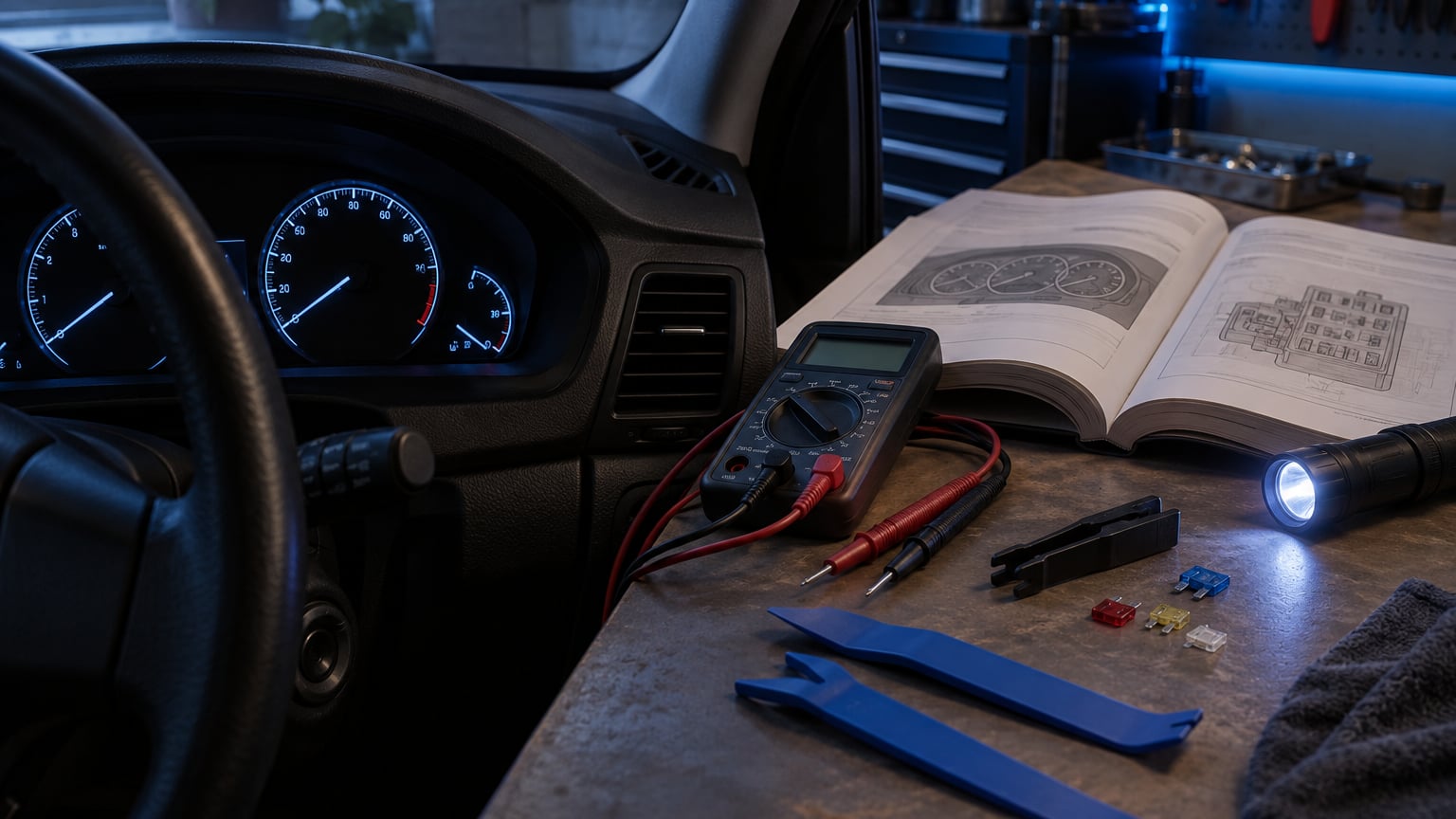
Flickering dashboard lights almost always mean the voltage reaching your instrument cluster is unsteady, and the usual culprit is a loose or corroded ground, a dirty battery terminal, or a charging system that cannot hold output under load. You can narrow it down at home in about an hour with a multimeter, a flashlight and your owner’s manual, and most of the work is cleaning, tightening and reseating rather than buying parts.
Start by watching when the flicker happens. That single detail decides whether you are chasing a bulb, a switch, a ground or a dying alternator, and it saves you the parts-cannon run that has ended half the threads I have read on this topic. If the lights flicker over bumps or when you turn the wheel, it is a connection. If they dim when the blower motor or the A/C kicks in, it is charging.
Table of Contents
- What You Need
- How to Fix Flickering Dashboard Lights: Step-by-Step
- Common Mistakes
- Frequently Asked Questions
- Why are my dashboard lights flickering with the headlights on?
- Is a flickering dashboard light caused by a bad bulb or a fuse?
- Why do my BMW dashboard lights flicker when I press the brake?
- Can a weak car battery cause dashboard lights to flicker?
- Do I need a scan tool to diagnose a flickering instrument cluster?
- Conclusion
What You Need
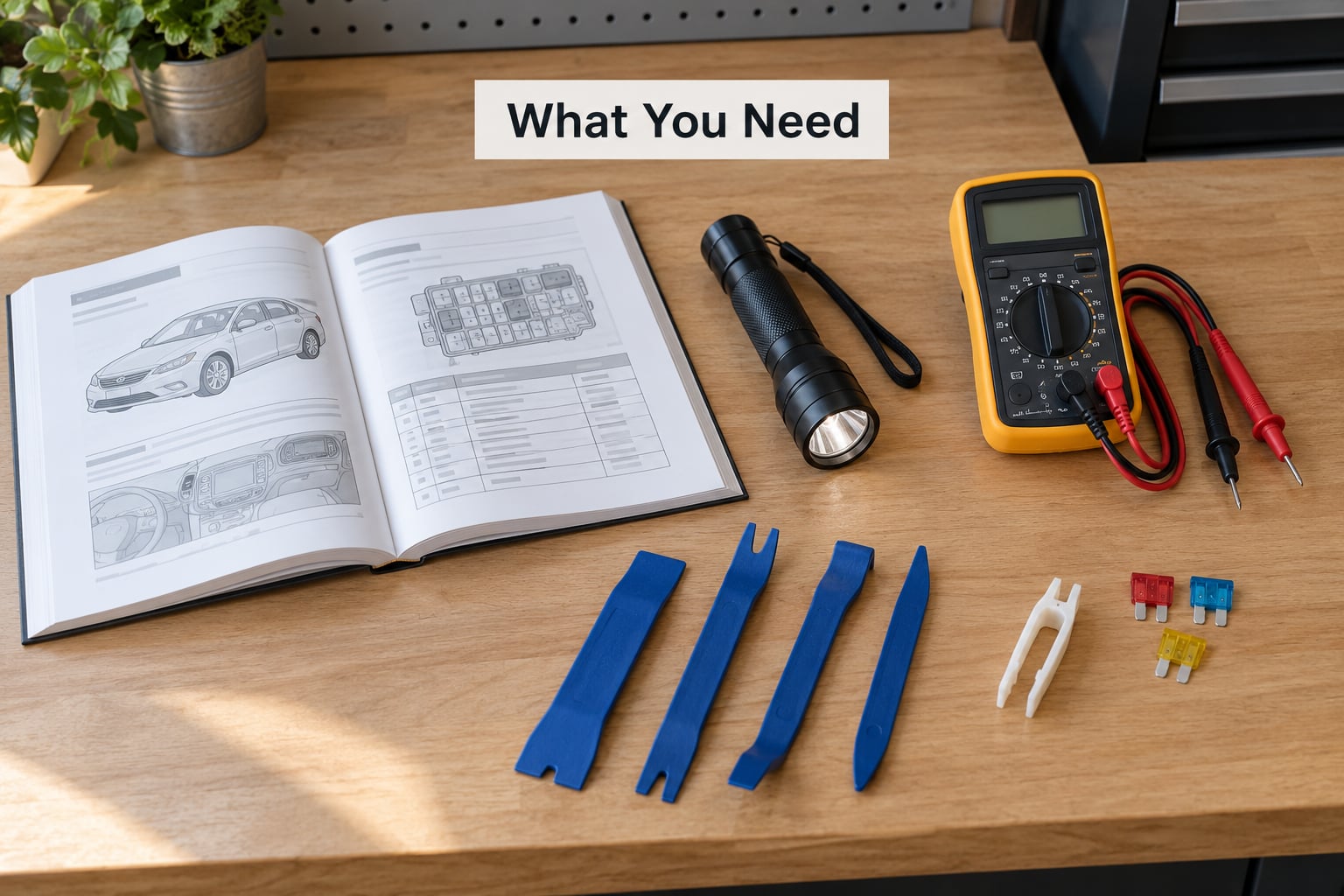
None of this is exotic. If you own a socket set, a wire brush or terminal cleaner, a fuse puller and a multimeter, you have everything the job needs.
- Owner’s manual. It holds the fuse layout, the lighting circuit numbers and, on many cars, the location of the body ground points.
- Flashlight. A headlamp or phone flashlight lets you look into the footwell and under the dash without a shop light.
- Digital multimeter. This is the only tool that turns a guess into a diagnosis. A test light is a rough substitute for checking whether a circuit has voltage, but it cannot measure a voltage drop.
- Fuse puller and spare fuses. Pull the correct rating from the owner’s manual, never a larger one.
- Terminal cleaner or wire brush, plus baking soda and water. For green or white corrosion on battery posts and ground straps.
- Trim tools and socket set. Plastic pry tools for the cluster bezel and a small socket for battery terminal clamps.
- Diagnostic scanner (optional). Helpful on a late-model car where the cluster talks to the body control module, but the first four steps never need one.
- Battery memory saver (optional). Worth fitting before you touch anything on a car with radio codes, seat memory or window presets.
You can safely skip the scanner and the memory saver for the electrical checks in the next section. You should call a technician instead of continuing whenever the fault turns into burned plastic, or when the work means pulling apart a dashboard.
How to Fix Flickering Dashboard Lights: Step-by-Step
1. Confirm the Flicker Pattern
Record what you see before you touch anything. This is the part that makes the next five steps obvious instead of guesswork, and it is the first thing to fix flickering dashboard lights honestly requires.
Watch for a full minute at idle, then with the headlights on, then while you turn the wheel, then over a bump. Note whether the whole cluster pulses or only one display, and whether the headlights dim in step with it. A faint buzzing gauge cluster and a headlight that dims together point to the charging system. One backlit gauge that blinks on its own points to that gauge’s bulb or socket.
| What you see | Likely cause | Where to look |
|---|---|---|
| Flicker over bumps or when steering | Loose ground, connector or bulb socket | Ground straps, battery terminals, cluster connector |
| Dims when blower, A/C or headlights load up | Weak alternator, worn belt or weak battery | Charging output test, serpentine belt |
| Flicker only at idle | Alternator ripple at low engine speed | Voltage regulator, belt tension |
| Flicker right after a car wash or rain | Water in a lamp or connector | Rear of gauge, footwell connectors, seals |
| Flashing and the car will not crank | Battery discharged or bad connection | Battery state of charge, terminal clamps |
| One gauge or one backlight flickers only | Local bulb, socket or stepper motor | That bulb and its socket |
2. Check the Dimmer Switch and Lighting Controls
Before you blame the electrical system, rule out a setting. The dashboard brightness control is sometimes a rheostat that dims cluster backlighting, and on cars with automatic headlights the same control also feeds the map and dome lights.
Cycle the dimmer from full bright to off in small steps and watch for a point where the backlight stutters. On many cars the cluster brightness adjustment lives in the instrument menu instead of on a rotary switch, so set it to mid-range and drive. Turn the map light and dome light off one at a time as well. A switch whose contacts are worn can flicker the whole backlight circuit when you nudge it, and that is a five-minute fix once you find the switch.
3. Inspect the Correct Fuse
Use the owner’s manual to find the lighting or instrument fuse that feeds the cluster, then pull it with the puller and hold it up to the light.
A blown fuse shows a broken or blackened filament across the glass. Replace it only with the exact amperage and type the manual calls for. A fuse that blows again after you fitted a good one means there is a short or an over-current draw somewhere in that circuit, so the fix is to find it, not to fit the next fuse. Leave the new fuse out if you need to drive and chase the fault.
Do the same for any fuse that feeds a lighting circuit you have not touched. Two circuits failing at once usually means a shared ground rather than two separate bulb failures.
4. Fix Flickering Dashboard Lights at the Bulb, Socket, or LED
Where the cluster uses replaceable bulbs, pull the cluster trim, take the bulb straight out and reseat it firmly. A socket that is barely engaged will flicker every time the car hits a bump, and that one reseat solves a surprising number of complaints.
Look inside the socket for green corrosion, a browned contact or a tab that no longer grips the bulb. Clean it with contact cleaner, and if the metal has gone soft or the plastic has melted, the socket needs replacing. Swap in a bulb of the exact type the manual lists, since a wrong wattage runs hot and kills itself again.
Modern clusters are usually a sealed LED or display assembly. There is nothing to replace inside one, and the fix is upstream: voltage, ground, or the control module driving the backlight. Never pry a sealed cluster open and never cut into wiring behind a dashboard that carries an airbag, because the yellow connector there means the airbag harness is there.
5. Check Grounds, Connectors, and Wiring
Grounds are the most common cause of intermittent flicker, and they are the first place to look when dashboard lights flicker while driving.
Clean the battery posts and both battery terminal clamps with baking soda and water, dry them, and refit the clamps so they bite metal. Then find the main grounds: battery negative to chassis, chassis to engine, and the ground straps behind the dash and near the alternator case. Scrape off paint at the bare-metal contact point, clean the stud, and tighten it solid.
Now measure. With the engine off and the key on, a healthy battery reads 12.6V or better at rest. Start the engine and read again at the battery posts: you want roughly 13.8V to 14.8V. Under 13.2V while running means the alternator or its voltage regulator is not keeping up, and that is why the lights dip when a big load comes on.
For the cables themselves, run a voltage drop test. With the engine running and the headlights on, put one meter lead on the battery negative post and the other on the chassis ground point you are suspicious of, with both probes held by someone or clipped in place. More than about 0.2V of drop means that connection is corroded under the surface, even if it looks clean. Do the same test on the positive side from alternator output to battery positive; above roughly 0.3V means replace or clean that cable.
With the car idling, wiggle the battery clamps, the ground studs and the wiring behind the dash while someone watches the cluster. A flicker that appears when you move a specific connector has just shown you where to cut the harness open. Wiring pinched by a bracket, chewed by a mouse, or sitting in a puddle needs repair, and that is where terminal crimping or a proper soldered repair earns its keep. If water has been pooling under the carpet near a footwell connector, dry the area fully and check the seal before closing the dash back up. Our guide to fixing cloudy plastic on tail lights covers the same kind of lens and seal work from the outside of the car.
6. Scan Control Modules and Verify the Repair
On a late-model BMW, Ford, Honda or newer Chevrolet, the instrument cluster is a display driven by the body control module over the vehicle network. A flickering backlight with no voltage problem often means the module logged a bulb-out or communication fault, or the cluster is being reset as it loses the CAN bus momentarily.
A phone scan tool with a Bluetooth adapter is enough to read stored codes and see live data from the lighting circuits. A code that repeats after you clear it tells you which module is unhappy. If the flicker appears with no code, no voltage drop and no fault at any connector, the module or the cluster itself is the remaining suspect, and that is a bench job.
Verify the fix under the exact conditions that started it: same speed, same bumps, same loads, lights on at night. Then confirm that no new warning light comes on and that the meter still reads in range with everything switched on. Do not call it fixed until the original trigger has been cleared.
Common Mistakes
Replacing the dimmer before reproducing the fault. If the backlight only stutters at one brightness level, the switch is the suspect. If it flickers over a bump, the switch is not the problem, and swapping it wastes an afternoon.
Fitting the same fuse over and over. A second blown fuse is the electrical system’s way of telling you there is a short circuit in that circuit. Find the draw with a test light or a clamp meter before the fuse box melts.
Probing around the yellow airbag connector. A multimeter probe through a seat belt connector or a crash sensor can light the airbag and cost you a module. Work only on circuits you have positively identified.
Shorting battery terminals with a test light to see a spark. Do not do this. It dumps your battery, can damage modules and risks hydrogen gas near the battery. Use a meter.
Ignoring grounds because they look fine. Corrosion under a clamp and paint under a ring terminal both hide completely. The voltage drop test is the only honest way to know.
Assuming every cluster is user-serviceable. Sealed LED and display assemblies, and any cluster behind an airbag, belong in a shop.
Two safety rules, and they matter more than any of the above. Stop driving and arrange a tow if you notice a burning smell, smoke, melting connectors, dimming headlights at night, a stalling engine, or several systems resetting at once. Intermittent voltage can damage control modules quickly, and you can find the same fault in the morning with the car parked.
Frequently Asked Questions
Why are my dashboard lights flickering with the headlights on?
A working dimmer or headlight switch routes a lower voltage to the cluster backlighting, and a worn switch can make that output stutter as you adjust it. It also happens on cars where the cluster brightness control is an electronic dimmer that fades the LEDs as the lighting circuit shares a ground. Set the brightness to mid-range and drive; if the flicker stops, replace the switch. If it continues over bumps or under load, the cause is a ground or charging fault instead.
Is a flickering dashboard light caused by a bad bulb or a fuse?
Sometimes, but those are the last two causes to suspect, not the first. A single bulb flickering on its own usually means a loose socket, corrosion, or a bulb of the wrong type, and a single blown fuse means a short or an over-current draw in that circuit. When the whole cluster, gauge needles and headlights all pulse together, the bulb and fuse are almost never to blame. Start with grounds and battery terminals, because that pattern points to unstable voltage reaching the cluster.
Why do my BMW dashboard lights flicker when I press the brake?
Pressing the brake lights draws extra current, so any weak spot in the supply shows up right then. On a BMW the usual causes are a corroded ground point behind the dash, a dirty battery terminal, or an alternator whose voltage regulator cannot hold output. Check for stored lighting or communication fault codes with a scanner as well, because some clusters report a fault instead of dimming. Verify the repair by braking at the same steady speed that triggered the flicker.
Can a weak car battery cause dashboard lights to flicker?
Yes. A battery that cannot hold charge sags under load, and the drop reaches the cluster as dimming and flicker, especially while cranking or when the blower and headlights are on. Measure the battery with the engine off after it has sat a few hours: 12.6V or higher means state of charge is fine and you should look at the charging system instead. Start the engine and read again; you want roughly 13.8V to 14.8V at the battery posts.
Do I need a scan tool to diagnose a flickering instrument cluster?
No. The first four checks, grounds, battery terminals, the lighting fuse, and the bulb and socket, are all done by hand or with a multimeter, and they cover most cases. A scan tool earns its place on late-model vehicles where the cluster is driven by the body control module, because it will show stored bulb-out or communication faults and live lighting data that you cannot see from the driver’s seat. Many owners also read codes on a phone with a cheap Bluetooth adapter.
Conclusion
Begin by reproducing the flicker and writing down what triggers it, then work the dimmer settings and the lighting fuse before you remove a single part. Clean the battery terminals and the main ground points, measure 12.6V at rest and roughly 13.8V to 14.8V with the engine running, and run a voltage drop test on any cable that looks suspect.
If the readings are good and the flicker follows bumps or the steering wheel, the wiring behind the dash is where the fault lives, and that is the point to stop and let a technician repair the harness properly. The same goes for smoke, a burning smell, melted connectors, an airbag warning, or a fuse that keeps blowing. Diagnosing flickering dashboard lights is mostly patience and measurement; guessing at parts is what turns a simple cleanup into a long repair.