
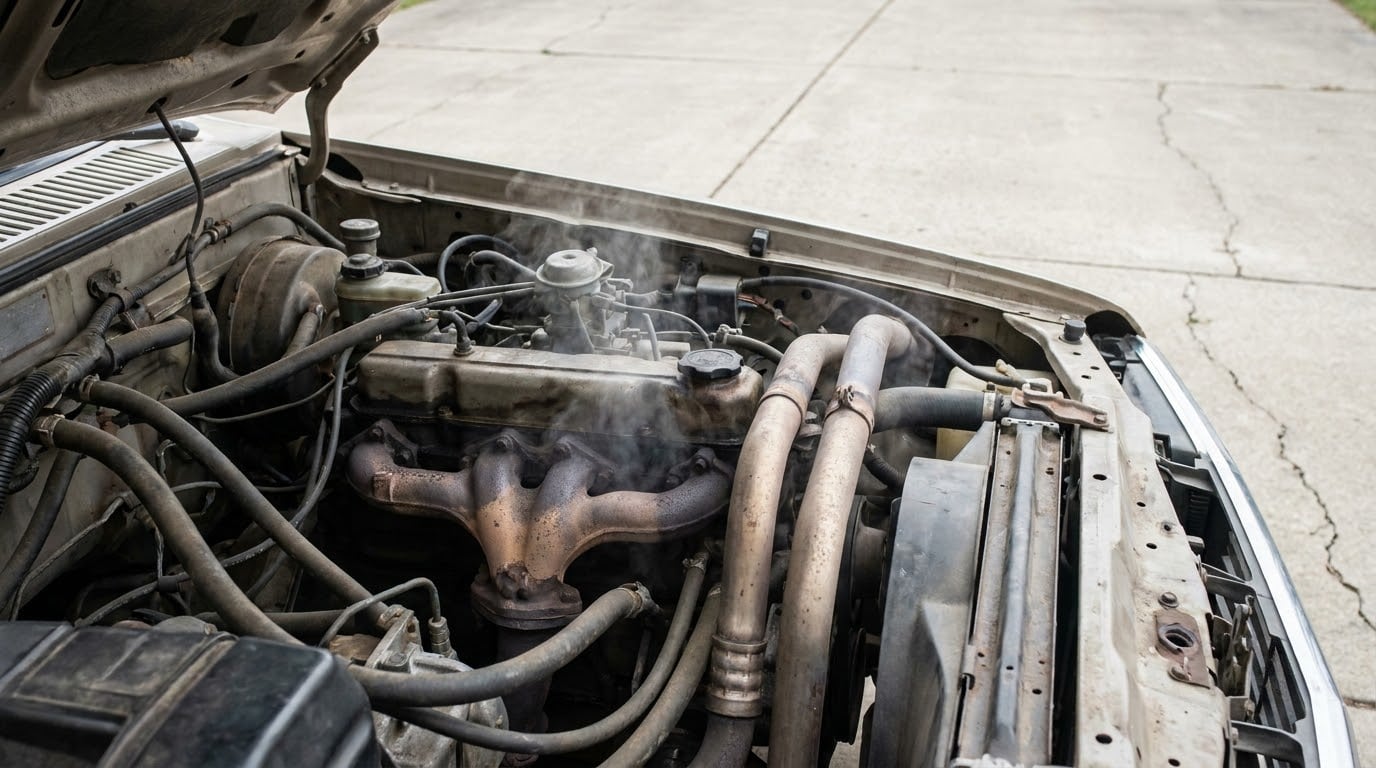
A hissing noise from engine after turning off is usually nothing to worry about. The moment you shut the engine down, the vacuum, exhaust flow, and air conditioning pressure you were building up collapse, and air escapes through the weakest seal it can find. A second or two of quiet hissing after a hot engine is normal. A hiss that goes on for minutes, comes back every time you park, or shows up while the engine is running is a fault worth chasing down.
Here’s how to tell the two apart before you start worrying about a blown gasket or a head gasket failure, which is where most online scares end up.
Table of Contents
- What Causes a Hissing Noise From Engine After Turning Off?
- Is a Short Hiss After Shutdown Normal?
- What Does the Location and Timing of the Hiss Tell You?
- What Are the Most Likely Causes?
- How Can You Diagnose the Noise Safely?
- Can You Drive With a Hissing Noise After Shutoff?
- What Fixes Are Usually Needed?
- Frequently Asked Questions
- Why does my engine hiss for a few seconds after I turn it off?
- Is it normal for the hiss to last longer when the engine is very hot?
- Why do I hear the hissing noise only after driving on the highway?
- Can a hissing sound after shutdown mean an exhaust leak?
- What warning signs mean I should stop driving and inspect the car?
- Does a hissing noise after turning off the engine always require a repair?
- What Should You Do First?
What Causes a Hissing Noise From Engine After Turning Off?
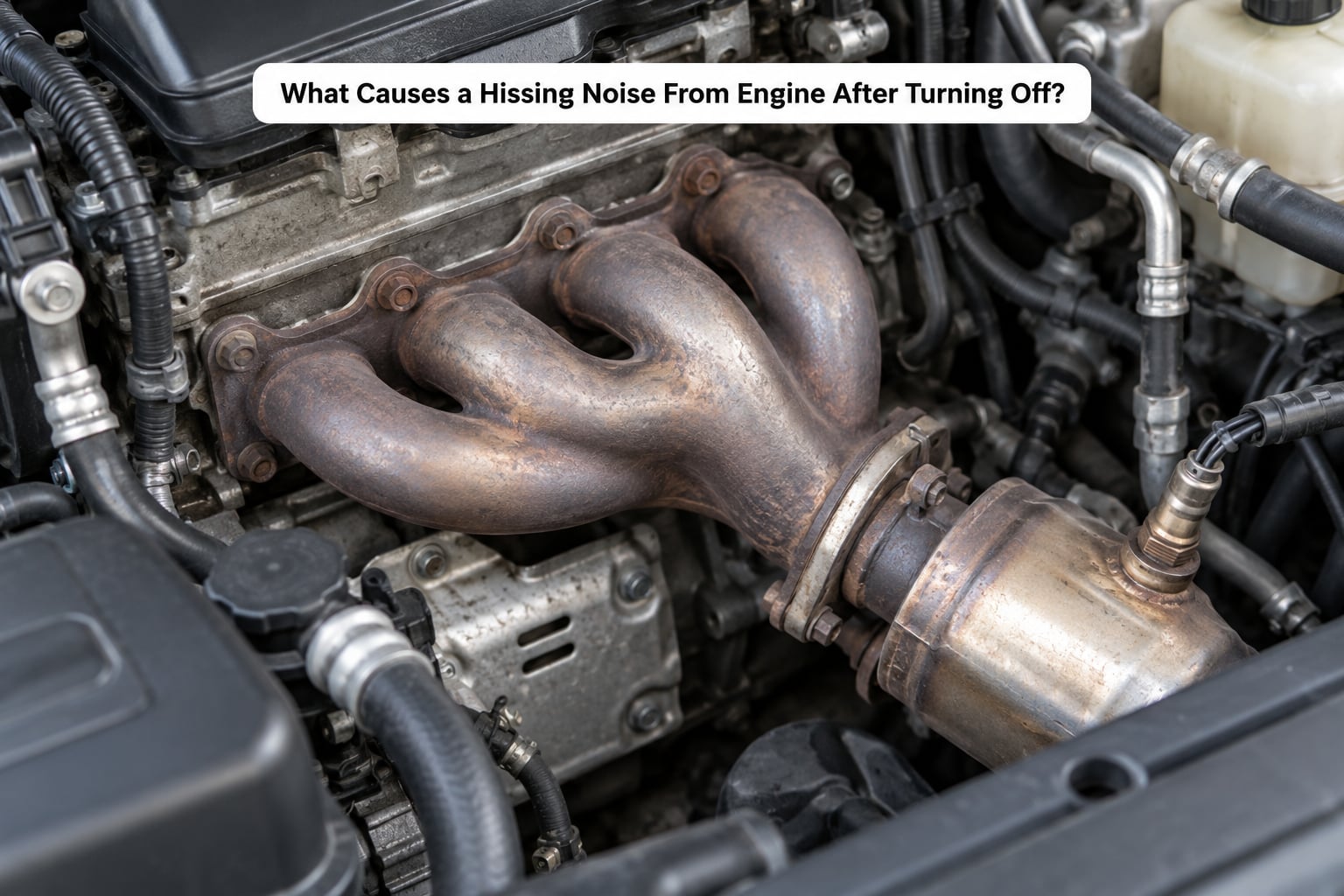
The short answer: pressure equalization. While the engine runs, the exhaust pump, the AC compressor, the water pump, and the crankcase ventilation system are all moving air and creating pressure differences. Shut it off and every one of those pressure sources stops at once.
Air then escapes to get back to normal, and it takes the path of least resistance: a PCV valve, a purge valve, a cap gasket, a cracked hose nipple, or a rusted exhaust joint. That escaping air is the hiss.
Two very different situations produce that same sound. When every seal is doing its job, you get one brief release and then silence. When a seal has failed, the pressure keeps bleeding out for as long as there’s pressure to bleed, and you hear a sustained or repeating hiss.
Timing matters more than volume. A soft noise that stops before you’ve closed the door is almost never a problem. A loud one that outlasts a full minute is.
Is a Short Hiss After Shutdown Normal?
Usually yes. Nearly every car makes some noise for a second or two after you shut a hot engine off. The metal has expanded during the drive, exhaust valves are still hot, and the cooling system is settling as the temperature drops.
Duration is the single most useful clue, and it’s the one most guides skip:
| How long the hiss lasts | What it usually means |
|---|---|
| Under 2 seconds | Normal. Exhaust and metal contracting as the engine cools. |
| 2 to 10 seconds | Usually normal. AC pressure equalizing or a purge or bypass valve opening. |
| 10 to 15 minutes | Probably the AC system. One Honda CR-V owner traced a hiss this long to the AC components; worth confirming rather than ignoring. |
| Constant, or louder with every start | Not normal. Treat it as a leak and keep looking. |
| Present while the engine is running | Different problem entirely, usually a vacuum leak or a worn exhaust gasket. |
A longer hiss when the engine is very hot is still usually fine, because there is simply more pressure and more heat to release. Owners on the forums often note that their cars hiss more in summer or after a long highway drive for exactly that reason.
Signs you should not wave off as normal: any visible steam, a sweet or burnt smell, a puddle of coolant or oil under the car, a check engine light, or a rough idle. Those change the question from “is this sound normal” to “what is leaking.”
When a hissing noise from engine after turning off is just physics
You have hot metal, hot oil, and trapped air all looking for an exit. A short release is the system doing exactly what it was designed to do, and it is not a symptom of anything.
What Does the Location and Timing of the Hiss Tell You?
Location is more reliable than volume. Two different systems can produce an identical noise, but they almost never sit in the same spot on the engine.
| Where you hear it | Likely source |
|---|---|
| Rear of the car, near the tailpipe | Exhaust system: manifold gasket, flex pipe, catalytic converter, or a rusted pipe joint. |
| Front of the car, center of the engine bay | Radiator cap, coolant overflow tank, or a hose connection venting pressure. |
| Passenger side of the engine bay | Bypass valve or PCV valve on the intake manifold, common on Hondas and Acuras. |
| Under the car, near the firewall | Brake booster vacuum line. This one is safety critical, so treat it seriously. |
| Behind the dashboard, faint, after a long drive | AC system equalizing pressure through the evaporator expansion valve. |
| Only after a car wash or rain, near the tailpipe | Not a fault at all. Water hitting a hot exhaust makes a sizzling noise that sounds exactly like a leak. |
Timing adds a second layer. A hiss that starts the instant you turn the key usually means a component is venting as soon as pressure builds. One that starts a minute or two later often points to the AC or the fuel vapor system, since those equalize more slowly.
If the sound only appears after highway driving and never after a trip around the block, think heat and pressure: a cooling system cap, a coolant level, or an AC system that needs a specific temperature to vent. A sound that shows up only after short cold trips points elsewhere entirely, often to the crankcase vent.
What Are the Most Likely Causes?
In rough order of how often they turn out to be the problem.
Normal thermal contraction of the exhaust
Metal that has been glowing for an hour cools and shrinks. That movement opens a gap somewhere in the exhaust for a moment, and air rushes through. This is the under-two-seconds hiss, and there is nothing to fix.
AC pressure equalization
The air conditioning system holds refrigerant and pressure above atmospheric. When you shut off, that pressure equalizes through the expansion valve and the evaporator lines, which is a textbook hiss. Owners on the CivicSi forum describe exactly this after runs with the air conditioning on.
Volvo owners on their own forums note the same thing from the other direction: running the AC for a few minutes after you park lets the pressure bleed off slowly and quietly instead of all at once at shutdown.
EVAP purge valve and fuel vapor
Modern cars route fuel vapors into the intake to burn them. At shutdown the purge valve opens to equalize the fuel tank, and that produces a short hiss right at the tank or the valve. A GRYaris owner traced their post-shutdown hiss to exactly this and confirmed it was normal behavior.
If the hiss comes with a strong fuel smell around the rear of the car, the valve is stuck open and that one is a repair, not a shrug.
PCV valve and crankcase vent
The PCV valve meters crankcase gases into the intake. On many cars the valve sits in a cap or on a hose, and when the engine stops and vacuum drops it opens and audibly releases pressure. One MechanicAdvice owner found the true culprit was the air and oil separator crankcase vent membrane, which turned out to be cheap and easy.
A related item is worth knowing: if the PCV system is stuck closed, crankcase pressure builds and the engine can hiss through the dipstick tube or the oil filler cap. Our guide to how to find a vacuum leak in an engine covers the running-engine version of this.
Exhaust or vacuum leak
A cracked manifold gasket, a failed flex pipe, or a perished vacuum hose will hiss under load and keep hissing. This is the case where the sound continues long past the point where pressure equalization should have finished, and it usually comes with a rough idle or a drop in fuel economy.
Radiator cap and cooling system pressure
A cap that does not seal at operating pressure lets coolant-side pressure vent itself as the engine cools, and it hisses on the way out. Watch the coolant level in the tank over a few days. If it drops, the cap is not your only problem, but it is a strong suspect.
Brake booster vacuum leak
This is the one worth repeating. If air is getting into the brake booster, you may get a hissing noise under the hood and softer pedal response at low speed, and in some conditions exhaust can be pulled toward the cabin. If your brakes feel spongier than they did last month, get the booster line checked before you drive the car normally.
Valve train and lifters
If the hiss is really a ticking or tapping that only happens after shutdown, you are hearing hydraulic lash going quiet as oil drains away from the lash adjusters. That is a different noise from an air hiss, and it points at lifter or cam wear. Our post on what a knocking engine sounds like breaks down how to tell the two apart by sound.
How Can You Diagnose the Noise Safely?
Do this in the driveway, on level ground, in park with the parking brake on. Let the engine cool before you put a hand anywhere near the exhaust manifold, and keep clear of the fan and any hot pipes.
1. Get a second set of ears and a phone. The whole difficulty is that the sound lasts a few seconds. Have someone stand at the rear and at the front while you shut it off, and record it on video so you can listen back for location and duration.
2. Listen with the engine running. A vacuum leak is loudest at high vacuum, which is off idle. If the hiss is much worse at 2500 RPM than at idle, that is a vacuum leak rather than a shutdown artifact.
3. Try the cardboard test on the dipstick. This is the method Scotty’s community uses, and it is the cheapest diagnostic on this page. With the engine running at idle, pull the dipstick and hold a piece of cardboard over the tube opening. If the crankcase is pulling a proper vacuum, the cardboard should stay sitting there. If the air flow is strong enough to lift it, crankcase pressure is too high and the PCV system is not doing its job.
4. Repeat it at the oil filler cap. Same idea, different point. With the engine idling, the cap should be held down and you should feel suction at the neck. That suction should drop noticeably when you briefly open the throttle. Little or no suction means the same crankcase pressure problem.
5. Spray soapy water on suspect connections. Mix dish soap with water, cover the exhaust joints, the vacuum hoses, the intake manifold runners, and the coolant hose joints. Bubbles that grow and hold mean a leak. Keep water away from electrical connectors and never spray a running engine with a hose.
6. Use a smoke machine for the vacuum system. This is the tool that earns its keep on a stubborn vacuum leak. Run the engine, feed smoke into the intake, and watch for escaping smoke at every hose, boot, and manifold seam. If you do not own one, a shop will usually do this in a few minutes.
7. Watch the cooling system for a few days. Check the coolant level cold, before you start the car, and again a week later. A cap that is not holding pressure will show up as a slow drop long before you see steam.
Can You Drive With a Hissing Noise After Shutoff?
In most cases, yes. A brief hiss after shutdown on a car that runs cleanly, with no warning lights, no smells, and no visible leaks is not a reason to leave the car parked.
Driving it to a shop is reasonable when the sound is new, the engine runs and brakes normally, and there are no warning lights. Keep it short and avoid heavy load until you know what you are dealing with.
Stop driving and get it inspected if any of these show up:
- A temperature gauge climbing, or a coolant warning light
- Steam from under the hood or from the exhaust
- A strong fuel smell around the rear of the car
- A check engine light or a rough, unsteady idle
- Brake pedal travel that has grown longer than it used to be
- A hiss you can hear with the engine running, or one that is getting louder over days
Overheating has its own damage chain, and our how to fix an overheating engine safely guide covers what to do when the gauge starts moving.
One warning worth taking seriously: an exhaust leak ahead of the catalytic converter can pull carbon monoxide into the cabin, particularly with the rear windows open. If the hiss is loud from the driver’s seat and you have an exhaust smell, do not keep driving it.
What Fixes Are Usually Needed?
The repair follows the cause, and most of these are straightforward once you know which one you have.
- Normal exhaust contraction: nothing. This is the healthy outcome.
- AC pressure equalization: nothing, though running the air conditioning briefly after parking reduces it.
- EVAP purge valve or fuel vapor: replace the purge valve, usually a cheap part and mostly labor.
- PCV valve or crankcase vent: replace the valve or the separator membrane. Often a do-it-yourself job with basic tools.
- Exhaust leak: replace the gasket, flex pipe, or section of pipe. Rusted-through sections near the manifold usually need a welder or a replacement exhaust component.
- Vacuum leak: replace the hose, boot, or seal. Smoke testing first saves replacing parts that were never leaking.
- Radiator cap or cooling system: start with the cap, then pressure test the system if the level keeps dropping. A cap that fails a pressure test is cheap compared to a head gasket.
- Brake booster: replace the vacuum line, check valve, or booster. Get this one done properly.
- Valve train: an internal inspection. Oil pressure tests, lifter measurements, and possibly a cylinder head off. This is the point where a mechanic earns their fee.
If the sound only happens at shutdown, tell the shop that explicitly. Mechanics are tuned to noises that happen while the car is running, and a sound that lasts four seconds at the key can leave them guessing.
Frequently Asked Questions
Why does my engine hiss for a few seconds after I turn it off?
Because pressure you built up while driving collapses the moment the engine stops. Exhaust flow stops, the AC compressor stops, and the vacuum in the intake disappears, so air escapes through the weakest seal it can find. On most cars that is the PCV valve, a purge valve, or a cap gasket. Two or three seconds of quiet hissing from a hot engine is completely normal.
Is it normal for the hiss to last longer when the engine is very hot?
Yes, usually. A hotter engine has more pressure and more heat in the exhaust and cooling systems, so there is more air to release and it takes longer to release it. Cars also tend to hiss more in summer and after a long highway drive for the same reason. The duration matters less than what comes with it. If the longer hiss comes with steam, a warning light, or a dropping coolant level, get it checked.
Why do I hear the hissing noise only after driving on the highway?
Highway driving puts the most heat into the engine, exhaust, and cooling system, and it runs them at steady high load for a long time. That maximizes both temperature and pressure, which is what drives the release of air at shutdown. It also points you toward the right suspects: a radiator cap not sealing at operating pressure, a low coolant level, or an AC system that needs a certain temperature to vent. Short trips on the same car often stay quiet.
Can a hissing sound after shutdown mean an exhaust leak?
It can. An exhaust leak usually hisses louder and longer than a normal release, is loudest from the rear of the car, and often comes with a rough idle or a drop in fuel economy. An owner on the CivicSi forum and others have described the same pattern. One complication worth knowing: an exhaust leak ahead of the catalytic converter can pull carbon monoxide toward the cabin, so an exhaust smell with the windows open is a reason to stop driving it.
What warning signs mean I should stop driving and inspect the car?
Stop and have it looked at if the temperature gauge climbs or a coolant light comes on, you see steam under the hood, the coolant level drops between cold checks, there is a strong fuel smell at the rear of the car, the check engine light is on, the idle is rough, or the brake pedal feels longer and softer than it used to. Any of those changes a harmless sound into a fault worth chasing.
Does a hissing noise after turning off the engine always require a repair?
No. Most post-shutdown hisses are pressure equalization and need nothing at all. The ones that do need work tend to last much longer than a few seconds, come back every time you park, get louder over weeks, or come with warning lights, smells, a rough idle, or softer brakes. Start with the duration and location checks in this guide. If you cannot account for the sound in a few minutes of listening, a shop smoke test will find it fast.
What Should You Do First?
Time it. Have someone listen at the front and the rear while you shut the engine off, and write down how many seconds the hiss lasted. Under two seconds is normal and you can stop worrying about it.
Then check for the warning signs: warning lights, steam, smells, coolant level, and brake pedal feel. If all of those are clean and the hiss still runs long or shows up on every drive, run the dipstick cardboard test and the oil filler cap check on a warm engine.
If the hiss is growing louder over weeks, or it comes with a rough idle, a coolant level that keeps dropping, or softer brakes, book an inspection and mention that the sound only happens at shutdown. That one sentence saves a lot of diagnostic time.