
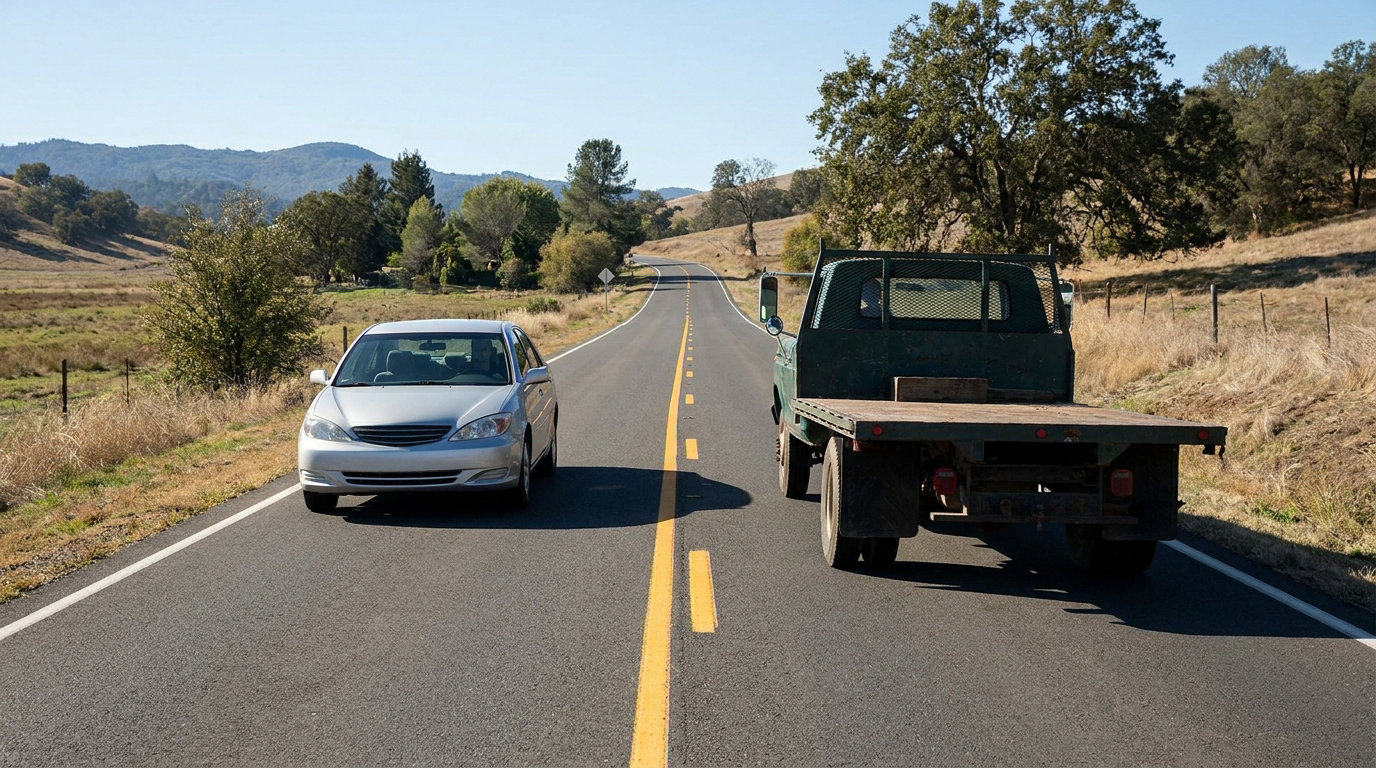
To pass safely on a two lane road, stay in your right lane until you have a clear view of oncoming traffic, confirm the center line permits passing, signal and check your mirrors and blind spot, move left only when the way is clear, match the speed of the vehicle you are passing, and return to your lane as soon as you are safely ahead of it. Passing is the riskiest maneuver a new driver performs, because for a few seconds you are sitting in the lane that belongs to somebody else.
A two-lane road has one lane in each direction, separated by a painted center line. There is no passing lane and no shoulder wide enough to disappear into, so every pass puts you directly in the path of whatever is coming the other way. That is why experienced drivers treat passing as a decision, not a reflex.
Most of the accidents I have looked at over the years come down to the same thing: a driver committed to the maneuver before the view was good enough. A truck crests a hill a second earlier than expected. A line of oncoming cars bunches up behind a slow vehicle. The pass that looked fine at 55 mph is a bad idea at 70.
This guide walks through the whole process in order: what you need before you start, each step of the maneuver and how to tell it is going well, the situations where you should abandon it, and what to do when the driver coming the other way will not slow down. Laws differ by state, so treat the legal details here as the general framework and check your own state’s vehicle code for specifics.
Table of Contents
- What You Need
- Step-by-Step
- How to Pass Safely on a Two Lane Road: Confirm You May Pass
- How to Pass Safely on a Two Lane Road: Check the Entire Road Ahead
- How to Pass Safely on a Two Lane Road: Build a Realistic Time Gap
- How to Pass Safely on a Two Lane Road: Choose Speed and Position
- How to Pass Safely on a Two Lane Road: Monitor Oncoming Traffic
- How to Pass Safely on a Two Lane Road: Return to Your Lane
- How to Pass Safely on a Two Lane Road: Abort the Pass
- How to Pass Safely on a Two Lane Road: Reading Signals From Trucks and Slow Vehicles
- How to Pass Safely on a Two Lane Road: Clearing Cyclists, Riders, and Pedestrians
- Common Mistakes
- Passing on a crest or a blind curve
- Choosing a gap that barely fits
- Accelerating hard alongside the slower vehicle
- Skipping the mirrors or the shoulder check
- Riding the center line
- Returning to your lane too soon
- Returning with no room ahead
- Assuming a signal makes the pass legal
- Continuing when conditions deteriorate
- Sitting in the left lane after the pass is over
- Passing while you are already too close
- Ignoring the vehicle you are following signaling to turn
- Tips for specific conditions
- Frequently Asked Questions
- How much space do I need to pass another car safely?
- Is the oncoming driver responsible for moving over while I pass?
- Should I pass a slower vehicle if I am already following it too closely?
- Can I pass another car on a two-lane road with a broken yellow centerline?
- When should I cancel a pass on a two-lane road?
- Is it safer to pass a slow vehicle quickly or match its speed?
- Conclusion
What You Need
There is no special equipment for passing on a two-lane road. What you need is a car that is mechanically sound enough to commit to the maneuver, a clear view, and an accurate sense of how long the pass will take. Skipping any of those three turns a normal pass into a gamble.
A vehicle you can trust
Passing asks more of your brakes, your tires and your steering than ordinary lane changes do, because you are asking for more than your comfort level in a fraction of a second. Tires with low tread cannot clear standing water, and worn pads or a soft pedal will not give you the fast, decisive response an aborted pass requires. Before a long rural drive, walk the car: check tire pressure and tread depth, brake feel, lights, and that both mirrors and the glass are clean enough to use.
Clear glass, working mirrors, and a belt
Most drivers lose sight distance to a dirty windshield, a mirror folded inward by someone in the passenger seat, or a fogged rear window. Fix those before you move. Buckle up before you roll, not while you are lining up behind a truck.
Enough fuel to avoid an unplanned stop
A fuel gauge light coming on while you are stuck behind a combine at 40 mph is how passing decisions get rushed. Fill up before the drive.
A working knowledge of your state’s passing law
The framework below is the same across the United States, but the details are not always. Every state sets its own minimum clearance figures, its own rules about passing at intersections and railroad crossings, and its own penalties. Know yours. If you see a sign that contradicts what you have read anywhere, the sign wins.
A passing rule you can state in one sentence
Keep right, use the left lane only to pass, and return right as soon as you are clear. If you cannot say that out loud, go back to it until you can. Nearly every rule in this article is a version of that sentence.
Step-by-Step
Here is the sequence I teach. Each step includes what you do, what tells you it is working, and when to call it off. Read it through once before you need it on the road.
How to Pass Safely on a Two Lane Road: Confirm You May Pass
Learning how to pass safely on a two lane road starts with the law, not the throttle. You have the right to pass whenever it is lawful and safe, and nothing more. A passing zone is the stretch of road where the center line is broken yellow, the signs do not forbid it, and your view is long enough to see an oncoming vehicle before you reach the passing vehicle’s rear bumper.
Do not pass where a no-passing sign stands, where a solid yellow center line means two opposing directions may not cross, or where a double solid yellow separates opposing traffic. Do not pass at an intersection or a railroad crossing unless the vehicle ahead has actually stopped and you can see clearly both ways. Do not pass on a crest where you cannot see what is coming over it, around a curve where your sight line ends inside the curve, at a railroad crossing, on a bridge with no shoulder, in a tunnel, or inside a work zone with narrowed lanes and changed markings.
A solid yellow line is a wall you may lean against but never cross. A solid yellow line paired with a broken yellow line still means oncoming traffic may not cross into your lane. Reserve the left lane for the act of passing, not for driving.
How to Pass Safely on a Two Lane Road: Check the Entire Road Ahead
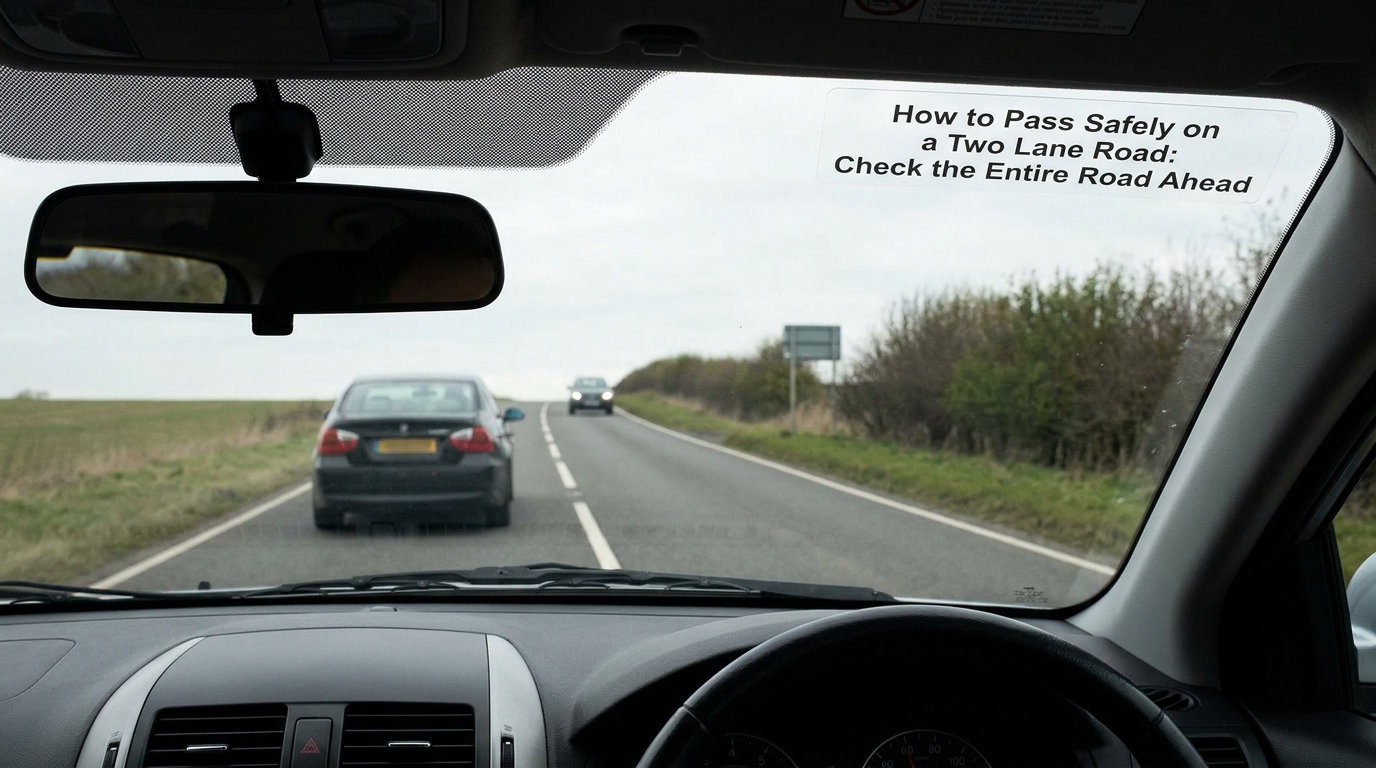
Scan far down the oncoming lane first, then well back behind you in the passing lane. Most drivers check the vehicle they are about to pass and never look past it, which is exactly the wrong order. The oncoming lane is where the pass ends badly, so it gets the longest look.
Read the road for the whole length of the pass, not just the first hundred feet. Look for the crest of a hill where an oncoming vehicle might already be committed. Look for a curve where the far lane disappears behind a guardrail, a stand of trees, or a line of parked cars. Look for driveways, side roads, and turn lanes where a vehicle can appear without warning. Look for a stopped or disabled car with its hazards on, a work crew, a dropped load of gravel, and a cyclist or pedestrian on the shoulder with nowhere else to be.
Open pavement is not the same as a safe pass. What matters is whether the road ahead of you stays clear long enough for you to complete and merge back, and whether the view behind you stays clear long enough that nobody is filling the space you are about to occupy.
How to Pass Safely on a Two Lane Road: Build a Realistic Time Gap
No single number works everywhere, because the distance a pass needs depends on how fast you are going, how much faster than the other vehicle you are, how heavy both vehicles are, and how much room you have ahead to merge back into. Anyone who gives you a fixed number for every situation is handing you a rule for the easy cases only.
What does work is a rough time estimate, plus a lot of margin. Count the seconds you expect to spend alongside and ahead of the slower vehicle. Then look at the oncoming lane and count how many seconds of clear road you have before the next oncoming vehicle reaches you. If the two numbers are close, you do not have a pass, you have a coin flip. Open the margin further.
A useful working minimum for a normal car passing a normal car is roughly ten seconds of clear oncoming road visible ahead of the slower vehicle before you commit. Ten seconds sounds like plenty on a straight road and turns out to be badly insufficient on a wet road at dusk with a truck in front of you. When in doubt, wait for a wider window. Drivers generally report that the passes that felt too cautious rarely get remembered, while the ones that felt tight are remembered for a long time.
How to Pass Safely on a Two Lane Road: Choose Speed and Position
Your speed going into the pass matters as much as the gap. A vehicle doing 35 in a 55 zone gives you 20 mph of closing speed to work with, which can turn a slow farm machine into a ten-second pass. The same vehicle at 15 mph in a 70 zone leaves you a much smaller margin for anything that goes wrong, and it tempts you into rushing.
Signal, check your mirrors, look over your shoulder, and move left smoothly. Stay a steady few feet off the center line rather than swinging wide across it; the space you leave on the right is what keeps you from turning a recoverable pass into a head-on collision. Keep a real following distance behind the vehicle you are passing, with more than you think you need, because part of that distance is your escape room if the pass goes wrong.
Accelerate smoothly to a speed slightly above the other vehicle’s. Abrupt braking beside a slower vehicle is how sideswipes happen. Do not linger beside it either: the longer you sit in the oncoming lane, the more chances something appears. And do not slam past and then match its speed again, because merging back into a slower stream at speed difference makes you the fast-moving vehicle this time.
How to Pass Safely on a Two Lane Road: Monitor Oncoming Traffic
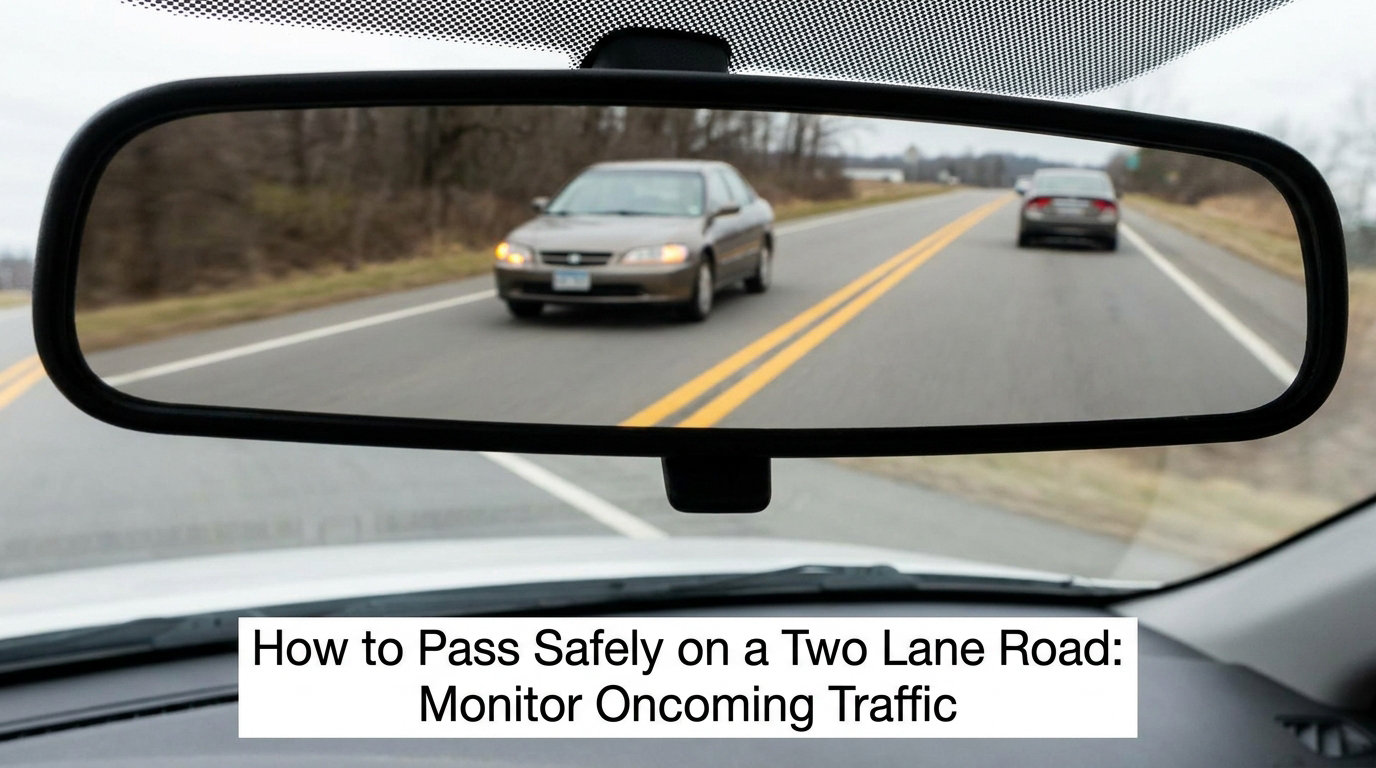
Your eyes belong on the road ahead, not on your mirror. Experienced drivers use the side mirror to track oncoming vehicles through the whole maneuver, glancing for a second or two at a time and returning to the road ahead, because the oncoming lane is where the vehicle you are watching usually is not yet.
If an oncoming vehicle appears and does not slow, your first move is to give yourself more room in front of you by easing off the throttle and letting the gap to the slower vehicle grow. Every extra second of daylight ahead of you is a second the oncoming driver has to react to you. If that vehicle keeps coming at you and you cannot complete the pass, you are already in the left lane without the room to finish, so take the gap now. That is the abort decision, and step seven covers it.
From behind the wheel you also carry responsibility for the driver behind you. If a car closes in while you are passing, stay in the left lane and let it follow you back at a safe distance rather than cutting right into its path. Forcing your way back in front of a tailgater is how sideswipes start, and you will see that pattern over and over in dashcam footage.
How to Pass Safely on a Two Lane Road: Return to Your Lane
The merge back is the part drivers rush, and it is the part that decides whether the pass was safe. Experienced drivers say it constantly: do not cut back in too quickly. Every near miss recorded on a dashcam happened in the two seconds after the driver decided the pass was finished.
Signal, check your mirrors, and look over your shoulder. Then make sure of the things a mirror cannot tell you: a car that closed on you while you were beside the truck, a motorcycle that slipped into your blind spot, a vehicle that has moved toward the center line because it did not like being passed. Your mirrors are showing you lanes, not intentions.
Merge smoothly back to the right as soon as you are safely ahead of the vehicle you passed, with room in front of you to accelerate, and stay clear of the center line. If you do not have that room, staying in the left lane briefly is the smaller error, even though it feels like the bigger one. Signals give other drivers notice, not permission, and they do not make an unsafe merge safe.
Once you are back in your lane, rebuild your following distance before you settle into cruise. The vehicle you just passed will usually accelerate to match you, and driving right behind it is the easiest way to undo a clean pass.
How to Pass Safely on a Two Lane Road: Abort the Pass
Aborting is not failure. It is the maneuver working correctly. Sit in the left lane long enough with no room to return and you have turned a routine pass into a head-on situation that only the oncoming driver’s restraint can save.
Back out early and gently when any of these show up: an oncoming vehicle appears in the passing lane, or an oncoming vehicle does not slow when you are in the left lane. Also back out when visibility drops from fog, glare, rain, dust, or a truck’s dust plume; when the road narrows, the shoulder disappears, or a curve starts before you are clear; when the vehicle ahead suddenly accelerates or changes its speed unpredictably; when you are running out of room ahead of it; when traction is poor; or when you are on a crest and the oncoming lane is a strip of empty air for as far as you can see.
The mechanics are simple and worth practicing. Ease off the accelerator so the vehicle ahead pulls away from you and the space in front grows. Turn on your right signal so the oncoming driver knows which way you are going. Stay as far right as you safely can while you remain out of their path. Look at the vehicle ahead, not at the driver whose side you are on. Wait for a real gap before moving back, even if it means following for a while at their speed.
Do not force the maneuver, and do not expect an oncoming driver to move over for you. Passing on a two-lane road is your responsibility. An oncoming vehicle that yields to you at the center line may be obeying an illegal expectation rather than good manners, and relying on that habit is how a mutual-yield misunderstanding becomes a head-on collision. The correct reading of the other driver’s intent is that you are the one who has moved into their lane.
How to Pass Safely on a Two Lane Road: Reading Signals From Trucks and Slow Vehicles
Slow vehicles often warn you before you reach them, and drivers on forums and in trucker groups rely on these cues even though none of them are in the vehicle code. A large vehicle ahead flashing its left turn signal is commonly read as an indication that the driver is there and you may pass when your own check allows. A right signal from the same vehicle is commonly read as do not pass, there is something ahead in your lane.
Treat this as a courtesy, not a clearance. It tells you the driver is aware of you, which shortens the pass and lowers the risk of an unexpected vehicle in front of them. It says nothing about the oncoming lane, blind hills, or whether you have the room to get back. Plenty of drivers on r/driving and r/IdiotsInCars argue that the flash is worth more than most safety gear, and plenty of others say they would rather judge the road themselves. Make your own decision based on your view, not on the flash.
For the truck’s sake, and yours, get past a slow vehicle cleanly. Sit in the left lane a long time and the driver has to hold a steady line while you work around them, which is tiring on a long grade and miserable in crosswind.
How to Pass Safely on a Two Lane Road: Clearing Cyclists, Riders, and Pedestrians
A person on a bicycle or a motorcycle has no steel shell, no crumple zone, and often no way to move out of your path. The rule of thumb is simple: give more clearance than the vehicle’s width plus a few feet, and move away from a cyclist rather than toward them. Bicycle commuters describe a repeated near miss pattern of cars crossing the double yellow to squeeze past on the inside, then drifting back over the line right where the rider needs to be. On a downhill curve with poor sight lines, that drift is the whole problem.
For motorcyclists, the danger is often the opposite: riders hold a lane position that surprises a car, and they may be checking the vehicle they are passing rather than you. Pass on the left when the road allows it, leave generous space, and never assume you have been seen just because they did not move over.
Pedestrians and people working on or beside a vehicle are the ones you pass at walking pace, with the widest margin the road allows. Many states also set specific minimum clearance distances for passing bicycles and motorcycles in narrow lanes, and those figures are where the safe answer and the legal answer meet.
Common Mistakes
Almost every mistake below is a shortcut taken to finish the pass sooner. Each one can be corrected with a specific habit.
Passing on a crest or a blind curve
You commit when the oncoming lane looks empty, and the empty part is simply the far side of the hill. Do not pass where your sight line ends before the vehicle ahead’s rear bumper does. If you cannot see oncoming pavement at least the distance you expect the pass to take, wait.
Choosing a gap that barely fits
Drivers measure the gap against the vehicle in front instead of against the time it takes to get back. Check how far ahead you will be when you merge, then double it and ask whether the weather and light justify it.
Accelerating hard alongside the slower vehicle
Sudden speed changes next to a larger vehicle invite contact and unsettle everyone in it. Build speed in one smooth motion and hold it.
Skipping the mirrors or the shoulder check
Mirrors tell you where vehicles are, not what they are about to do. A proper check is mirror, then shoulder, then a decision, repeated continuously through the pass rather than done once at the start.
Riding the center line
Straddling the yellow line through a pass is the single most common catastrophic error dashcam communities document. It removes the margin that lets you correct, and it puts you in the oncoming lane by default instead of by choice.
Returning to your lane too soon
The urge to get back to the right lane is strongest exactly when it is most dangerous. Stay left until you are fully ahead with room to accelerate, even if you feel like you are holding up traffic.
Returning with no room ahead
Merging in front of a vehicle you have just passed, with no gap, makes you the obstruction. If the space in front is occupied, continue your pass and merge when it opens.
Assuming a signal makes the pass legal
Your blinker tells other drivers your plan. It does not create a passing zone, shorten an oncoming vehicle’s reaction time, or excuse crossing a solid line. Obey the markings first, signal second.
Continuing when conditions deteriorate
A pass that was reasonable when you started may not be reasonable at the crest. Rain, glare, a truck throwing up spray, or an oncoming line of four vehicles all mean the gap you judged has changed. Re-judge.
Sitting in the left lane after the pass is over
This is the one that generates the most complaints from other drivers, and they are right. Cruising in the passing lane at steady speed, even in a legal passing zone, is the offense most people notice and it is what shapes the reputation of the driver ahead of you.
Passing while you are already too close
Following too closely and passing are different problems with different fixes. Fix the following distance first. Starting a pass from three car lengths back leaves you no room to accelerate smoothly and no room to fall back if the oncoming lane is not clear.
Ignoring the vehicle you are following signaling to turn
A left signal means slowing and pulling toward the center line, possibly across it at a driveway or side road. Let the car move into view before you decide anything, and expect it to take longer than you would like.
Tips for specific conditions
On hills, do not pass near the crest and expect to see the oncoming lane; if you cannot see far enough to complete the pass on the near side of the hill, do not start. Around curves, add margin for a vehicle that is faster than it appears and for a shoulder that is narrower than the map suggests. In rain, ice, or snow, extend your following distance first and pass only if you must, never to make up time. At night, judge the gap by the reflection of your headlights in the oncoming vehicle’s mirrors, which tells you more about closing distance than the taillights do. Around heavy vehicles, expect the airflow to push you toward them as you clear the front bumper, so hold a firm grip and be patient. In speed-limit areas, remember that you are choosing to give up a large part of the available gap by passing at all; a wide margin means passing later, not passing faster. And if a car will not slow for you while you are in the left lane, treat it as an abort and get out of the way. Slowing down is not a defeat in this maneuver, it is the maneuver working.
Frequently Asked Questions
How much space do I need to pass another car safely?
There is no fixed distance that works everywhere. Judge the gap in seconds instead: count the time you expect to spend alongside and ahead of the slower vehicle, then compare it with the seconds of clear oncoming road you can see. A rough working minimum for a normal pass is about ten seconds of clear oncoming road, and you need much more in rain, darkness, or when passing a truck.
Is the oncoming driver responsible for moving over while I pass?
No. You moved into their lane, so the responsibility is entirely yours. An oncoming driver who drifts toward the center line is being courteous, not obeying a rule, and some jurisdictions treat that as a violation on their part. Never plan a pass around the assumption that they will yield, because that habit turns a mutual-yield misunderstanding into a head-on collision.
Should I pass a slower vehicle if I am already following it too closely?
No. Too-close following and passing are separate problems, and you cannot fix one from inside the other. With only three or four car lengths behind a truck, you have no room to accelerate smoothly and no room to fall back if the oncoming lane is not clear. Back off to a safe distance first, then decide whether a pass makes sense at all.
Can I pass another car on a two-lane road with a broken yellow centerline?
A broken yellow line permits passing in both directions, so yes, that is where passing is allowed. The permission is conditional, not automatic. You still need clear sight distance, a usable gap in oncoming traffic, and room to merge back ahead. Solid yellow means you may not cross for passing, and a solid line paired with a broken line means oncoming traffic may not cross either.
When should I cancel a pass on a two-lane road?
Cancel early and gently when an oncoming vehicle appears or fails to slow, when visibility drops, when the road narrows or a curve starts, when the vehicle ahead accelerates unexpectedly, when traction is poor, or when you are near a crest you cannot see past. Ease off the throttle to open the gap ahead, signal right, stay as far right as you safely can, and wait for a real opening.
Is it safer to pass a slow vehicle quickly or match its speed?
Match the speed first, then build a modest, steady advantage. Slamming past at a large speed difference leaves you with no margin to correct a steering adjustment, unsettles the driver you are passing, and puts you straight into a fast-moving merge when you come back. A smooth pass with a slightly higher speed takes the same road but keeps the car under control the whole way.
Conclusion
Passing on a two lane road is a decision made before the wheel ever turns. Keep right by default, use the left lane only when the markings allow it and your sight distance supports it, and treat the oncoming lane as the most important thing in your mirrors for the whole maneuver.
If you take one thing from this guide, make it the first three checks: scan far ahead down the oncoming lane, confirm the center line and signs permit a pass, and compare the room you actually have with the time the pass will really take. If those three line up, signal, check mirrors and blind spot, match the speed smoothly, and merge back only when you are fully ahead with room to accelerate. If any of them does not line up, stay in your lane and wait for the next opening.
Every good pass looks unremarkable from the outside. That is the whole goal.