
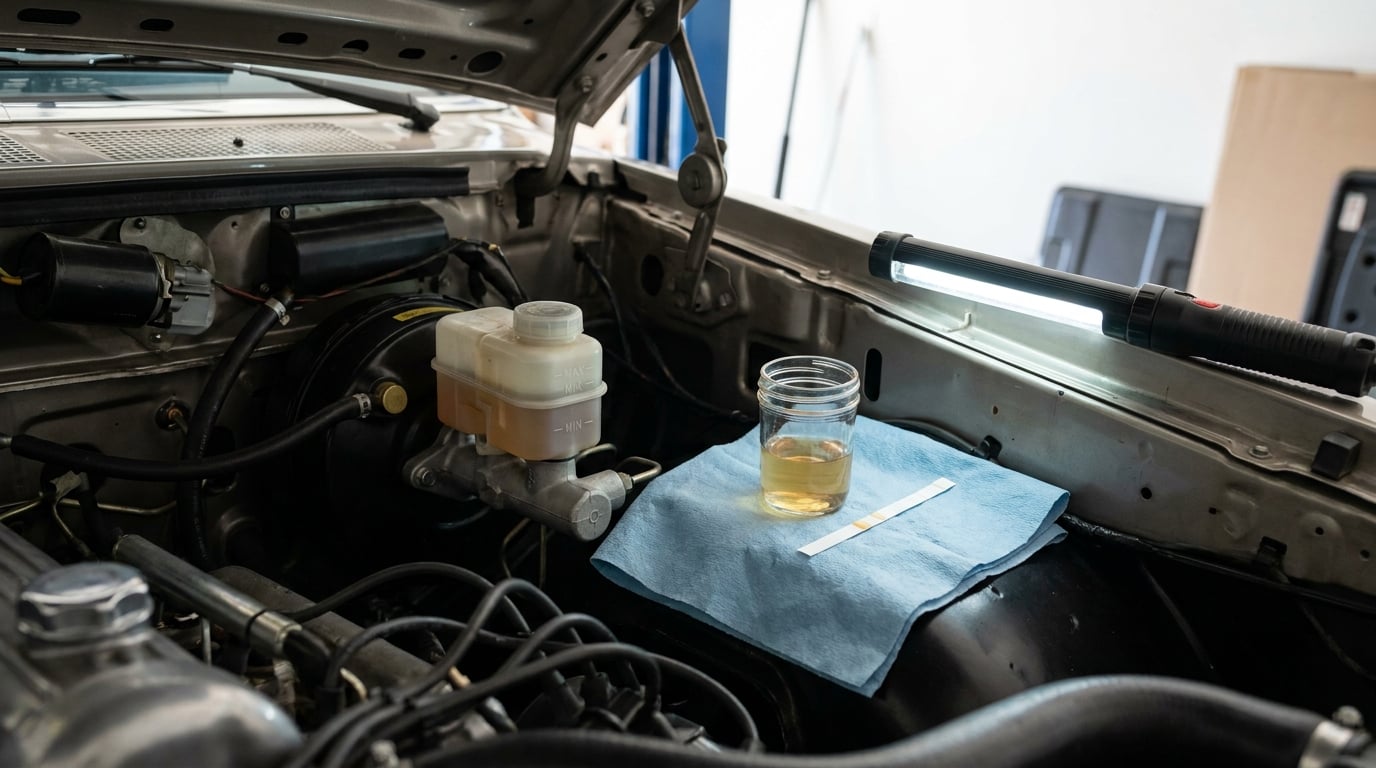
Checking brake fluid on a BMW takes about five minutes and needs almost nothing: level ground, a flashlight, a clean rag, and the owner’s manual. Park on flat ground with the engine off and cold, look at the translucent reservoir on the master cylinder, and compare the fluid line with the MIN and MAX marks molded into the plastic. Then look at the color through the wall. Here is the catch worth knowing before you start: color tells you what has happened to the fluid’s additive package, not how much water it has absorbed. Treat it as a screen that tells you when to look closer, not as a verdict.
On most BMWs the reservoir sits toward the firewall on the driver’s side of the engine bay, close to the round master cylinder body. A flashlight helps more than you would expect, because the engine bay is usually dusty and the fluid line is genuinely hard to see without one. If your car has a reservoir with no visible marks molded into the side, that is more common than it should be; more on that in step two.
Table of Contents
What You Need
The list is short, and almost every owner already owns all of it.
- The owner’s manual for your exact model and year. It gives the fluid specification and the reservoir location, and it is the only authority that matters on a BMW.
- A flashlight or a bright inspection lamp. The MIN and MAX lines are faint, and bay lighting is usually poor.
- Clean paper towels or a sheet of white paper to wipe the cap and to hold a dab of fluid so you can judge the color in daylight rather than in shadow.
- Nitrile gloves. Brake fluid is hygroscopic, meaning it pulls moisture out of the air, and it will strip paint on contact.
- A small clear sample container (optional but useful). A driveway cup or a clean glass jar lets you compare a sample against a fresh bottle.
One warning about fluid type, because this is where BMW owners get into trouble. Many BMWs specify DOT 4, and some specify a low-chloride or BMW-specific variant of it. DOT 5 is a silicone-based fluid, and it must never be mixed with DOT 3 or DOT 4. The two types are chemically incompatible, they look completely different, and a bottle of DOT 5 in your trunk is not a reasonable emergency substitute. If you are unsure what your car takes, read the cap marking and the manual before you open anything.
Step-by-Step: How to Check Brake Fluid Level and Color
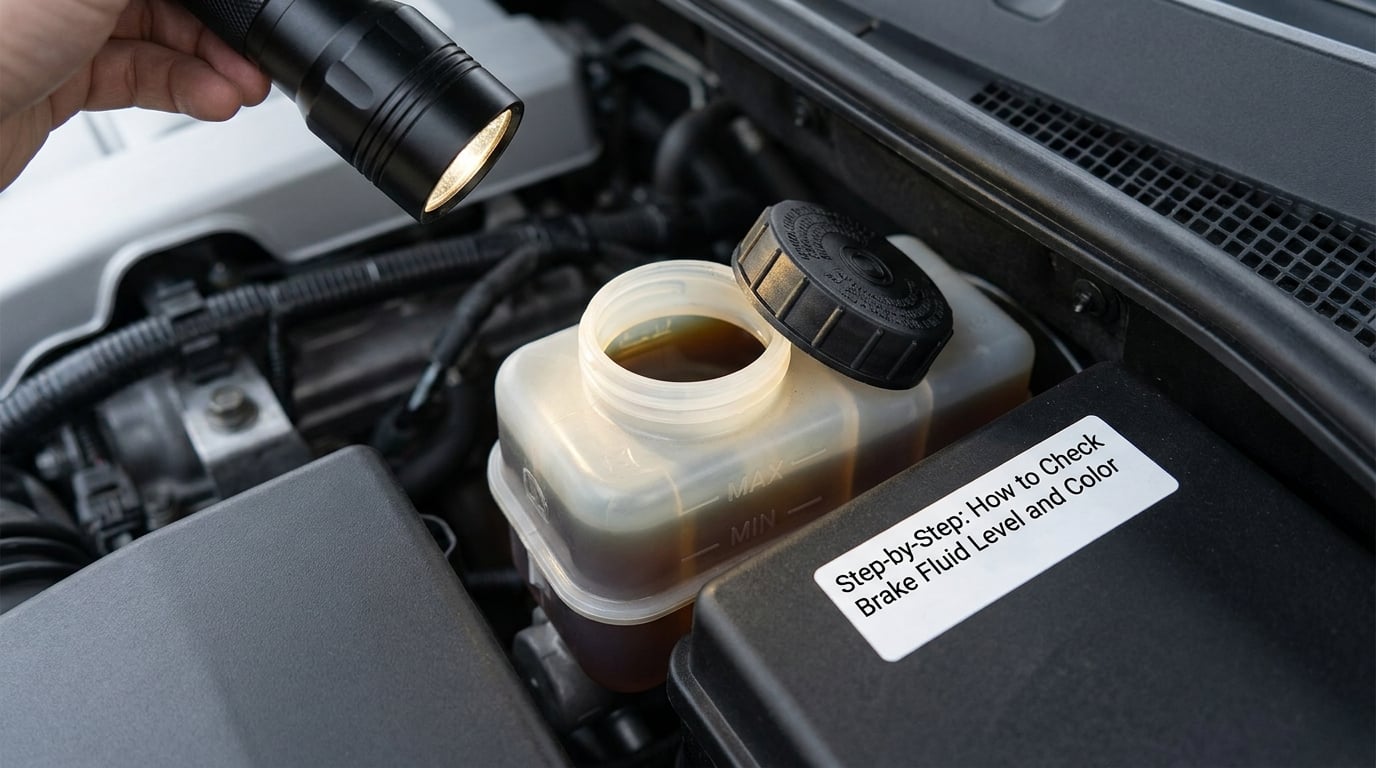
- Park the car on level ground, set the parking brake, switch the engine off, and let it cool completely.
- Open the hood and locate the brake fluid reservoir on top of the master cylinder near the driver’s side firewall.
- Wipe the reservoir cap clean with a paper towel before you remove it, so nothing falls into the fluid.
- Read the fluid level against the MIN and MAX lines molded into the translucent plastic, and look at the fluid color through the wall.
- Look for dampness around the reservoir, master cylinder, hard lines, flexible hoses, and the calipers at each wheel, then replace the cap and clean up any spill.
1. Park Safely and Find the Reservoir
Park on a genuinely level surface, not on a driveway slope, because the fluid line reads high on an incline and you could dismiss a real low level as normal. Set the parking brake, put the transmission in park, and let the engine cool. Working around a hot exhaust header or a hot brake assembly is how minor jobs turn into burn injuries.
Once the hood is up, look toward the back of the engine bay on the driver’s side. You are looking for a small plastic tank, usually milky white or translucent, sitting on or near a metal cylinder. On some cars the reservoir is remote from the master cylinder and connected by hoses, which is normal on vehicles with ABS and an electronic parking brake. If you are not certain which tank it is, the manual diagram settles it in seconds; guessing is how people end up checking power steering fluid instead.
2. Clean the Cap, Then Check the Fluid Level
Clean the cap before you open it. Brake fluid picks up dirt, dust, and moisture from everything it touches, and a reservoir on a BMW often sits in a corner of the bay where road grit collects. Wipe the cap and the neck of the tank with a damp towel, dry it, and only then remove the cap.
Now look at the level. The MIN and MAX lines are molded into the side of the reservoir, and the fluid surface should sit between them, closer to MAX. Some cars let you read the level without removing the cap at all, because the lines and the fluid line are both visible from outside; if you can see it, skip the cap entirely and leave the system sealed.
Here is the part owners get wrong: a level between MIN and MAX is not the same as a correct level. The fluid should read near MAX, and if it has dropped meaningfully below where it was at your last check, something is being consumed. A level below MIN is a fault, not a maintenance item. If your reservoir has no molded marks at all, judge it against the photo in the manual and against where the fluid sat when you bought the car; that is genuinely the best available reference.
3. Inspect the Color and Consistency
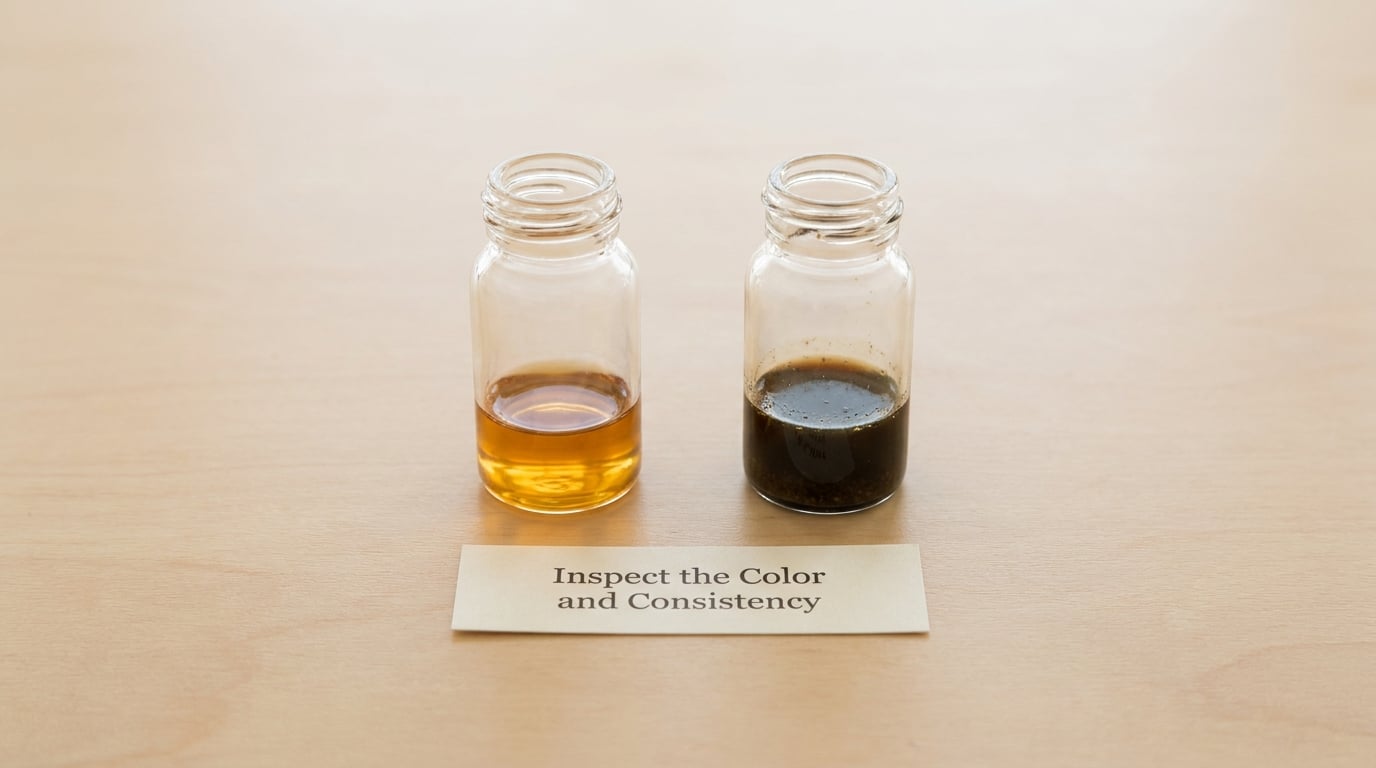
This is the color half of how to check brake fluid level and color, and it is where most guides oversell what they can tell you. Read the table as a screening tool, not a measurement.
| What you see | What it usually means | What to do |
|---|---|---|
| Clear, nearly colorless, or very pale straw | New fluid | Nothing. This is the target state after a flush. |
| Pale amber or honey | Normal new DOT 3 or DOT 4, sometimes tinted by the additive package | Normal. Judge it against a fresh bottle if you are unsure. |
| Medium amber to dark brown | Oxidized fluid, usually past its service life | Book a fluid change. It has absorbed moisture and lost boiling point margin. |
| Nearly black or opaque | Badly degraded fluid with burnt or contaminated additive package | Replace it fully. Do not top off. |
| Milky, cloudy, or a separated layer | Water or coolant contamination, or fluid of the wrong type | Do not drive it. Have it diagnosed and the system bled. |
| Visible grit, sediment, or specks | Corrosion or wear debris circulating in the system | Inspect the calipers and lines, then flush properly. |
Two honest caveats. First, a dark garage will make clean fluid look dirty and dirty fluid look black; take a dab on a paper towel and judge it outdoors. Second, color tracks the additive package, not water content. Fluid can look perfectly clear and still have absorbed enough moisture to lose a large share of its boiling point, which is the failure that matters on a long mountain descent. The reason mechanics keep pushing a two-year interval even when the fluid looks fine is that there is no filter in the system, only a small screen to catch debris. Degradation happens in place, and color slows down but never stops noticing it.
4. Check for Leaks and Reassemble
Low fluid almost always means a leak, so spend your time looking rather than topping up. Start at the reservoir and master cylinder, then follow the hard lines along the firewall and down the frame rails, then the flexible hoses where they enter each caliper, then the caliper body and the wheel cylinder. Look for a film, a wet spot, corrosion staining, or fluid collected in a bracket. Do not touch anything hot and do not reach near moving suspension parts; you are looking, not handling.
Replace the cap firmly. Then wipe up every drop. Brake fluid strips paint and softens clear coat in minutes, and it is toxic to pets and children, so treat any spill as a cleanup job, not a wipe-and-go. If you did open the reservoir, keep the cap off your workbench rather than setting it on a dirty surface, and dispose of any leftover fluid in a sealed container.
5. Know When to Service the Brakes
Work down this list based on what you actually found.
- Level near MAX, fluid clear or pale amber, no wetness: nothing to do today. Note the level and check again in three months or at your next oil change.
- Level between MIN and MAX but clearly lower than last time: a leak is the likely cause. Add the correct fluid to bring it back up, then find the leak before the level drops again.
- Level below MIN: do not keep driving. Inspect the lines, hoses, and calipers, or have a shop do it.
- Amber to dark brown, or any black, milky, or particulate fluid: schedule a proper fluid change rather than a top-off.
- Wetness anywhere, a brake warning light, or a pedal that travels further than usual: stop driving and have it diagnosed.
If you want a real number instead of a guess, a brake fluid moisture tester is cheap and takes about a minute. Under 2 percent water content is fine. At 2 to 3 percent, plan a flush. Above 3 percent, and especially approaching 4 percent, the fluid’s boiling point has dropped far enough to risk vapor lock and fade under repeated hard braking, so treat it as urgent. If the color looks fine and you have no tester, the next scheduled fluid change is still the right call rather than leaving it indefinitely.
One reassurance worth having, since it comes up constantly: driving a car with slightly low but clean fluid straight to a shop for a proper fluid change or a leak check is normally fine. What is not fine is topping it off every week, ignoring a pedal that goes soft or a warning light, or driving with milky or burnt-looking fluid. A short, careful trip to the driveway is a different situation from a two-hour drive on the highway.
Common Mistakes
- Judging condition by color alone. Clear fluid can still be moisture-heavy. Color is a screen; the moisture reading is the test. Our guide to how to tell if brake fluid is contaminated covers the finer signs.
- Opening the cap before cleaning around it. Grit falls straight into the reservoir, and the system has no filter to catch it.
- Treating a full-looking reservoir as a correct level. The marks are the reference, not the top of the tank, and not your memory of where it was last month.
- Checking on a slope or with the engine running. A slope shifts the reading, and a running engine changes the level as fluid moves through the master cylinder.
- Adding the wrong fluid type. DOT 3 and DOT 4 are both glycol-based and mixing them briefly is not catastrophic. DOT 5 is silicone-based, and mixing it with either one causes gel formation and a system that must be fully flushed. Check the cap marking before you pour anything.
- Topping off repeatedly instead of finding the leak. A reservoir that needs fluid every few weeks is telling you where a line or caliper is weeping. If a low-fluid light is on, start with what causes a low brake fluid warning light.
- Leaving spilled fluid on painted surfaces. Clean it immediately with water. If you want the actual moisture number rather than a guess from a paper towel, how to test brake fluid with a moisture tester is worth the few dollars.
As routine maintenance goes, this is one of the cheapest checks on the car. Look every three to six months, or at every oil change, whichever comes first. Look sooner if you tow, drive in coastal or humid weather, run a lot of downhill, sit in stop-and-go traffic, or store the car for months at a time. If your manual specifies a fluid change interval, that number outranks everything here. Most manuals land on two to three years or roughly 20,000 miles, whichever arrives first.
Frequently Asked Questions
What color should brake fluid be?
Fresh DOT 3 or DOT 4 should look clear to pale straw, sometimes a light amber or honey tint from the additive package. Older fluid moves through amber, then dark brown, and ends up nearly black. A milky or cloudy look means water or coolant contamination rather than normal aging, and visible grit means debris in the system. Keep in mind that color reflects the additive package, not moisture content, so a clear sample can still need replacing on schedule.
Can I use DOT 5 brake fluid in my BMW?
Only if your manual or your reservoir cap specifically calls for DOT 5. Most BMWs specify DOT 4, and DOT 5 is a silicone-based fluid that must never be mixed with glycol-based DOT 3 or DOT 4. Mixing them can cause the fluid to gel, which clogs valves and can render the system unusable until it is fully flushed. If your car calls for DOT 4, buy DOT 4 and stay with it.
Should I check brake fluid when the engine is cold or hot?
Check it cold, with the engine off. A hot reservoir expands the fluid and can hide a low reading, and a running engine moves fluid through the master cylinder, which also distorts the level. The exception is right after a long drive: let the car sit until the engine and exhaust are cool, then look. Reading a warm reservoir is not dangerous, it is just unreliable.
Is it safe to add brake fluid when the level is low?
Topping up with the correct DOT type is safe and is the right first move, because a low level usually means something is leaking. Use only sealed, unopened fluid from the correct specification, never fluid from an old open bottle, and never mix types. Topping off restores the level but does not flush anything, and if you keep needing fluid, the level will keep dropping until the leak is found. Get it inspected rather than repeating the top-off.
How can I tell if brake fluid has absorbed too much moisture?
Color will not tell you. A moisture tester or test strips will: under 2 percent is fine, 2 to 3 percent means a flush is due, and above 3 percent, especially near 4 percent, the boiling point has dropped far enough to cause fade and vapor lock under hard braking. A drop of fluid that separates into two layers, or looks milky, is another strong signal. In the absence of a tester, follow your manual’s fluid change interval rather than waiting for the color to change.
Conclusion
Park on level ground, engine off and cool, and read the reservoir against its MIN and MAX marks before you do anything else. Take a dab of the fluid on a paper towel, look at it in daylight, and check the reservoir, lines, hoses, and calipers for wetness. That five-minute routine answers most of the question, and it is worth doing every three to six months or at every oil change.
Low fluid, visible leaks, a brake warning light, a pedal that feels softer or travels further, and brown, black, milky, or gritty fluid all mean one thing: stop topping off and get a proper diagnosis. Fluid at a readable level with a clean, pale color means your BMW’s brakes are fine today. As of 2026, the owner’s manual still settles every question this check raises, including the one that matters most, which is the specification your car actually requires.