
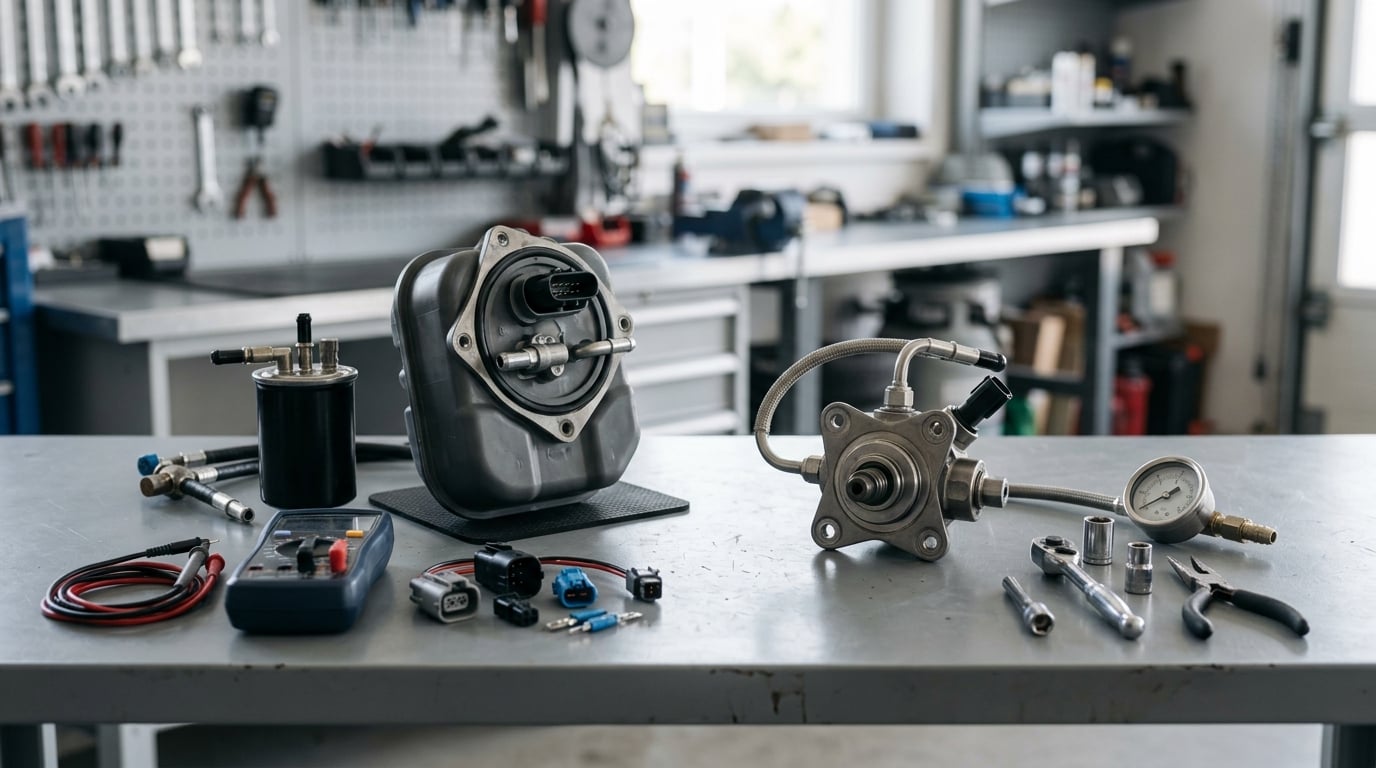
A failing BMW fuel pump shows up as extended cranking, a rough or unsteady idle, hesitation or stalling under acceleration, loss of power at highway speed, and a check engine light or limp mode. Most BMWs run two fuel pumps, so the exact symptom set depends on which one is dying. Here are the eight signs worth knowing, what causes them, and how to test the system before you buy parts.
That last point matters more than most guides admit. Owners on the E90 and 1addicts boards routinely report three or four shop visits and multiple pumps replaced before anyone looked at the injectors. A fuel pump that throws a code and a fuel pump that is actually causing your drivability complaint are two different problems, and the second one is the expensive one.
Table of Contents
- BMW Fuel Pump Failure Symptoms: 8 Signs to Recognize
- How BMW Fuel System Failure Symptoms Develop
- What Causes BMW Fuel Pump Failure?
- How to Test BMW Fuel Pump and Fuel Pressure
- When Is It Safe to Drive a BMW With Fuel Pump Problems?
- How to Fix BMW Fuel Pump Failure Symptoms
- Frequently Asked Questions
- What are the most common BMW fuel pump failure symptoms?
- What does a failing fuel pump sound like?
- Can a bad fuel pump cause a BMW not to start?
- How do I check fuel pump pressure on a BMW?
- Should I drive if my BMW stalls when the fuel is low?
- Why does a BMW fuel pump fail even after replacing the filter?
- Conclusion
BMW Fuel Pump Failure Symptoms: 8 Signs to Recognize
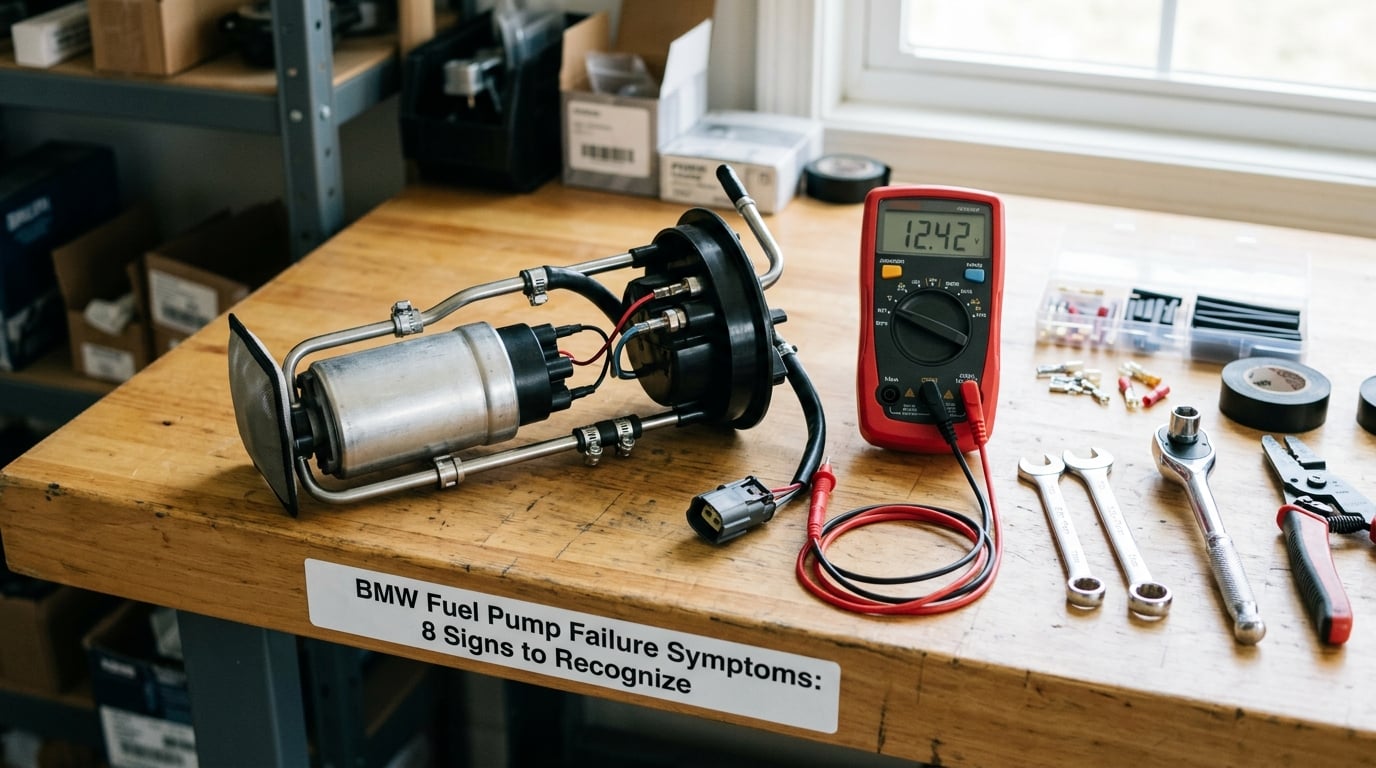
Read the table below before anything else. It maps each sign to what is usually behind it and how quickly you need to act.
| Sign | What you notice | Usual cause | Urgency |
|---|---|---|---|
| Long crank | Starter turns for several seconds, especially after the car has sat overnight | HPFP pressure loss or low-pressure side holding no fuel | Watch it |
| Rough idle | Shaking at idle, worst when cold, then settling once warm | Lean running from low rail pressure, or DME failsafe | Watch it |
| Hesitation | Stutter between roughly 2,500 and 4,000 rpm in third through sixth | Intake carbon, VANOS solenoids, or starving injectors | Book a look |
| Stalling under load | Engine dies climbing a hill, towing, or on hard acceleration | Fuel demand outruns what the pump can deliver | Book a look |
| Loss of power | Flat feeling at highway speed, boost that fades early | Turbo bypass or reduced fuel delivery in failsafe | Book a look |
| Misfires | Cylinder-specific or random misfire counts, rough shake under load | Starved or contaminated injectors | Book a look |
| Warning lights and codes | 1/2 engine light, Service Engine Soon, limp mode | Stored fuel pressure faults such as 2AAF, 4A4A, P0087, 29DC | Read the codes |
| Sounds and smells | Whine from under the rear seat, ticking from the engine bay, or a fuel smell | Worn pump motor, HPFP solenoid, or an actual leak | Smell means stop |
Cold start versus hot start behaviour is the first clue
A pump that has lost pressure overnight will crank long when the car has been sitting. Press start after thirty minutes and it starts normally; press start after twelve hours and the starter runs for four or five seconds before it catches. Owners describe the same pattern for months before anything else shows up.
That is the pattern to note, because it separates a fuel pressure problem from a battery or starter problem. A weak battery cranks slowly and gets worse every time. A starving pump cranks at normal speed and then catches suddenly.
Whining, ticking and rattling come from different places
A rising whine from the fuel tank area that follows engine speed is the low-pressure pump motor wearing out. A ticking or light rattling that changes with rpm and comes from the engine bay is usually the high-pressure pump solenoid or fuel control valve clicking as it struggles.
Neither noise proves failure on its own. Plenty of healthy cars make a faint pump hum, and a valve-train rattle sounds similar if you are not sure where it is coming from.
How BMW Fuel System Failure Symptoms Develop
Fuel delivery is a chain: the tank pump draws fuel and pushes it forward under low pressure, the engine-bay high-pressure pump lifts it to thousands of psi, and the control valve meters it to the injectors. When a link in that chain weakens, the pressure the DME expects slowly stops matching reality.
The key thing to understand is that the symptoms do not prove the pump is at fault. A weak fuel rail pressure sensor, a clogged filter, or a wiring fault at the pump connector produces the identical complaint, and the pump may be perfectly healthy.
Early signs versus late signs
In the early stage the engine compensates. Cold starts get a little longer, the idle is a touch more uneven, and fuel economy drops a percent or two. None of that is dramatic, which is why it gets ignored for weeks or months.
In the late stage the DME can no longer hold pressure under load. That is when you get stalling under acceleration, misfire counts that keep climbing, and eventually a car that will not restart. The progression is not linear. Some cars jump from mild rough idle to refusing to start in a week.
What the DME does in failsafe
Here is the part that confuses people. When rail pressure drops below what the engine needs, a solid HPFP failure does not usually kill the motor outright. The DME bypasses the high-pressure pump, shuts down boost, and routes fuel straight to the injectors, running the engine on low-pressure fuel.
That is why the engine shakes and runs rough instead of dying. What feels like a dying engine is actually a protective strategy, and the turbo noise disappearing when you ask for full power is part of the same event.
What Causes BMW Fuel Pump Failure?
Causes run from ordinary wear to wiring, and they cluster differently depending on which pump you are looking at. None of them produce a symptom set that identifies itself.
Worn motors, clogged filters and fuel quality
The most common mechanical cause is simply a pump motor wearing out. On the HPFP, the internal valve and solenoid take the punishment and eventually stop holding pressure. On the tank unit, the pump and the fuel level sensor in the same module fail together often enough that BMW sells them as one assembly.
A neglected fuel filter starves the high-pressure pump and forces it to draw harder than it was designed to. Owners report failures at wildly unpredictable mileages, from a few hundred miles on a nearly new car to well over 60,000 on one that had been serviced on schedule, so maintenance history is a weak predictor.
Fuel brand is a weak predictor too. Failures show up on cars that ran one brand exclusively, which is why brand-switching advice does not hold up. What does help is using good quality fuel from a station with a reliable supply and avoiding a tank that has been left sitting for months.
Electrical faults and control module failures
The pump, its pressure sensor, its connector, and the fuel control valve are all electrical, and all of them age. Corroded connectors under the rear seat or in the engine bay cause intermittent symptoms that come and go with weather, which is why some cars start fine after a drive and refuse to start after it has stood.
On the diesels and on some later petrol engines, the electric pump in the tank is commanded by a control module rather than a relay and fuse. When that module misbehaves you get a live fuel supply message on the dash, sometimes while the engine is still running.
What gets mistaken for a bad fuel pump
This is the expensive list, because every item on it produces the same complaint as a dying pump.
- Leaky or contaminated injectors. A leaking injector floods one cylinder, a dirty one delivers erratically. Owners who replaced the HPFP, the LPFP, the pressure sensor, plugs and coils before finally replacing injectors described exactly this trap.
- Clogged VANOS solenoids. Causes hesitation and a rough idle with no warning light at all.
- Carbon build-up in the intake ports. On direct-injection engines, walnut blasting resolves mid-range hesitation that looks identical to a fuel starvation complaint.
- Clogged fuel filter. Cheap to check, expensive to ignore.
- Coils and spark plugs. A misfire under load with no fuel code usually means ignition.
- Weak battery. Low cranking voltage can starve the pump during start-up and mimic a long crank.
Which engines are most prone
Model and engine code tell you where to start looking, not what will fail.
| Platform | Common engines | Which pump draws complaints |
|---|---|---|
| E46 | M54, N52 | LPFP and fuel level sensor module |
| E60 | N52, N54 | HPFP on the N54, a well-documented weak spot |
| E90 / E92 | N54, N55, N52 | HPFP on the N54, LPFP on the N52 |
| F30 / F32 | N20, B48 | Both pumps; fuel rail sensor on the N20 |
| F10 / F11 | N55, B48 | LPFP module and electric pump drive |
| G-series | B48, B58 | Electric tank pump, pressure sensor, control valve |
How to Test BMW Fuel Pump and Fuel Pressure
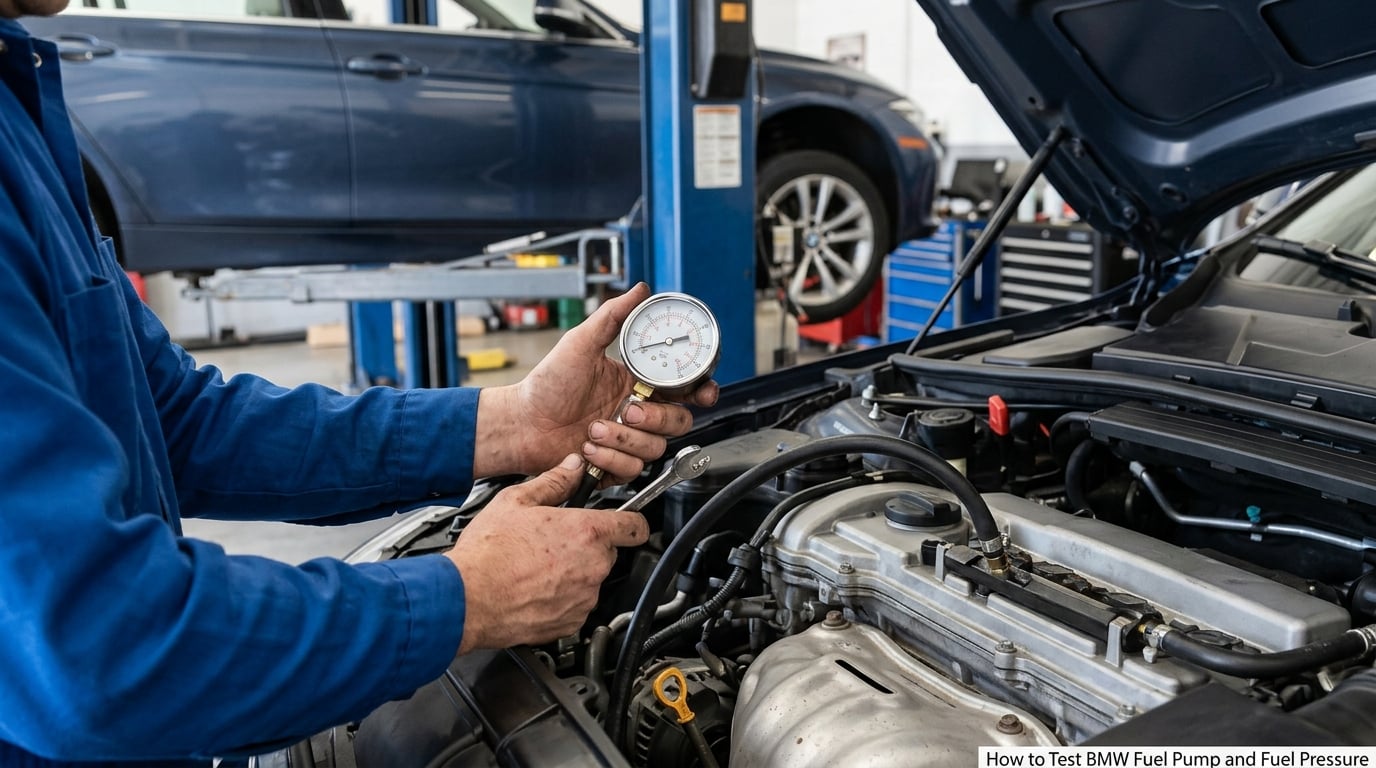
Work through this in order. Each step tells you whether the next one is worth doing, and skipping ahead is how people end up with a new pump on a car that had a wiring fault.
- Scan and photograph the codes. Use a BT scanner or equivalent and clear them, then drive until the symptom returns and scan again. Codes that will not reset on a clear-and-crank point away from a simple pressure fault.
- Watch live fuel rail pressure. With the engine idling and again at 3,000 rpm, note the commanded pressure against the actual reading. A sensor that reports low pressure while the engine runs fine is a sensor, not a pump.
- Check power and ground at the pump connector. Verify the relay operation, fuse, and voltage drop on the ground side under load. Intermittent corrosion here explains symptoms that come and go.
- Inspect the fuel filter. Note its date or mileage if it was replaced. A starving high-pressure pump downstream of a blocked filter will fail again even with a brand-new pump fitted.
- Run a mechanical pressure test. A gauge on the fuel rail gives a hard number against the specification for your engine. This is pressurised fuel work, and it needs the correct adapter, the correct procedure, and a shop that does it regularly.
- Only then swap a component. If pressure is confirmed low, replace the pump. If pressure is correct and the misfire counts keep climbing, test the injectors instead.
Follow the service manual for your specific BMW. Fuel pressure specifications, connector pinouts, and test points differ across engines, and the numbers in a forum post are not yours.
One more thing before you read any code. The code 2AAF fuel pump probable is over-sensitive, and BMW’s own troubleshooting documentation requires a documented test procedure before you replace the low-pressure pump on that code alone. Replacing a pump on 2AAF is the single most common expensive mistake on these cars.
When Is It Safe to Drive a BMW With Fuel Pump Problems?
Short answer: sometimes, for a short trip to a shop, and only when the failure is a pressure problem with no leak. Not when there is a fuel smell, and not when the engine is stalling under load.
Stop driving and tow it if you notice any of these:
- Any smell of fuel, inside or outside the car. A smell means a leak, and pressurised fuel near a hot exhaust is a fire risk.
- Visible fuel on the ground under the car.
- Stalling at idle, stalling on hills, or stalling repeatedly at highway speed.
- Misfire counts that keep rising, or a severe shake.
- A fuel smell warning message or a fuel supply message with the engine running.
A long crank paired with a rough idle and a stored pressure code is a different situation. That combination is consistent with a pump losing pressure, not with a leak, and a careful drive to a shop is reasonable if the car starts reliably when you ask it to. Keep the trip short, drive gently, and avoid sustained high rpm.
One owner habit from the forums genuinely helps in the meantime. Hold the brake pedal for a couple of seconds before pressing start. That gives the low-pressure system time to prime, and it takes the worst of the long crank out of the start. It buys you time; it does not fix anything.
How to Fix BMW Fuel Pump Failure Symptoms
Once a pump is confirmed, the repair itself is the easy part. What matters is what you check at the same time, because a contaminated system puts the new pump through the same failure.
On the high-pressure pump, the job is remove, replace, and bleed the system properly. Many shops skip the bleed, and the car will run rough for days afterward while the air works out of the rail, which leads owners to think the new pump is bad too.
If a high-pressure pump has failed hard, it can throw metal debris through the fuel rail and into the injectors. When debris is found, injectors get replaced in banks rather than individually, which is why the same fault can turn into a very different job depending on what comes out when the rail is opened. Ask whether the injectors were pulled and inspected before you accept the invoice.
Two things make repairs worse than they need to be. The first is a budget pump that fails within weeks. Owners report off-brand pumps dying in a fraction of the time the original lasted. The second is a dealer that claims to have fitted a revised pump and hands back the old part number. Ask for the part number in writing before the car leaves.
On the low-pressure side, replacement usually means the whole tank fuel unit module, which is why the job runs into four figures on a car where the fuel tank sits under the rear seat. Scope it properly before ordering parts.
What reduces the odds of a repeat:
- Replace the fuel filter on schedule, and never fit a new pump onto a filter you have not inspected.
- Use good quality fuel from a busy station.
- Keep the codes cleared and read. Catching a pressure fault early costs far less than catching it after an injector job.
- Run a scan after any fuel system work and confirm pressure readings before you call the repair finished.
If your car is a known high-pressure pump candidate and the failure happened early in its life, check whether a manufacturer warranty extension or technical service bulletin was open for your model year before you pay for anything out of pocket. Owners of affected cars have also used repeated failed repairs as grounds for a state lemon law claim, though that is a legal question rather than a mechanical one, and the rules differ by state.
Frequently Asked Questions
What are the most common BMW fuel pump failure symptoms?
The four most common are extended cranking time, a rough or unsteady idle, hesitation or stalling when you accelerate, and a check engine or Service Engine Soon light. Many owners also notice a whine from under the rear seat or a slight drop in fuel economy. Because most BMWs have both a low-pressure and a high-pressure pump, the exact pattern depends on which one is weakening. Symptoms alone never confirm which component is at fault, so codes and a pressure test come before parts.
What does a failing fuel pump sound like?
A rising whine from the fuel tank area that tracks engine speed usually points to the low-pressure pump motor wearing out. A ticking or light rattling from the engine bay that changes with rpm often comes from the high-pressure pump solenoid or the fuel control valve. Some owners report a purring noise at idle right before the engine cuts out. None of these noises confirms a fault on their own, because healthy pumps hum and a valve-train rattle can sound similar.
Can a bad fuel pump cause a BMW not to start?
Yes. If the pump cannot hold pressure, the engine will crank far longer than usual and may not catch at all, especially after the car has been sitting overnight. A car that cranks at normal speed and then suddenly fires is a different symptom from one that cranks slowly and weakly, which points at the battery or starter instead. Before replacing a pump, confirm low pressure with a gauge and check the codes, because a weak battery can starve the pump during start-up and mimic the same complaint.
How do I check fuel pump pressure on a BMW?
Connect the correct adapter to the fuel rail test port and read rail pressure with a gauge, comparing it against the specification for your engine. On a healthy car the reading holds steady at idle and rises under load. Watch live rail pressure data in the scan tool at the same time, since a sensor that reports low while the engine runs fine is a sensor fault rather than a pump fault. This is pressurised fuel work, so have a shop do it or follow the service manual for your specific model.
Should I drive if my BMW stalls when the fuel is low?
Do not drive it. Stalling under load is the point where a pressure problem stops being a drivability complaint and becomes a stranding risk, and the stall can happen without warning on a highway entrance or on a hill. If the car stalls only at idle and a fuel smell is present, treat it the same way and tow it. A long crank with a rough idle and a stored pressure code is a milder situation, and a careful short trip to a shop is reasonable if it starts reliably when asked.
Why does a BMW fuel pump fail even after replacing the filter?
Usually because the filter was never the cause. A clogged filter is one of several things that starve the high-pressure pump, and a weak fuel rail pressure sensor, a corroded connector, or a control valve can produce identical symptoms. The opposite happens too, with a new pump fitted to a dirty system failing again in weeks. Replacing the filter without a pressure test is treating a guess, and the code 2AAF fuel pump probable fault is too over-sensitive to justify a pump on its own.
Conclusion
The first thing to do is work out which kind of fault you have: electrical, fuel pressure, or mechanical. Read the codes, watch live rail pressure, and confirm with a gauge before any part comes off. That sequence costs an hour and separates a pump replacement from a four-visit injector saga.
Start the sequence by writing down the year, model, engine, and whether the complaint is a long crank or a loss of power under load. Those four details decide most of the diagnosis before the car even reaches a shop.