
The lifetime fill claim is a myth in the way most BMW owners hear it. ZF, which builds the 8HP automatic, calls its factory fill maintenance-free and recommends an oil change after 150,000 km, or sooner under high temperature, heavy load, or an unknown service history. In practice most specialists settle on 50,000 to 75,000 miles or eight years, whichever arrives first.
What BMW actually means by lifetime is narrower than the marketing suggests. The transmissions are rated as tested to roughly 100,000 miles on the original fill with an acceptable rate of failure, which is also about where the extended warranty and the good-will repair limit run out. So the BMW transmission fluid change question is really a question about warranty accounting rather than about how long a gearbox can run on one fill of oil.
Quick answer: Lifetime in BMW language means the coverage period on the factory fill, not the working life of the fluid.
What ZF specifies: maintenance-free from the factory, oil change recommended after 150,000 km, shorter under high heat, heavy load or unknown history (ZF document TE-ML 11).
What to actually do: service the fluid, the integrated filter and the pan every 50,000 to 75,000 miles or eight years, and closer in if you tow, drive hard or bought the car without records.
Table of Contents
- BMW Transmission Fluid Change Lifetime Fill Myth: What Is the Truth?
- What Does Lifetime Fill Actually Mean?
- How Often Does BMW Transmission Fluid Need Changing?
- Why Does the Lifetime-Fill Myth Persist?
- What Happens If BMW Transmission Fluid Is Never Changed?
- How Fluid Condition and Driving Style Affect Service
- How to Inspect BMW Transmission Fluid Safely
- Lifetime Fill Versus Scheduled Service: What Should You Do?
- Frequently Asked Questions
- How often should transmission fluid be changed on a BMW?
- Is 120,000 miles too late to change transmission fluid?
- Why do some mechanics say not to change transmission fluid?
- Does a transmission flush hurt an old transmission?
- How can I tell if my BMW’s transmission fluid was ever changed?
- Does BMW require transmission fluid changes under warranty?
- What to Do First
BMW Transmission Fluid Change Lifetime Fill Myth: What Is the Truth?
The truth is that the lifetime fill label describes a sealed or monitored component, and a transmission is neither. Sealed for life usually means there is no routine service item to replace. A BMW automatic has a fluid, a filter and a torque converter that all wear at different rates, and the fluid is the only friction and hydraulic medium inside the gearbox.
BMW has also never published a lifetime interval because there is no such interval to publish. The Condition Based Service messages on the dash talk about oil, brakes, coolant and filters, and they never mention transmission fluid at all. That silence gets read as permission by a lot of owners, and dealers repeat it, which is why the myth keeps regenerating every model year.
What Does Lifetime Fill Actually Mean?
Lifetime fill is a warranty and marketing term, and it refers to the transmission system being covered rather than the fluid being immortal. The fluid is specified to do a job for a defined window, and the gearbox is rated to hold together with an agreed failure rate inside the warranty period. The two numbers are close enough to feel like the same statement and different enough to matter to your wallet later.
It also varies by car. Pre-2010 BMWs often carry older six-speed automatics from different suppliers, while most modern cars run the ZF 8HP family, and each has its own fluid spec. Lifeguard 6, 7 and 8 are not interchangeable, and forum threads about catastrophic failures usually trace back to a shop using the wrong one.
The honest way to read the label is this: the factory fill is warranted for a period of time, and nothing in the warranty promises you a fresh fluid at any mileage.
How Often Does BMW Transmission Fluid Need Changing?
Use ranges rather than a single number, because the schedule depends on the gearbox, the fluid type, how the car is used and what you know about its past. ZF maintenance document TE-ML 11 calls the factory fill maintenance-free and recommends an oil change after 150,000 km, with shorter intervals under high temperature, high load or an unknown vehicle history. Specialists translate that into something practical for street cars.
| How the car is used | When to service | Why the range moves |
|---|---|---|
| Mostly highway, relaxed pace | 75,000 miles or 8 years | Lower heat and load, fluid holds its friction longer |
| Mixed city and highway | 60,000 miles or 6 years | Normal daily use, the most common ownership pattern |
| Heavy stop-and-go, towing, severe heat | 40,000 to 50,000 miles | More clutch cycling and higher fluid temperature |
| Track days or a tuned engine | Around 40,000 miles, or once a season | Torque converter load and heat soak accelerate wear |
| Used car with no records | Treat it as overdue now | Unknown history is exactly the condition ZF flags |
The service is more than pouring out old fluid. The 8HP uses a transmission pan with the filter built into it, so the pan, its gasket seal and the bolts are replaced at the same time. The shop drains and refills cold, warms the fluid to 40-50C, cycles through every gear, then tops off again, because the volume expands with heat and the first fill always reads low.
Why Does the Lifetime-Fill Myth Persist?
Several things reinforce it. The gearbox is quiet when new, so owners get no signal at all, and a car that never makes a noise feels like proof that nothing needs doing. Maintenance-free wording is repeated by sales staff and service advisors who are quoting a warranty document rather than a maintenance manual. Low-mileage cars are everywhere on used-car lots, so plenty of high-mileage survivors with no service history exist purely by luck.
The fluid itself also hides its age. It is sealed in a sump you cannot see from the driver’s seat, and there is no dash warning when it degrades. Meanwhile the counter-argument keeps circulating online, that fresh fluid can stir up settled debris and unsettle a worn clutch pack. That is why r/E90 threads are full of owners paralyzed over a simple job. One r/BmwTech post sums up the whole disagreement in a line: BMW say it is lifetime oil, ZF say it is good for 100,000 km, and BMW calculates 180,000 km as end of life for the car.
What Happens If BMW Transmission Fluid Is Never Changed?
Fluid that has never been changed loses viscosity and its friction characteristics, and it picks up metal and wear material from the clutch packs and the valve body. The first things you notice are usually a faint groan at cold start, cold shifts that hang a beat too long, harsh changes once warm, or delayed engagement when you pull away from a stop.
What happens next is mechanical rather than cosmetic. The mechatronics module and the solenoids it commands depend on precise hydraulic pressure, and bimmerforums threads on these failures often land on a wearing main pressure valve inside the valve body. A torque converter that has been running thin can carry the same damage forward into what looks like an engine problem.
None of this is a guarantee. Plenty of cars run a very long time on one fill, and a handful make enormous mileage. The trouble is that failure mode is lopsided, and a fluid and filter service costs a fraction of the repair that follows a worn valve body.
How Fluid Condition and Driving Style Affect Service
The same car on two different schedules is the whole argument for ranges. Stop-and-go traffic cycles the clutch packs far more often than a steady motorway run, and each cycle stirs heat into fluid that is already working hard. Towing a trailer and long climbs in summer raise fluid temperature, which is the condition ZF names when it asks for shorter intervals. Track days are the extreme version of that load.
Cold weather pulls the other way. Fluid that has been sitting overnight drops out of its optimal viscosity window, which is why cold-start noise and hanging cold shifts show up on a car that shifts perfectly once warm. Repeated short trips never let the transmission reach full operating temperature, so condensation keeps building in the fluid, and the same problem shows up everywhere else on a car that lives on two-mile errands. Our guide to how often to change oil in a car that sits covers that logic in more detail.
An engine tune adds another layer. More torque and more heat than the fluid was specified for, on a component that was not designed for that output, shortens the margin on every service interval. And a used BMW with no records is the most common case in this whole conversation, because ZF names unknown history as its own reason to shorten the interval.
How to Inspect BMW Transmission Fluid Safely
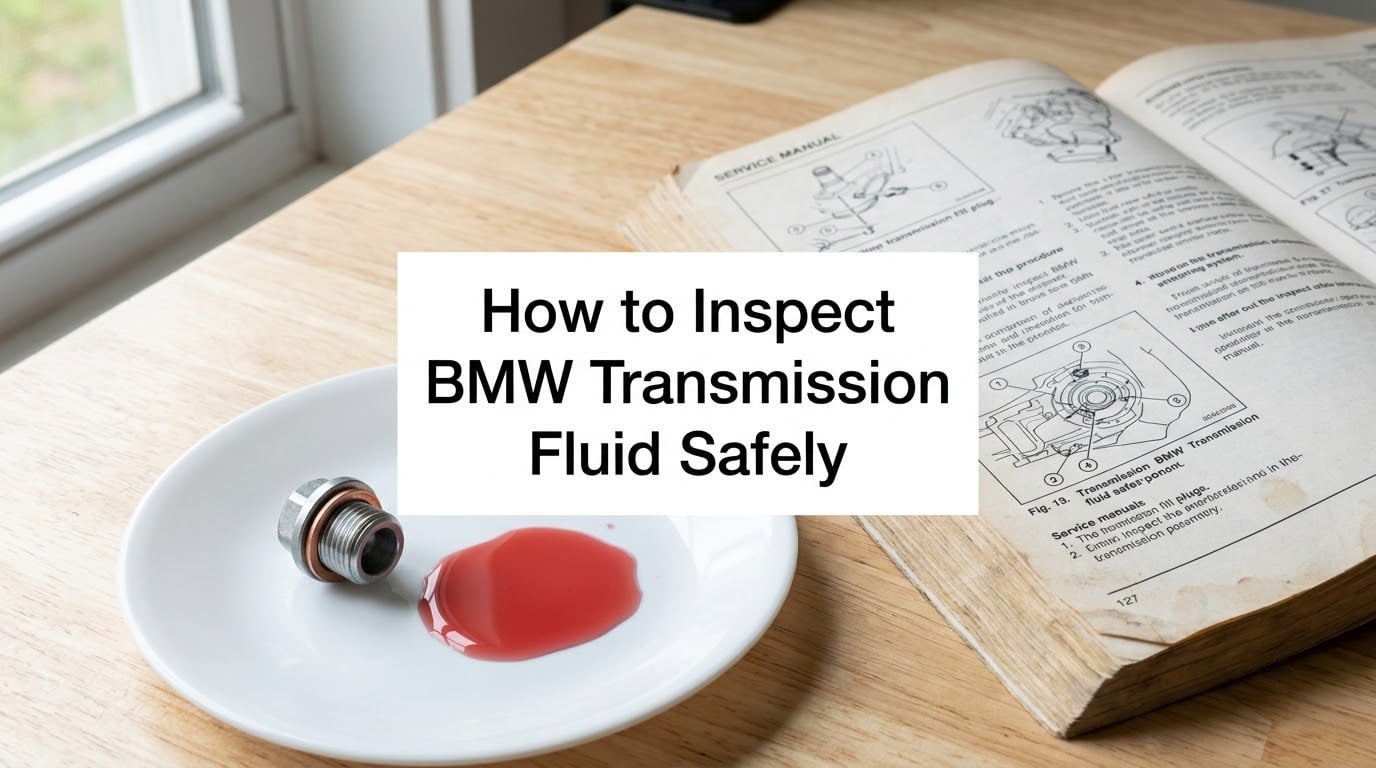
Start with the owner’s manual in the glovebox, because the check procedure and fluid spec are model specific. Most 8HP gearboxes are checked by removing the undertray and undoing the fill plug, since there is no dipstick to pull. Confirm the required Lifeguard spec before anything is ordered, and confirm the check procedure before anyone puts a wrench on the car.
What you are looking for is condition more than volume. Fluid that is very dark and opaque, smells burnt, or carries visible metallic particles all point to a transmission that needs a specialist look rather than a weekend drain. Fluid that returns clear and red-brown is a better sign, and the plug threads and seal condition are worth noting too, because a plug that will not come out cleanly suggests nobody has touched it in a very long time.
A drain-and-fill check leaves most of the fluid in the sump, so it tells you about condition and not much about volume. The full service with a scan tool, a warm top-off and a gear cycle is a shop job, and it is the only way to know the unit is holding the right level with the right fluid.
Get a qualified transmission specialist involved the moment you notice a cold-start groan, a shift that hangs, or a flare on the road. Those are the symptoms that turn a routine service into an urgent one.
Lifetime Fill Versus Scheduled Service: What Should You Do?
A BMW transmission fluid change on schedule is a small, well-understood job, and the arguments online are almost entirely about two edge cases. Here is the framework most owners settle on.
Is it too late at 120,000 miles or more?
No, and this is the question driving most of the panic. Fresh fluid cannot fix clutches that are already worn through, but starvation accelerates wear on healthy parts, so the argument for doing it at 150,000 miles is weaker than the argument for doing it at 60,000. On a car that shifts fine today and has no symptoms, a careful staged service at an independent specialist is the sensible call.
Flush or drain-and-fill?
Staged drain-and-fill, with the fill plug opened, the pan off and the filter replaced. A high-pressure machine flush on a high-mileage 8HP pushes debris through valves and clutches that may already be worn, and that is the scenario owners fear for a reason. The refill also has to use the exact Lifeguard spec for the gearbox, and this is where a lot of the reported catastrophes begin.
What about the other fluids while you are there?
Ask for the xDrive transfer case and differential fluids on the same visit if the car has them. Both are cheaper to do alongside the transmission service and far more expensive to reach later. Manual transmission owners have an easier decision, since the gearbox oil service is short, low risk and on a shorter interval than most people assume.
Keep the invoice, note the mileage and the fluid spec, and check the fill plug before you buy a used car. On an E90/F30 thread an owner at 100,000-plus miles found the fluid at the plug was very dark and the plug itself nearly impossible to loosen, which told the story of the entire maintenance history in one moment.
Frequently Asked Questions
How often should transmission fluid be changed on a BMW?
ZF, which builds the 8HP automatic used in most modern BMWs, states in its own maintenance document that the factory fill is maintenance-free but recommends an oil change after 150,000 km, and sooner under high heat, heavy load or unknown service history. Most specialists translate that to 50,000 to 75,000 miles or eight years, whichever comes first, with 40,000 to 50,000 miles for aggressive driving.
Is 120,000 miles too late to change transmission fluid?
No. Fresh fluid cannot repair a clutch pack that is already worn through, but thin, degraded fluid accelerates wear on parts that are still healthy. Owners with a high-mileage car that shifts well and makes no noise usually choose a careful staged drain-and-fill at an independent specialist rather than skipping the service entirely.
Why do some mechanics say not to change transmission fluid?
The concern is real but narrow. A machine flush on a high-mileage gearbox can push settled debris through valves and clutches that are already worn, and a sudden pressure or friction change can expose existing wear. That is an argument for a gentle staged service, not for leaving factory fluid in a transmission for the life of the car.
Does a transmission flush hurt an old transmission?
On an older 8HP with wear, a high-pressure flush is the riskier option. Most specialists prefer a drain-and-fill with the pan removed and the integrated filter replaced, a cold fill first, a warm top-off between 40 and 50C, and a cycle through every gear. The wrong Lifeguard spec is a separate and more expensive failure mode than the flush itself.
How can I tell if my BMW’s transmission fluid was ever changed?
Pull the service records first, then look at the fill plug under the undertray. Fluid that is very dark, smells burnt or carries metal particles suggests the factory fill is still in there. A plug that resists removal, missing service stamps on the maintenance sticker and a car bought without records all point the same way.
Does BMW require transmission fluid changes under warranty?
BMW does not list a transmission fluid service in its Condition Based Service schedule, and the lifetime fill wording points at warranty coverage rather than a maintenance requirement. What matters practically is that the transmissions are rated against a roughly 100,000-mile test window on the original fill, which is also close to where extended coverage and good-will repairs end.
What to Do First
Start with the check under the undertray, then book the service at the interval your driving style calls for rather than waiting for a noise. If your car already has no fluid change in its history, treat the lifetime fill claim as closed and put it on the schedule. The fluid, the filter and the pan are inexpensive compared with a valve body or a rebuilt 8HP, and the mileage myth is not worth betting a gearbox on. While you are booking, it is worth stacking up the rest of the routine work too, and how long an oil change takes is a quick way to work out how much of a day to set aside.