
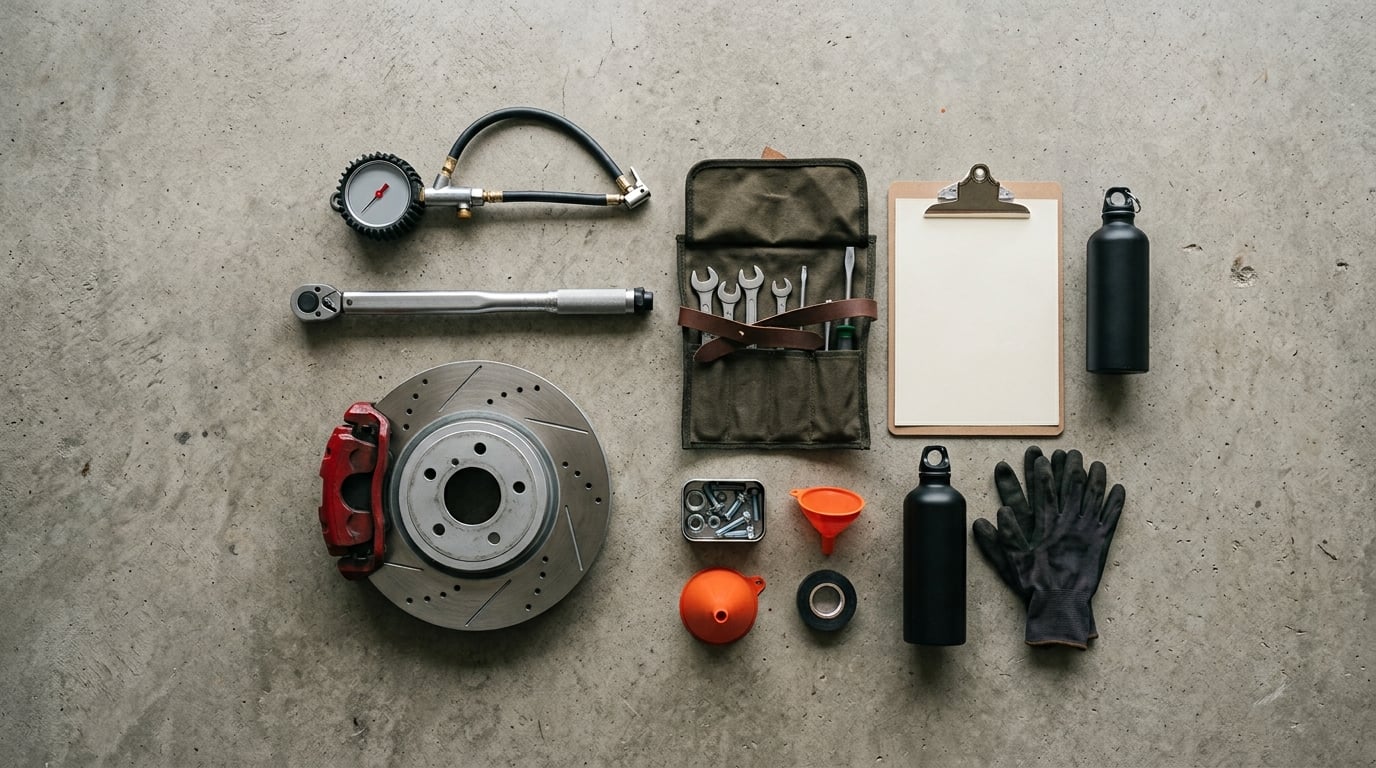
An HPDE track day preparation checklist has one job: make sure the car, the gear, and the driver are ready before the first session rather than after something goes wrong. Ten steps cover it, starting with confirming the car is eligible for your event and ending with a final morning walk-around plus paperwork check. Most failed tech inspections trace back to worn brake pads, old brake fluid, or a cabin nobody cleared.
HPDE stands for High Performance Driving Education. It is a club-run drivers school, offered by organizations like the Porsche Club of America and the BMW Car Club of America, where you drive your own road car around a closed circuit with run-off areas, flag control, and an instructor in the passenger seat. No race car, roll cage, or extra horsepower required.
What follows is the same sequence I would walk any first-timer through, updated for 2026. Read it once now, then again the night before. If you are prepping a car that has been sitting, our guide to how to store a car for six months is worth a read first, because stored cars come back with tire and brake issues more often than anything else.
Table of Contents
- HPDE Track Day Preparation Checklist at a Glance
- 1. Confirm the Car Is Suitable for the Track
- 2. Inspect Tires and Wheel Condition
- 3. Check Brakes, Pads, and Fluid
- 4. Verify Fluids, Hoses, and Cooling
- 5. Inspect the Rest of the Safety-Critical Equipment
- 6. Protect the Car With the Right Gear
- 7. Pack the Track-Day Emergency Kit
- 8. Rehearse Driving and Set Session Goals
- 9. Plan Fuel, Food, Rest, and Weather
- 10. Run the Final Morning Check and Paperwork Review
- Frequently Asked Questions
- Conclusion
HPDE Track Day Preparation Checklist at a Glance
Here is the whole thing on one page. The final column is the failure each step prevents, which is how you decide what matters when time is short.
| Preparation area | When to do it | What to check or pack | Failure it prevents |
|---|---|---|---|
| Car eligibility | 1-4 weeks out | Event rules, modifications, insurance, run-group level | Disqualification or a wasted entry |
| Tires and wheels | 1 week out, then morning of | Tread depth, uneven wear, bulges, cracks, valve stems, lug security | Sudden deflation at speed |
| Brakes, pads, fluid | 1 month out | Pad thickness, rotor face, fluid level and date, pedal feel | Faded pedal, warped rotor, car on a jack |
| Fluids, hoses, cooling | The night before | Engine oil, coolant, belts, hoses, visible leaks | Overheat session, lost car |
| Other safety equipment | The night before | Lights, mirrors, glass, wipers, belts, suspension, steering | Failed tech inspection |
| Driver gear | The week before | Approved helmet, eye protection, fire-resistant clothing, gloves, shoes | Turned away at the gate |
| Emergency kit | The night before | Gauge, plug kit, tools, fluid, tow strap, spare key, water | Waiting an hour for a ride |
| Driving rehearsal | Two weeks out | Goals, reference points, braking and throttle technique | Overreaching in session one |
| Fuel, food, weather | Night before and daily | Half tank minimum, food, 4-5 L water, layers, breaks | Dehydration and fading focus |
| Final walk-around | Morning of | Leaks, pressures, warning lights, lug nuts, waivers, track map | Missing document, flat tire in staging |
1. Confirm the Car Is Suitable for the Track
Read the event’s technical inspection rules before you touch a wrench. Clubs publish specific requirements, and they differ more than people expect. Porsche Club of America regions have asked for racing brake fluid flushed within six months, or OEM fluid within 90 days, and several require a shop-signed inspection form dated inside a set window. A BMW CCA chapter will run its own list.
Then check what you have actually modified. Harder tires, a different alignment, a roll cage, or a stripped interior all need to be declared and, in many cases, inspected more closely. A car that fails tech on event morning can sit in the paddock all day while you watch.
Insurance is the item people miss. A normal street policy does not cover you on a circuit. Most experienced drivers carry a stated-value track policy from a specialist provider such as Haggerty or Lockton for exactly that reason, and they buy it before the event, not the morning of.
Finally, be honest about run-group placement. Novice groups expect a mechanically sound road car and a driver who has never been on a circuit. Ask the organizer which group fits your experience rather than self-selecting the fastest one. Registration, timing, and group assignment are easier to sort out now than at the gate.
2. Inspect Tires and Wheel Condition
Street tires are the number one reason cars end up on a jack at an HPDE event, and that is the consensus on every owner forum, from Rennlist to r/GR86. A road-legal tire can be perfectly safe at 70 mph and still be the wrong tool once you are carrying cornering loads for twenty minutes.
What to look at, in order:
- Tread depth. Deep, even tread is the baseline. A tire worn to the wear bars has nothing left for the track.
- Uneven wear. Heavy wear on one shoulder suggests an alignment problem, and that is worth a shop visit before the event rather than during it.
- Bulges, cracks, exposed cords. Any sidewall bulge is a do-not-drive condition on a circuit. Cuts from stone chips are common and usually manageable.
- Valve stems. Look for a stem with no cap, a bent core, or rust weeping around the rim. Old rubber stems fail under sustained heat.
- Wheel condition. Check the barrel for curb rash and cracking, and confirm the spare, if you carry one, is actually the right size and style.
Lug security matters as much as the rubber. An impact wrench loosens studs over time without you noticing. Re-torque your wheels with a torque wrench to the manufacturer’s figure the night before, and check them again at midday and before your last session.
3. Check Brakes, Pads, and Fluid
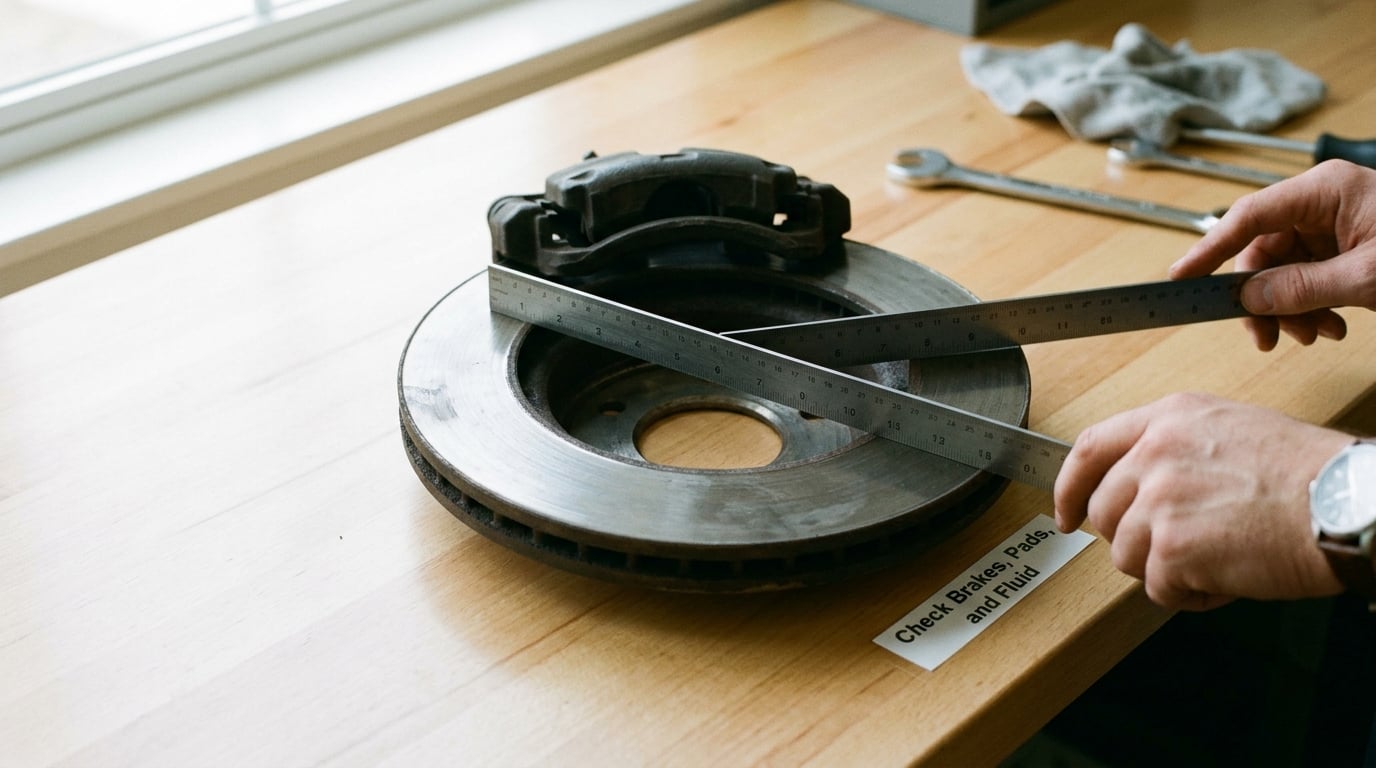
Brakes are the second-biggest reason a car does not finish a track day, and they are also the item with the clearest numeric threshold in the whole sport: many technical inspections require at least 50% pad thickness remaining. Measure the friction material at the narrowest point of the pad, not the edge, and if you are near the line, bring spares.
Then look at the rotors. A thin layer of surface rust after a wet spell is normal and clears itself in the first few stops. A lip you can catch a fingernail on, visible blueing across the friction surface, or a pad that has eaten past half the rotor is a machining or replacement job. A straightedge across the rotor face is the cheapest way to feel for warp.
Fluid matters more than most owners expect. Street fluid absorbs water over time and its boiling point drops, which is exactly how a brake pedal goes soft under repeated hard stops. Most clubs want a flush within six months, and high-temperature fluid is the correct choice for track work, not OEM fluid from a recent service. Rennlist regulars have long recommended a DOT 4 high-temperature fluid for a first day on OEM pads, which is plenty.
You can do the safe parts of this inspection yourself: check pedal travel and firmness on cold, verify the reservoir is topped off and the fluid is clear rather than brown, look for leaks at the calipers and lines, and confirm no brake warning light is lit. Jacking the car up, removing a caliper, or bleeding the system is shop work. Send it out if any of that needs doing.
4. Verify Fluids, Hoses, and Cooling
Track heat finds weak spots that a daily commute never touches. Check engine oil at the level your manufacturer specifies for the vehicle, and bring a spare quart so you can top up between sessions rather than driving a lap to find a station.
Look at the coolant reservoir cold, confirm the level sits between the marks, and make sure the overflow tank is not empty. A car that is a few degrees over ambient in the paddock has already lost cooling capacity somewhere.
Walk the length of every visible hose and belt with a flashlight. Look for wetness, gloss on a hose sidewall, cracking, fraying, or a belt that looks shiny or glazed. Any suspected leak goes to a qualified mechanic, not to a track morning. Follow the owner’s manual for service intervals and fluid specifications, and if the car has already spent months parked, treat a full fluid and filter service as part of the prep.
5. Inspect the Rest of the Safety-Critical Equipment
Brakes and tires get the attention, but inspectors look at more. Confirm every light works, including the brake lights and the turn signals. Check mirrors are clean and secure, the windshield is free of chips in the driver’s line of sight, and the wipers clear water properly with a little screen wash.
The horn should work. Seat belts should latch and retract, and the driver’s belt should sit low across the hips. Doors need to shut properly with no rattles. Push on each corner of the car and listen for knocks at the suspension, and check for free play or binding in the steering.
Then look underneath the car on the ground where you park it. Fresh fluid on the concrete, a wet patch under the radiator, or an oil film that was not there yesterday all end the day before it starts.
5A. HPDE Track Day Preparation Checklist for Brakes and Tires
If you have time for only one verification pass, do these two in this order. Measure pad friction material and confirm at least half the thickness remains, then read the brake fluid date and confirm a flush within the club’s window. Next, inflate tires to cold pressure set 4-6 lb below your normal street figure, which is roughly 35 lb cold on a typical road car, and check for bulges, cuts, and uneven wear. Finally, re-torque the lugs to spec and photograph the pressure reading for each corner. Everything else on this page can wait an hour. These two cannot.
6. Protect the Car With the Right Gear
Driver gear has one non-negotiable item: an approved helmet. Events specify a rating and date standard, and a Snell SA-rated model is the usual requirement. Check that the certification sticker is present and readable, because inspectors will look, and because a lapsed or unreadable sticker ends your day. Many tracks rent helmets if you cannot buy one in time, and that is a perfectly normal thing to do for a first event.
Around the helmet: eye protection, fire-resistant clothing, gloves, and closed-toe shoes with a thin, flat sole. Shoes matter more than people expect; thick athletic soles insulate you from the pedal feel that an instructor is asking you to develop. Balaclava and a helmet liner both help in hot weather with sweat management, and neither substitutes for the helmet itself.
For the car, consider paint protection film on at least the bumper and the hood leading edge. Debris off a circuit is abrasive, and stone chips and sandblast on the nose of your car are the most common cosmetic complaint from first-timers.
7. Pack the Track-Day Emergency Kit
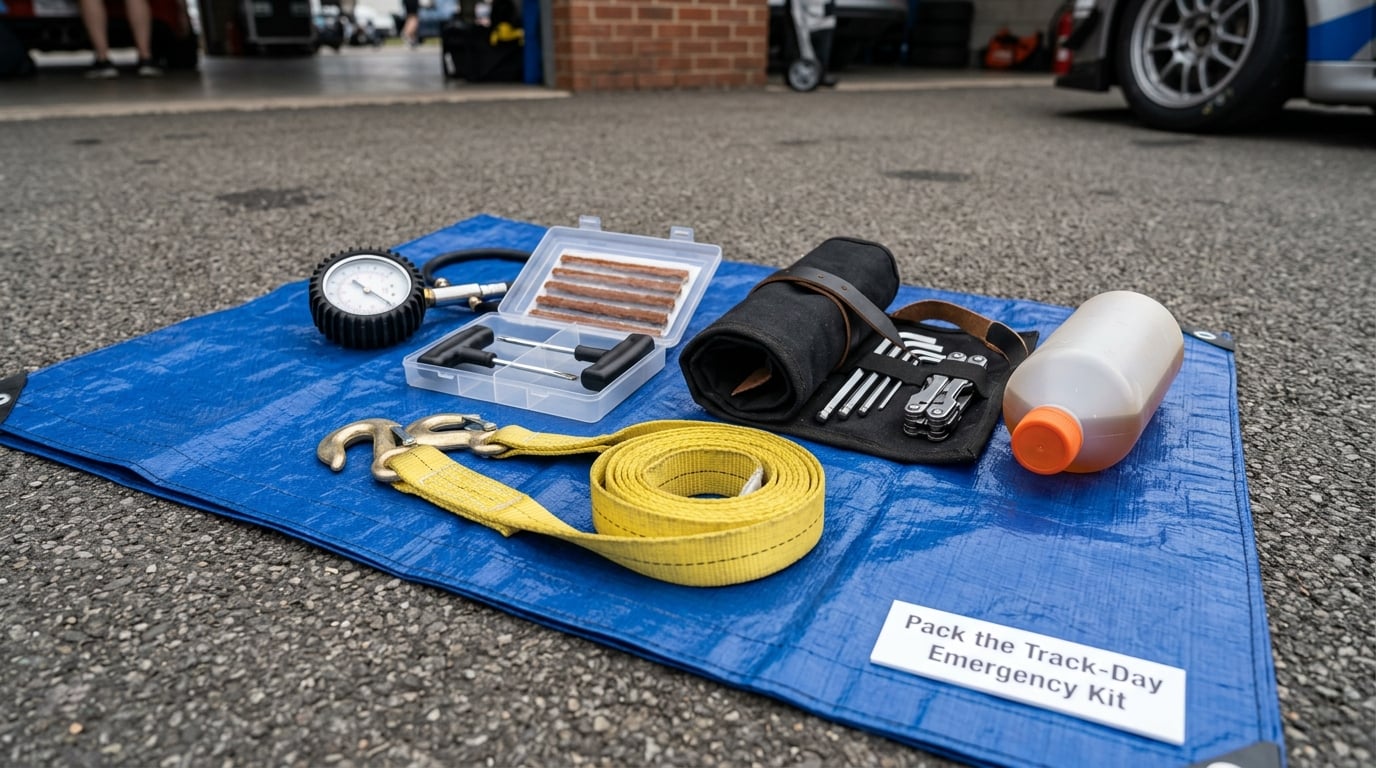
Split the load three ways: what the car needs, what you need, and what the paddock needs. Beginners consistently underestimate the third group.
Car kit. Tire pressure gauge, tire plug or inflator kit, a small tool roll, a spare quart of the correct oil, extra brake fluid if you have room, windshield cleaner with microfiber towels, and a spare key. A track-day tire gauge is cheap and far more accurate than the one at the gas station.
Driver kit. Water, food you can eat one-handed, sunscreen, ear protection, a change of socks, sunglasses that actually fit inside your helmet, and a light layer for the temperature drop after sunset.
Paddock kit. Folding chair, shade canopy or tarp, ground sheet, paper towels, a cooler, and the event’s contact numbers written down somewhere you can reach them without signal. Bring more water than feels reasonable. First-timers routinely under-buy; experienced drivers plan for 4-5 liters across a summer day.
One more thing people miss: a second key in the car. Solo drivers lock a car up with their only key inside it more often than anyone would like to admit.
8. Rehearse Driving and Set Session Goals
Your first session is a lesson, not a lap time. Decide in advance what you want to work on, write it down, and tell your instructor. Smoothness, line, and following reference points are better first-session goals than pace.
Find a safe reference point on the circuit and learn what it looks like on the approach. Build a mental map of braking zones, turn-in points, and apexes before you go fast anywhere. Practise threshold braking and smooth throttle inputs on a quiet road you know, so the motions are familiar before they are asked of you under load.
Ask for feedback after the run and mean it. Instructors would rather repeat something three times than watch a beginner struggle alone. Leave lap timers, cameras, and data logging devices off for an early event; they pull your eyes into the car at the wrong moment, and the time is better spent looking where the car is going.
9. Plan Fuel, Food, Rest, and Weather
Bring at least half a tank and treat any session where you watch the gauge as a session you ended badly. Fuel stops mid-event can be limited or closed, and a car that runs out of fuel in the paddock is a miserable way to end a day you came from work to enjoy.
Eat a real meal before you travel, then eat between every session. Hunger shows up as sloppy braking, not as a dramatic event. Set a water cadence so you drink before you are thirsty, because thirst is well behind the point where you actually need fluid.
Build in breaks. Fatigue and dehydration produce bad decisions, and experienced instructors name them alongside overconfidence and inexperience as the causes behind what gets called the red mist. If you have had four sessions and your attention is drifting, skip one. There is always another event.
Check the forecast and the track’s weather policy, and pack for the worst version of it. Rain cools the track and adds standing water; a hot day adds sun through the helmet, dehydration, and tired legs. Layers are cheap insurance.
10. Run the Final Morning Check and Paperwork Review
Do this the night before and again in the morning, in that order, so you catch problems while there is still time to act. Walk the car on level ground and look underneath first for fresh fluid. Then run the tire pressure gauge on all four corners while the tires are cold, adjust, and record the numbers.
Confirm the lug nuts are torqued, the brake fluid reservoir is full, the oil is at level, and no warning light is lit. Check that the car carries the required fuel level, a clean windshield, and a helmet with a legible certification sticker. Do not set the parking brake after a session on hot rotors; it warps them and they can stick. BMW CCA instructors are emphatic about this one.
Handle the documents next. Sign the waiver, carry your tech inspection form with the inspection date on it, download the track map and paddock layout, and note the timing and flag rules. Put the event’s instructor and track phone numbers in your phone and on paper.
Arrive early enough to attend the mandatory drivers’ meeting, which covers flags, passing, point-by procedures, and where the run groups line up. Sit through all of it. Set your seating position with a slight bend in the arms, hands at nine and three, seat belt tight across the hips, and take a moment to find the reference point on your first cool-down lap.
Frequently Asked Questions
What should I do to prepare for a track day?
Read the event’s technical inspection rules first, then check the items that most often fail: brake pad thickness, brake fluid date, and tire condition. Flush brake fluid within the club’s required window, set cold tire pressure slightly below street pressure, and clear every loose item from the cabin. Confirm insurance covers track use, pack an emergency kit, and arrive early for the drivers’ meeting.
What is an HPDE track day?
HPDE stands for High Performance Driving Education. It is a club-run drivers school, hosted by organizations such as the Porsche Club of America and the BMW Car Club of America, where you drive your own road car on a closed circuit. An instructor rides along in the passenger seat, flag marshals control the session, and you move up through run groups as your skills improve.
Can I use street tires for my first HPDE event?
Most first-timers do, and the car usually comes home fine. The reason experienced drivers push dedicated track tires is the failure mode: street compounds overheat under sustained cornering loads and lose grip sooner, and they have less consistent construction. Inspect your tires carefully for tread depth, bulges, cuts, and uneven wear, and drop cold pressure a few pounds below your street figure before the event.
What is the minimum brake pad thickness for a track day?
Many technical inspection forms require at least 50% of the friction material remaining, and that is the number to plan around. Measure at the narrowest point of the pad rather than the edge. Also check the rotor for lip, blueing, and warp, and confirm the fluid is a high-temperature DOT 4 type flushed inside the club’s window, often six months.
What should I bring with me to the track?
Split it three ways. Car kit: tire gauge, plug kit, tool roll, spare quart of oil, screen cleaner, spare key. Driver kit: water, food, sunscreen, ear protection, a change of socks, sunglasses that fit your helmet. Paddock kit: folding chair, shade canopy or tarp, ground sheet, cooler, and the event contact numbers written down. Experienced drivers plan for 4-5 liters of water on a summer day.
What do I do if I find a problem during the event?
Stop driving and tell your instructor or the track staff immediately. Most tracks have a recovery or tow service and will help get the car off the racing line safely. Do not limp a car with a fluid leak, a failed brake, or a tire you are unsure about back to the paddock. Then check the event rules for mechanical issue rules, because a car that cannot run may still be able to take part in classroom sessions.
Conclusion
Start at the top of the list and work down. Confirm the car and the event rules first, then do the mechanical work that cannot be done on event morning: brake pads, fluid, and tires. Add the driver gear and the emergency kit the night before, and finish with the morning walk-around and the paperwork.
Ten steps is roughly a weekend of work for most people, and it removes almost every reason a car would not leave the paddock. If something on this list is not right, fix it this week or ask a qualified mechanic to look at it. If you want a second set of eyes, how to store a car for six months covers the maintenance side of getting a car genuinely ready after time off the road.
Then go and enjoy it. Everyone’s first session is slower than they expected, and that is the correct outcome.