
So what happens at a teen driving safety course? It runs in a fixed order: classroom instruction on traffic laws, signs and signals, then supervised behind-the-wheel practice that begins in a closed course and works up to neighborhood, city and highway driving, and finally a road test. The hours differ by state, but the shape of the course is nearly identical everywhere in the US.
Most teens start somewhere between 14 and 16, right around the learner’s permit. The reason the course exists is simple. A new driver has a lot to look at and almost no driving history behind them, and history is the slowest teacher available.
Two things catch most families off guard. The classroom half is not filler you sit through to get a signature, and the in-car half starts far slower than anyone expects, with deliberate practice in a car that is barely moving.
Table of Contents
- What Happens at a Teen Driving Safety Course?
- What Does a Teen Driving Safety Course Teach?
- What Happens During the Classroom Portion?
- What Happens During Behind-the-Wheel Practice?
- How Does an Instructor Assess a Teen Driver?
- How Long Does a Teen Driving Safety Course Take?
- What Should a Teen Bring or Know Before the Course?
- What Can a Teen Expect From the Final Test?
- Frequently Asked Questions
- Do parents have to be present for a teen driving safety course?
- What happens if a teen does not pass the driving safety course?
- Can a teen take a driving safety course in a BMW?
- Is a teen driving safety course the same as a learner’s permit test?
- How should a teen prepare for the first behind-the-wheel lesson?
- Can a driving safety course replace supervised practice with a parent?
- Conclusion
What Happens at a Teen Driving Safety Course?
A teen driving safety course has four parts that build on each other. Knowledge instruction first, then a permit exam, then supervised in-car training in stages, then the road test. Most programs handle the classroom half in a school or online and the driving half one-to-one in a car with a licensed instructor.
The sequence usually runs like this:
- Enroll with a state-licensed program and hand over the permit paperwork.
- Study traffic laws, signs, right-of-way rules and safe driving judgment in a classroom or online module.
- Pass the written knowledge exam to earn the learner’s permit.
- Run a cockpit drill covering seat, mirrors, steering, brakes, accelerator, signals and gauges.
- Practice starting, stopping and turning in a closed course, often around cones.
- Drive real roads, progressing from quiet neighborhoods to busy arterials, highways, night and rain.
- Log the required hours, then pass a road test for the license.
Because licensing belongs to each state, no two courses are identical. Texas, Ohio, New York and California all set their own minimum classroom and in-car hours, and your state motor vehicle agency is the only authority on the exact numbers.
What Does a Teen Driving Safety Course Teach?
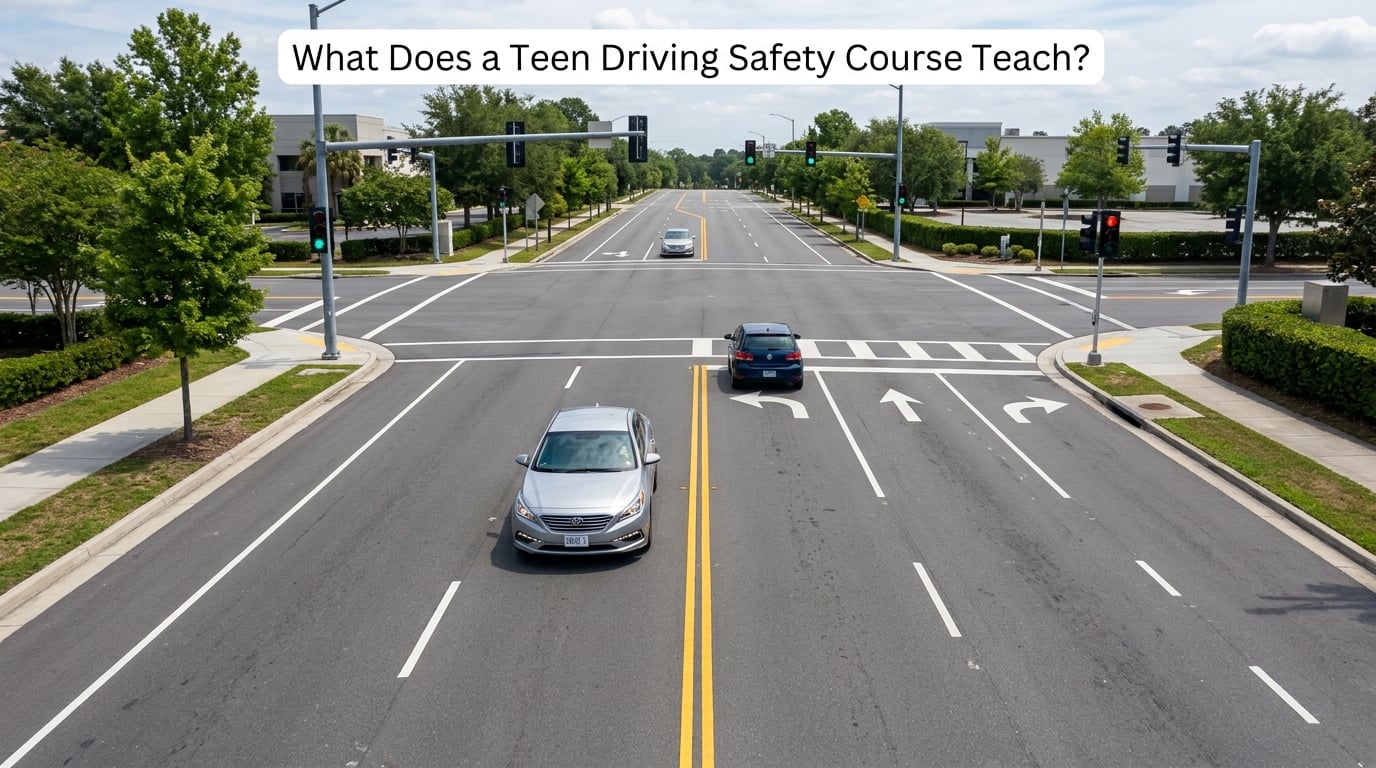
It teaches three separate things: the rules of the road, the mechanics of controlling a car, and the habit of looking ahead far enough to react. Most curricula cover the same core list, usually broken into modules of a few lessons each.
- Traffic laws, speed limits and right-of-way at intersections and crosswalks
- Signs, signals, pavement markings and work-zone etiquette
- Hazard perception and scanning ahead for people, objects and gaps
- Mirrors, blind spots and holding a steady lane position
- Following distance and managing speed in stages
- Turning, stopping, parking and backing up safely
- Braking smoothly and stopping in the distance you actually have
- Distracted driving, road rage and how to respond to aggressive drivers
- Impairment awareness, seat belts and occupant safety
- Night driving and inclement weather driving modules
- What to do when you are pulled over, and how to behave at an accident scene
- Basic vehicle care: tire pressure, lights, signals, wipers and fluids
Two violations show up again and again in teen programs, and both have their own module. The first is speeding, which is why speed management gets its own session rather than a line in the manual. The second is failure to yield or give right-of-way, which is why intersection scanning is drilled over and over instead of explained once.
There is a less obvious payoff too. A parent on the 912 BBS forum described the closed-course portion as a good deal because it teaches a kid how the car will react and what the limits of the car actually are. That is the part no amount of reading about traffic law can give you.
What Happens During the Classroom Portion?
The classroom half is where the language of driving gets learned. Instructors cover the rules of the road, sign shapes and colors, what each signal and pavement marking means, and what the law expects of you at a crosswalk, a merge and a school zone.
Vehicle controls usually get covered here too, on paper or a diagram, before the student touches a real car. Seat and mirror position, where the brake and accelerator sit, what the gauges mean, how to signal a turn and how to check mirrors without losing sight of the road.
Occupant safety and impairment awareness have their own sessions, and so does driver behavior: distracted driving, aggressive driving and road rage, and what to do if another driver is escalating at you. That last one is discussed more concretely than most people expect, because instructors have seen it go wrong on real drives.
You will also see discussion of the mistakes new drivers actually make. Late braking, drifting wide in a turn, failing to check a blind spot, following too closely. Naming the error in a classroom is far cheaper than repeating it on a road.
Formats vary. Some programs run in a school classroom during the day, some run evenings at a driving school, and many states now allow the knowledge portion online with an in-person knowledge test afterward. The reading is the same; the delivery changes.
What Happens During Behind-the-Wheel Practice?
In-car training starts with the car parked. The first job is the cockpit drill: seat position, distance from the pedals, mirror adjustment, and a walk around the vehicle checking lights, tires and signals. Nothing moves until that is right.
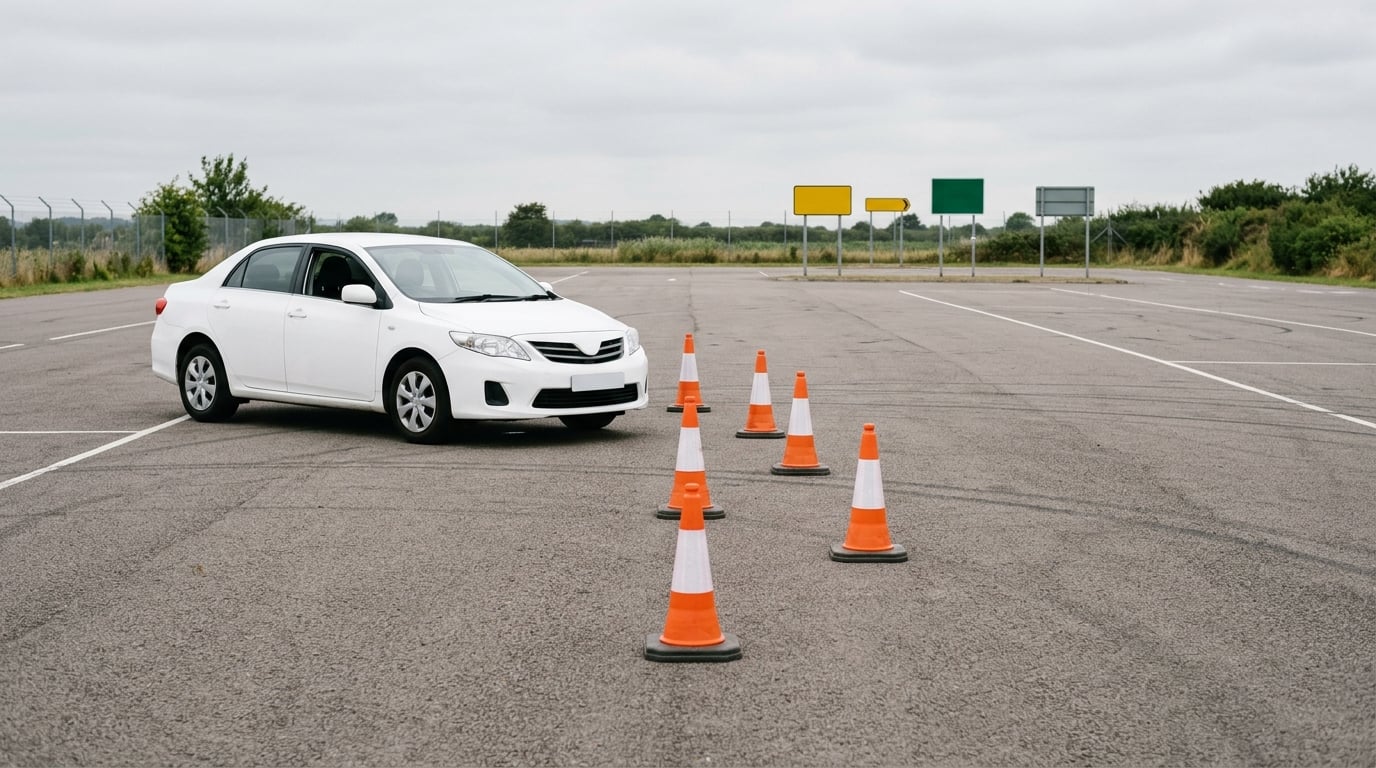
Then the student works on vehicle control in a closed course. Starting and stopping in gear, smooth braking, turning both directions, backing straight, backing while looking over the shoulder, and parking between two lines or beside a curb. A cone course is common, and the student repeats a maneuver several times before the instructor lets them move on.
Repeats are the method, not a sign of failure. A new driver needs the steering wheel to feel the same on the fourth attempt as on the first, and repetition is the only thing that produces that. Instructors correct one or two things at a time instead of listing everything at once, which is why a lesson can feel like a lot of driving the same block over and over.
Once the basics are solid, the route opens up. Quiet residential streets first, then multi-lane roads, then intersections with real cross traffic, then highway on-ramps and merging. Night driving and wet-weather segments usually come last, once the student is confident in daylight.
Why a teen driving safety course starts in a closed course
Because the car can lose control safely there, and because that is the one lesson experience cannot teach. Parents on Reddit have described it as putting a new driver in a car on a course and making them spin out, hit things and lose control in a controlled setting. It sounds alarming and it is exactly the point: the student learns where the tires give up, how long it takes to stop, and what the steering wheel does when the front end is already going somewhere else.
After each lesson the instructor files an evaluation. Students and parents get a short record of which skills were covered, how the student is progressing, which areas need attention and what to practice next. Most programs also keep a log, so the paperwork trail is real and it accumulates the whole way to the road test.
How Does an Instructor Assess a Teen Driver?
It is a structured observation of specific behaviors, not a judgment about confidence, personality or how a kid feels about driving. Instructors watch the same list every time, which is what makes the feedback fair.
- Vehicle control: smooth steering, controlled speed, no sudden inputs
- Observation: mirrors checked, blind spots covered, eyes up and ahead
- Signaling: turns and lane changes announced correctly and in time
- Speed management: appropriate for the road, the traffic and the weather
- Right-of-way: yielding, stopping and proceeding at intersections and crosswalks
- Lane positioning: staying centered, spacing between vehicles, merging
- Following distance: enough space to react, not tailgating in traffic
- Braking: smooth in normal stops, firm and straight in an emergency
- Parking and backing: controlled, accurate, and checked with mirrors and over the shoulder
- Overall judgment: scanning, deciding, and choosing the safe option under pressure
Errors recorded early are exactly what later lessons target. A student flagged for wide turns in week one will be running lane-positioning drills in week three.
How Long Does a Teen Driving Safety Course Take?
A full teen program typically runs anywhere from a few weeks to a few months, and the total is set by state rules plus the number of hours you schedule per week. A defensive driving course, which adults often take for a ticket or a record refresh, is a different and much shorter animal, often a single day. So is a free community safety class offered by a city or a police department.
| Stage | What happens | Typical time |
|---|---|---|
| Enrollment | Sign up with a state-licensed program, submit permit paperwork | An afternoon of admin |
| Knowledge instruction | Traffic laws, signs, right-of-way, controls, safety topics | 24 to 32 classroom hours depending on state |
| Permit exam | Written knowledge test, sometimes an eye test or thumb print | Same day |
| Cockpit and closed course | Seat, mirrors, controls, starting, stopping, turning, cones | First one or two lessons |
| Neighborhood and city driving | Residential roads, turns, parking, lane positioning, intersections | Part of the practice block |
| Highway, night and weather | Merging, lane changes, night driving, wet-weather driving | End of the practice block |
| Road test | Vehicle check, control tasks, road maneuvers, safe driving | About 30 to 45 minutes |
The in-car number is where states differ most. Texas, for example, requires 44 in-car hours broken into 7 instruction hours, 7 observation hours and 30 hours of supervised practice, and Ohio lists a 24-hour classroom requirement alongside 8 hours behind the wheel. Your own motor vehicle agency publishes the figures that actually apply to you, so check there rather than trusting a number you read on a website.
What Should a Teen Bring or Know Before the Course?
Bring the learner’s permit and the identification the school asked for. A copy of the vehicle registration and proof of insurance normally has to be on file with the program before the car leaves the lot.
The car matters more than families expect. It needs to be roadworthy rather than beautiful: working lights, turn signals, brake lights, horn, wipers, tires with air in them, and nothing broken that shifts weight or pulls. Before the first lesson it is worth a quick walkaround. Our guide to basic car maintenance tools covers what a teen can check or help check safely at home.
Two seasonal items get missed. If the first lessons land in cold months, tire pressure matters more than usual, and what PSI car tires should be in winter explains why. And if the program runs any part of the course on snow or ice, what tire siping is and whether it helps is worth reading too.
On the day itself, a few habits carry over from driving ed directly to the car: seat belt on before the engine turns, hands at the nine and three positions, and comfortable driving glasses if the teen needs them for distance. Glasses that work for the classroom and slide down in the wind are a real and common problem.
Reading the owner’s manual cover to cover is genuinely useful here. A teen who knows what the brake pedal feel, the gear selector and the fuel door do spends less of the first lesson catching up on the car instead of driving it. Nerves are normal, and instructors see them every day. Saying so out loud before day one does more than any pep talk afterwards.
What Can a Teen Expect From the Final Test?
The road test is a short, structured drive with an examiner, and it usually opens with the same check the instructor has been running all along. A walk-around of the car, lights and signals on, tires and basic condition.
From there expect basic control tasks, then driving on real roads. Parallel or angle parking, a turn from a side street, a multi-lane change, stopping and starting in traffic, and a section where the examiner deliberately sets up a hazard to see whether the student scans and responds.
The examiner scores a defined set of skills and errors are recorded by type rather than as a vague judgment. Most states allow a retake after a waiting period, and most of them require the underlying course hours to be documented before the test is even scheduled. Passing requirements, the waiting period and the license restrictions that follow all belong to the state, so pull up your motor vehicle agency checklist before the test, not after.
Frequently Asked Questions
Do parents have to be present for a teen driving safety course?
Usually not, and it depends on the program. Most instructor-taught courses run with just the student and the instructor in the car, and a parent waits at the office or watches from outside. Some states allow a parent-taught or self-taught option, and there the parent is required to be in the car and to sign off on the logged hours. Ask the program directly which arrangement they run.
What happens if a teen does not pass the driving safety course?
A student can absolutely have a rough lesson or a rough test. Instructors are not surprised by mistakes, and most programs will repeat a skill or schedule an extra lesson rather than treat one bad day as a verdict. A failed road test usually means a waiting period and a retake, not a restart from zero. The logged classroom and in-car hours normally stay valid either way.
Can a teen take a driving safety course in a BMW?
Yes. The make of car is almost irrelevant. What the program needs is a properly registered and insured vehicle, a licensed adult driver who meets the supervising driver age requirement, working lights, signals, brakes, horn and wipers, tires with air in them, and a clear insurance policy that covers teen drivers. Comfortable, reliable, well-maintained and roadworthy beats expensive every time.
Is a teen driving safety course the same as a learner’s permit test?
No, they are two different things. The course is the training: classroom hours plus behind-the-wheel hours. The learner’s permit test is the short written knowledge exam, and in many states it can be taken before any in-car training happens. The road test at the end is a third thing entirely, and it is the one that leads to the license.
How should a teen prepare for the first behind-the-wheel lesson?
Get sleep, not a cram session. The first lesson is a cockpit drill and low-speed control work, not an exam. Have the permit, the required identification, the vehicle registration and insurance paperwork ready the night before. Sit in the passenger seat and adjust the seat and mirrors once so the student knows the settings. Expect to drive the same short route several times, and expect to be told what to work on, not to be graded.
Can a driving safety course replace supervised practice with a parent?
Only in states that allow it. Where a parent-taught or self-taught route is legal, a parent or qualified adult supervises the logged in-car hours and the paperwork is the same either way. Where the state requires a licensed school, a course cannot be swapped out for family practice. Either way, extra hours with a parent help and never hurt, because most of the logged practice is ordinary neighborhood driving.
Conclusion
A teen driving safety course is a controlled progression: rules first, then vehicle control, then judgment in traffic. The classroom explains what the law expects, the closed course teaches what the car will actually do, and the later road hours put the two together under real conditions.
Start by pulling up your state motor vehicle agency requirements, because the hours, the age threshold and the paperwork trail are all set there. Then pick a state-licensed program, get the car inspected and roadworthy, and treat the first lesson as practice rather than a test. Most teens come out of the course driving more cautiously than the driver who taught them, which is the entire point.