
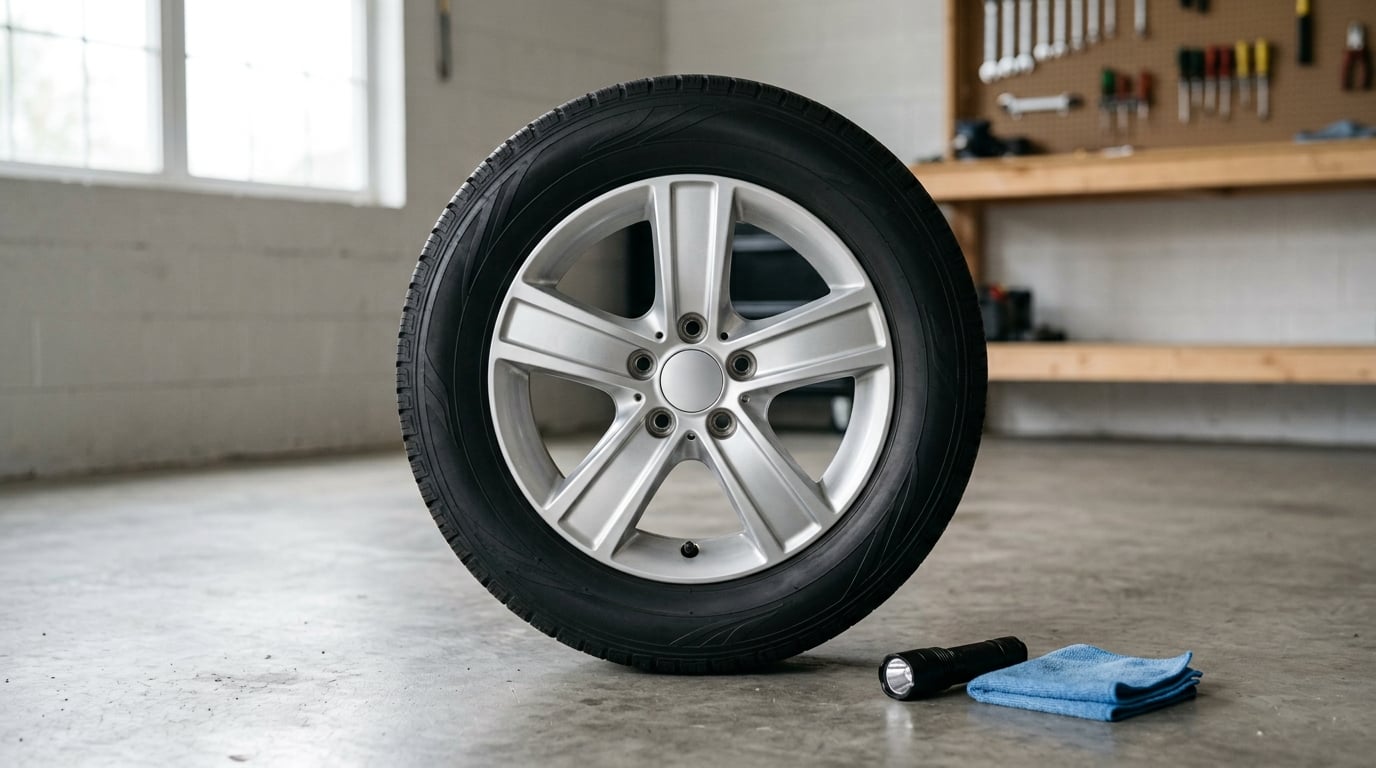
Reading a tire sidewall takes about two minutes, a flashlight, and the door open. The big molded code, something like P205/65R15 91V, reads left to right as tire type, section width in millimeters, aspect ratio as a percentage, construction, rim diameter in inches, then a load index and speed rating, while a separate DOT stamp on the other side of the tire tells you the week and year it was built.
Get those right and you can confirm a replacement tire actually fits your car, spot an old set on a used truck before you buy, and avoid the single most common mistake, which is inflating to the maximum pressure printed on the sidewall instead of the pressure listed on your door-jamb placard.
Here is that example code pulled apart, in the order the characters actually run:
- P — passenger car tire
- 205 — section width, 205 mm measured sidewall to sidewall
- 65 — aspect ratio, the sidewall stands 65 percent as tall as the tire is wide
- R — radial construction
- 15 — rim diameter in inches
- 91 — load index, 615 kg (1,356 lb) per tire
- V — speed rating, 149 mph sustained
- DOT code, last four digits — manufacture week and year, so a final code of 2947 means week 29 of year 47
Nothing on a sidewall is a secret code. It is a standardized shorthand, and once you know the order it stops looking like noise.
Table of Contents
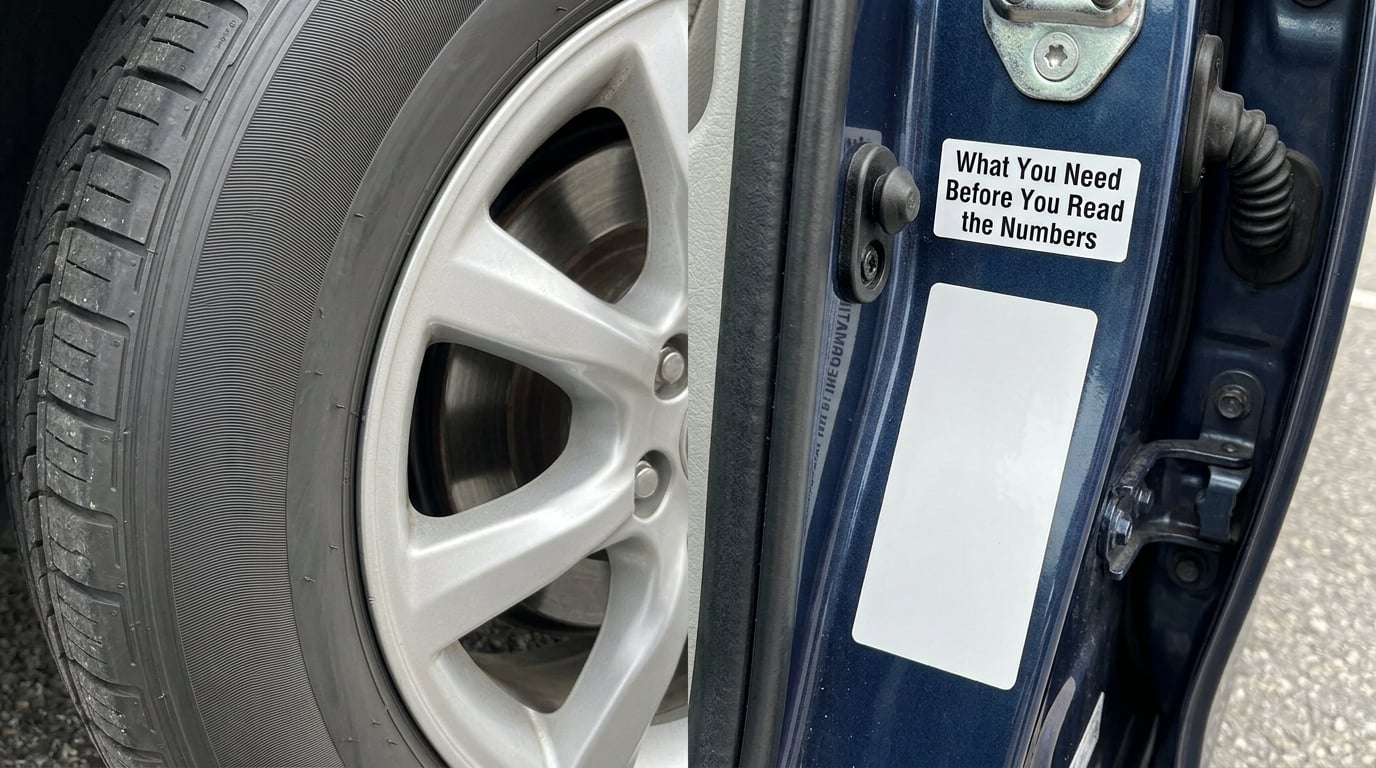
What You Need Before You Read the Numbers
Start with your vehicle information, not the tire. The tire tells you what you have; the car tells you what it needs.
- The door-jamb placard. Open the driver’s door and look at the frame pillar or the driver’s door edge, not the jamb itself. It lists the OEM tire size, the cold inflation pressure front and rear, and the minimum load index and speed rating. This sticker is the authority, and it outranks anything you infer from the tire currently bolted on.
- The owner’s manual. It explains replacement tire specifications, including alternate sizes the manufacturer approves and how to read the tire pressure monitor, which matches a tire to a specific rim and position.
- A flashlight or phone light. Molded lettering on the inner sidewall of a wheel sitting in a wheel well is genuinely hard to read in daylight shadow.
- A clean rag and a soft brush. Road grime fills the grooves between raised characters. Wipe the section you are reading and the code pops out.
- Something to write with. Load capacity, overall diameter and the four-digit date are three numbers you will want to compare rather than squint at.
Two things about tire information matter more than the tire itself. First, the placard pressure is a cold inflation pressure, measured before the car has been driven more than a mile or parked in the sun. Second, if your car is a BMW or any other performance sedan, the placard often lists more than one approved size, and the alternative sizes are explicitly sanctioned rather than a guess.
Step-by-Step: How to Read a Tire Sidewall in Order
1. Find the tire size and service description
The largest molded text on the sidewall is the tire size designation, usually found on the outer face where it is easiest to read. Take a real example: 225/45R17 91W.
The 225 is the section width in millimeters, measured across the widest part of the tire with the sidewalls inflated, not the tread width. The 45 is the aspect ratio: the sidewall height is 45 percent of 225 mm, so 225 multiplied by 0.45 equals 101.25 mm of rubber from bead to tread. The R is radial construction, which describes how the carcass plies are laid, with an D for diagonal or bias-ply and B for belted bias on older trucks and trailers.
The 17 is the rim diameter in inches, and it is also the bead diameter, since that is where the tire clamps to the wheel. Then 91W is the service description, a load index and a speed rating that together describe what the tire is rated to carry and sustain. Add the two halves and you get the overall diameter, which for this example works out to roughly 634 mm: twice the 101.25 mm sidewall, plus 17 inches converted to 431.8 mm.
A lower aspect ratio does not mean the tire is a smaller tire. It means the same section width spread across a bigger wheel, which is why 45s on a 19-inch rim and 45s on a 17-inch rim look and ride nothing alike. Legacy inch-format sizes still show up on older and larger trucks, written as 40×13.5R17LT, where the first number is overall diameter in inches, the second is section width, and a 17 is buried at the end. Those convert to modern metric equivalents such as 340/85R17.
2. Read the load index and load rating
The two digits after the rim size, 91 in our example, are the load index, an index into a standardized chart rather than a weight in pounds. Index 91 equals 615 kg, or 1,356 lb, per tire. Multiply by four for the set, and remember that figure assumes correct inflation pressure, since a tire that is underinflated carries less than its rating.
Here is the chart you will use most:
| Load index | kg per tire | lb per tire | Typical fitment |
|---|---|---|---|
| 70 | 335 | 740 | Mini cars, small hatchbacks |
| 75 | 387 | 853 | Compact sedans |
| 80 | 450 | 992 | Midsize sedans, crossovers |
| 85 | 515 | 1,136 | Family sedans, small SUVs |
| 90 | 600 | 1,323 | Mid-size SUVs, sedans |
| 91 | 615 | 1,356 | Performance sedans, sport trims |
| 95 | 690 | 1,521 | Large sedans, performance coupes |
| 97 | 730 | 1,609 | Sport sedans, EVs |
| 100 | 800 | 1,764 | Luxury sedans, full-size SUVs |
| 110 | 1,000 | 2,205 | Full-size trucks and tow vehicles |
Two rules make this simple. A replacement tire must have a load index equal to or higher than the number on your door-jamb placard, and matching the tire’s load capacity to the vehicle’s requirement is more important than matching the tire’s brand.
There is a wrinkle worth knowing about. P-metric tires, the ones with a P at the front, are rated at 35 psi. Euro-metric tires, which carry no P, LT or ST prefix, carry load index ratings that assume a lower inflation pressure around 26 psi. Same number, different test condition, so a 91 on a Euro-metric tire and a 91 on a P-metric tire are not interchangeable ratings if you run anything other than the original design pressure.
3. Interpret the speed rating letter
The letter after the load index is the speed rating, a laboratory-measured maximum sustained speed that the tire passed testing at its rated load and pressure. It is a ceiling the tire is certified for, not a suggestion about how fast you should drive in the rain.
| Letter | Maximum mph | Where you see it |
|---|---|---|
| Q | 100 | Studded winter tires, some winter categories |
| S | 112 | Older sporty sedans, full-size trucks |
| T | 118 | Common on coupes, sports cars, winter light trucks |
| H | 130 | The most common passenger tire rating today |
| V | 149 | Sport sedans, performance crossovers, EVs |
| W | 168 | High-performance sedans, sport wagons |
| Y | 186 | Super cars and some ultra-performance tires |
Going up is fine. A V-rated replacement on a car that came with H-rated tires handles more speed than the original, and plenty of owners do exactly that. A rating letter is a capability, not a permission slip, and grip in bad weather is a completely separate story from what the letter measures on a dry surface. Never let a speed rating stand in for tread depth or age.
4. Identify the construction and molded material markings
Not every tire sidewall prints a ply breakdown, but many do, as words like TREAD: 2 POLYESTER + 2 STEEL + 1 POLYAMIDE and SIDEWALL: 2 POLYESTER. Read it as what it is: a count of carcass layers and a note on what they are made of. Steel belts belong in the tread for traction and stiffness, while polyester and polyamide carry the flex in the sidewall.
On light truck and SUV tires you will often see the ply rating next to the treadwear number in one line, such as LT245/75R17 110S 6 PR, where 6 PR means six-ply rating. Three plies is a normal, respectable carcass count on a passenger or crossover tire, not a warning sign; bias-ply construction, marked with a D, is the older and less common pattern.
The construction letter after the aspect ratio tells you the same thing in one character: R for radial, which is standard on every modern car, D for bias-ply, and B for belted bias still found on some classic and trailer applications.
5. Check the treadwear, traction and temperature codes
Near the DOT code you will find a three-part grade, the Uniform Tire Quality Grade, printed like 180 A A. The first number is the treadwear rating, measured in miles under controlled wear testing against a reference tire. The first letter is the traction grade for wet grip, running AA as the best and C as the lowest tested class. The second letter is the temperature grade for heat resistance, also AA through C.
Here is the part almost everyone gets wrong. Treadwear numbers are relative to a standard reference tire, not to each other. One brand’s 180 and another brand’s 220 were tested under different procedures and cannot be compared directly, and even within a single brand the number reflects a lab test on new tires, not how fast yours will wear with your alignment, your inflation pressure and your commute.
Traction and temperature grades are no more predictive. Both are lab test results, and both say nothing about how a tire will feel on a cold wet road in your neighborhood. When you need a real read on whether a tire still works, look at the tread wear indicator, the small triangle and arrows or the TWI marking molded inside the groove. Once the tread reaches 2/32 inch at that location, the tire is done, no matter how high the treadwear number was.
Unbalanced or feathering wear is a different signal entirely, and it usually points at alignment or inflation rather than the tire itself. Our guide to what tire feathering is and what causes it walks through the pattern and the fix.
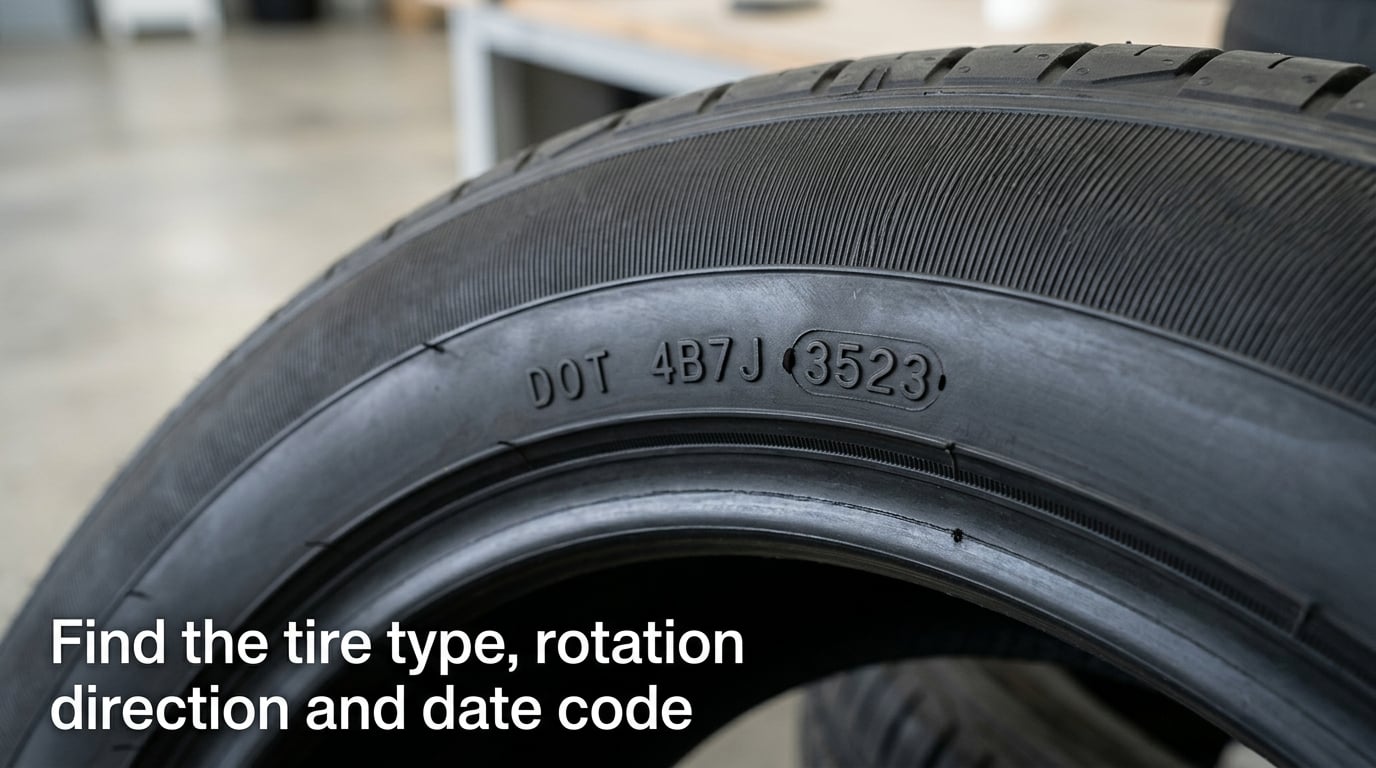
6. Find the tire type, rotation direction and date code
The DOT code, officially the tire identification number, is a long string of letters and numbers stamped into one sidewall. The opening block identifies the manufacturer, the plant code and any size code; skip all of it. The last four digits are the part you care about: the first two are the week of manufacture from 01 to 53, the last two are the year. A final code of 2947 is week 29 of year 47.
More on dating tires, including what to check on a used car, is in how to tell how old a tire is. The working rule is to inspect closely at 5 years, plan to replace by 6, and scrap anything 10 years or older even if the tread still looks new, because rubber ages from the inside out. Buyers regularly find tires on a used vehicle that were made before the vehicle itself shipped.
Other symbols worth locating while you have the light out:
- Rotation arrow. A molded arrow showing the direction the wheel must spin for a directional tire. Getting it backwards shortens tread life and pushes the outside edge into a hard wear pattern.
- M+S means mud and snow, a designation that covers a very wide range of tires and is honestly weak on its own. The three-peak mountain snowflake, a mountain with a snowflake inside it, is the symbol that actually indicates a winter tire meeting severe snow service requirements.
- Run-flat symbols. Words like RSC, RFP or a small symbol with a flat tire and a wrench mark a run-flat design built to travel on a deflated tire for a limited distance at reduced speed. They also mean a harsher ride and mandatory replacement after the run.
- Foam-filled or sound-absorbing markings and OE marks showing which vehicles the tire was designed for, plus an E-marking number in a circle for European type approval.
- Reinforced or HL on many electric vehicle tires, which carry higher load indices because of battery weight, often with foam inserted to cut road noise.
Finally, most sidewalls print a maximum cold inflation pressure and a maximum load, often 35 psi, plus a seating and service instruction. That number is a structural limit the tire is tested to, not a recommendation. Follow the pressure on the door-jamb placard instead, and use cold pressures year round, including in winter. Our guide to what PSI car tires need in winter explains why cold weather changes the reading but not the target number.
Common Mistakes When Reading Tire Numbers
Placard versus sidewall is the decision tool. Both carry numbers, only one of them is telling you what your car needs.
| What you are checking | Door-jamb placard | Tire sidewall | Which one governs |
|---|---|---|---|
| Tire size | OEM size and approved alternates | Actual installed size | Placard |
| Inflation pressure | Cold pressure to run, front and rear | Maximum cold pressure limit | Placard, always |
| Load capacity | Minimum load index required | Actual load index of the tire | Tire must meet or exceed |
| Speed rating | Minimum letter required | Actual letter on the tire | Tire must meet or exceed |
The mistakes that show up again and again:
- Copying a tire size off another car. A tire that fits a sedan correctly can be an inch taller or wider than the clearance the suspension and wheel arch allow on a different model. Sidewall height changes with rim diameter, so two tires with the same numbers in the same code can still be different heights.
- Reading aspect ratio as width. The first number is the width; the second is a percentage. 40 does not mean 40 inches of sidewall, it means 40 percent of the section width.
- Ignoring the load index. A wider tire is not automatically a stronger tire. The placard minimum is a floor, and going below it is how people end up with a tire that runs hot under load.
- Treating the speed letter as a safety grade. A V-rated tire with 2/32 inch of tread is a hydroplaning hazard with a nice letter on the sidewall.
- Thinking the date code is a warranty date. It is a manufacture date. A five-year-old tire may still be under warranty, but age is what matters to the rubber, not to the invoice.
- Downsizing to save a few dollars. A smaller overall diameter changes speedometer accuracy, braking distances, ride height and, on stability-control-equipped cars, how the systems behave at the limit.
Sidewall damage deserves its own triage, because owners constantly wonder whether a cut is a four-tire decision or nothing at all.
| What you find | What it usually means | Repairable? | Action |
|---|---|---|---|
| Cut or gouge in the tread | Glass, nail, road debris | Often, if it is under 6 mm and in the tread | Proper patch-plug repair, then monitor closely |
| Cut in the sidewall | Curb strike, slash, impact | No | Replace the tire |
| Bulge or bubble in the sidewall | Internal ply or belt separation | No | Replace the tire immediately, do not drive on it |
| Nail or screw embedded in the sidewall | Puncture past the safe repair zone | No | Replace the tire |
| Fine cracks and scaly texture | Dry rot from age and UV exposure | No | Replace; check the date code to see whether age explains it |
Before you buy replacements, run this checklist: placard size confirmed against the new tire code, load index equal or higher, speed letter equal or higher, four-digit date code checked on every tire in the set, overall diameter within about 3 percent of the original, and tread that looks like it was not stored in a yard. Five minutes of reading prevents the expensive kind of learning.
Frequently Asked Questions
What does 70 mean on a tire?
The 70 is the aspect ratio: the tire’s sidewall height is 70 percent of its section width. On a 205/70R15, that works out to 205 mm multiplied by 0.70, or about 143.5 mm of sidewall. Higher numbers mean more rubber, more sidewall flex, and usually a quieter, softer ride with less grip on smooth pavement. Lower numbers such as 40 mean a shorter sidewall and a heavier, more responsive feel.
Is a 40 sidewall low profile?
Yes, by everyday standards. Most original-equipment tires today fall between 45 and 55, and performance cars and many EVs run 30 to 40. Check the rim diameter too, because it changes the math: a 40 aspect ratio on a 17 inch rim is taller in millimeters than a 45 on a 22 inch rim. Short sidewalls also flex less over potholes, so replacement cost and ride harshness are worth factoring in.
How do I read tire age off the sidewall?
Find the DOT code, then ignore the first block of letters and numbers that identifies the maker and plant. The final four digits are the date: first two are the week of the year from 01 to 53, last two are the year. So a final code of 2947 means week 29 of year 47. Inspect closely at 5 years, plan to replace by 6, and scrap anything 10 years old or older even if the tread looks deep.
What is the 3% rule for tires?
It is a tolerance on overall rolling circumference. If a replacement tire’s overall diameter is within about 3 percent of the original factory size, the speedometer and odometer stay inside their legal accuracy range and the car keeps its intended handling. Push beyond that and you change speedometer error, braking distances and ride height. Electronic stability control on many modern cars is also calibrated around the original tire circumference.
Is a 3-ply sidewall good?
Ply is simply the count of carcass layers, so three plies is not by itself a warning. A typical premium passenger tire has four or more plies, often two steel belts in the tread plus polyester or polyamide layers in the carcass and sidewall. On SUVs and light trucks the ply rating appears next to the treadwear number in one line, such as 6 PR, where PR means ply rating and reflects the load the tire is designed to carry.
Conclusion: Match the Sidewall to the Placard First
Do one thing before you order anything: put the sidewall code next to the tire information on your door-jamb placard and compare them field by field. Size must match or be an alternate your manufacturer approves, load index and speed rating must meet or beat the placard minimums, and your inflation pressure comes from the placard rather than from the maximum printed on the rubber.
After that, the rest of the sidewall tells you what you are living with. The last four digits of the DOT code tell you whether the tires are young or a set you should replace regardless of tread. The UTQG numbers tell you very little about your specific car, so do not lean on them. And if you find a cut, a bulge or dry rot anywhere in the sidewall, replace that tire rather than trying to save it, because no amount of careful reading changes where the damage sits.