
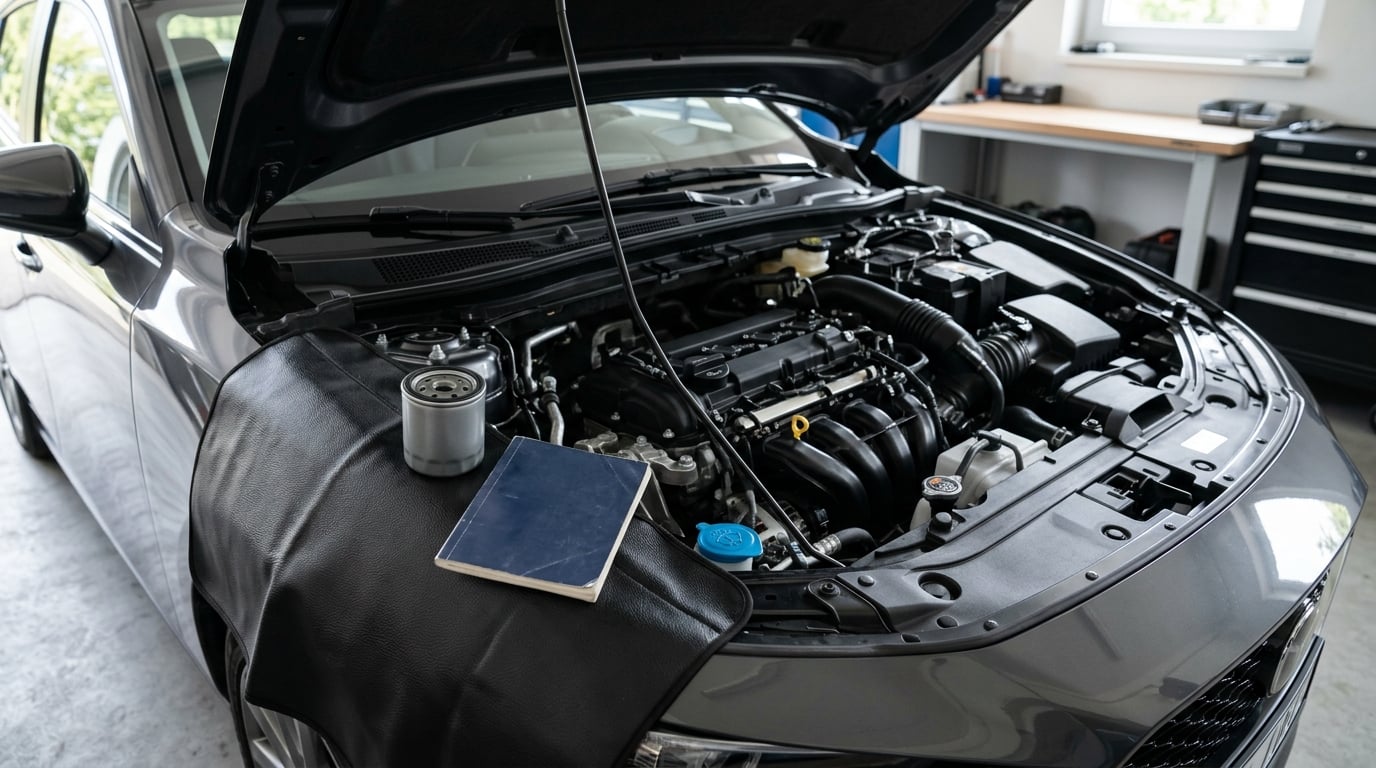
Short answer: on most modern cars, change engine oil every 5,000 to 10,000 miles or every 6 to 12 months, whichever comes first. The interval printed in your owner’s manual is the controlling number, and it splits into a normal schedule and a severe-service schedule that is roughly half as long.
That single sentence is where most of the confusion comes from, because the number a quick-lube shop tells you, the number a dealer tells you, and the number in your manual are often three different things. Modern engines also hold to tight oil specs, so an oil that meets the right viscosity but not the manufacturer’s approval standard is the wrong oil no matter how good it looks on the label.
The rest of this guide walks through how to find the right number, when the calendar matters more than the odometer, which driving patterns move you onto the severe schedule, and what a complete oil change should include. Updated for 2026, and written for the US market with metric conversions where they help.
Table of Contents
- How Often to Change Oil in a Modern Car?
- What Does the Owner’s Manual Say About Oil Changes?
- What Oil-Change Interval Is Typical?
- Does the Oil-Change Time Limit Matter?
- Which Driving Conditions Call for Earlier Changes?
- Does Driving Style Change the Answer?
- What Type of Engine Oil Should You Use?
- Should You Choose Conventional, Synthetic, or Synthetic Blend Oil?
- What Counts as a Complete Oil Change?
- How Can You Tell When the Next Change Is Due?
- When Should a Driver Get the Interval Checked?
- Frequently Asked Questions
- Is 10,000 miles too long for a modern car’s oil change?
- Can I extend my oil-change interval if I drive very little?
- Does a modern car require synthetic oil for every service?
- Do I need to replace the oil filter every time?
- What happens if I wait until the oil-change light comes on?
- How often should I change oil on a BMW or other European car?
- Conclusion
How Often to Change Oil in a Modern Car?
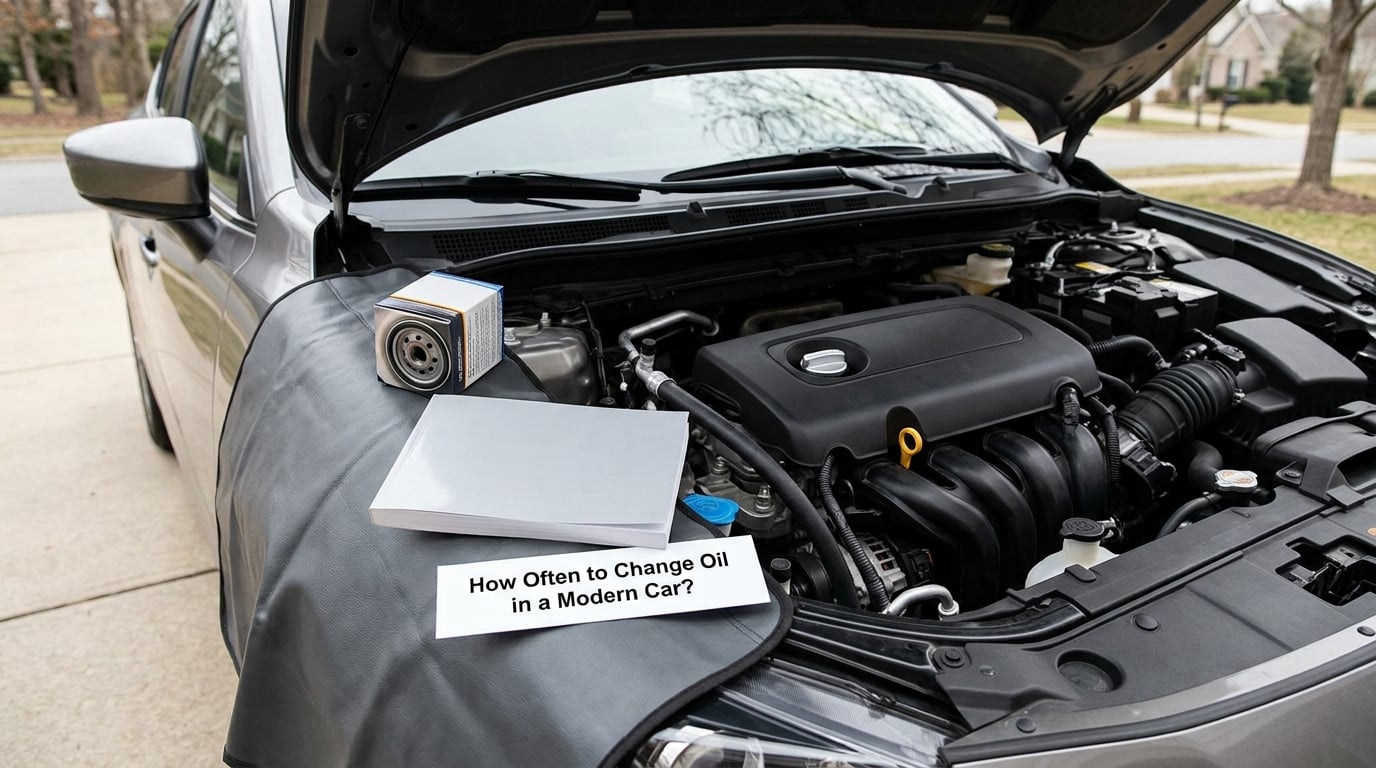
Four things decide your answer, and they all come out of documents that ship with the car. First, the mileage and time interval in the owner’s manual, taken from the schedule for your engine and drive type. Second, whether your driving actually matches the normal schedule or the severe-service schedule.
Third, the oil specification. Many manufacturers only approve their long interval when the oil carries a specific approval standard, and a shorter interval is the required fallback when you use oil that does not. Fourth, engine age. High-mileage engines, turbocharged engines and engines that burn a measurable amount of oil between services all deserve more caution than the printed number assumes.
Ignore none of the four. The commonest mistake I see is a driver who treats the mileage limit as the rule and the time limit as a suggestion, and that instinct is exactly backwards for a car that sits.
What Does the Owner’s Manual Say About Oil Changes?
The owner’s manual is a legal and technical document, and on oil it is unusually specific. It names the approved viscosity, the required specification or approval standard, the fill quantity including the filter’s oil capacity, and the interval in both miles or kilometres and months.
Most manuals lay out two schedules. Normal service assumes a mix of highway and city driving, usually with full synthetic or a manufacturer-approved long-life oil. Severe service assumes stop-and-go traffic, short trips, extreme temperatures, towing or heavy loads, and dust, and it typically halves the interval.
Three things are not the manual: the sticker on a quick-lube receipt, the interval in a dealer service-department pitch, and the number in a manufacturer’s advertising claim. A “10,000-mile oil change interval” claim is only valid on a specific engine using a specifically approved oil, and even then only under normal driving.
Owners who argue about this online are usually arguing past each other. On r/4Runner, the settled consensus is roughly annual or 10,000 miles on quality synthetic, and 6 months or 5,000 miles for seasonal sensitivity. On r/Crosstrek, a dealer pushed a first change at 3,000 miles. Both can be honest, because they describe different cars and different drives.
What Oil-Change Interval Is Typical?
Use the table below as a reference range, not as a specification. Your manual outranks it in every case.
| Oil type | Typical miles | Typical months | Notes |
|---|---|---|---|
| Conventional | 3,000 to 5,000 | 6 | Rarely specified on newer engines; most OEMs moved to 0W-20 synthetic |
| Synthetic blend | 5,000 to 7,500 | 6 | Common middle ground where the manual allows a choice |
| Full synthetic | 7,500 to 10,000 | 6 to 12 | Extended interval only if the manufacturer approves the oil |
| Manufacturer-approved long-life oil | Up to 10,000 or more | 12 | Requires the specific approval standard listed in the manual |
Metric equivalents run roughly 5,000 to 7,500 miles as 8,000 to 12,000 km, and 7,500 to 10,000 miles as 12,000 to 16,000 km. Vehicles sold outside the US are frequently specced on the km schedule even when the owner lives here.
Engine type shifts the range too.
| Vehicle or engine | Interval guidance |
|---|---|
| Diesel | Often longer by mileage, frequently 10,000 to 15,000 miles, and always check the manual for required low-SAPS or low-ash oil |
| Hybrid | The gasoline engine still gets serviced on schedule, though a low-mileage hybrid may hit the time limit first |
| Turbocharged | Shortened interval is common because heat and shorter trips stress the oil; many manuals call frequent short oil changes out explicitly |
| High-mileage engine over 100,000 miles | Shorter interval, closer level checks between services, and watch for consumption between changes |
| New or recently rebuilt engine | Follow the manual’s break-in schedule, which is often an early first change |
How Often to Change Oil in a Modern Car by Mileage?
Work it out from three numbers. You need your current odometer reading, the interval from your manual, and the mileage recorded at your last oil change.
Subtract the mileage at the last service from the mileage at the last service plus the interval. If the last change was at 42,180 miles and the interval is 7,500, the due point is 49,680. Add a margin and treat anything under 500 miles before that point as a plan, not a promise, since a trip through heavy traffic or a tow will eat into it.
One important detail: the reset button does not record mileage. The change is logged from the odometer at the moment of service, which is why an accurate service record matters more than the receipt you keep in the glove box.
Does the Oil-Change Time Limit Matter?
Yes, and for a low-mileage driver it matters more than the mileage. The month count exists because oil ages whether the car moves or not, and a car driven 900 miles a year will reach the 12-month limit having barely touched the mileage limit.
Three things degrade oil during that time. Additive depletion is the quiet one: the anti-wear, detergent and antioxidant packages that protect an engine wear down with heat cycles, and mileage is only one of the ways heat arrives. Fuel dilution happens when a seal lets gasoline into the oil, which short trips make worse because the fuel never fully burns off. Moisture does the same thing in humid weather or on a car that lives outside through the wet season.
There is a reader question worth answering straight. Low-mileage discussion on r/askcarguys and r/cars, collected in a Yahoo Autos roundup, leaned toward following the time limit rather than waiting for the mileage. That is the right read for a car that barely moves, and a car that spends months parked outside should be treated the same way. Our guide on how often to change oil in a car that sits goes deeper on the storage and seasonality side of it.
Which Driving Conditions Call for Earlier Changes?
Match your driving to the severe-service column in the manual, and if you tick two or more of these, treat the severe interval as your working number.
- Short trips. A commute under 10 miles may never bring the engine to full operating temperature. This is the most common severe-service trigger in the US.
- Stop-and-go traffic. Long idling at low speed keeps oil temperature high without the airflow that cools it.
- Extended idling. A vehicle idling for work, delivery or heat keeps the engine running long past the point of useful warm-up.
- Extreme cold or heat. Sustained sub-zero starts and sustained desert heat both shorten oil life.
- Dusty, gravel or off-road driving. Contaminants load the oil and the filter faster than the interval assumes.
- Towing and heavy loads. Sustained high engine load raises oil temperature and shear rate.
If the severe schedule is the honest description of your car, take the earlier number. There is no penalty for a car that stays healthy, and the cost of an over-serviced engine is a few hundred dollars while the cost of a neglected one is a rebuild.
Does Driving Style Change the Answer?
Hard acceleration, repeated fast starts, sustained high-speed motorway running and any track use all increase the thermal and mechanical load on the oil. Sustained high speed can also raise fuel consumption slightly, which raises the odds of fuel dilution.
What driving style does not do is create a private interval outside the manufacturer’s guidance. If you tow a trailer every weekend, the manual already anticipates that pattern in the severe schedule. Inventing a middle number of your own is how people end up either over-servicing or accidentally running long.
Turbocharged engines deserve a specific note. The oil in a turbo engine is also the oil that cools the bearing and the oil that lubricates a high-heat exhaust-side shaft, and many manuals call out frequent short oil changes by name. A shortened interval there is not marketing.
What Type of Engine Oil Should You Use?
Start with the manual, because the modern specification is stricter than the viscosity grade. Most new gasoline engines want 0W-20, and a great many will not accept 5W-30 even though it looks like a superset. The lower grade is there for fuel economy and for tighter bearing clearances in newer engines.
Then look for the approval mark, which is a separate thing from the viscosity printed on the jug. Toyota, Honda, GM, Ford and Hyundai each use their own approval standards, and BMW, Mercedes-Benz and Volkswagen publish long-life standards such as BMW Long Life, MB 229.5 and VW 504 or 507. A full synthetic that meets every one of those is fine; the question is whether the manual requires one of them for your long interval.
Get the quantity right too, and count the oil that stays in the replacement filter. Add your model’s specification, the filter’s capacity, the drain plug washer and the dipstick check, and you have the total. Overfilling is as damaging as underfilling, because the crankcase pressurises and the foam is aerated.
If the shop you use does not have the oil your manual calls for, that is a reason to go somewhere else rather than a reason to accept whatever is on the shelf.
Should You Choose Conventional, Synthetic, or Synthetic Blend Oil?
Conventional oil is mineral oil refined from crude. Synthetic blend mixes a base stock with some synthetic, and full synthetic is built entirely from synthetic base stocks with a more uniform molecule size. That uniformity is what gives full synthetic better flow at cold temperatures, better stability at high temperatures and a longer useful life.
For a car built in the last fifteen years, the question is usually settled. Newer engines are designed around low-viscosity synthetic oil, running tighter tolerances and higher injection pressures, and the manual usually names a synthetic specification outright.
What synthetic does not do is automatically double your interval. A longer interval comes from the manufacturer approving that oil for a long-life schedule, and the oil has to meet that approval. Use a non-approved full synthetic in a car specced for a shorter interval, and you follow the shorter number.
Higher-mileage engines are the exception where a higher-viscosity oil sometimes makes sense, because a conventional or high-viscosity formula can slow a small consumption rate. That is a conversation with a technician who has put the car on a lift, not a rule to apply on sight.
What Counts as a Complete Oil Change?
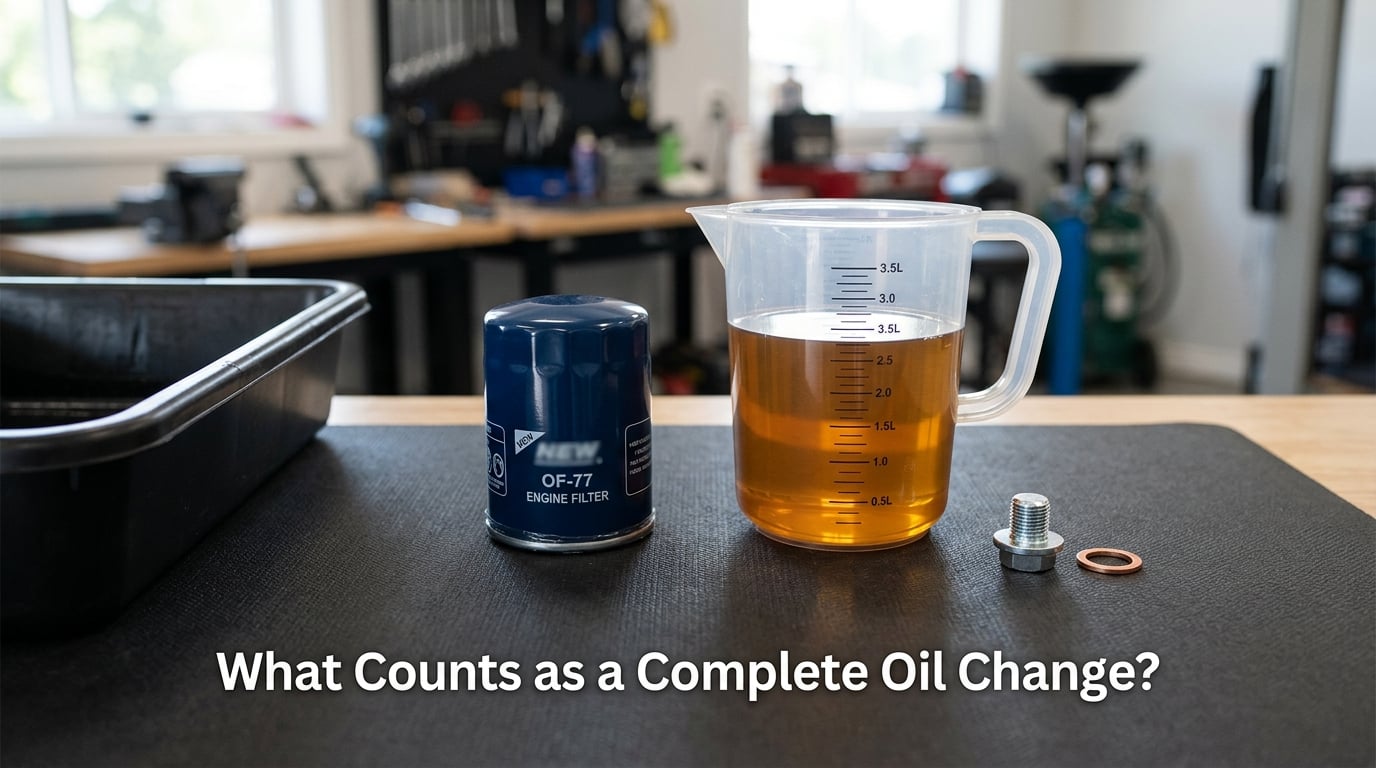
A complete oil change is a service, not a pour. It includes draining the old oil, replacing the drain plug washer, fitting a new oil filter, refilling with the correct quantity of oil that meets the manual’s specification, and inspecting for leaks while the car is still apart.
Good shops also look at the state of the oil as it comes out, check the other fluids, look under the car for wet spots on the subframe and pads, and record the mileage and date on the receipt. Old oil has to be disposed of properly, which is part of what you are paying for and part of why the cheapest quote is not always a good one. If you are weighing the shop counter against doing it yourself, we have covered the timing in how long an oil change takes, DIY and shop.
A top-off is a different thing entirely. It replaces oil that burned or leaked, it leaves the filter and the additives untouched, and it is not a substitute for a scheduled change. Engines that burn a quart between services deserve an oil change on the shorter schedule, not a habit of topping up the dipstick. One r/4Runner owner running a 2014 Camry at 150,000 miles on 0W-20 tops off roughly every 500 miles; that is a consumption pattern worth having a technician look at rather than a service interval to plan around.
A quick change takes minutes once the car is apart, and the parts of it that take real time are the drain, the filter seat and letting the oil settle before the level check.
How Can You Tell When the Next Change Is Due?
Use a service record, an odometer note, and the dashboard, in that order of reliability. A paper or phone log that lists date, mileage and oil specification is the thing that protects you at resale and the thing that tells you the true interval for your car.
Most cars built in the last twenty years have an oil life monitor, and it usually shows remaining life as a percentage in the instrument cluster. Find it in your vehicle’s information display, usually through a menu such as vehicle status, service info or maintenance, and read the oil life figure rather than the raw mileage. The percentage is an estimate, not a measurement.
That distinction matters. An oil life monitor does not sample the oil. It works from engine temperature, trip length, idle time, load and time since the last reset, then subtracts from a starting percentage. It is a good model, but it is desensitised by a pattern of short winter trips and it can be reset without an oil change, which is how a light comes back on three weeks after service.
Some manuals ask for an early first change on a new engine as part of break-in. If yours does, do it. A handful of early short-trip miles are cheap insurance during the period when the engine is still seating its parts.
Use the dipstick for level and condition, not for timing. Check it on level ground with the engine warm and shut off for a few minutes. Dark oil is not a verdict on its own, since modern oils darken with use. Grit, a milky residue, a fuel smell, or a level that drops between services are all worth a technician’s attention.
When Should a Driver Get the Interval Checked?
Some messages are a prompt to schedule service. Others mean stop driving soon. The table separates the two, because treating an oil pressure warning like a routine reminder is the mistake that turns into an expensive repair.
| Dashboard message | What it means | Urgency | Action |
|---|---|---|---|
| Oil change reminder or oil life percentage | A service interval calculated by the vehicle, not a fault | Prompt, not urgent | Book the change on the interval that applies to your driving |
| Check engine light | A stored fault, often unrelated to oil | Read the code promptly | Scan it before replacing anything |
| Oil pressure warning light | Pressure below what the engine needs right now | Urgent | Pull over safely, switch off, and do not drive it further |
| Low oil level message | Level fell faster than expected, or a leak | Urgent | Stop, check level when cool, arrange inspection |
Get an interval checked by a technician when oil disappears between changes, when a light returns soon after a service, when you see a fresh stain under the car, when the oil looks milky or smells of fuel, or when a rattle or knock appears at idle. On r/AskMechanics the recurring frustration is exactly this: manufacturers who permit a quart per thousand miles while also printing a 10,000-mile interval. If you are in that group, a shorter interval and a leak check are a reasonable position, and the manual’s severe schedule is the right place to anchor it.
Frequently Asked Questions
Is 10,000 miles too long for a modern car’s oil change?
Not on most modern cars when the oil meets the manufacturer’s approval standard and the driving is normal, because 10,000 miles is a common printed interval. It becomes too long if you tow, run short trips or sit in heavy traffic, since the severe schedule is about half that length. It is also too long on a high-mileage engine that burns oil between services. Your manual decides.
Can I extend my oil-change interval if I drive very little?
No. A low-mileage driver almost never reaches the mileage limit, so the month count is the limit that applies. Oil ages through heat cycles, additive depletion and moisture even at low mileage, which is why most manuals pair a mileage figure with a 6 to 12 month limit. Follow the time limit, and treat a car that rarely drives as closer to the severe schedule.
Does a modern car require synthetic oil for every service?
Most cars built in the last fifteen years do, or at least their manuals specify a low-viscosity synthetic such as 0W-20. Check the specification and the approval mark rather than the word synthetic on the front label, because the approval standard is what qualifies the oil for the long interval. If the manual names a specification, a conventional oil in the right viscosity grade is still the wrong oil.
Do I need to replace the oil filter every time?
Yes, on almost every modern car. The filter holds the wear debris and contaminants that the drained oil no longer contains, and reusing a filter with fresh oil defeats the point of the service. Filter change intervals are occasionally extended on a few models, so check the manual, but treat a filter swap as part of a complete oil change rather than an optional extra.
What happens if I wait until the oil-change light comes on?
On most cars the light means the calculated interval is up, not that the engine is in danger, so waiting a short while is rarely a problem. Waiting a long time is a different matter: sludge, additive depletion, fuel dilution and viscosity loss can all build up quietly and the oil pressure warning is the one you never want to see. Change it when the light comes on, and go by your manual’s interval if it has already passed.
How often should I change oil on a BMW or other European car?
European makers often publish longer intervals than Japanese manufacturers, and many specify long-life oils such as BMW Long Life, MB 229.5 or VW 504 and 507. Longer is not automatic, because those intervals depend on the exact oil and the normal schedule. Match the oil to the approval standard in your manual, follow the severe schedule if you tow or drive short trips, and expect a healthy European engine on 10,000 miles to be normal.
Conclusion
Start with the manual, not with a number someone told you at the counter. Find the maintenance schedule for your engine, read the normal and severe intervals, note the oil specification and the approval mark, and write down your current mileage so you know your real due point.
Then check your driving against the severe-service list. If two or more of those conditions describe your year, use the shorter interval. Keep a record with date, mileage and oil type, and treat the dashboard light as a prompt to act rather than a deadline. That is the whole method, and it answers the question of how often to change oil in a modern car for any vehicle: the manual’s number, adjusted honestly for how and how much you drive.