
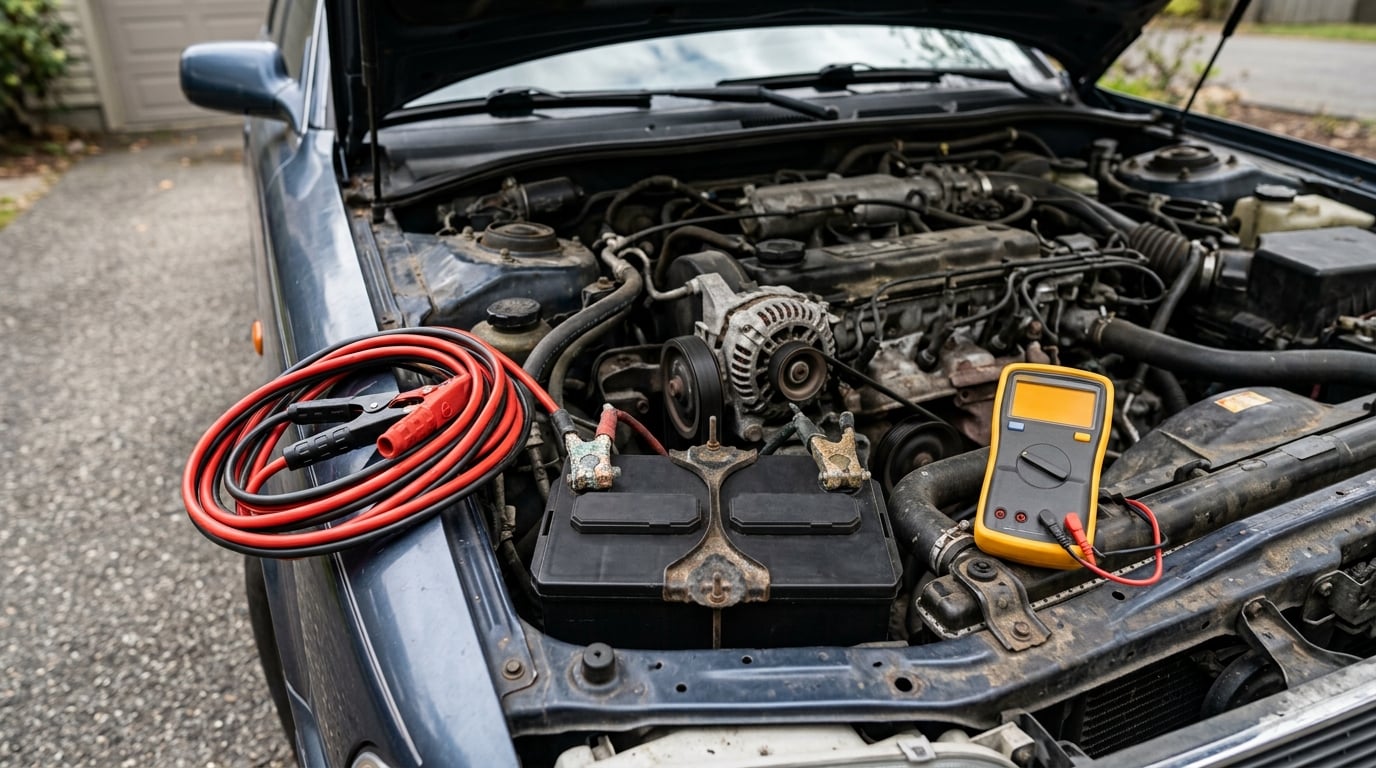
A weak or dead battery stops the car from starting at all. A failing alternator lets the car start normally, then kills the lights, the accessories, and eventually the engine itself. That single distinction is how to tell if it is the battery or the alternator, and you can confirm it at home in about ten minutes with a basic multimeter or with nothing but your ears. The trick is to run the tests in order, cheapest and easiest first, and read the results before anybody starts buying parts.
Most of the confusion on this comes from the two parts failing with overlapping symptoms. A slow crank can be a flat battery, and a dead battery can be a symptom of an alternator that stopped charging. So rather than a list of things that might be wrong, this guide walks through a sequence: check the battery cold, check what the charging system does with the engine running, then rule out the three things people forget. Take the readings in sequence and you will know which part to blame.
Table of Contents
What You Need
You need a digital multimeter set to DC volts, and that is genuinely the only tool that gives a definite answer. A basic meter from any electronics aisle is fine; auto-ranging is not required, but a model with a hold function helps when you are leaning over the engine bay.
Alongside the meter, keep these to hand:
- The owner’s manual for your specific vehicle. Some cars, especially hybrids and anything with automatic start-stop, do not follow the standard numbers.
- A flashlight or headlamp, because engine bays are dark and you will be looking at a battery case at 7am.
- Terminal cleaning brush and a solution of baking soda and water if the posts look crusty.
- Jumper cables or a portable jump starter for the no-meter test, plus a socket wrench for the terminal clamp if yours uses one.
- Paper towels and eye protection. Battery acid is real and it burns.
Park on level ground, in daylight, with the parking brake on and the transmission in park or in neutral. Pop the hood before you sit in the driver’s seat, and never work on the battery with the engine running unless you have specifically decided to run the voltage test below. Remove any metal jewelry, and keep the wrench away from both terminals at the same time. A short across the posts is unpleasant and it will flatten your new battery.
Step-by-Step
Run these in order. Each step eliminates a group of suspects, so a pass at step one means you can stop worrying about a whole category. Do not jump to buying parts until step two, because replacing the battery on a car with a bad charging system is the single most common expensive mistake in this whole area.
Check the Battery Before Starting the Engine
Start with the free inspection. Open the hood and look at the battery itself before you touch a meter. You are checking for four things: a swollen or bulging case, a leaking or crusty white-green crust around the posts, a loose or broken hold-down clamp, and any cable that looks green, fuzzy or eaten away. A battery that bulges on the sides or the bottom has been cooked internally, usually from heat or a failing voltage regulator, and it will not be saved by a charger.
Now measure the resting voltage. Set the meter to DC volts, touch the black probe to the negative terminal and the red probe to the positive terminal, and leave the vehicle off for at least ten minutes so the surface charge settles. Here is how to read it:
- 12.6 to 12.7 volts means fully charged and healthy. Move on to step two.
- 12.4 to 12.5 volts means roughly 75 percent charged. It will probably start, and it will probably let you down in a few weeks.
- 12.2 volts or lower means discharged. Charge it, or fit a known-good battery, before you judge the alternator.
One wrinkle: on a car that has been parked for a day or two, 12.2 volts can simply be the standing drain from the alarm, clock and phone chargers, not a fault. A battery that has been sitting unused for weeks will read low no matter what. Judge resting voltage on a car that was driven within the last day, and treat a low reading on a long-sitting car as a charge-me-first situation rather than a dead verdict.
Also remember that cold cranking amps matter more than the voltage figure. A battery can rest at a healthy 12.6 volts and still be too weak to turn the engine over on a cold morning, because thick oil drags hard on the starter and every accessory wants power at once. Sluggish cranking that sounds slow and lazy points at the battery. A cranking speed that is normal but turns over without ever firing points somewhere else entirely.
Measure Voltage While the Engine Runs
This is the step that actually separates the two parts, and it is the only home test that comes close to definitive. Put the probes on the same two battery terminals, and take a reading in each of these three states.
With the engine off, you should still see 12.4 to 12.7 volts. Start the engine and watch the number. It should climb and settle between 13.7 and 14.7 volts, which means the charging system is putting back what the starter just took out. Now rev the engine gently to about 2000 rpm and the reading should stay steady or climb a little. A needle that climbs with revs and then sags back down is the classic sign of a charging system that cannot keep up.
Here is the cheat sheet, which reconciles the ranges you will find published elsewhere:
| Test point | Healthy reading | What a bad reading means |
|---|---|---|
| Engine off, at rest | 12.4 to 12.7 V | Below 12.2 V means discharged, not necessarily faulty |
| Engine running at idle | 13.7 to 14.7 V | Below 13.7 V means the alternator is undercharging |
| Engine running, around 2000 rpm | Holds steady or climbs | Sags below idle reading means a worn belt or failing output |
| Engine running, high load (lights, blower, defrost all on) | Stays above 13.0 V | Reads under about 12.5 V under load means internal diodes are going |
| Engine running | Below 15.0 V at all times | Above 15.0 V means the voltage regulator has failed and is boiling the battery |
Members of r/Cartalk describe the same test in one line: roughly 13 to 14 volts with the engine running, and a reading that collapses toward 10.5 volts the moment you pile load on points at the alternator or a bad connection rather than the battery. That load step matters. A marginal alternator will idle at an acceptable 13.8 volts and fall apart as soon as the headlights, blower and defrost all come on, which is why testing with everything switched off is a mistake that sends people to the parts counter for the wrong part.
While the engine runs, switch the headlights on and then off and watch the voltage. A dip is normal. Flickering headlights that brighten when you rev are not. A burning rubber or hot-wire smell under the hood with the engine running is not a diagnostic puzzle either; shut it down and get it looked at.
You will also see readings quoted as low as 13.5 V and as high as 14.8 V by different sources. They are not in conflict, they just sit at different ends of the acceptable band for different vehicles, and temperature moves the number too. Use 13.7 to 14.7 as your working range and worry only when a reading falls clearly outside it.
Run the Jump-Start Test
This is the test that needs no equipment at all, and it is the fastest way to catch a bad alternator. Read it before you drive anywhere with a suspect car.
Inspect the dead battery first. If the case is swollen or the terminals are destroyed, stop, because jump starting is not going to tell you anything useful. Then connect your cables: positive to positive, negative to negative on the dead battery, and the other end of the pack on the good battery or a known-good one. Start the engine.
Now the verdict. If the car starts and keeps running after you disconnect the cables, the battery was discharged and the charging system is doing its job. Charge or replace the battery and you are done. If the car runs for a short while and then dies as soon as, or soon after, the cables come off, the battery had enough charge to start the engine and the alternator is not putting anything back. That failure pattern is the most common real-world answer people get, and it is the one that sends owners to r/AskAMechanic asking which part to replace first.
The window for a bad alternator is usually minutes. Some cars limp along for twenty or thirty minutes on stored charge, and hybrids with a large battery pack can run much longer, which is why watching the dash rather than the clock matters. Also remember that a good jump start proves nothing about battery health. A battery can be ten years old, start fine on a jump, and fail again in three days, because the test only tells you whether the charge is holding under load, not whether the plates are still good.
Use the Test Light or Voltage Drop as a Cross-Check
If you have no meter, there is still a usable check. With the engine at idle, turn the headlights on and watch them from outside the car. Then rev the engine to around 2000 rpm. Headlights that noticeably brighten on the rev have an undercharging alternator. A radio that fades, a power window that slows halfway up, or a backup camera that cuts out under the same conditions point the same way. A dashboard that flickers while idling and steadies when you rev is often a bad ground rather than a bad alternator.
With a meter, a voltage drop test is the cross-check worth learning. Set the meter to DC volts, put the red probe on the positive battery terminal and the black probe on the alternator output bolt, then crank the engine. The difference between the two readings should stay well under 0.5 volt. Do the same from the negative terminal to the alternator case and you are reading the ground path. Anything over a volt of drop means corroded cables, a bad ground strap, or a failing connection, and no alternator on earth will charge properly through a bad cable.
This is where a good battery reading can still mislead you. A battery reading 12.6 volts while the engine runs means the voltage regulator and alternator are fine, but if the ground strap from battery to engine block has rusted away, the actual current path is starving and accessories will brown out. Clean the posts, tighten the clamps and re-run the test before you condemn anything.
One more limit worth knowing: free testing at an auto parts store is a battery test. It proves charge state and, often, cranking performance. It does not tell you whether your charging system is keeping that battery charged once you start driving, which is why owners leave with a confident your battery is fine and a car that dies again the next morning. Ask for an alternator output test or a road test, not just a battery printout.
Check the Rest of the Charging System
Three other suspects turn up often enough to be worth ruling out, because they imitate both parts.
The starter. A rapid clicking sound with no crank at all is the starter solenoid trying to engage and failing, which usually means a depleted battery, but it can also mean a solenoid with a bad contact. A starter that spins without the engine firing points at fuel or spark, not at either part of this question.
The serpentine belt and the alternator bearing. A worn belt that slips under load gives you exactly the undercharging pattern, and it is far cheaper to fix. A dry bearing makes a whining or grinding noise that rises and falls with engine speed. If the belt is glazed, cracked, or frayed, replace it before you decide anything about the alternator.
Parasitic draw. This is the third suspect that gets mistaken for a bad alternator constantly. Something stays awake after you shut the car down and drains the battery overnight. Test it the way owners do in r/MechanicAdvice: with a multimeter on DC current, break the negative battery connection and watch what the meter shows. A normal reading settles in the range of roughly 25 to 50 milliamps on most cars. If it holds a few hundred milliamps, or it slowly climbs, something is not shutting down. A glove box light left on, an aftermarket alarm, an unplugged phone charger, or a stuck relay will do it. Parasitic draw is a wiring fault, not a charging system fault, and replacing either part will not fix it.
It can also be both at once. A weak battery makes the alternator work harder and strains its diodes, and a failing alternator undercharges the battery until the plates sulfate. People on forums describe spending on a new battery, watching the problem return inside a week, and only then suspecting the alternator. Testing in the order above catches that loop before you pay twice.
Common Mistakes
Replacing the battery first, without testing the charging system. This is the expensive one. A new battery on a bad alternator dies again within weeks, and you have now bought a part you did not need. Fix: run the engine-running voltage test before you buy anything, every time.
Jumping a battery you have not looked at. A swollen case or a broken post means the jump gives you a temporary start and no useful information, and you are handling acid. Fix: inspect first, always.
Setting the meter to the wrong mode. Continuity or current mode on a battery will read roughly zero and tell you the battery is fine. Fix: DC volts, DC 20V range, probes on the terminals, black on negative.
Testing with the accessories off. A marginal alternator passes at idle and collapses under load. Fix: run the heater blower, headlights, radio and defrost, then re-read.
Ignoring corrosion and grounds. Green crust on a post or a rusted ground strap can drop enough voltage to make a healthy charging system look broken. Fix: clean with baking soda and water, rinse, dry, tighten, then retest. Do not get baking soda into a cell opening.
Disconnecting the battery while the engine is running to see if the car keeps running. This is the dangerous folk test, and it is still circulating on video. It works by dumping stored energy back through the ignition, and on a modern car it can fry the ECU, the airbag control module, the infotainment unit and the instrument cluster. Fix: do not do it. Use the voltage reading, which is safer and more accurate.
Reading a warm alternator and calling it done. A reading taken seconds after start-up is not the same as a settled one. Let it idle for twenty seconds and take two readings, one at idle and one at rev.
One safety line above all the rest. If the engine stalls while you are driving, if the battery light comes on at speed, or you smell anything burning, pull over, shut the engine off and switch on the hazards. A car that will not steer and brake properly because of an electrical failure is not worth the trip to the shop. Book a tow.
Frequently Asked Questions
Can a bad battery start the car but still be the problem?
Yes, and it is one of the most common reasons people misdiagnose this. A worn battery can hold enough charge to crank the engine and still fail the next morning. Clues: a noticeably slow or lazy crank, a battery older than three to five years, a swollen case, or a car that will not start when it has been parked for a few days but starts fine after a short drive. A parts store load test measures cranking performance under load, which catches these cases that a resting voltage reading misses.
What voltage should the alternator produce while the engine is running?
Between 13.7 and 14.7 volts at the battery terminals, with the engine at idle. Many cars are built a little lower, so anything from about 13.5 to 14.8 is normal. Below 13.7 the charging system is undercharging, and above 15.0 the voltage regulator has failed and will boil the battery dry. Check with the engine off first, then start it, then repeat with headlights, blower and defrost running to see whether the reading holds under load.
Why does the battery die after the car has been driven?
Short trips are the usual reason. Alternator output is lowest at idle, so frequent stop-and-start driving never fully replaces what the starter took out, and the battery slowly slides into a discharged state. It also happens when the car sits unused, since the alarm, clock and interior electronics still draw a small current every night. If the battery dies within a day or two of a long drive, look at parasitic draw or a failing alternator instead, because a healthy battery should hold for weeks.
Should I replace the battery or alternator first?
Always confirm the charging system before you buy a battery. The alternator is the harder failure to spot, because a new battery makes the car start and then quietly goes flat again a few weeks later. Run the engine-running voltage test, and if the reading sits between 13.7 and 14.7 volts, the charging system is fine and you can replace the battery with confidence. If it is out of that band, the alternator comes first, and the battery gets replaced afterwards.
Can a bad alternator damage a new battery?
It can, in two ways. An undercharging alternator never brings the battery back up to full charge, so the plates sulfate and the battery dies young. A failed voltage regulator pushes more than 15 volts into a battery that cannot take it, which boils the fluid and can make the case swell within weeks or months. That is also why a bulging battery is worth investigating for a charging fault rather than simply replacing, since the regulator is what produced the damage.
So here is the order of operations. Look at the battery, read its resting voltage, then start the engine and confirm the charging system sits between 13.7 and 14.7 volts. That single sequence separates a weak battery from a charging fault, and it takes about ten minutes. If the car dies as soon as the jumper cables come off, the alternator is your problem. If the battery reads low but the charging voltage is healthy, the battery is your problem. And if the symptoms come and go, or the car stalls while you are driving, get it on a lift rather than throwing parts at it.