
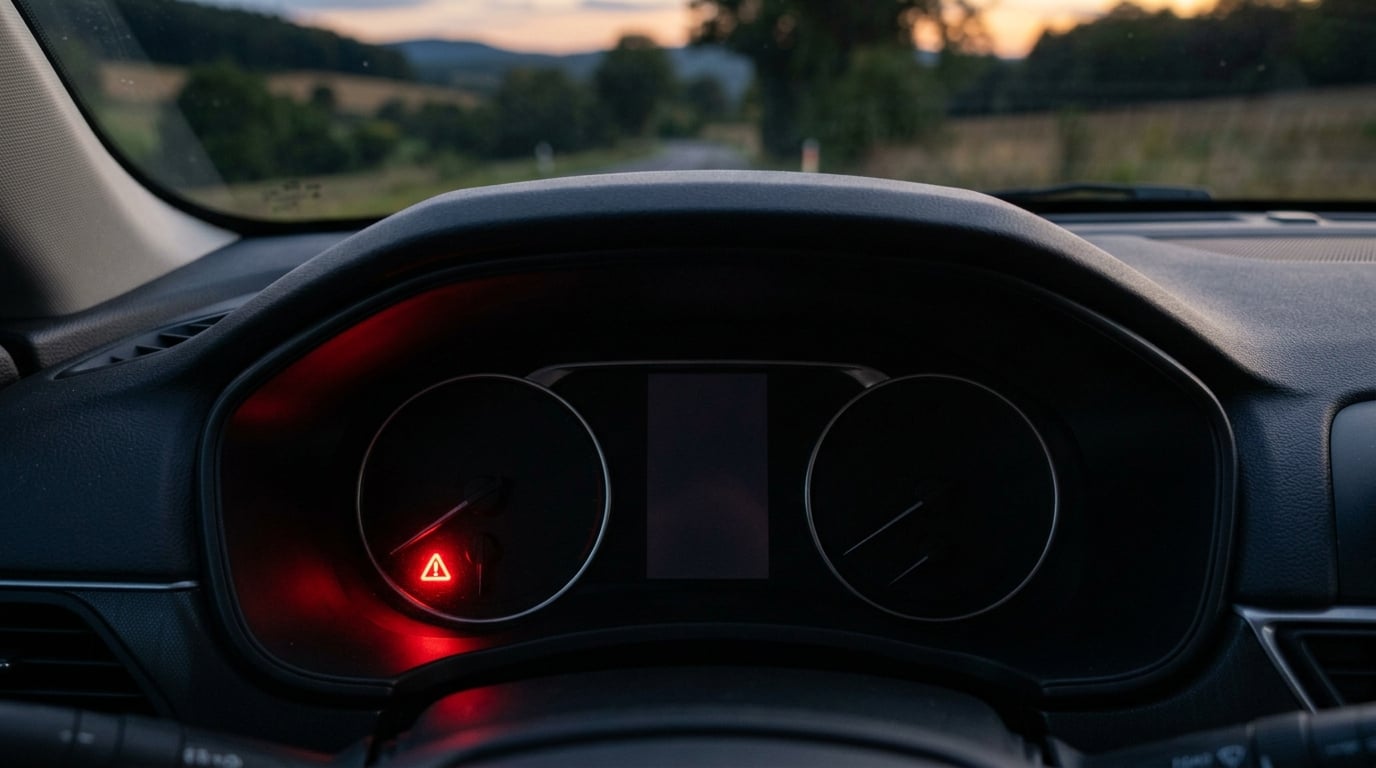
If you are wondering how long can you drive with the battery light on, the honest answer is usually 15 to 60 minutes on a healthy, fully charged battery, and only a few minutes on an old or weak one. There are no guarantees. Once the charging system stops working, the battery is the only thing powering your ignition, fuel pump, and lights, and it drains from that point on.
The number that matters most is not minutes but miles. A 20-minute drive in slow traffic covers a few miles, while 20 minutes at highway speed covers a couple of dozen. Before you turn the key, work out the distance to the nearest parts store or shop and compare it against the range in the table below.
Table of Contents
- How Long Can You Drive with the Battery Light On?
- What Does the Battery Light Mean on a Car?
- How Many Minutes of Driving May You Have?
- What Can Drain the Battery While You Drive?
- How to Drive Safely with the Battery Light On
- Battery or Alternator: Which Problem Is Causing the Light?
- When Should You Stop Driving Immediately?
- Frequently Asked Questions
- Can I drive 30 minutes with the battery light on?
- Is it safe to drive to a mechanic with the battery light on?
- What happens if I ignore the battery warning light?
- Why is my battery light on but the car seems to drive normally?
- How do I know if the battery or alternator is the problem?
- Should I turn off accessories when the battery light comes on?
- Conclusion
How Long Can You Drive with the Battery Light On?
You can drive, but you are driving on a consumable resource. The moment the battery warning light stays on with the engine running, the alternator is no longer replenishing what the car is spending, and the clock starts.
Here is what actually happens. The alternator converts engine rotation into current, and it normally holds the system between 13.8 and 14.4 volts. When charging output drops, the car runs entirely off the 12-volt battery. A fully charged battery holds roughly 12.6 volts at rest, and it cannot be drained much below that before the ignition and fuel systems start to stumble.
That is the whole answer, and it is deliberately vague. Battery age, how much of it you started with, what you have switched on, the temperature, and how hard the engine is working all change the outcome. Two identical cars with the same fault can differ by an hour.
What Does the Battery Light Mean on a Car?
The battery light is a charging-system warning. It does not mean the battery is empty. It means the car is no longer keeping the battery topped up, which usually points at one of a handful of faults.
- Failing alternator. The most common cause by a wide margin, especially past 100,000 miles. Internal diodes or the voltage regulator can fail while the belt still spins, so no noise tells you.
- Loose, cracked, or slipped serpentine belt. Cheap to fix, and the one cause a driver can sometimes diagnose by looking under the hood with the engine off.
- Corroded or loose battery terminals. A white or blue-green crust on the posts, or a terminal that moves in your hand, breaks the circuit even with a good battery.
- Blown fusible link or damaged wiring. A blown mega fuse near the battery is usually a symptom of a short somewhere, not a fuse problem on its own.
- Battery that has reached end of life. Typically three to five years, sooner in hot climates.
Why the light is normal for a second at key-on
When you turn the key before starting, the light comes on while the alternator is not yet turning. That is the bulb check, and it confirms the bulb and the sending circuit work. It should go out within a second or two of the engine running. If it stays on after the engine is warm, you have a real fault.
Why the car can still drive fine with the light on
A charged battery is a big reservoir, and a modern alternator that has partially failed can still push enough current to keep the engine running. That is why drivers report a car that feels completely normal with the light glowing on the dash. It is also why you cannot judge the remaining time by how the car feels.
How Many Minutes of Driving May You Have?
These are planning ranges drawn from what owners report in practice, not lab measurements. Treat the lower end of each row as the number to plan around.
| Situation | Rough time remaining | Rough distance |
|---|---|---|
| Healthy battery, under 3 years old, engine warm, no accessories | 30 to 60 minutes | 15 to 35 miles |
| Healthy battery, night driving with headlights on | 20 to 45 minutes | 12 to 30 miles |
| Older battery, 4 to 6 years, or one that has sat unused for weeks | 10 to 20 minutes | 5 to 12 miles |
| Battery already weak on arrival, or a long trip with the air conditioning running | 2 to 10 minutes | 1 to 5 miles |
| Battery completely flat but engine is running | Under 5 minutes | Under 3 miles |
Owners on car forums report everything from a five-minute failure to a 40-minute drive through traffic, and that spread is exactly the point. Nobody has a way to know which end they are on until the lights start dimming.
How long can you drive with the battery light on before it dies?
It dies when the battery can no longer hold enough charge to keep the ignition energized, and that happens without much warning. A multimeter turns the guesswork into a reading: with the engine running, 13.8 to 14.4 volts means the charging system is working, 13.0 volts is marginal, and anything at or under 12.5 volts means pull over now. A battery sitting at 12.5 volts after a drive is already well down.
What Can Drain the Battery While You Drive?
Some of these are faults and some are ordinary physics. Knowing which is which tells you whether the light means a tow or a ten-minute drive.
- A dead alternator. Zero charging. Everything the car draws comes straight out of the battery.
- A belt or tensioner problem. A slipping belt often shows as a squeal under load, and the alternator output drops and rises with engine speed.
- Parasitic draw. Modules, alarms, and infotainment systems draw a trickle with the engine off. Over weeks, that flattens a battery until the light comes on the first time you turn the key.
- Heat and cold. Battery life is measured in calendar years, and extreme heat shortens it. Very cold mornings increase cranking demand just when capacity is lowest.
- Short trips. A ten-minute drive never replaces what the starter took out. Drivers who live on short hops often kill healthy-looking batteries.
- Accessories and loads. Heated seats, a heated steering wheel, seat ventilators, an aftermarket amplifier, and a roof box of light all draw current. The air conditioning compressor is the biggest single offender in traffic.
How to Drive Safely with the Battery Light On
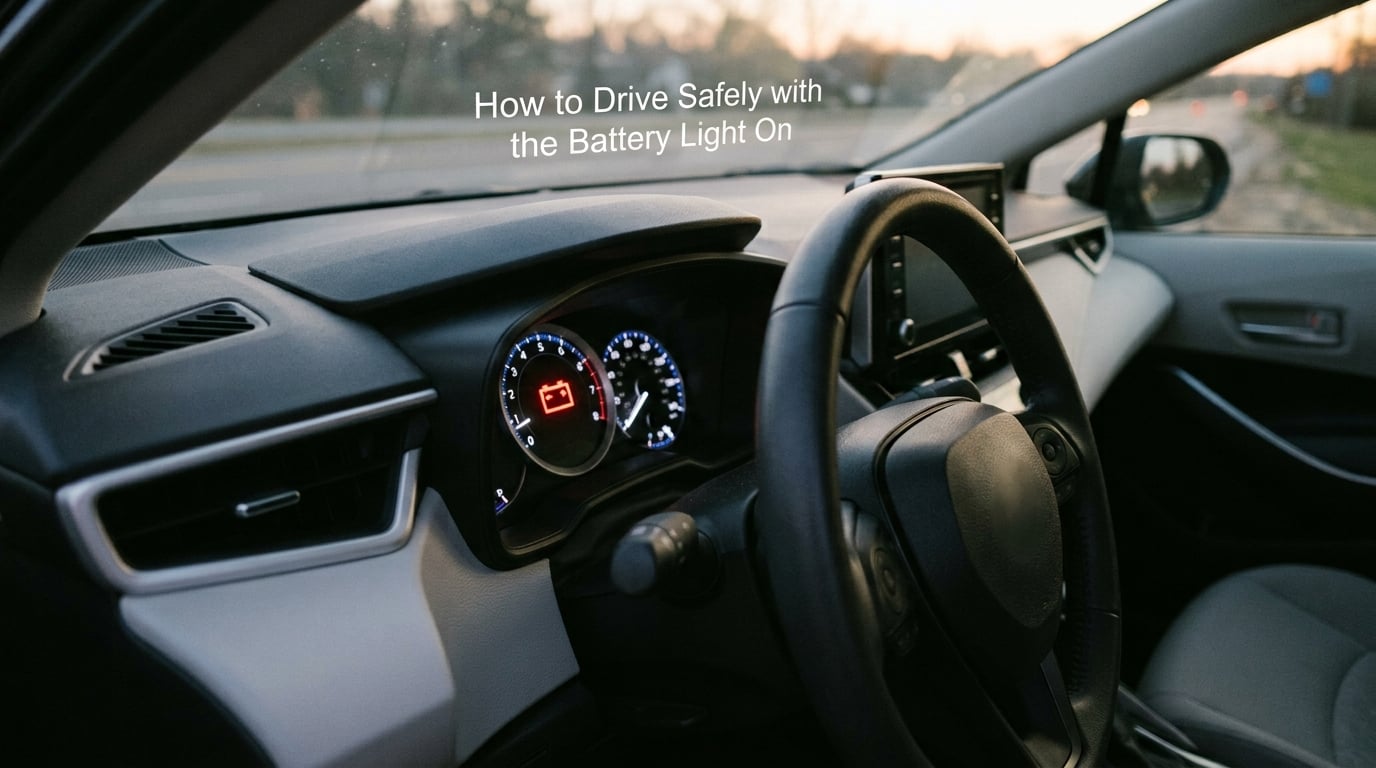
Work through this in order. It takes about thirty seconds and it materially changes how long you have.
- Turn off what you do not need. Heated seats, heated wheel, seat ventilation, radio, phone charger, and any rear entertainment. Keep headlights on if it is dark, and leave the air conditioning alone unless you can do without it.
- Ease off the throttle and hold a steady speed. Hard acceleration and steep climbs ask more of the alternator, and if it is slipping that is when it slips most.
- Do not shut the engine off in traffic or in a parking lot. This is the one rule people break most often. Every restart is a large draw on a battery that cannot recover, and the chance of getting a second start back drops sharply. If the light comes on in a garage, drive the car out before it dies in the doorway.
- Drive to the nearest safe place to stop. The parts store four miles away beats the shop twelve miles away. If a tow is closer than the repair, call the tow.
- Avoid repeated stops and starts. Each launch spends charge you cannot get back, and traffic gives you no way to recover it.
- Once parked, shut it down. Every minute of idling with a failed alternator is charge you are throwing away, and idling consumes fuel without giving the battery anything back.
If the car stalls in a live lane, hazards on, gears in park, parking brake set, and stay in the vehicle with it locked until help arrives if traffic is moving around you.
Battery or Alternator: Which Problem Is Causing the Light?
These two get confused constantly because they throw the same light. The symptoms overlap early and separate later.
| Symptom | Weak battery | Failing alternator |
|---|---|---|
| Light on with engine running | Yes, usually after a slow start | Yes, usually while driving |
| Slow or laboured cranking | Strong sign | Rare |
| Engine runs but will not restart after a stop | Strong sign | Common, once voltage drops |
| Dim or flickering headlights, flickering cluster | Rare | Strong sign |
| Whining or grinding from under the hood | None | Possible, not always present |
| Burning rubber or hot wire smell | Corroded terminal can cause it | Strong sign, stop driving |
| Voltage at the posts with engine running | 12.4 to 12.8 volts | Under 13.0 volts |
The pattern most people describe fits the alternator: the car starts fine, drives fine, and the light appears at speed or with the air conditioning running. A battery problem usually announces itself at key-on with a slow crank.
How to test it with a multimeter
- Set the meter to DC volts, engine off, and measure across the battery posts. A healthy rested battery reads 12.6 volts or higher.
- Start the engine and read again. 13.8 to 14.4 volts means the alternator is charging correctly.
- Read 13.0 to 13.7 volts with the engine running and the alternator is failing, or the belt is not driving it properly.
- Read 12.5 volts or lower and stop the car. Do not plan a trip on it.
Be careful around a running engine: keep the leads clear of the fan belt and moving parts. If you are not comfortable opening the hood on the shoulder, skip the test and let a technician run it.
When Should You Stop Driving Immediately?
These signs mean minutes, not an hour. Pull over at the first safe place as soon as you notice one.
- Headlights dimming or the dash flickering. The most honest warning your car gives, and the one most often ignored because the road is still lit.
- Accessories responding slowly. A window that takes a second longer, a radio that fades, heated seats that go cool.
- Engine hesitation, roughness, or a drop in rpm. Fuel delivery is the first thing to suffer when voltage sags.
- Any burning smell. A failed alternator or a melted fusible link can start a fire. Stop, shut off, and stay away from the engine bay.
- A hot or swollen battery case. Get out and step away from the vehicle.
- Heavier steering or a change in braking. Power assist drops first, and that is a control problem, not a comfort problem.
Once you are parked, do not keep cranking the starter to see if it will fire. That drains what is left and can damage the battery. Call roadside assistance or a tow.
Frequently Asked Questions
Can I drive 30 minutes with the battery light on?
Often yes, if the battery is healthy and you drive with the radio, heated seats, and other accessories off. Thirty minutes of gentle driving is the middle of the planning range, not a promise. If the car is more than four years old, the battery has been sitting unused, or the air conditioning is running in traffic, treat your real budget as closer to ten minutes.
Is it safe to drive to a mechanic with the battery light on?
It is safe if the car is running normally and the trip is short. Drive directly there, keep the speed even, avoid hard acceleration, and do not stop anywhere along the way. The risk is not the driving itself, it is stalling in traffic because you ran out of charge. If dimming lights or a rough engine show up, the mechanic is no longer the destination.
What happens if I ignore the battery warning light?
The engine will eventually stall, and it may stall suddenly in a merge, a parking garage, or at a light. Continued running also deepens the discharge on a battery that is not recovering, which can shorten its life permanently and, in rare cases, damage electronics. A smell of burning from under the hood means stop immediately and get away from the car.
Why is my battery light on but the car seems to drive normally?
A charged battery is a large reserve, and a partially failing alternator can still keep the engine running. The car will not warn you with a number, only with symptoms, and those show up late. Some cars also have enough stored energy in the battery to restart even after the charging system has stopped entirely. Do not treat normal running as evidence that the fault is minor.
How do I know if the battery or alternator is the problem?
A slow cranking start that clears once the engine is running points at the battery. Dim or flickering headlights, a flickering instrument cluster, or a voltage under 13.0 volts at the battery with the engine running points at the alternator. A loaded or undercharged battery also throws the same light, so a technician should test all three before you pay for parts.
Should I turn off accessories when the battery light comes on?
Yes. Every accessory you switch off is charge you keep for the ignition and fuel systems. Turn off heated seats, the heated wheel, seat ventilation, the radio, phone chargers, and any aftermarket equipment. Leave the headlights on when it is dark, and be more careful than usual with the air conditioning, since the compressor is the heaviest single load in stop-and-go traffic.
Conclusion
Treat the battery light as a charging-system fault, not a low-battery warning. Cut the electrical loads, drive straight to the nearest place you can safely stop or get a real diagnostic, and do not shut the engine off along the way. Whatever the outcome on the road, get the charging system tested properly rather than hoping the light goes away on its own.