
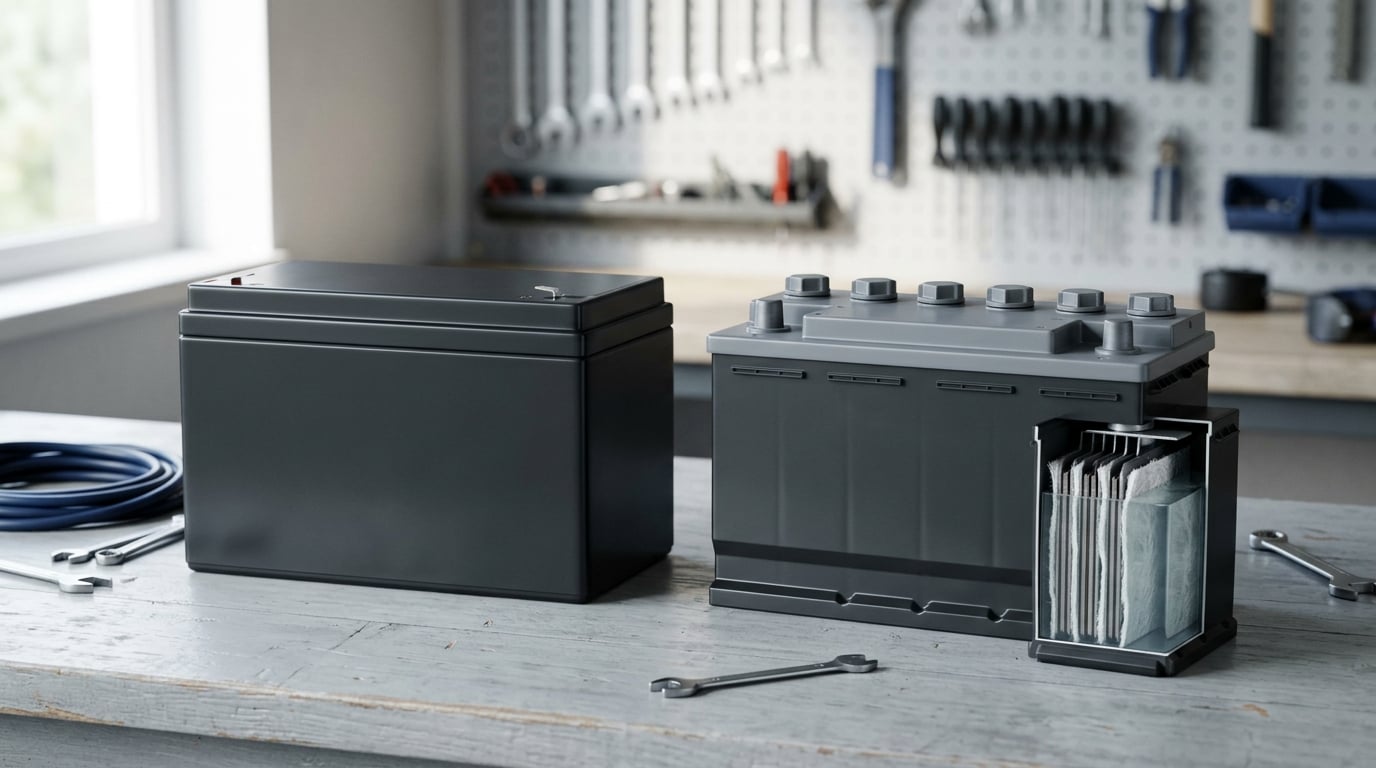
AGM vs flooded car battery explained in one line: both are 12V lead-acid batteries, but an AGM seals the electrolyte inside absorbent fiberglass mats while a flooded battery holds free liquid acid in a vented case. Pick AGM for start-stop vehicles, heavy electrical loads and cold climates. A flooded battery is still fine in an older, simple car.
That is the whole argument, honestly. Everything that makes an AGM better — cranking power, cycle life, no water top-ups, no corrosion mess — traces back to one design decision about how the acid is held. Get that one thing clear and the rest of the comparison explains itself.
I have pulled apart enough dead batteries to know where owners go wrong. The most common mistake is not buying a cheaper or dearer battery; it is fitting the wrong chemistry to a car that expects the other one, then wondering why the charging system misbehaves. The second most common is assuming any charger is fine for an AGM. It is not.
Before you spend anything, check the label on your existing battery or the battery specification in your owner’s manual. That single check tells you whether the car came with an AGM, an enhanced flooded battery (EFB) or a plain flooded unit, and it decides most of the rest of this article.
Table of Contents
- AGM vs Flooded Car Battery Explained at a Glance
- What Is the Difference Between AGM and Flooded Car Batteries?
- How Each Battery Holds and Releases Charge
- Which Battery Works Better in Cold Weather?
- How Maintenance and Safety Compare
- Lifespan, Weight, and Cost: What Changes?
- Which Should You Choose?
- Frequently Asked Questions
- Can I replace a flooded battery with an AGM battery?
- How do I know if my car needs an AGM or flooded battery?
- Are AGM batteries harder to charge?
- Why does my battery die after several short drives?
- Do AGM batteries last longer than flooded batteries?
- What should I check before buying a replacement car battery?
- A Simple Battery-Choice Checklist
AGM vs Flooded Car Battery Explained at a Glance
Here is the short version of agm vs flooded car battery explained, criterion by criterion. Read the middle column first if you just want the practical answer.
| Criterion | AGM (absorbent glass mat) | Flooded (conventional wet cell) |
|---|---|---|
| Electrolyte | Sulfuric acid absorbed in fiberglass mats | Free liquid sulfuric acid |
| Case | Sealed, valve regulated, spill proof | Vented, open to gas release |
| Gas recombination | Most oxygen and hydrogen recombine internally | Hydrogen vents out; water is lost |
| Internal resistance | Low, plates held under compression | Higher, plates free to move |
| Cold cranking amps | Typically higher for its size | Good, but drops harder as it ages |
| Cycle tolerance | Built for hundreds to thousands of shallow cycles | Shallow cycles slowly shed active material |
| Start-stop rated | Yes, this is what it was designed for | No, an EFB is the intended part |
| Service life | Typically 4 to 7 years | Typically 3 to 5 years |
| Water top-ups | None | Every few months on a worn battery |
| Mounting orientation | Upright or on its side | Must stay upright |
| Spill risk in an accident | Very low | Real; acid under the seat is nasty |
| Self-discharge in storage | Low, holds charge for months | Higher, needs periodic charging |
| Sulfation risk | Much lower, as shown by owners on Honda forums | Higher, plate shorting is common |
| Vibration and shock | Mat keeps plates in contact | Plate material shakes loose over time |
| Charging profile | Higher voltage setpoint, 14.4 to 14.7 V typical | Standard, roughly 13.8 to 14.4 V |
| Overcharge tolerance | Poor; a weak regulator cooks it fast | More forgiving, but still not unlimited |
| Trickle charger | Must be a smart maintainer, never a dumb one | Any float charger works |
| Weight | Heavier for the same group size | Lighter |
| Purchase cost tier | Higher, often 40 to 100 percent over flooded | Lowest |
| Best suited to | Start-stop, electronics-heavy cars, cold climates, storage | Older simple cars, short daily drives, lowest budget |
Read that table twice, because the charging rows matter more than people expect. An AGM and a flooded battery do not want the same thing from your alternator and regulator, and that is where a lot of the forum panic about “AGM batteries dying early” comes from.
What Is the Difference Between AGM and Flooded Car Batteries?
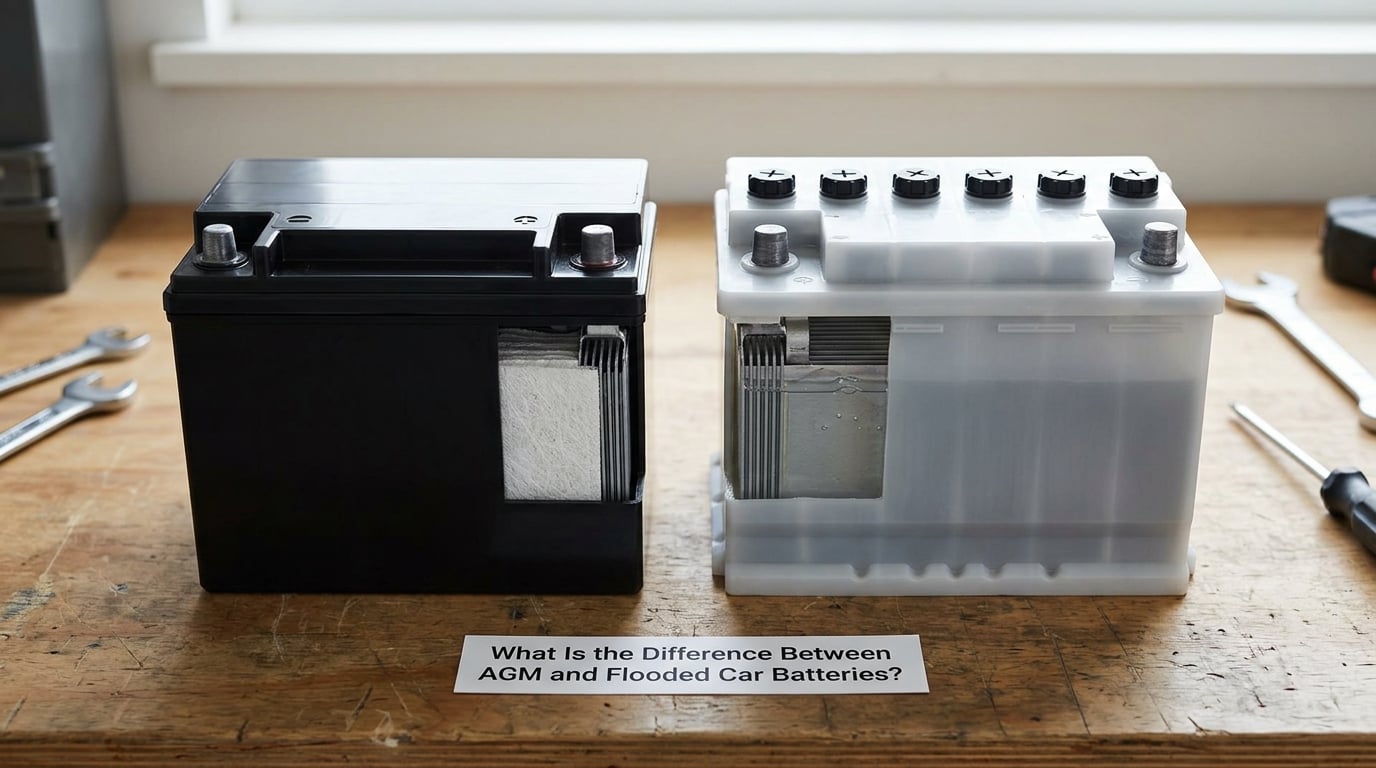
Both are lead-acid batteries, so the chemistry inside is the same. The difference is entirely in how the electrolyte is contained, and everything else follows from that.
What the glass mat actually does
An AGM battery suspends the acid in a fiberglass mat pressed tightly between the lead plates. The mat holds the liquid by capillary action, so there is no free fluid to slosh around and the case can be sealed shut.
Two useful side effects follow. Because the plates are held under compression, they stay in contact and internal resistance stays low. Because there is no free acid, the battery can be mounted in almost any orientation and will not spill in a collision.
What a flooded case does
A flooded battery hangs the same plates in a bath of free liquid acid, usually with cell caps on top. It is cheaper to build, and it delivers strong cranking current, but it needs a vent to release hydrogen gas as it charges and it loses a little water each time.
Owners of older trucks and SUVs report this pattern repeatedly: a flooded battery lasts around four years in mild weather, then starts dying early because vibration shook plate material loose and the electronics load never let it fully recharge.
Where EFB fits as the middle ground
An enhanced flooded battery (EFB) is a better flooded battery. It uses a different alloy and a glass fibre separator to survive several hundred shallow cycles, which is exactly what a non-start-stop modern car with a big infotainment draw needs.
Many current models that have no start-stop system still ship with an EFB. If your manual calls for one, that is the part to buy, and it is cheaper than an AGM while lasting longer than a conventional flooded unit.
How to identify what you have right now
Look at the case first. AGM cases are sealed and usually carry a valve or a warning label about sealed electrolyte. Flooded and EFB cases have removable cell caps on the top.
Then read the label for the words AGM, Absorbent Glass Mat, VRLA, EFB, Enhanced Flooded, or plain flooded lead acid. If the label has rubbed off, the battery type and group size are printed in the owner’s manual spec plate or in the under-hood fuse box sticker.
Finally, weight is a rough clue. An AGM in the same group size as a flooded battery weighs noticeably more, because of the mats and the denser construction. It is a clue, not a proof.
How Each Battery Holds and Releases Charge
AGM takes a charge faster and holds it better, and it recovers from deep discharge more reliably. Flooded batteries accept charge fine when healthy, but they lose capacity faster once they are old or repeatedly run down.
Charging behaviour and voltage
Because the acid sits in a compressed mat, the cells have lower internal resistance, so an AGM pulls charging current more readily. It also wants a slightly higher charging setpoint, commonly 14.4 to 14.7 V against a regulator, where a flooded battery is usually happy at 13.8 to 14.4 V. Owners of certain European models have noted the same thing: the car expects the AGM charge profile.
On a fully rested battery, 12.6 to 12.8 V means full. Around 12.4 V is a typical resting reading for a part-charged battery. If you are seeing 12.3 V, the battery is not “good”, it is simply not at rest, so recharge and test it under load before judging it.
Is a trickle charger fine on an AGM? Only a smart maintainer, never an old-style dumb trickle charger. A fixed-voltage trickle charger will push current into a full AGM for hours, cook the electrolyte, and boil the water out through the safety valve. That single mistake is the top cause of short-lived AGMs I see.
What actually kills an AGM battery
Overcharging from a failed regulator or the wrong charger is number one, and owners describe it in plain terms: the battery swells, the case gets hot, and it dies young. Number two is deep discharge, which happens more often than people think.
Number three is heat. A battery under a hot hood in a desert climate ages far faster than the same battery in a temperate one, and neither chemistry escapes that. Number four is vibration in a stiff frame or over a rough road, though the mat handles this better than flooded plates do.
Number five is simply time. Nothing makes a battery last forever, and a six-year-old AGM that sits unused is still due for replacement.
Deep discharge and parasitic drain
A car’s alarm, clock, and infotainment memory draw a small current while parked, and a long holiday is a genuine risk for either chemistry. An AGM at 1 to 3 percent self-discharge a month holds its charge far longer than a flooded battery at 3 to 5 percent.
If you do find a deeply discharged AGM sitting at 12 V or lower, it is not automatically dead, but recovery is slow and only works on a charger with a recovery or reconditioning stage, matched to AGM chemistry. Once a battery is below about 10.5 V for long periods, treat it as suspect and replace it rather than gambling.
Which Battery Works Better in Cold Weather?
AGM wins in cold weather, mainly because it accepts a charge faster when the engine is running and cold, and because its lower internal resistance gives it a stronger first crank on a cold morning.
Cold weather punishes both chemistries, though. A car that sits overnight in freezing conditions does not recharge enough to put back what the starter and the heated cabin took out, so battery plates sulfate and capacity drops. That effect is much worse for a battery that is never fully brought back up to a full charge.
Read the label for cold cranking amps, and treat it as a floor rather than a quality score. Two batteries with the same CCA number can behave very differently if one has sat on a shelf for a year. For long cold spells, park the car in a garage or fit a maintainer between trips, because no chemistry starts well at minus 20 after sitting flat.
A flooded battery with a strong enough CCA rating is still perfectly adequate in cold weather if your car has no start-stop, no heavy accessory load and you drive long enough to recharge properly. Cold alone is not a reason to move to AGM.
How Maintenance and Safety Compare
AGM needs almost nothing; flooded needs water, ventilation and clean terminals. In safety terms, AGM is the easier battery to live with because a sealed case cannot vent hydrogen or spill acid under the seat.
Terminals, water and corrosion
Both types still want clean terminals and a proper connection. Disconnect the negative terminal first, clean the posts with a wire brush or a dedicated terminal cleaner, and refit without touching the metal bare.
A thin film of protectant on the clamp helps slow future corrosion. Flooded batteries need a distilled water top-up when the level drops to the mark, and topping up with tap water is one of the most common DIY mistakes people make.
Venting, spill risk and handling
A flooded battery releases small amounts of hydrogen while charging, so it should be kept in a ventilated space rather than sealed in a compartment with no airflow. It also stays upright only, and a serious collision can spread acid under a seat or into trim.
AGM gases recombine internally, so venting is minimal and spill risk is low. It can sit on its side for transport or storage, which is useful if you are testing a battery on a bench. Both chemistries contain sulfuric acid, so gloves and eye protection still apply, and you never clamp a charger across a battery you have just filled with water.
When jump-starting, connect positive to positive and negative to negative, never lean over the battery, and remove the negative clamp last. If the battery is swollen, hissing or leaking, do not connect a charger at all.
Registration and recycling
Many European vehicles record the battery type in the control unit. Owners of recent Volkswagen and Audi models on r/MechanicAdvice report that replacement without programming leaves warning messages on the dash, and BMW and Mercedes do the same thing. If your manual mentions battery registration or coding, budget for a dealer or a capable independent shop to do it after fitting.
Take the old battery to a recycling point or a parts retailer that accepts them. Lead and acid are recoverable, and most retailers give a store credit for the core, but never leave a battery in a household bin or in a hot car.
Lifespan, Weight, and Cost: What Changes?
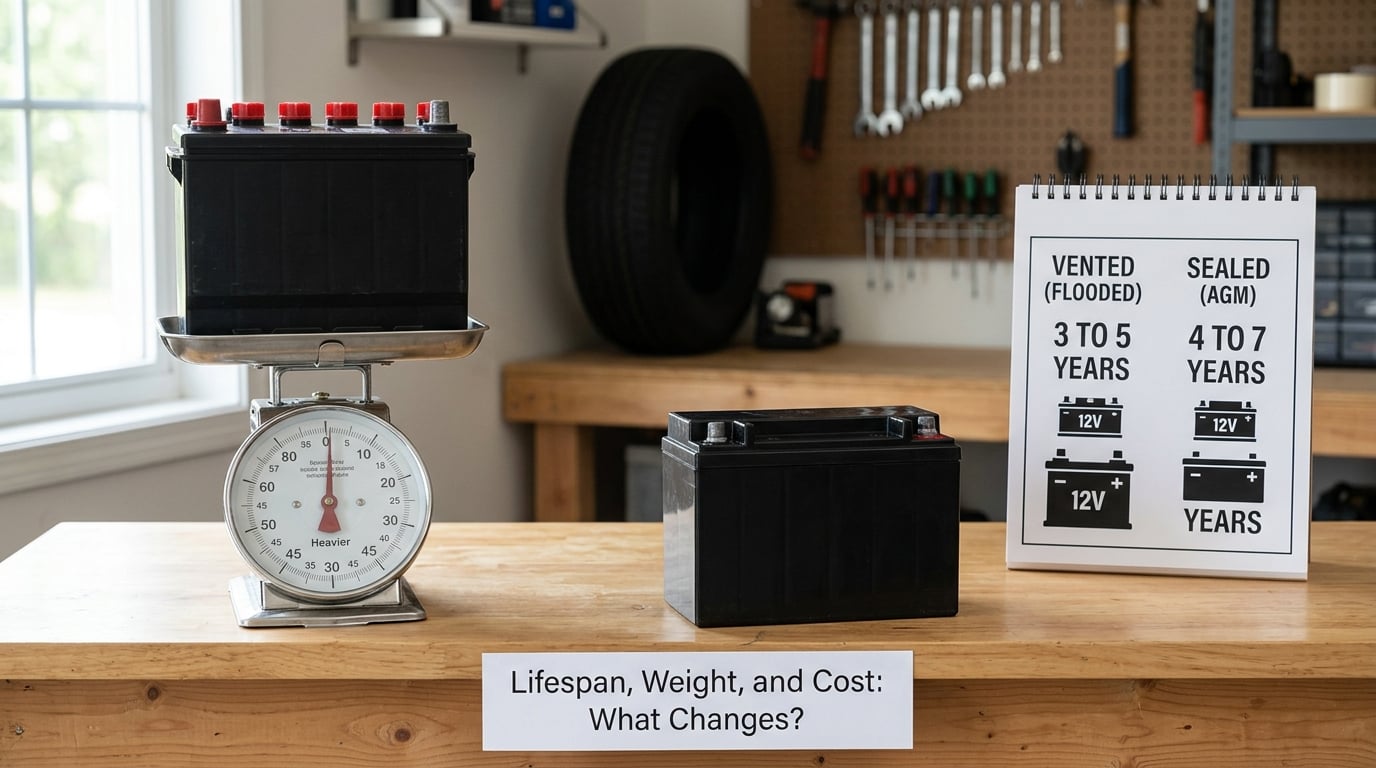
Lifespan is where the money argument actually lives. Real-world service life is typically 4 to 7 years for an AGM and 3 to 5 years for a conventional flooded battery, with heavy short-trip use pulling both figures down.
Weight moves in the opposite direction from cost. An AGM in the same group size is heavier, because the glass mats and denser plate construction add mass, and that extra weight shows up every time you lift one into a boot.
Purchase cost tiers differ too. An AGM commonly carries a premium of roughly 40 to 100 percent over the equivalent flooded battery, and the absolute figure depends on group size, brand and where you buy. The fair way to compare is annual cost, not the sticker on the first one.
Do the arithmetic simply. Take the purchase price, divide by expected years, and multiply that annual figure by the number of batteries you will buy over ten years of ownership. An AGM at 1.7 times the price that lasts six years instead of four is usually the cheaper option over a decade. The same AGM in a car driven ten minutes a day, where no battery ever gets fully charged, is a poor investment.
Hot climates compress both ranges. Underhood heat in a desert or Gulf Coast region is a constant stress on the plates, and a flooded battery in that environment can fail sooner than the published figures suggest.
Which Should You Choose?
Buy an AGM if your car has start-stop, came with AGM from the factory, runs heavy electronics, sits in cold weather, or is parked for weeks at a time. Buy a flooded or EFB battery if your car is older, simple and driven regularly.
Here is the shortlist, case by case.
Start-stop vehicles and modern European cars. Match what the factory installed. If the car shipped with AGM, put an AGM in it, and get the battery registered. Mechanic consensus is simple: replace AGM with AGM and never downgrade a start-stop car to flooded. Owners on r/CarAV ask this question constantly, and the mechanical answer is usually yes, an AGM is a drop-in fit, but the coding step is what gets missed.
BMWs, Audis and other electronics-heavy cars. These vehicles run seat heating, radar, sensors and idle-stop logic hard. Owners of these models also note that the charging profile for AGM sits a little higher than standard lead acid, so a healthy charging system matters more here than anywhere else.
Cold-climate drivers. AGM gives the better cold start and recharges faster after short winter trips, which is the pattern that actually shortens battery life up north.
Short-trip drivers and commuters. If most trips are under fifteen minutes, your alternator rarely replaces what the starter used. In that case an EFB is the sensible middle ground, and a smart maintainer is worth more than any battery upgrade.
Heavy accessory loads. Winches, amplifiers, roof lighting, dash cams and trailer wiring deep-cycle a battery constantly. This is the use case where flooded units die in a couple of years and AGM earns its place.
Older vehicles on a budget. A straightforward flooded battery in a straightforward car is genuinely fine. Do not spend on AGM for a car with no start-stop and a light electrical load.
Cars stored for months. AGM, plus a maintainer, or a monthly top-up on the flooded battery. Long-term parking is where self-discharge quietly ends batteries.
Whatever you choose, make sure the charging system and the starter are healthy first. Mechanics on forums repeat this warning for good reason: an AGM installed over a failing alternator or alternator that charges too low will undercharge it and look like a defective battery. AGM vs flooded car battery explained is really a question of fit, and fit means checking the car, not just the label.
Frequently Asked Questions
Can I replace a flooded battery with an AGM battery?
Usually yes, because an AGM fits the same group size and terminal layout and needs no routine water top-ups. The exceptions are start-stop vehicles, which should keep AGM or a rated EFB, and European cars that register the battery type in the control unit, where a mismatched entry can trigger warning messages. Check your owner’s manual for the specified chemistry first.
How do I know if my car needs an AGM or flooded battery?
Check three places. The label on the battery in the boot or engine bay, the battery specification in the owner’s manual, and the sticker on the fuse box or strut tower. Look for AGM, absorbent glass mat or VRLA on the case for a sealed unit, cell caps on top for flooded, and EFB or enhanced flooded for the middle-ground type. Follow what the manual specifies.
Are AGM batteries harder to charge?
Slightly more demanding, and getting it wrong is expensive. An AGM wants a charging setpoint around 14.4 to 14.7 V and must be paired with a smart charger set to AGM mode. An old fixed-voltage trickle charger will keep pushing current into a full battery, boil out the water and destroy it. Any modern automatic charger in the right mode handles both types fine.
Why does my battery die after several short drives?
Because a short trip does not replace what the starter and accessories take out. Without a full recharge the plates build up sulfation, water is lost, and capacity shrinks permanently. The fix is longer trips, or a smart maintainer between uses. If the battery has already been run down repeatedly, replacing it is usually cheaper than trying to recover it.
Do AGM batteries last longer than flooded batteries?
In normal service, yes. Typical real-world figures are 4 to 7 years for an AGM against 3 to 5 years for a conventional flooded battery. The gap narrows or reverses if either battery lives under constant heavy accessory load or is driven mostly in short bursts, because neither chemistry ever gets a full charge. Heat under the hood pulls both numbers down.
What should I check before buying a replacement car battery?
Confirm the required chemistry, group size and cold cranking amp rating from the owner’s manual or the existing case. Then have the alternator output and the starter draw tested, because both chemistry choices fail on an unhealthy charging system. Note the terminal layout, check whether the car needs battery registration after fitting, and plan to recycle the old unit.
A Simple Battery-Choice Checklist
Work through this in order before you order anything, and agm vs flooded car battery explained becomes an easy decision.
First, confirm the chemistry the manufacturer specifies, whether the case says AGM, EFB or flooded. Second, match the group size, terminal layout and cold cranking amp rating to the manual rather than the old battery. Third, have the alternator output and starter draw tested, because a weak charging system wears out even a good battery.
Fourth, compare reserve capacity alongside CCA if your driving includes long loads or cold mornings. Fifth, confirm whether your car needs battery registration after fitting, then get it done. Finally, take the old battery to a recycling point and run a smart maintainer on the new one through the first winter.
Fit the battery the car was built for, keep the terminals clean, and drive long enough to keep it charged. That is most of the battle.