
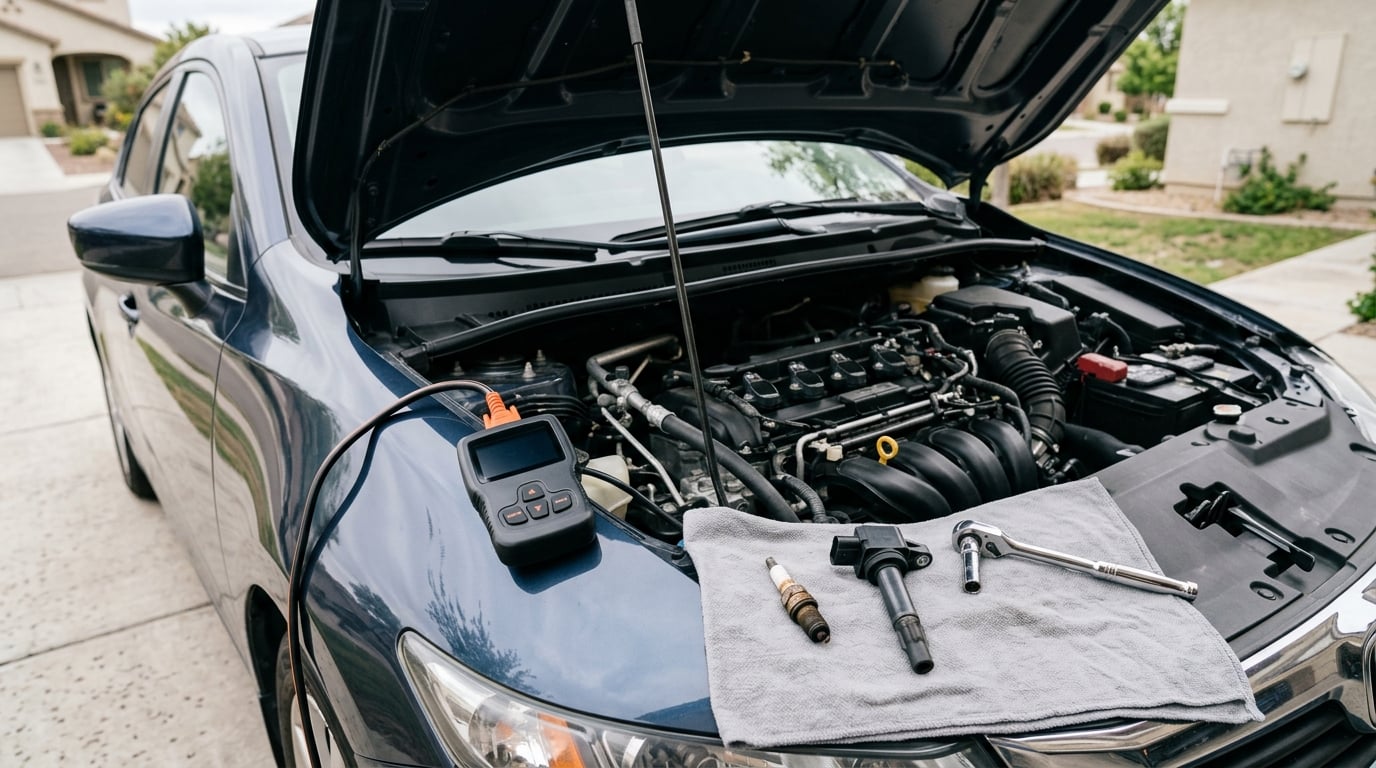
An engine misfire is one cylinder failing to burn its air-fuel charge on schedule, and it shows up as a stumble, a shake or a momentary loss of power. To fix a car that misfires, you work outward from the code: read the trouble code with an OBD-II scanner, find the cylinder, then test ignition, fuel, air supply and compression in that order. Most misfires end at a spark plug, an ignition coil or a cracked vacuum hose, and a basic code reader plus hand tools covers most of the diagnosis.
The order matters more than the tools. Swapping parts until the noise stops is how people end up with six new coils on the driveway and the same stumble on the way home. Code first, then test, then replace.
Table of Contents
- What You Need
- Step-by-Step
- 1. Confirm the Misfire and Check for Safety Concerns
- 2. Read the Check Engine Light and Scan for Codes
- 3. Inspect the Spark Plug and Ignition System
- 4. Check Fuel Delivery and Air Intake
- 5. Test Sensors, Exhaust, and Mechanical Causes
- 6. Clear the Code and Verify the Repair
- 7. Know When to Stop and Call a Mechanic
- Common Mistakes
- Frequently Asked Questions
- Conclusion
What You Need
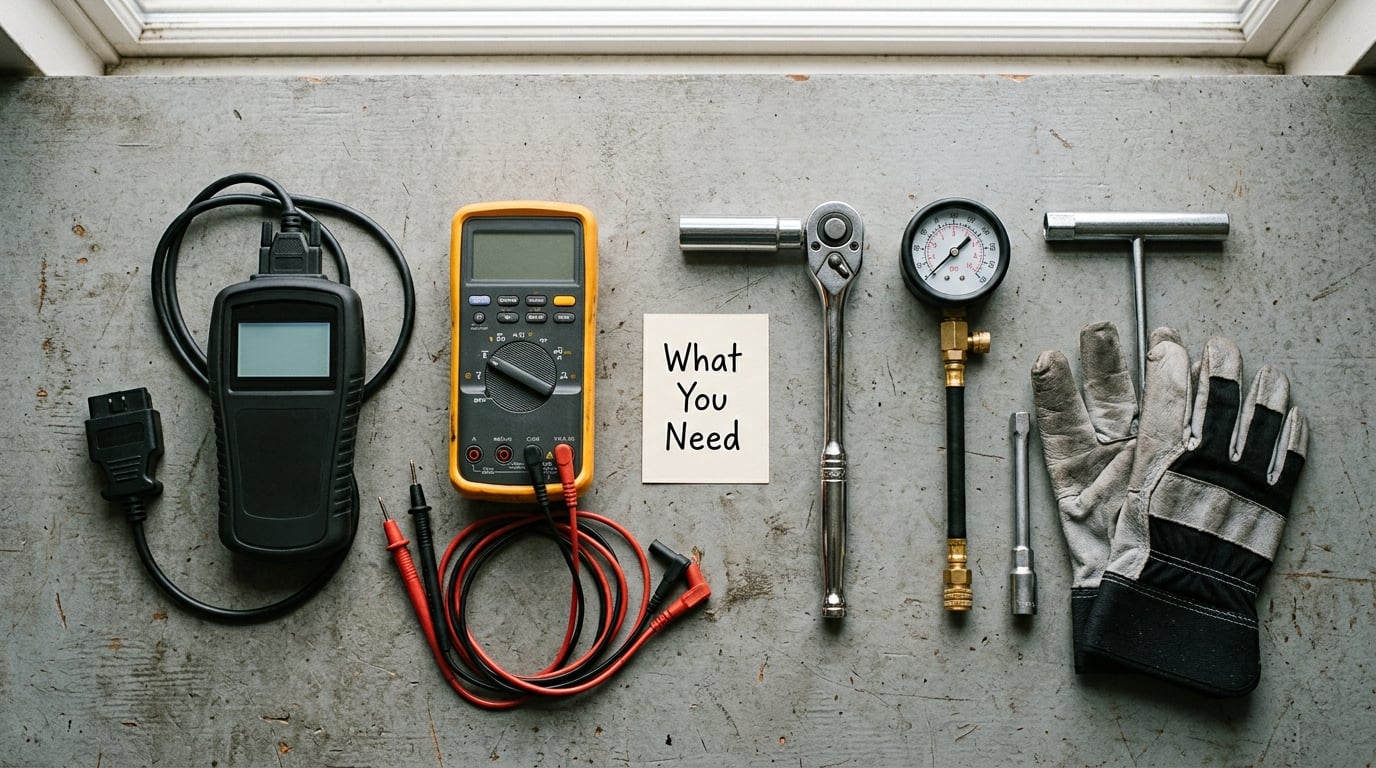
You need an OBD-II code reader first. The port has been standard under the dash since 1996, usually on the driver’s side near the steering column or centre console, shaped like a trapezoid with 16 pin holes. A phone-style scanner reads stored and pending codes and shows freeze-frame data; a more capable unit also runs live data and bi-directional tests. Everything past code reading is optional depending on where the fault lands.
After that, gather these, and skip anything your car does not need:
- OBD-II code reader — the non-negotiable item. Without codes you are guessing.
- Digital multimeter — checks battery voltage at the coil and injector during crank, and coil primary resistance.
- Spark plug socket and ratchet — usually 13mm or 16mm; the deep socket you need for coil-over-plug engines is a specific size, so check yours.
- Compression tester and adaptor — a screw-in gauge for small engines, a hose-and-clamp type for larger threads.
- Smoke machine or a carb cleaner can with a throttle body adapter — for finding vacuum leaks you cannot hear.
- Basic hand tools — socket set, screwdrivers, needle-nose pliers, torque wrench for the plug reinstall.
- Safety gear — nitrile gloves for fuel work, eye protection, a fire extinguisher within reach, and a laptop or phone to keep the manual open.
Also pull your service history and the factory manual’s torque spec for the spark plugs. Torque on an aluminium head is not a guess, and over-torquing cracks the threads.
Step-by-Step
1. Confirm the Misfire and Check for Safety Concerns
A real misfire feels like a single-cylinder stumble: the engine shakes or jerks slightly at a steady speed, drops power for a beat, or the idle hunts up and down. It usually gets worse under load, and it is most obvious when cold. A blown exhaust pop on decel is another tell. What it is not: a transmission shift flare, a worn accessory belt squeal, or a brake pedal pulsation — none of those set a misfire code.
Stop driving immediately if the check engine light is flashing rather than steady. A flashing light means the ECU caught a misfire severe enough to dump raw fuel into the exhaust, and that is how catalytic converters get destroyed. Same for a loud metallic knock, a sudden power loss, an overheating needle, or a fuel smell strong enough to make your eyes water. Get it towed or flatbedded to a shop.
Write down the conditions while they last: cold or warm, at idle or at speed, roughly what throttle, whether it happens in gear or coasting, and how long it lasted. That note is worth more than any part you buy on a hunch, because it decides which test you run first.
2. Read the Check Engine Light and Scan for Codes
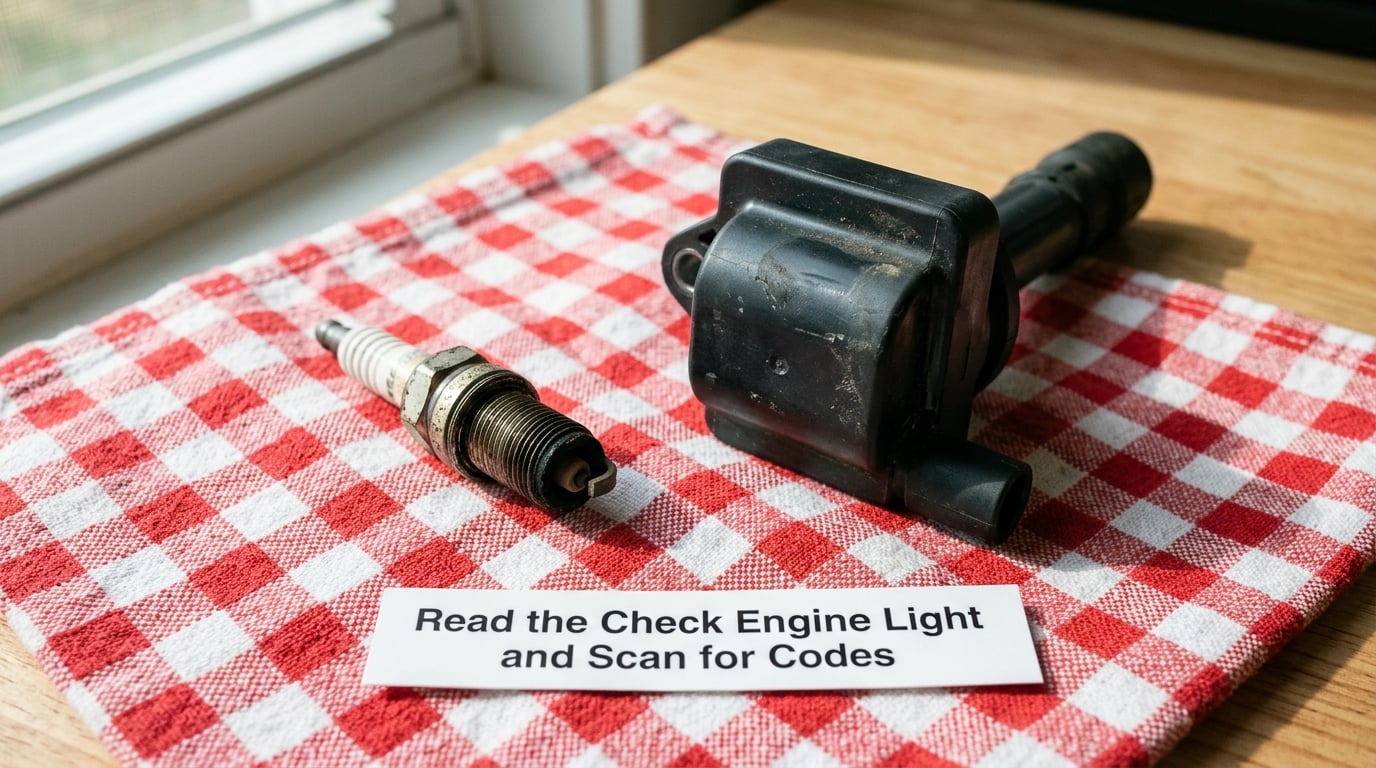
Plug the scanner into the OBD-II port, turn the key to on or start the engine, and read codes before you clear anything. Here is how to fix a car that misfires, step by step: the code tells you whether the ECU saw a random misfire or one specific cylinder, and that distinction decides your whole afternoon.
| Code | Meaning | Likely cause | First test |
|---|---|---|---|
| P0300 | Random or multiple cylinder misfire | Vacuum leak, weak fuel pressure, weak coil, dirty MAF, low compression | Smoke test the intake, check fuel filter age, run a compression test |
| P0301 to P0308 | Misfire detected on a specific cylinder | That cylinder’s plug, coil or injector | Swap the coil to another cylinder and rescan |
| P0304 | Misfire on cylinder 4 | Same as above, one cylinder only | Swap test on cylinder 4 |
| P0171 / P0174 | System too lean (or too lean, cylinder bank 2) | Vacuum leak, low fuel pressure, dirty MAF, weak injector | Smoke test, verify fuel filter and pump pressure |
| P0101 | Mass air flow circuit performance | Contaminated MAF element, cracked intake tract | Inspect and clean the MAF element with MAF cleaner only |
| P0302 with lean codes on a bank | Cylinder 2 misfire plus lean condition | Vacuum leak on that bank, injector, EGR passage | Check intake gaskets and PCV before touching injectors |
| P0420 | Catalyst efficiency below threshold | Often damage caused by a long-running misfire, not the original fault | Fix the misfire first, then re-test |
Read pending codes too. A pending code is a fault that has not yet met the threshold to light the lamp, and on an intermittent misfire it is often the better clue. Freeze-frame data records engine rpm, load, coolant temp and throttle at the moment the misfire was counted — this is how you learn whether it only happens at low throttle or only when cold.
Note the freeze-frame before clearing anything. Once the code is erased, that evidence is gone.
3. Inspect the Spark Plug and Ignition System
On a coil-over-plug engine the plug lives under a coil pack or individual coil on top of the plug; on a distributor car it sits under the cap in the center of the engine. Remove them one at a time so the plug tubes stay aligned, and keep the plugs in firing order so you know which one came from where.
Read the plug. A healthy plug has light tan to brown deposits and a dry, clean electrode. Heavy black carbon means it’s burning fuel — rich mixture, weak spark, oil in the combustion chamber. White, chalky deposits point to coolant in the cylinder. Oil-stained threads or a greasy black tip means oil is getting past the valve cover gasket or the plug tube seals. A centre electrode worn down to a thin stub, or a sharp ground strap, means the plug has run long past its service life. Compare the fouled plug against the others — a plug that looks obviously different from its neighbours is your first suspect.
Then do the swap test, which is the highest-value five minutes in this whole procedure. Disconnect the coil from cylinder 4 and move it to cylinder 2, reinstall, clear the code and drive. If P0304 becomes P0302, the coil follows the misfire and the coil is the fault. If the misfire stays on cylinder 4, the coil is innocent and you look at the plug and injector for that cylinder. One moved coil replaces a lot of guessing, and it works on V6, V8 and four-cylinder engines alike.
Check the coil’s primary resistance with the multimeter and compare it to the manufacturer’s spec, and check for 12V at the coil connector while the engine cranks. A coil that passes both when static can still fail hot, which is why intermittent misfires that clear up when the engine warms are a classic weak-coil symptom.
If plugs and coils test clean, look at the plug wires, the coil boots and connector for arcing or green corrosion on older cars, and the distributor cap and rotor if your engine has one. Damaged plug tubes let oil leak onto the boot and kill the spark.
4. Check Fuel Delivery and Air Intake
An engine needs the right amount of air and fuel measured at the same time. Break either one and the cylinder burns wrong — lean, rich, or not at all.
Start at the easy end. Pull the air filter and look at it. A filter packed with leaves or dust starves a mass air flow sensor of proper flow, which makes the ECU command rich and can light up a random misfire code. Then run the intake tract. Play a low tone or carb cleaner aerosol around the throttle body, the MAF housing, the intake manifold runners and the PCV hose while the engine idles; a change in rpm means air is entering somewhere it shouldn’t.
That PCV hose is the cheap check most guides skip. A cracked or disconnected crankcase ventilation hose pulls unmetered air past the intake and produces exactly the rough cold idle, hesitation and random misfire people chase for weeks. Owners on r/AskMechanics traced a misfire to a cracked PCV valve and fixed it with a cheap replacement part.
The EGR valve is the other one. It carries exhaust gas into the intake to control combustion temperature, and a failed valve — especially one that sticks open — dumps unmetered hot gas into the intake and causes misfires and rough idle. The test is a warm-engine one: on IH8MUD an EGR failed its warm-engine test and was confirmed by passing exhaust gas straight into the intake. Cold, a bad EGR often hides completely.
On the fuel side, check the filter age, listen for a rising/whirring noise from the tank area, and verify the pump has power and ground at the tank. Injectors can be checked for battery voltage and resistance with the multimeter per the service spec, and swapped between cylinders as a diagnostic — an injector that fails to move the misfire when relocated is the bad one. Any work that opens a pressurized fuel system is a shop job, and so is anything involving a multi-port fuel rail on a modern direct-injection engine.
5. Test Sensors, Exhaust, and Mechanical Causes
Start with the accessible sensor connections: unplug and inspect the MAF or MAP connector, the coil connectors and the wiring loom near the exhaust manifold for cracked insulation or heat-burned plastic. Check the engine ground straps and battery terminals too; a corroded engine ground is a known cause of random all-cylinder misfires that no amount of part swapping will fix, and owners on r/Cartalk chasing a stubborn all-cylinder misfire eventually land on grounds and recent work.
An exhaust leak ahead of the oxygen sensors can also throw a misfire, since the sensors see the wrong gas. Listen for a hiss at low idle around the manifold gasket and the flex pipe joints. A leak between the front and rear O2 sensors just makes the car run rich with no code at all.
After everything checks out, run a compression test. Warm the engine first, remove all plugs, crank each cylinder and record the number. Cylinders should read within about 10 percent of each other, and a healthy small four-cylinder often sits around 200 psi or more — your manual has the spec. One cylinder far below the others points at a burned valve or a damaged piston ring on that cylinder. Then do a leak-down test to confirm the low reading, and listen at the tailpipe and the oil filler for where the air escapes.
Low compression is a mechanical fault: a head gasket, a bent valve, a scored cylinder or a ring failure. That is not a weekend job with hand tools. A coolant seal failure can also sit behind an otherwise unexplained misfire, and one r/RX8 owner was pointed at a cooling-system test using air bubbles in the radiator to find it — worth knowing if you have run the car hard and everything else came back clean.
6. Clear the Code and Verify the Repair
Clear codes only after you have inspected, not before. Clearing erases the freeze-frame data and the pending codes, which are the evidence you need for an intermittent fault — one of the biggest sources of wasted diagnosis in the r/MechanicAdvice threads, where owners report codes that cleared themselves and problems that never really got solved.
Fix the confirmed cause, clear the code, and then verify. Take a drive that reproduces the original conditions: same speed, same throttle, same warm-up state. Then scan again and confirm no new pending codes, and watch live data if your scanner supports it — short-term fuel trim on a healthy engine sits near zero, and persistently high trims mean air or fuel is still off.
If the misfire is gone but the old code never came back, you fixed the right thing. If it returns, you have a fault that survives the swap test, and it is time to bring the code history and your notes to a technician.
7. Know When to Stop and Call a Mechanic
Hand it over when any of these are true:
- You have a fuel leak, a wet smell near the tank, or the car dies from a flooded interior.
- The check engine light flashes, or the engine knocks.
- Compression is low on one or more cylinders, or the leak-down test shows air at the head or the tailpipe.
- The misfire persists after a coil swap, a clean set of plugs and a smoke test with no vacuum leak found.
- Codes keep coming back after the same repair, or the ECU has gone into limp mode repeatedly.
- You need to pull an intake manifold, a fuel rail on a direct-injection engine, or anything in the exhaust on a car you have never worked on.
A 2015 Nissan Altima in one r/MechanicAdvice thread carried misfires on cylinders 4 and 3, a rough idle, unstable revs, no check engine light and a knock, and never got a clean fix. That is a multi-cause, intermittent, no-code case — exactly the profile where a shop with a scope, a smoke machine and a scan tool earns its labor charge. Knowing when to stop is part of knowing how to fix a car that misfires.
Common Mistakes
Clearing the code before you read the freeze-frame. The freeze-frame holds the rpm, load and coolant temperature at the moment the misfire was counted. Erase it and you lose the only clue to an intermittent fault. Read everything, write it down, then clear.
Replacing every spark plug and every coil at once. You will never know what was wrong, and if the misfire comes back you start over with no data. Replace what the test points to. If plugs are genuinely overdue and you are already in there, doing all of them is reasonable — but do the swap test first so you still learn which cylinder was failing.
Swapping a coil without identifying the cylinder. The swap test only works if you know where the misfire is. A code like P0304 names cylinder 4; move that coil and watch whether the code follows it.
Treating every check engine light as engine failure. A lean code or a MAF code can be a cracked hose and a dirty sensor. A steady light is a stored fault to diagnose, not a death sentence — and the same light means very different things depending on whether it is steady or flashing.
Assuming the noise is the fault. A stumble at low throttle is often a vacuum leak; a stumble that disappears when the engine is warm points more at a coil. The symptom tells you which test to run.
Driving hard while diagnosing. Every extra misfire cycle sends unburned fuel into the catalytic converter. If you are still testing, drive gently, keep it short, and stop if the light starts flashing.
Over-replacing instead of testing grounds and recent work. If the misfire started right after other service, or appeared after a battery disconnect reset the ECU, suspect the work itself: a battery terminal not tightened down, a ground strap not re-torqued, a sensor unplugged and reseated only part way. An all-cylinder random misfire with no pattern is very often wiring, power or ground rather than any single part.
Two quick pieces of expert framing that save time. On a MAP-equipped car, a vacuum leak tends to read as a general lean condition until it gets bad enough to upset one cylinder specifically, which is why MAP-based engines can misfire on a single cylinder where a MAF-based car just runs rough. And on a MAF car the same leak shows up earlier, as a rich or wandering idle. If one cylinder keeps misfiring on a MAP engine, check the intake gasket around that runner before you condemn the injector.
Frequently Asked Questions
Can a misfiring engine be fixed?
Yes, in most cases. A misfire is a symptom, and the underlying cause is usually a spark plug, ignition coil, cracked vacuum hose, dirty air filter, weak injector or an exhaust leak. Read the code to find the cylinder, test that cylinder, and you have a repairable part. Low compression or internal engine damage is the exception that turns this into an expensive job, which is why a compression test is the last step, not the first.
Can I still drive if my engine is misfiring?
Sometimes, carefully. If the check engine light is steady and the car is otherwise healthy, short gentle drives to a parts store or shop are usually fine. If the light is flashing, the engine is knocking, or you smell fuel, do not drive it at all — every misfire dumps unburned fuel into the catalytic converter and can destroy it. Long trips, highway speed and heavy load are the fastest way to turn a cheap repair into an expensive one.
Is a misfire expensive to fix?
It depends entirely on the cause, and the gap is enormous. A spark plug, vacuum hose or PCV valve is a cheap part and a short job. An ignition coil or injector sits in the middle. Low compression from a burned valve or a failed head gasket is a shop repair with parts and labour, and a catalytic converter damaged by driving through a long misfire adds a second large bill on top. Diagnose before replacing, because guessing is the expensive part.
Can a misfire go away by itself?
Sometimes, and that is exactly what makes intermittent misfires frustrating. A marginal coil or a hose that only leaks when the engine is flexing can stop misfiring once conditions change, and the code may self-clear. That does not mean the cause is gone, and it usually comes back. If the light went off on its own, read pending codes before clearing them — they usually still hold the fault that caused it.
Why is my car misfiring with no check engine light?
A few reasons. The misfire may not be frequent enough to trip the ECU’s counter, which typically needs several detected misfires in one drive cycle. If your scanner shows an intermittent misfire flag under live data, that is your evidence even without a stored code. Weak coils that fail hot, marginal injector delivery and vacuum leaks that only open under load all produce symptoms the light never catches. Drive with live data and freeze-frame on, and log what you feel.
Will a vacuum leak or bad EGR valve cause a misfire code?
Both can. A cracked vacuum hose or intake manifold gasket lets unmetered air past the intake, the mixture goes lean, and a lean mixture burns badly — which can set P0300 or a lean code like P0171 and P0174. A failed EGR valve, particularly one stuck open, dumps hot exhaust gas into the intake and causes misfires and rough idle that often only show up when the engine is warm. Smoke test the intake first, then check the PCV and EGR hoses.
Conclusion
Start with three things: confirm it is really a misfire and note the conditions, scan for codes and freeze-frame data before you touch anything, then inspect the accessible ignition and air-intake parts on the cylinder the code named. Fix the confirmed cause, clear the code, and drive the same conditions to verify. Anything involving pressurized fuel, low compression, a flashing check engine light or a knock belongs in a shop — and knowing where that line sits is what keeps a misfire a cheap afternoon rather than an expensive week.