
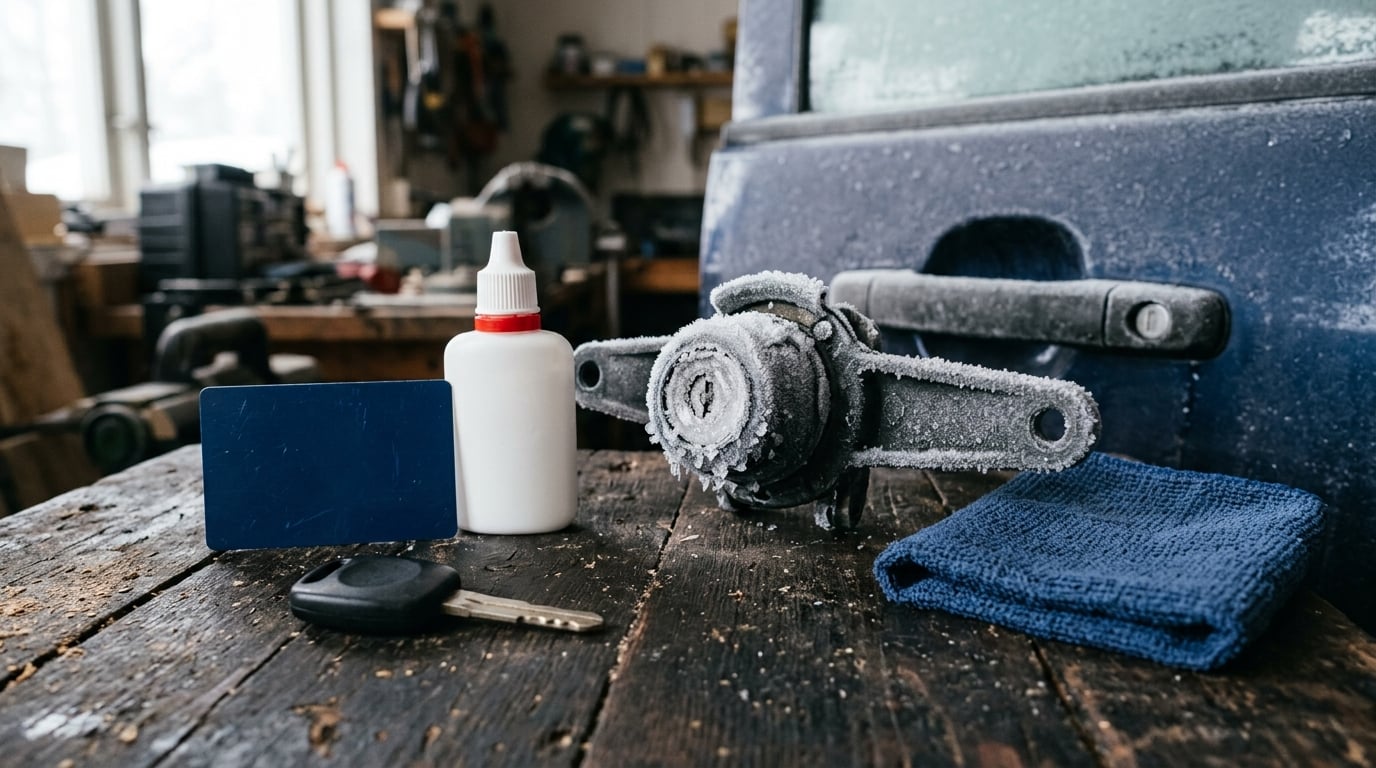
A frozen lock is nearly always water that got in and turned solid, and the cure is gentle thawing rather than heat. To get ice out of a door lock, clear the loose snow from around the keyway, then use lukewarm water or a proper lock de-icer and give it a few minutes to work. Most locks turn freely within five to ten minutes.
Here is what happens overnight. Rain, snow, condensation off the glass, or the water left behind by a car wash finds its way into the keyway, the overnight temperature drops below freezing, and the ice grips the key and the lock pins together. The cylinder itself also contracts slightly in the cold, so a lock that felt fine at noon can feel tight at 7am.
Car cylinders and house cylinders are not the same problem. A car lock is usually the only way in, and the driver standing in the cold has a narrow list of options. A house lock has a key on a ring, a spare neighbour, or a garage entry as backup, and the cylinder is often part of a multi-point uPVC locking system where forcing anything damages the whole mechanism, not just the keyway.
Table of Contents
- What You Need
- How to Get Ice Out of a Door Lock Step by Step
- Common Mistakes
- Prevent the Lock from Freezing Again
- Frequently Asked Questions
- Can I use rubbing alcohol to get ice out of a car door lock?
- Is there a safe way to unlock a frozen BMW if the remote does not work?
- Will hot water thaw a car door lock faster?
- What should I do if the key goes in but will not turn after the ice melts?
- Does lock de-icer leave residue that can damage the keyway?
- How can I stop a car door lock from freezing again?
- What to Do First
What You Need
Almost everything you need is already in the house or the glove box. The point of the list is to separate what is safe from what is not.
For clearing the keyway: a plastic card, a plastic pick, a soft nylon brush, and a flashlight so you can see into the cylinder. Anything made of steel can scratch the pins and gummy the lock later.
For thawing: lukewarm water from a tap or a thermos, a small squeeze bottle or a plastic straw to aim it, a towel or flat container to catch the runoff, and a lock de-icer. Isopropyl alcohol at 70% or hand sanitizer with at least 60% alcohol works too, and both melt ice far faster than water because they have a much lower freezing point.
Keep these away from the lock: a hair dryer on high heat, a heat gun, a lighter or a candle, boiling water, and general-purpose aerosol lubricants that are not sold for locks. Keys with transponder chips or buttons are also heat-sensitive, so keep a hairdryer away from the key itself.
If your door has a keypad, a smart lock, or a powered latch, read the owner’s manual before putting anything in the keyway. A few manufacturers restrict which fluids are safe around electronic actuators, and a powered lock can draw current through a mechanism you cannot see.
How to Get Ice Out of a Door Lock Step by Step
Work from the gentlest method upward and stop at the first one that works. You are looking for one sign that a stage succeeded: the key slides in without resistance and turns with a normal amount of force.
Start by Removing Loose Ice and Snow
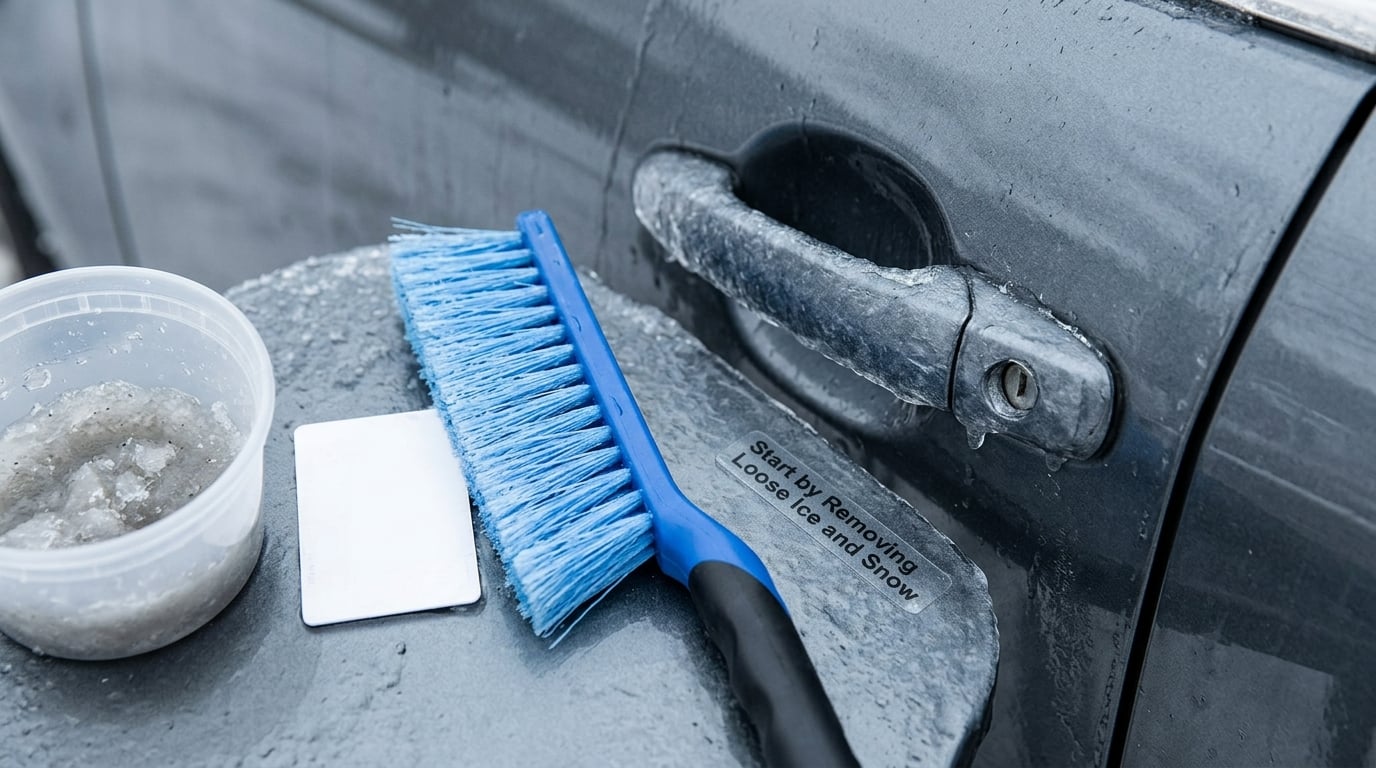
Clear the snow sitting on top of the lock first, because a cap of ice traps cold air against the cylinder even after the slush goes. Slide the plastic card under the ice edge, or use the soft brush, and let the pieces fall into your hand or container. Work at the edge of the plug, not down inside it.
Shine the flashlight in and look for a solid white or clear plug sitting in the keyway. If you can see the plug and it is loose enough to lift out with a plastic pick, take it out whole. Anything you push deeper into the cylinder is only moving the blockage somewhere you cannot reach.
It worked if: the keyhole looks open and clear all the way to the shoulder of the key blade, or the key now goes in noticeably deeper than before.
Use Lukewarm Water When the Lock Is Only Slightly Frozen
Tap water is warm enough. Aim the stream at the lock body and the area around the keyway rather than straight down the middle, and let it run for 30 to 60 seconds. Put your towel or container underneath first so the water does not run into the door seam and freeze there instead.
Then test the key. Lukewarm water works because the ice is only a thin layer; if there is a solid plug deep in the cylinder, the water just takes the edge off and you are back to step one of the de-icer.
Never use hot or boiling water on a lock. It can warp the cylinder, swell the rubber door seals, dull the paint around the lock plate, and the meltwater can refreeze deeper in the mechanism the moment it cools. A car that has been washed in a heated bay can get a small paint defect from temperature shock the same way.
It worked if: the key turns smoothly and the door opens without the key fighting you.
Apply Lock De-Icer When the Ice Is Firm
Buy de-icer made for locks, not general spray lubricant. The good ones run roughly 50 to 70% isopropyl alcohol, and the strong ones often include a corrosion inhibitor and a thickener that stays in the lower part of the cylinder instead of running straight out.
Insert the straw, squirt until liquid reaches the bottom of the keyway, and wait. Thirty seconds to a couple of minutes is normal, and you will often hear or feel a small shift as the ice loosens. If the key still will not turn, squirt again and wait once more. Two short applications beat one long soak.
Wipe the outside of the lock when you are done. Repeated drenching leaves a sticky film on the pins, and drivers report that locks which get soaked with de-icer over and over can start feeling gritty after a few seasons.
It worked if: the key rotates with a click as the pins clear the shear line.
Try Isopropyl Alcohol for Stubborn but Undamaged Locks
Isopropyl alcohol at 70%, or hand sanitizer with 60% alcohol or more, is the fastest home option because it drops the freezing point of the water trapped in the cylinder. Coat the blade of the key, slide it in gently, and wiggle it slightly. Do not push hard; the ice needs a moment to let go.
Do this outdoors or in a well-ventilated spot, keep the bottle away from a flame, pilot light, or hot engine, and do not spray a large amount at once. Check the manual before using alcohol on weather seals or around a powered latch, and never leave a soaked key sitting in the lock overnight.
It worked if: the key reaches full depth and the cylinder turns within a few seconds of the alcohol going in.
Warm the Key Carefully as a Last Resort
A key that has been sitting in a warm house for an hour can carry a little heat into a cylinder with only a light bond of ice. Warm the key, not the lock, and use it while the lock is already clear enough for the blade to enter. Wiggle gently and take the key back inside to rewarm if the first try does nothing.
Skip the hairdryer, the heat gun, and the open flame. Dry heat on a frozen cylinder bakes the outer ice and locks it tighter, it can craze plastic key heads, and a transponder key or a key with buttons can be ruined outright. Heating the key over a flame also adds nothing except risk, and bending a stiff cold key to gain leverage is how keys snap in cylinders.
It worked if: the cylinder turns before the key cools to the touch.
Know When to Stop and Call a Locksmith or Roadside Assistance
Stop thawing and get help if the key still will not turn after the cylinder has fully thawed, if the key goes in but binds and twists instead of rotating, if you feel resistance that feels like a mechanical jam rather than ice, or if the key has chipped or broken. Any of those mean the damage is already done and heat or more force will only make the repair more expensive.
Also stop if water is sitting inside the door, if a weather seal is torn, or if the lock is part of a multi-point system where the door is still latched at the top and bottom. If the owner’s manual restricts what can go into the keyway, follow the manual.
A locksmith can open the cylinder, pull the linkage apart, and check the actuator and the latch rather than guessing. Roadside assistance handles the same problem on a car, and a lot of insurance and dealership plans include lockout service, so it is worth checking your coverage before paying cash on a cold night.
Common Mistakes
Pouring boiling water on the lock. It thaws in seconds and then warps the cylinder, swells the seals, and refreezes as it cools. Lukewarm water is slower and works, and that is the whole point.
Using a hair dryer or heat gun on high. Dry heat drives moisture deeper into the cylinder and bakes the outside of the plug. If you use a dryer at all, keep it on cool, keep it moving, and stay well back from the key if it has electronics.
Heating the key with a lighter or a cup of hot water. The heat you can add to a key is tiny next to the whole cylinder, and the risk to a plastic head or a transponder chip is real.
Forcing the key. Turning a key that is frozen is how a key snaps at the shoulder and ends up inside the cylinder. That turns a twenty-minute problem into a cylinder replacement.
Pushing metal picks, screwdrivers, or keys in as an ice tool. Steel marks the pins and the spring, and the metal then attracts moisture and rust. Plastic and patience cost nothing.
Spraying a general lubricant into a frozen lock. Products people reach for by habit are not built to stay in a lock, and they attract dust. Locksmiths on the r/AskALocksmith forum and on the Ford Trucks Forum consistently point to graphite powder for the lock mechanism instead, with a product made for locks if you prefer a spray.
Trying the same failed method twice more. If lukewarm water and a de-icer application have both failed, there is likely a plug deeper in, a broken key, or a mechanical problem. Repeating a method that just failed wastes the twenty minutes you needed to call someone.
Prevent the Lock from Freezing Again
Prevention is mostly about water, because ice needs water. Wipe the keyway area dry after a car wash or after driving through slush, and use a cover on a car that parks outside overnight. AAA and Keytek both recommend putting a small magnet over the keyhole after the car is parked, which keeps moisture from settling into the keyway in the first place.
For the mechanism itself, use graphite powder, the dry lubricant locksmiths prefer for lock cylinders. It sheds water rather than holding it. Do not pack powder into the keyway where it can gum the pins; follow the product directions and treat the cylinder, not the key blade.
For door seals, a silicone-based spray or a small amount of silicone sealant on the rubber keeps the lip from bonding to the frame. Owners on TeslaModelY Reddit and MDXers.org report that treating the seals cut their freezing issues noticeably, and the same trick works on uPVC doors. Heavy silicone build-up on rubber is not a good idea, so use light coats.
A thin coat of petroleum jelly on the key before a known freeze is a cheap insurance policy for the car lock, and it wipes off afterwards. A heated doormat or a sheltered entryway does more for a house door than anything you can do to the cylinder. The real long-term check is the weather stripping around the door, because a seal that has hardened or torn is what lets the moisture in.
One limit worth knowing: de-icer and alcohol are for thawing, not for staying in the lock. Rinse the cylinder with a light oil made for locks after a heavy winter, so nothing sticky is left sitting on the pins.
Frequently Asked Questions
Can I use rubbing alcohol to get ice out of a car door lock?
Yes, and it is one of the fastest methods you have at home. Rubbing alcohol at 70% isopropyl, or hand sanitizer with at least 60% alcohol, drops the freezing point of the water trapped in the cylinder, so ice loosens in seconds. Coat the key blade, slide it in gently without forcing, and work in a ventilated spot away from flames or hot engines. Wipe the residue off afterwards so the pins do not get sticky.
Is there a safe way to unlock a frozen BMW if the remote does not work?
Treat the mechanical keyway like any other car lock. Pull the hidden key from the fob or grab the spare, brush the loose ice out of the cylinder with a plastic card, then use lock de-icer or 70% isopropyl alcohol and wait a minute before testing the key. Skip the heated key trick if your key has buttons, and read the manual first, since some models place electronics in or near the door handle.
Will hot water thaw a car door lock faster?
It thaws faster and then causes more work. Hot or boiling water can warp the cylinder, swell the rubber door seals, and dull the paint around the lock plate. The meltwater also carries moisture deeper into the door, where it refreezes as soon as the metal cools. Lukewarm tap water is the safe ceiling, and for anything more than a light frost, a lock de-icer works better anyway.
What should I do if the key goes in but will not turn after the ice melts?
Stop turning it. If the key reaches full depth and the cylinder is warm and dry but still will not rotate, you likely have a jammed cylinder, worn pins, or a broken piece of key rather than ice. Wiggle the key gently while applying light upward pressure, and do not keep leaning on it. If nothing moves within a minute, call a locksmith or roadside assistance so the cylinder can be opened and inspected.
Does lock de-icer leave residue that can damage the keyway?
A single application is fine and the alcohol mostly evaporates. The problem comes from soaking a lock over and over, which leaves a sticky film on the pins and the springs that can make the key feel gritty. Wipe the outside of the lock after use, and once the weather turns, flush the cylinder with a light lubricant made for locks. Never use de-icer on a smart or powered lock without checking the manual.
How can I stop a car door lock from freezing again?
Keep moisture out first. Dry the keyway after a car wash or after driving through slush, and park with a small magnet over the keyhole overnight so condensation cannot settle inside. Treat the door seals with a light coat of silicone-based spray so the rubber does not bond to the frame, and use graphite powder on the lock mechanism itself, since it sheds water instead of trapping it. A car cover helps if the car sits outside overnight.
What to Do First
Start with the least aggressive step: brush the loose snow off the lock, look into the keyway with a flashlight, and lift out any plug you can see. If the obstruction was light, lukewarm water and a few patient minutes will usually do the rest. Escalate to a lock de-icer, then to isopropyl alcohol, only when the gentler step failed for a clear reason.
Call a locksmith or roadside assistance once the cylinder is fully thawed and still will not turn, or the moment you feel a key binding, a broken key, or moisture inside the door. That is a mechanical repair, not a thawing job, and forcing it turns a cold morning into an expensive one.