
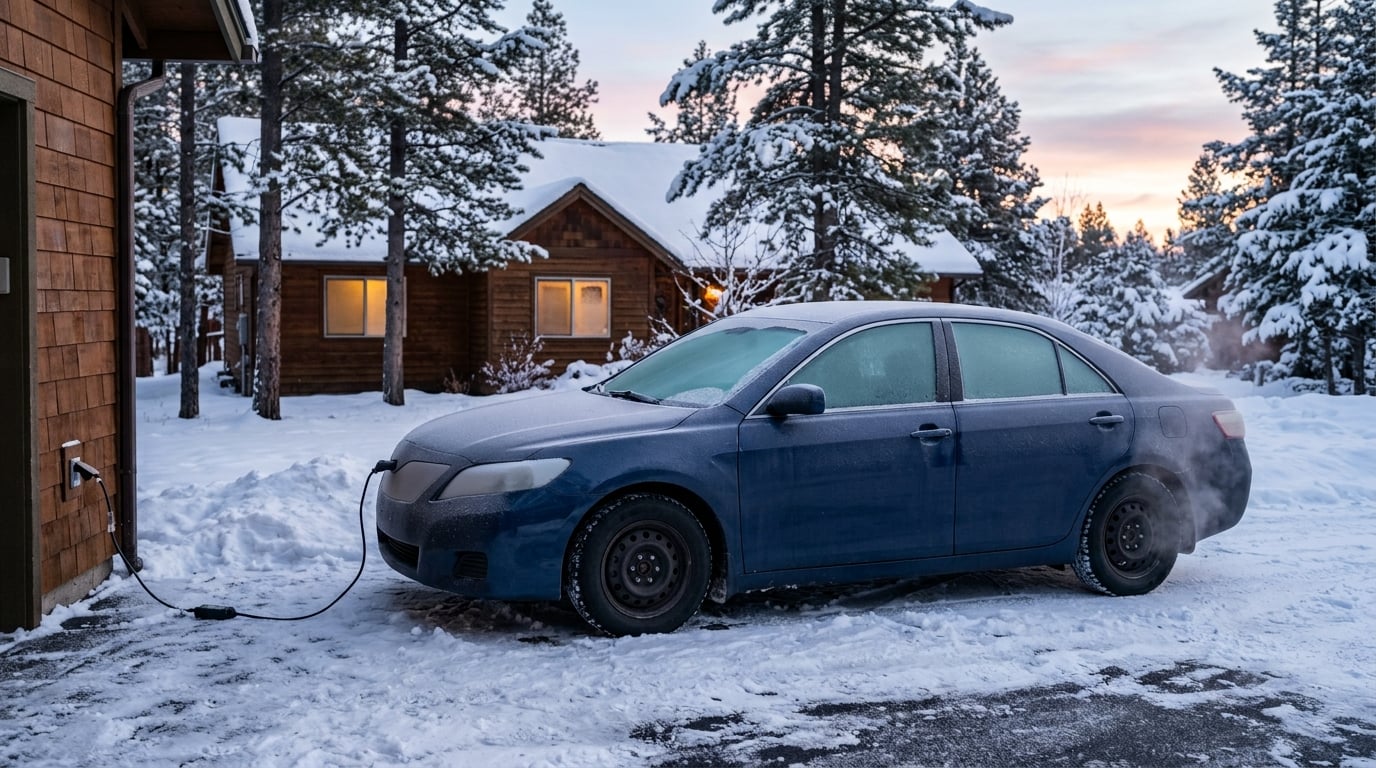
If you have a modern gasoline car, you only need about 30 to 60 seconds before you drive away gently. The old 10-minute idling ritual belonged to carbureted engines, and today it wastes fuel, raises emissions, and barely gets the cabin warm any sooner.
The catch is that “warm up” means two different things. Getting the engine lubricated takes about half a minute. Getting it fully warm takes several miles of gentle driving, and no amount of sitting still will shortcut that.
Below is what the oil pump, the coolant, the fuel system and your cabin are each doing during those first few minutes, plus the temperature and vehicle-type cases where the number does change.
Table of Contents
- How Long Should You Let Your Car Warm Up?
- What Does Warming Up a Car Actually Do?
- Warm-Up Time by Vehicle Type and Weather
- How to Warm Up a Car Without Wasting Fuel
- Do You Need to Warm Up Before a Track or Autobahn Drive?
- Common Warm-Up Myths and Car-Saving Mistakes
- When Should You Wait Longer or Call a Mechanic?
- Frequently Asked Questions
- The Best Warm-Up Is the Shortest Safe One
How Long Should You Let Your Car Warm Up?
The answer for a typical modern gasoline car is 30 to 60 seconds, then drive gently. Cold-idle speed is your signal: a cold engine usually idles fast, often 1,200 rpm or more, and settles toward roughly 800 rpm as oil pressure comes up. Once it settles, back out of the driveway.
The logic is simple. A cold engine idles fast precisely to circulate oil quickly, so the warm-up is really a lubrication step, and on any car built in the last few decades it happens in well under a minute.
Why 30 to 60 seconds is enough
- Oil circulation. The oil pump pushes oil from the pan through the galleries to the bearings, cam and valve train in roughly 20 to 30 seconds.
- Heat from driving. An engine under light load warms several times faster than one sitting at idle, because the combustion and the coolant system need airflow to shed heat.
- Fuel economy and emissions. A cold engine runs a rich air-fuel mixture. Driving it out of that state soon is better for the wallet and the tailpipe than sitting in it.
When to adjust the time
- Extreme cold. Sub-zero mornings and long nights parked outside justify a few extra minutes, mostly because the driver and the windshield need them, not the engine.
- Older or specialty vehicles. Carbureted classics, diesels, and many performance cars have specific procedures in the owner’s manual. Follow the manual.
- Towing a heavy load. Give it more time, and drive the first miles like the trailer isn’t there.
What the 30-60-90 rule actually means
You will see “30-60-90” floating around owner communities, and it is a decent shorthand even though no manufacturer publishes it. The first 30 seconds is for oil pressure, the first 60 seconds or roughly a mile is gentle driving, and about 90 seconds in, before any hard acceleration, the engine is ready to be worked.
Treat it as a floor, not a target. On a 55 degree morning you can be well past it before you finish buckling your seatbelt.
Watch the idle, not the temperature gauge
Waiting for the temperature needle to move tells you the coolant is warming, which is not the same as the engine being lubricated. The habit that works is dead simple: wait until the fast idle drops to about 800 rpm, then go. The gauge will catch up on its own schedule.
What Does Warming Up a Car Actually Do?
Four things are happening in the first few minutes, and only the first one genuinely needs you sitting still.
Oil reaches the parts that need it
When the engine shuts down, most of the oil drains back to the pan. The first few seconds of running are the closest thing to dry metal-on-metal contact a modern engine ever sees, which is why the oil pressure light matters. Once that light goes out, the lubrication job is essentially done.
Coolant and the thermostat get moving
The thermostat stays closed while the engine is cold, routing coolant through the block so the engine warms evenly instead of dumping heat into the cabin. This is the part that takes miles, not seconds.
Fuel changes from a rich cold-start mix
Cold-start fuel enrichment is why a cold idle sounds uneven and twitchy. The engine management system is deliberately running a rich mixture and a higher idle speed, and it calms down as everything comes up to temperature. A rough cold idle is usually normal; a rough hot idle is not.
Fuel vaporizes and the intake and exhaust warm up
Modern fuel injection sprays liquid fuel directly into the intake port, so vaporization happens in the cylinder rather than in a carburetor bowl. Catalytic converters are also mounted close to the exhaust manifold now, so they heat up within minutes instead of the miles a 1970s unit needed.
Fully lubricated is not the same as fully warm
This is the distinction that causes most of the confusion. Lubricated means the oil is circulating and the oil pressure light is out, which takes under a minute. Fully warm means coolant has reached its normal operating range, typically around 195 to 205 degrees Fahrenheit, which takes several minutes of gentle driving. You can do the first one standing still. Only the second one responds to being driven.
Which is why idling to warm the cabin is a losing trade. At idle the engine makes very little heat and the cabin heater has almost nothing to work with. Driving at moderate speed generates real heat, and the defroster clears faster than you can clear it with a long warm-up.
Warm-Up Time by Vehicle Type and Weather
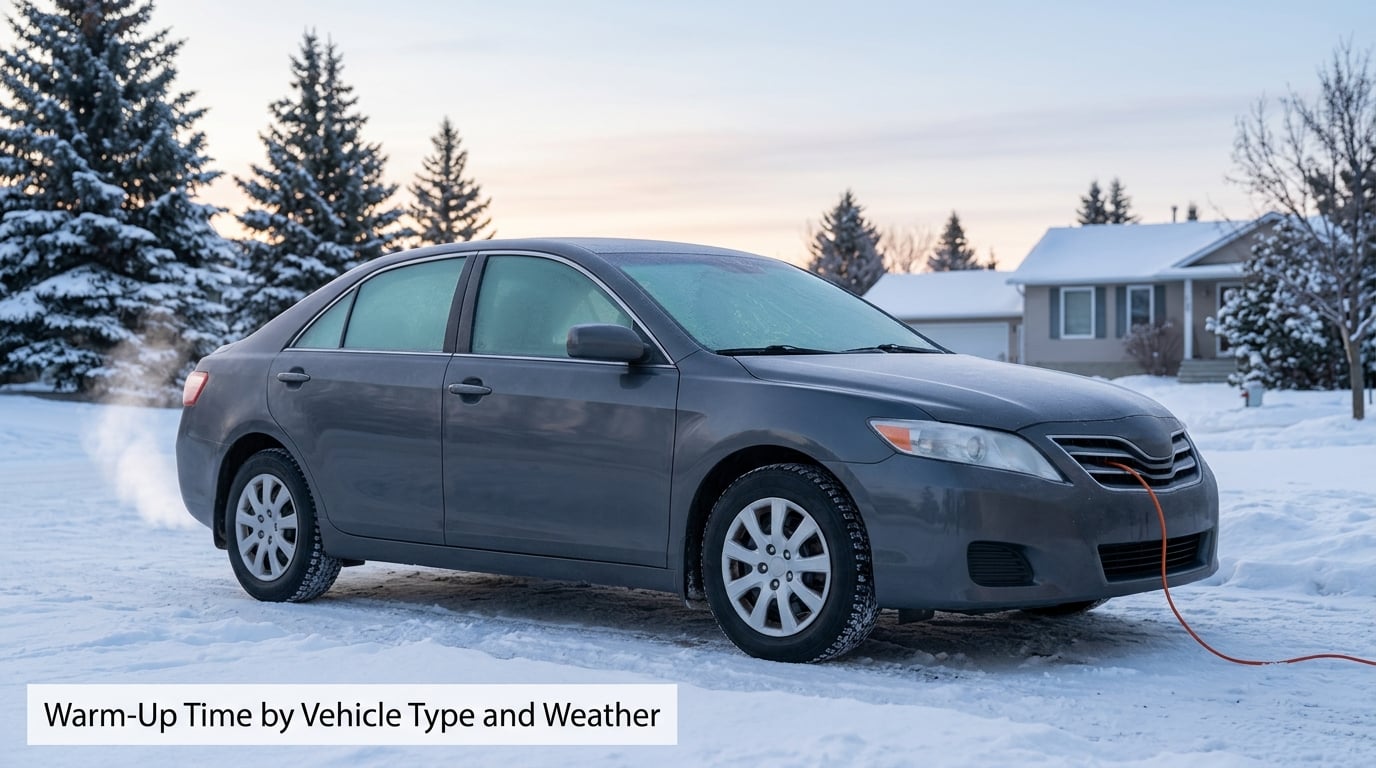
Temperature changes the number modestly. Vehicle type changes it a lot. Here is the practical range I would use for a modern gasoline car on a normal day.
| Outside temperature | Idle time before driving | First-minute driving guidance |
|---|---|---|
| 60 F and above | None, or about 30 seconds | Drive normally once the idle settles |
| 40 to 60 F | 30 seconds | Easy throttle for the first mile |
| 20 to 40 F | 60 to 90 seconds | No hard acceleration, let the coolant catch up |
| Below 20 F | 2 to 3 minutes, or drive gently right away | Extra care with the clutch or torque converter |
| Sub-zero overnight | 3 to 5 minutes if using a block heater, otherwise drive gently | Assume the engine will run rough for the first half mile |
The reason deeper cold deserves more time is less about the engine than about everything around it: frozen moisture in the intake, a stiff gearbox, tires that need a few minutes of rotation, and a cabin that takes longer to defog. If you drove five minutes each way to work all winter, that is a very different question from someone whose car sits outside overnight at 5 below.
| Vehicle type | Recommended warm-up | Why | Extra caution |
|---|---|---|---|
| Modern gasoline | 30 to 60 seconds | Fuel injection and an oil pump that flows almost immediately | Avoid hard revs until the gauge moves |
| Classic or carbureted | 2 to 3 minutes | Carburetors choke for richer mixture and stall when cold | Follow the manual, especially in cold weather |
| Diesel | 3 to 5 minutes to operating temperature | Lower combustion heat and more knock risk on a cold engine | Do not rev or load it while cold |
| Turbocharged | 30 to 60 seconds, then drive gently | Oil must reach the turbine bearings before boost | Full throttle before warm can be damaging |
| Performance or track | Per the manufacturer’s procedure | Many require a set rpm, a temperature target, and specific oil | Never improvise; the manual’s numbers exist for a reason |
| Hybrid | No warm-up required | The engine starts and stops on its own schedule and warms itself under load | Gentle driving still applies once it fires |
| Electric | No engine warm-up at all | There is no engine, and the battery dislikes being cold | Precondition the cabin and battery while plugged in |
How long should you let a car warm up below 20 degrees?
Two to three minutes, then drive gently, or start driving gently right away if you want. The engine will not reach operating temperature while you sit there, and a block heater changes the calculation more than idling does. A block heater warms the coolant and the oil before you ever turn the key, which is the single most effective cold-weather step for a vehicle parked outside.
Why old and manual-transmission cars are different
A 1990s car with a manual transmission has a clutch and gearbox that need the same low-viscosity oil treatment, and cold oil is stiff. Feathering gently in first gear is kinder than flooring it, and on a very cold morning a 1992 economy car might genuinely want a couple of minutes that a newer crossover does not.
How to Warm Up a Car Without Wasting Fuel
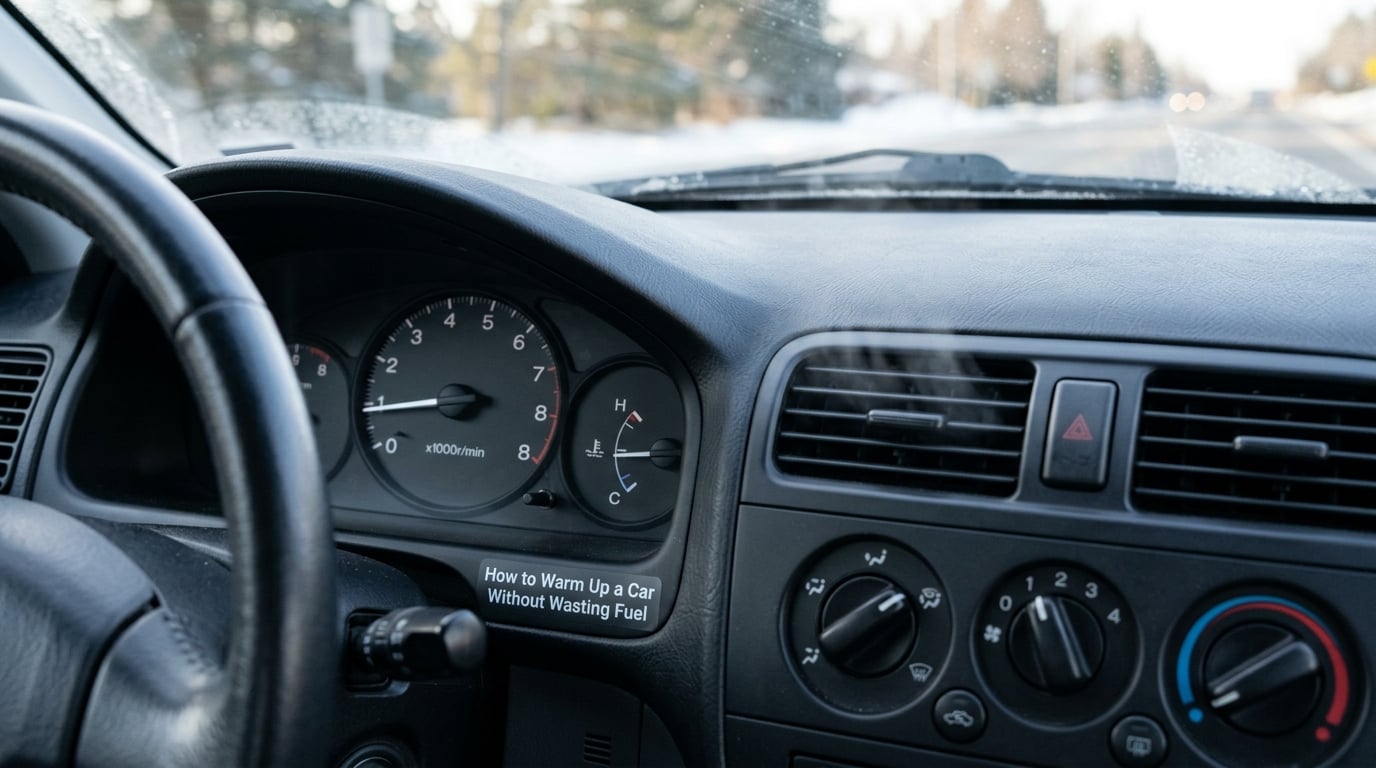
This is the routine I use in winter, and it takes about a minute and a half.
- Walk around the car first. Tire pressure drops roughly a pound per 10 degrees of temperature change, so check it cold. Look at the windshield for ice, and check the fluid levels while you are out there.
- Start it and do not touch the throttle. Let the engine settle to a steady idle on its own. Watch the dash: the oil pressure light should go out within seconds.
- Clear snow and ice from the exhaust pipe and roof before you drive. A blocked tailpipe in a garage is a carbon monoxide problem, and a roof full of snow is a windshield problem.
- Scrap the glass. Warm the defroster and the cabin while you scrape, which is the real reason people wait in the first place.
- Pull away gently for the first mile. No hard braking, no full throttle, gentle changes. Let the coolant come up with the engine working.
- Watch the temperature gauge, not the idle. Once it settles into its normal range, drive normally.
Do You Need to Warm Up Before a Track or Autobahn Drive?
Yes, and for this case the answer is not 30 seconds. Track cars, drag cars, and long high-speed autobahn runs put real load on tires, brakes, transmission fluid, and oil, and each of those wants to be at a stable operating temperature before it is asked to work.
What a proper warm-up looks like is route-based, not clock-based. A brisk ride on the road that gets you to operating temperature is better than standing still, and a session that includes several passes of the route with progressively harder braking gets the tires and fluid where you want them. Watch the gauges and the tire temperatures, not the clock.
What you should not do is park in a lot and hold a set rpm for ten minutes, which is a rule that gets repeated endlessly in owner forums. Idling to a cap does not raise oil temperature nearly as fast as driving does, and on many cars it simply runs a rich mixture the whole time. Those owners are right that you should not hammer the car cold, and wrong about using the parking lot to do it.
Manufacturers of performance cars often specify a warm-up procedure of their own, including a target coolant temperature, an oil temperature reading, and a maximum rpm. If your car has one, that procedure beats anything on a forum, and it beats this article too.
Common Warm-Up Myths and Car-Saving Mistakes
| The belief | What is actually true | What to do |
|---|---|---|
| Every car needs 10 to 15 minutes before driving | That was a carburetor-era rule. Modern fuel-injected engines need under a minute to be lubricated. | Wait for the idle to settle, then drive gently |
| A hotter engine is always better | Only up to normal operating temperature. Extra heat does not make an engine safer; it just costs fuel and adds emissions. | Warm it to operating range by driving, not by idling |
| Idling is best in freezing weather | Idle makes very little heat, so the cabin and defroster get cold air. Driving makes real heat. | Start and drive; use a block heater beforehand |
| You should rev it to warm it up faster | High rpm on cold oil is the least gentle thing you can do to a fresh engine. | No throttle until the gauge starts moving |
| My car stalls or twitches when I pull away cold | That is cold-start fuel enrichment, not a fault. It settles once the engine is warm. | Wait for a steady idle. If it persists warm, get it checked |
| A long idle helps on short winter trips | Short trips never reach operating temperature, so extra idling just burns fuel and condenses moisture into the oil. | Combine errands, or take the longer route home |
Extended idling has its own costs worth naming. The engine runs a rich mixture, which can wash fuel down the cylinder walls into the oil, and it cools poorly at idle, so a long warm-up in freezing weather can leave moisture condensing in the crankcase. Meanwhile the catalytic converter works harder on a cold engine, adding to your emissions. Put simply: idling warms the engine slowly, which means more time spent running cold, not less.
When Should You Wait Longer or Call a Mechanic?
Some symptoms are a sign to wait, and some are a sign to stop driving and call someone. Do not confuse a rough cold idle with any of these.
- The oil pressure light stays on after start-up or flickers while idling. That is not a warm-up question, it is an oil pressure question.
- A temperature warning light or a needle that climbs past the normal mark shortly after moving. Pull over and shut it down.
- Coolant puddles under the car, or a sweet smell in the cabin. Do not keep driving.
- White or blue smoke that does not clear within a minute or two of driving.
- A rough, unsteady idle that persists once the engine is fully warm, or a check-engine light that stays on after a warm restart.
- Slow cranking, a flickering battery light, or lights dimming at idle. A few minutes off the key lets the battery recover after cranking, but a battery that needs that regularly is a battery that needs replacing.
The owner’s manual always wins. If your manual specifies a warm-up procedure, a coolant type, an oil specification, or a cold-start rpm limit, that is the number to use, and no general article including this one should talk you out of it. A manufacturer that wrote a specific procedure for a specific engine has reasons you cannot see from the driver’s seat.
Frequently Asked Questions
What is the 30-60-90 rule for cars?
It is a community shorthand, not a factory rule. Give it about 30 seconds for the oil pump to build full pressure, about 60 seconds or a mile of gentle driving for the engine and coolant to start moving, and about 90 seconds before any hard acceleration. On a mild day you will pass all three before you finish adjusting your mirrors.
Is it bad to let your car idle for 15 minutes?
It is not dangerous, but it is wasteful and mildly hard on the engine. A cold engine runs a rich air-fuel mixture, cools poorly at idle, and can wash fuel down the cylinder walls into the oil. It also does not heat the cabin any faster, because idle makes very little heat.
Does warming up your car actually help?
Partly, and only briefly. A short idle of 30 to 60 seconds helps because the engine has just started with most of its oil in the pan, and the first seconds are the closest thing to dry running. Beyond that minute, driving gently helps far more than sitting still.
Why does my car engine idle rough after warming up?
A rough idle that settles as the engine warms is usually cold-start fuel enrichment, which is normal. A rough idle that is still rough once the gauge reaches normal operating range is a different story. Check for vacuum leaks, dirty injectors, or a failing idle air control valve, and have it looked at.
Can revving on a cold start once destroy an engine?
One rev is not going to destroy anything on a healthy engine, but it is the wrong habit to build. Cold oil is at its thickest and least able to film the bearings, so repeated hard revs on a cold engine are what accelerate wear. Keep the first mile gentle and you will never think about it again.
Do electric cars need to warm up before driving?
No engine means no engine warm-up. What a cold battery wants is preconditioning, ideally while the car is plugged in, so the cabin and the high-voltage pack are ready when you leave. With a hybrid, the gasoline engine warms itself under load and the car decides when to start it.
The Best Warm-Up Is the Shortest Safe One
Start the car, wait while the oil pressure light goes out and the idle settles to roughly 800 rpm, scrape the glass, and drive gently until the temperature gauge reaches its normal range. That is the whole routine, and for most cars in most weather it is somewhere between 30 and 60 seconds of idling.
Add time deliberately in four cases: deep cold with the car parked outside, a diesel that needs to reach operating temperature, an older carbureted car following its manual, and any performance or track driving where the manufacturer has written a specific procedure. Outside of those, extra idling costs you fuel and gives the engine nothing in return.
And whatever the weather, do not run a car in a closed garage. Carbon monoxide is odorless and it builds up faster than most people expect.