
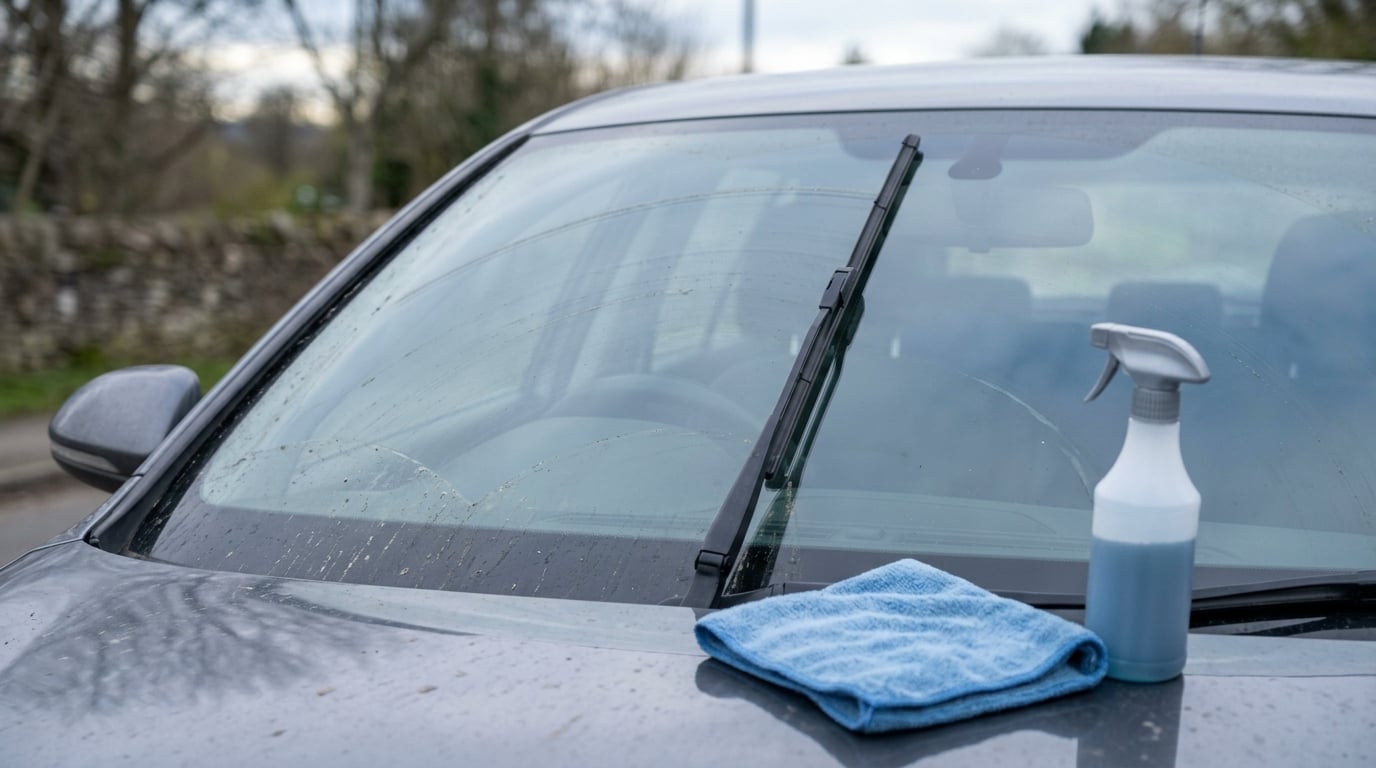
What causes chattering windshield wipers? In almost every case, friction: the rubber edge grips the glass instead of gliding over it, so the blade sticks and releases, sticks and releases. Dirt baked onto the windshield, a hydrophobic treatment like Rain-X, hardened rubber, or a wiper arm sitting at the wrong angle all raise that friction. Usually you can pin down the cause in about ten minutes with a bottle of isopropyl alcohol and a clean cloth.
Most chatter is fixable at home for the cost of a blade and a little elbow grease. A few cases are not, and those are the ones where people end up replacing blades three times before they realize the arm or the motor is the actual problem. That is why the diagnostic order matters more than the fix itself.
Table of Contents
What Causes Chattering Windshield Wipers?
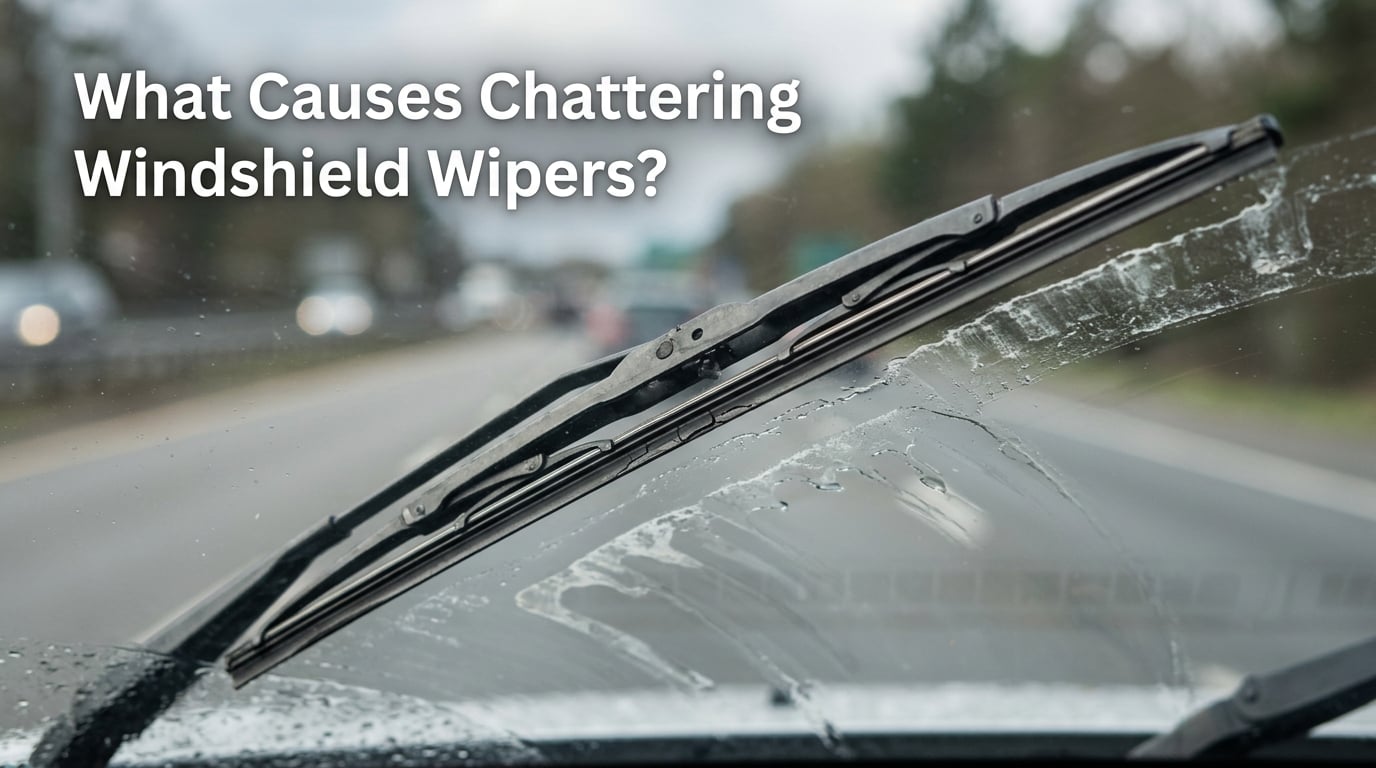
The short answer is stick-slip friction between the rubber lip and the glass. A wiper blade is designed to flip its stiffening element 180 degrees at each end of the stroke so the rubber edge always points the way it needs to. When the blade sits at anything other than roughly 90 degrees to the glass, or when the surface grabs the rubber, that flip no longer happens cleanly and you get judder instead of a sweep.
It helps to know which of three things you are actually hearing, because each points somewhere different.
- Skipping: the blade hops over a band of glass and lands past it, usually in one specific spot on the windshield. That is nearly always a dried compound, tree sap, bird mess, or a spot of etching that has built a lip.
- Juddering or chattering: rapid shaking along the whole stroke, or only part of it. That is a friction and pressure problem: contaminated glass, hardened rubber, or an arm that is not pressing the blade down evenly.
- Total failure: the blades do not move, move in fits and starts, or jump and reverse mid-sweep. That is not friction at all. You are looking at a stripped motor gear, a loose linkage, a blown fuse, or a failing motor park switch.
Chatter at highway speed but silence in a car park is a different signal again. Aero load pulls the blade harder into the glass at speed, and a blade that is only marginal becomes a noise maker once the airflow starts helping the rubber stick.
Common Wiper Chatter Causes
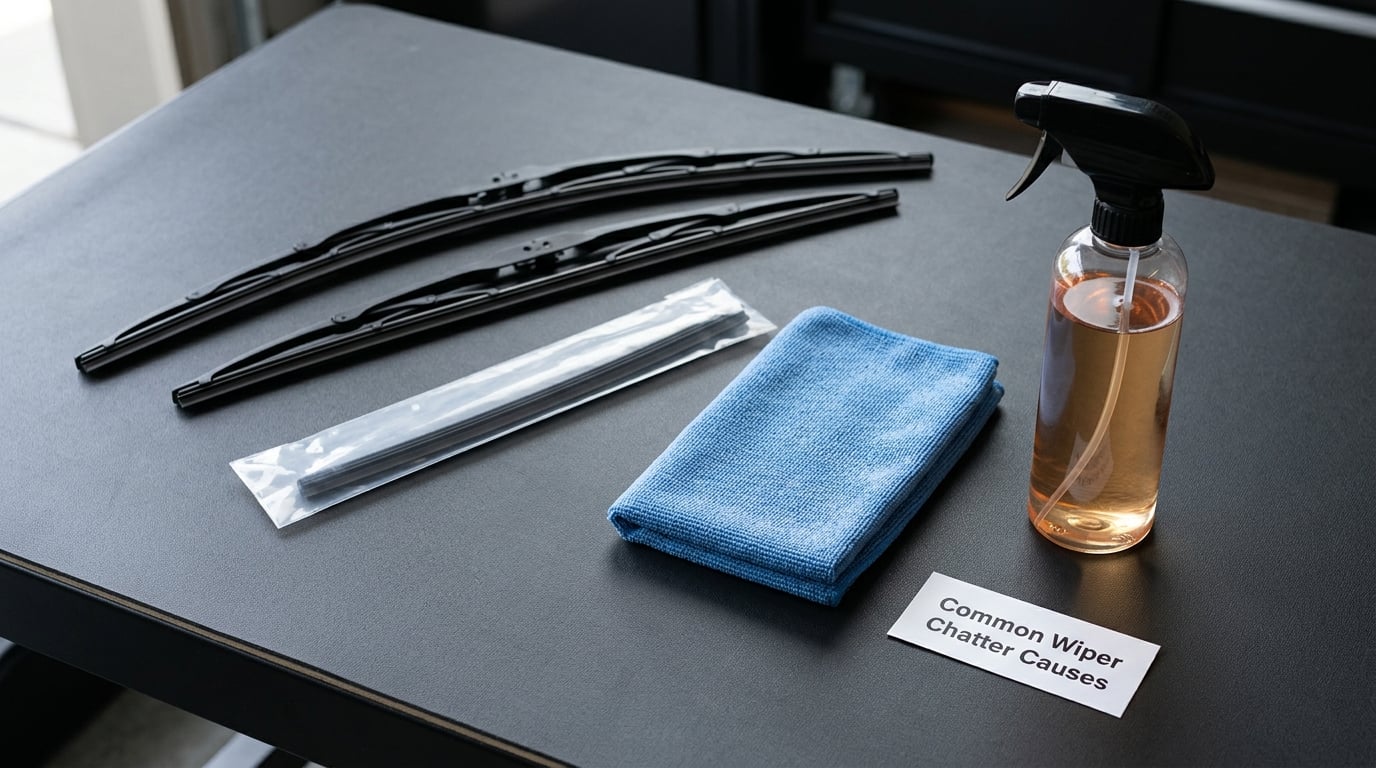
Here are the causes that account for nearly all of it, ordered by how often they turn out to be the real answer.
- Contaminated glass. Road grime, pollen, bug residue, road salt, and car wash wax leave a film that the rubber grips. Symptom: chatter starts the moment the blades get wet, sometimes only at low speed where the film hasn’t been rinsed away.
- Dried wiper compound or tree sap. A thin hardened line across the sweep. Symptom: the blade skips over the same band of glass every single stroke.
- A hydrophobic coating. Rain-X and similar water beading treatments change how the rubber grips a wet surface, and low-speed judder is a well-known side effect. Symptom: chatter that appears in drizzle and disappears once the glass is properly soaked.
- Hardened or torn rubber. Ultraviolet exposure and road salt stiffen the lip until it no longer flexes. Symptom: squeaking on wet glass, streaking, and chatter that clean or dampen the blade only temporarily.
- A misaligned or loose arm. The arm should sit close to perpendicular to the glass. Bent from an ice scraper, or simply out of adjustment, it changes blade pressure. Symptom: chatter confined to one blade, or to one end of the stroke.
- A weak arm spring. The arm is supposed to hold roughly 8 to 12 pounds of downward pressure. Fatigue or a stretched spring drops that to nothing. Symptom: the blade barely touches the glass, and the rubber lip curls or flattens unevenly.
- Motor, linkage, or electrical faults. Stripped gearbox, worn linkage bushings, a loose ground, or a failing park switch. Symptom: stuttering, jumping out of position, or the blades parking mid-windshield instead of at the base.
Rarely is it just one of these. A driver who has run dry rubber across a waxed windshield for a year usually turns up with a contaminated glass problem and a hardened blade at the same time, and fixing only one of them leaves the chatter in place.
Glass and Wiper Blade Problems
Start here, because it is the cheapest test and it rules out the most causes. A blade running on dirty glass can chatter just as violently as a new one, and buying blades to fix a contaminated windshield is the most common way people end up back at square one.
How to clean the windshield properly
Fill a spray bottle with isopropyl alcohol, dampen a clean microfiber cloth, and work section by section. Keep the blade lifted off the glass with a folded towel so you are not dragging rubber across it while you clean. Wipe the same area twice with clean sections of cloth. If a line still feels sticky after a pass, the compound is not gone.
For a stubborn band of sap or dried wax, a detailing clay bar worked over the glass with a lubricant spray does the job without scratching. Some owners in detailing communities go further and use very fine steel wool on the glass itself, wrapped in cloth, with isopropyl alcohol as the lubricant. It works, and it also strips a thin layer of glass, so I would save it for a windshield you are already planning to replace.
Once the glass is clean, run the blades with plenty of washer fluid. Chatter that disappears is a glass problem. Chatter that stays is mechanical.
What to look for on the rubber itself
Lift the arm and examine the lip under a light. Missing chunks, lengthwise tears, a ragged end, or a lip that no longer sits flat when you flex the blade by hand all point to replacement. A lip that is smooth but stiff, dull, or shiny from use is hardened rubber, and it will chatter on clean glass too. Wiping the blade with isopropyl alcohol on a cloth clears grime from the edge, but it does not bring hardness back.
Why new blades can still chatter
This is worth saying plainly, because it comes up constantly. A new blade on a contaminated or coated windshield will judder exactly like the old one, and it will do it in the first week. New blades do not need a break-in period in any mechanical sense, but the first few passes over an uncleaned surface can drag existing grit into the new rubber and spoil it. Clean the glass, then fit the blade.
Coated glass is its own case. Water-repellent treatments need a specific approach, and a blade that works fine on untreated glass can judder badly on a treated one. Detailers generally recommend a mild automotive glass cleaner rather than an aggressive solvent, and a blade with a softer rubber compound for treated surfaces. Forum owners report the same pattern repeatedly: chatter appears right after a hydrophobic treatment goes on, and it goes away when the treatment is removed.
Wiper Arm, Linkage, and Motor Problems
If the glass is clean and the blade is new, the fault has moved up the arm. Every problem in this group changes how much pressure the rubber feels, and a blade that cannot hold a consistent grip judders.
Arm angle and alignment
Lift the arm and let it sit naturally. The blade should run roughly perpendicular to the glass, which on most vehicles means the leading edge of the blade is about 90 degrees to the glass surface. If the arm has rotated in its spline, or a previous repair pushed it, you can usually spot it: the blade sits at a slant, one corner lifts, or the blade tip rises above the top of the glass on one pass.
The usual correction is to rotate the arm in the spline until the blade is square. Do it with the blades parked, and know that the spring inside the arm can snap if you force it. Owners on Jeep and BMW forums describe carefully unhooking the arm from the splined shaft, rotating it, and letting it re-seat under spring tension. Others grab padded pliers and bend the metal a few degrees. Both work; the pliers method risks kinking the arm, and I would rather not recommend it as a first move.
Spring tension and bent frames
A spring arm that has been holding tension through a few thousand cycles can relax, and ice or a careless scraper can bend the frame. Feel the arm with the blade removed: it should press the rubber down with a firm, even load, not a featherweight touch. A blade that looks bowed, kinked, or twisted along its length is done, and a bent arm will keep ruining new blades until it is straightened or replaced.
Members on MechanicAdvice point out one thing that catches people: the little plastic nut or clip on the pivot stud can work loose under constant vibration, letting the arm droop and the whole blade skate sideways. A dab of silicone-based lubricant on the pivot and hinge is a sensible preventive step, applied sparingly so it does not get onto the glass.
Linkage and motor faults
Wipers that jump, wander, or park at the wrong angle are mechanical rather than friction problems. On a traditional setup, the motor gearbox is a sealed plastic unit, and when its internal teeth wear out it drives the linkage in short bursts or not at all. On a bar-and-link system, worn bushings and a stretched cable let the blades run out of position on their own. Electrical causes include a blown fuse, a failing multi-function stalk switch, corroded ground points under the cowl, or a motor that stalls when the blades hit heavy ice.
A useful distinction: if the blades move smoothly and quietly through a full stroke with the motor running, the problem is the motor. If the blades only misbehave at certain positions or speeds, the problem is the glass, the blade, or the arm. Diagnose the motor last, and confirm it properly before ordering one. Forum threads are full of owners who replaced two or three blade sets and then the motor, and found the blades were never the problem.
How to Diagnose Wiper Chatter
Work through this in order. Each step costs a couple of minutes and rules something out.
- Clear the parking spot. Check the sweep path for ice, snow, a cover, or a loose plastic bag before you move anything.
- Clean the glass completely. Isopropyl alcohol and a microfiber cloth, section by section, with the blades lifted on a folded towel.
- Wet the blades properly. Spray washer fluid directly onto the rubber and let it sit for a minute. Dry rubber on glass is the worst possible test and will mislead you.
- Run each blade separately. Park one blade up if the vehicle allows it, or fit the arm the other way, so you know whether one blade or both are involved.
- Watch the stroke. Note whether the chatter is on the upstroke, the downstroke, at both reversals, or across the whole sweep.
- Inspect the rubber and the arm. Look for tears, missing sections, hardened edges, a bent frame, a loose pivot nut, and an arm that does not sit square to the glass.
- Re-test after cleaning. If the chatter is unchanged on clean, wet glass with a sound blade, you have moved to a mechanical fault.
What you see tells you a lot. This chart covers the patterns that come up most.
| What you observe | Most likely cause | What to do |
|---|---|---|
| Chatter in both directions across the whole sweep | Hardened rubber or contaminated glass | Clean the glass, inspect the lip, replace the blade |
| Chatter only on the upstroke | Blade angle off square; flip not happening cleanly | Check arm angle, replace the blade, reseat the arm |
| Chatter only on the downstroke | Weak spring or uneven pressure on the return stroke | Test spring tension, replace the arm if it is soft |
| Skips over one fixed band of glass | Dried compound, sap, bug residue, or etching | Clean with alcohol, then clay bar if it persists |
| Fine at rest, juddering at highway speed | Aero load pressing a marginal blade onto the glass | Replace the blade; a beam design with a spoiler helps |
| Judder only in light drizzle, fine in heavy rain | Hydrophobic coating on the glass | Wash the coating off, use a softer compound blade |
| Blades jump, stutter, or park high on the glass | Motor gearbox, linkage, or electrical fault | Check fuse and connections, then have the linkage and motor tested |
| Chatter appeared right after a fitment | Wrong blade length, or grit trapped against the new rubber | Recheck size and part type, clean the glass again |
How to Fix Chattering Windshield Wipers
Match the fix to what the diagnosis turned up.
- Contaminated glass. Clean it properly and re-test. If a band survives alcohol, use a clay bar with lubricant, or a machine polish from a specialist. Wax and hydrophobic treatments need removing, not just wiping over.
- Worn or hardened blade. Fit a new blade in the correct length and style for your vehicle. Beam and hybrid designs have no exposed frame and usually last longer, and refills are worth it if your arms take standard insert-type blades.
- Misaligned or loose arm. Park the wipers down, lift the arm off the splined shaft, rotate it until the blade sits square, and let the spring settle it back into position. Expect resistance from the spring.
- Weak spring or bent frame. Straighten the arm carefully with padded pliers, or replace it. Many arms are sold as driver-side and passenger-side pairs because the springs are matched.
- Stiff pivot or hinge. A small amount of silicone-based lubricant on the pivot stud and hinge joint restores smooth movement. Keep it off the glass and off the rubber.
- Linkage or motor fault. Fuse, connectors, and grounds first, all cheap to check. Beyond that it is shop work.
Two safety notes. The spring inside a spring-loaded arm stores real energy and can let go across your fingers, so keep your hands clear of the arm path and lift the arm slowly. And if your vehicle uses a hooked arm rather than a J-hook, the removal procedure is specific to that fitting, so follow the owner’s manual for the release direction instead of forcing it.
One more worth repeating, because the advice circulates everywhere online: do not put WD-40 on wiper blades. People report trying it and getting worse streaking and more chatter, and it is a petroleum film that collects dust. Isopropyl alcohol on a cloth cleans a blade edge. Silicone lubricant belongs on the pivot, not the rubber.
When to Replace the Wiper Blades or Motor
Replace the blades when any of this is true.
- The rubber lip is torn, cracked, or missing sections.
- Chatter persists after a full glass clean and a wet test.
- Streaking runs the length of the whole sweep rather than in patches.
- The blade was left dry on the glass for months and the edge no longer flexes.
- Blades were replaced recently and the chatter began within days, which points to a size or style mismatch or to a contaminated glass.
Replacement every 6 to 12 months is a reasonable interval, and sooner if you park in full sun, run salted roads in winter, or leave them up on a warm driveway. Do not forget the rear wiper, especially on SUVs, crossovers, and hatchbacks, where it is the only thing clearing the back window and it is easy to ignore for a year.
Consider the motor only after the glass, the blade, and the arm are all ruled out, and only when the fault is in the movement itself. The signs that justify looking at the motor: the blades stall or reverse mid-sweep, they crawl slowly, they leave the wiper park position, or they jump between spots. Confirm it first, since a bad connection or a melted connector can imitate a dead motor exactly.
Frequently Asked Questions
Is chattering windshield wipers dangerous?
Yes, it deserves attention before the next long drive. Chatter means the blade is bouncing instead of clearing the glass, so your view stays partly obscured, and the hard rubber dragging across a contaminated surface can scratch the windshield permanently. Wipers that jump or stall are worse still, because the driver is guessing at visibility in traffic. Clean and fix it this week.
Can washer fluid fix wiper chatter?
Sometimes, and it is worth trying before buying anything. Soaking the rubber edge in washer fluid softens a lip that has dried out and washes loose grit off the blade. If the chatter drops noticeably after a few minutes of soaking and then returns, the blade or the glass is the problem rather than the fluid. Soapy car wash liquid is not a substitute and leaves a film that makes chatter worse.
Is WD-40 safe to use on wiper blades?
No. WD-40 leaves an oily film that attracts dust and grit, which makes the blade skip and streak, and owners who have tried it often report the chatter getting worse rather than better. It is not a cleaner and not a rubber conditioner. Use isopropyl alcohol on a cloth to clean a blade edge, and use silicone-based lubricant only on the wiper arm pivot and hinge, never on the glass.
Why do my new wiper blades judder right after fitting?
Two usual reasons. The glass underneath was never properly cleaned, so the new rubber picks up the same grit that made the old blade chatter, or the blade is the wrong length or style for the arm. Check the part number against your vehicle, confirm the blade sits square to the glass, and clean the windshield again. New blades do not need a break-in period.
Why does chatter only happen on one stroke or at highway speed?
Upstroke-only chatter usually means the blade is not square to the glass, so the rubber does not flip cleanly at the top reversal. Downstroke-only chatter points to weak spring tension or uneven pressure. Chatter that only appears at highway speed is aerodynamic: airflow presses a marginal blade harder onto the glass, exposing a blade that is worn, dirty, or too soft.
When is the wiper motor the actual problem?
The motor is the likely cause when the blades stutter, crawl, jump out of position, or park mid-windshield instead of returning to the base, since those are movement faults rather than friction faults. Check the fuse, the connector under the cowl, and the ground points first, because a bad connection mimics a dead motor. If those check out, have the linkage and gearbox tested before ordering parts.
Conclusion
Start with the glass. Isopropyl alcohol, a microfiber cloth, and ten minutes of work rule out the most common cause of chattering windshield wipers, and they also tell you whether you are dealing with friction or a mechanical fault.
If the chatter survives a clean, wet test with a sound blade, the answer is in the arm or the linkage. Correct the angle, check the spring, look for a bent frame or a loose pivot nut. And if the blades are jumping, stalling, or parking in the wrong place, get the motor and electrical system confirmed before you buy anything.