
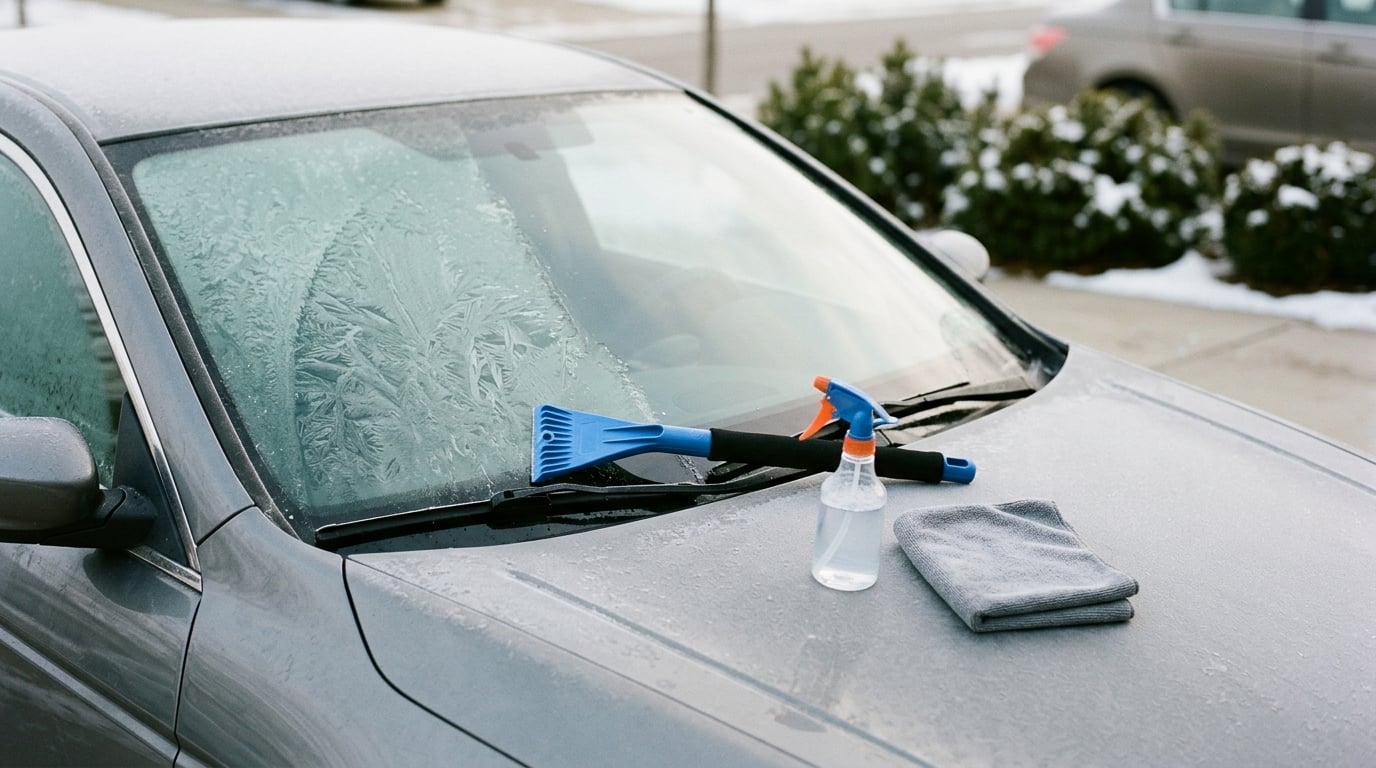
To remove ice from a windshield without scratching, soften it first with a de-icer or warm water, then push a clean plastic scraper across the glass at a shallow angle in long strokes. Never use boiling water, keys, metal blades or a shovel edge. Most of the scratching comes from grit trapped under a hard plastic or metal edge, so keep the blade clean and the ice wet while you work.
That takes about five minutes on a normal overnight frost. Longer if you have a thick bonded sheet of ice, or a car with a heat pump where the cabin warms slowly.
Windshields are laminated safety glass with a plastic interlayer and a factory coating, and they scratch easier than most people expect. A scratch deep enough to catch your fingernail refracts light, which is why the glass suddenly glares at night or at low sun. Fixing that means a new windshield plus camera recalibration, which is why the ten minutes of careful technique are worth it.
Table of Contents
- What You Need
- How to Remove Ice from a Windshield Without Scratching: Step-by-Step
- Common Mistakes
- Frequently Asked Questions
- Is it bad to scrape ice off your windshield?
- Does Magic Eraser scratch windshields?
- Is it safe to pour hot water on an icy windshield?
- Can I use a credit card to scrape ice off the glass?
- How can I remove ice from my windshield with no scraper and no supplies?
- How do I fix small scratches on my windshield?
- Conclusion
What You Need
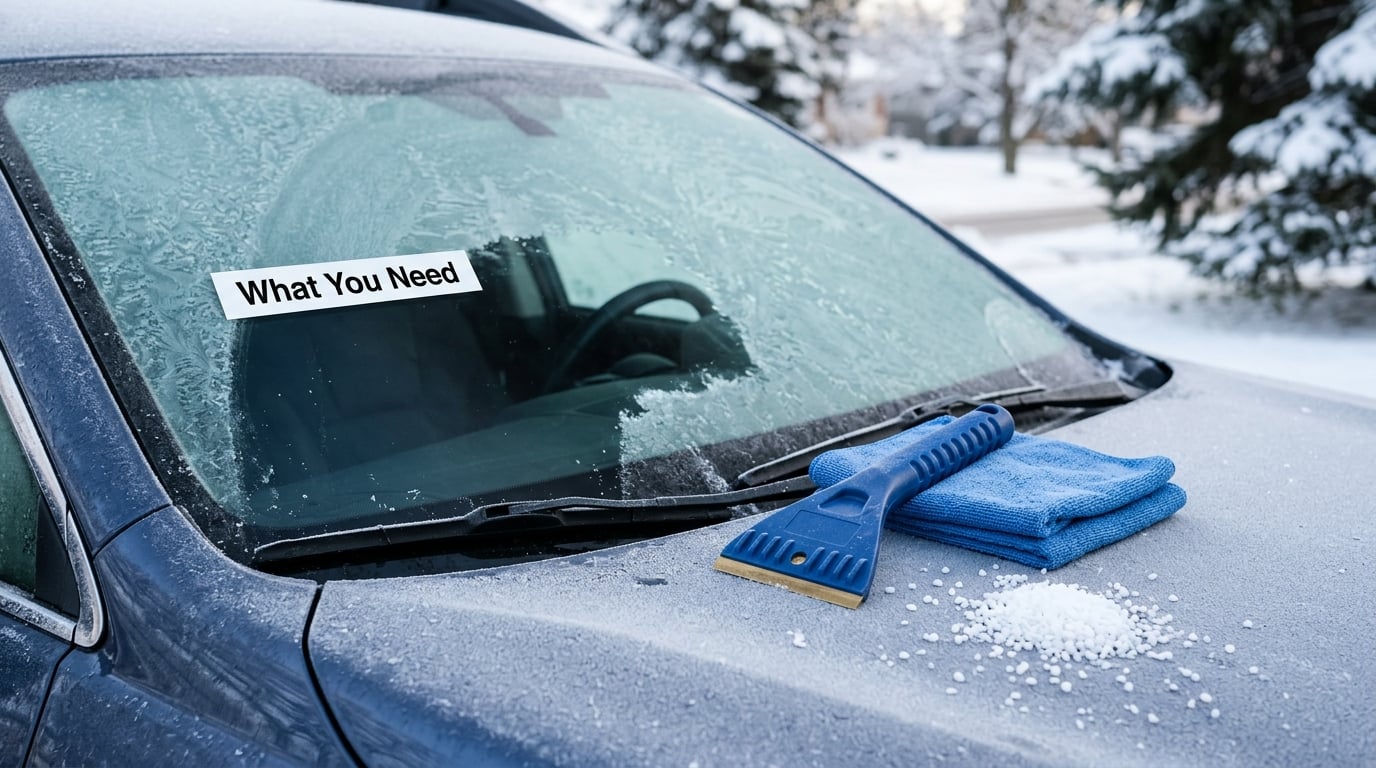
The whole job needs three things: something to soften the ice, something plastic to push it off, and something to wipe the residue. Everything beyond that is optional.
- A plastic ice scraper. Look for one with a rigid plastic blade and a soft brush on the opposite end for clearing snow off the roof and glass. Replace it the moment the blade cracks or the edges go ragged, because a chipped edge is what turns a scraper into a grinder.
- De-icer spray or a DIY solution. A trigger-spray de-icer that is rated below freezing works well. For a homemade version, mix two parts 70% isopropyl alcohol with one part water. Isopropyl does not freeze until around minus 128F, so it keeps working in cold that stops water-based mixes solid.
- Warm, not hot, water. A spray bottle of lukewarm water is safe and useful as a last resort. Hot tap water is generally tolerable; boiling water is not.
- A microfiber cloth or a soft paper towel. De-icer leaves a film, and that film causes glare at night. Wipe it off before you drive.
- Glass cleaner and a water-repellent treatment if the glass is already hazy, since a clean surface is noticeably easier to de-ice.
Useful extras: a small plastic card in the glovebox for emergencies, winter-rated washer fluid for the spray bottle, and a windshield cover for nights when the car sits outside.
Here is how the common tools compare, because the improvised ones are exactly where glass gets damaged.
| Tool | Scratch risk on glass | Verdict |
|---|---|---|
| Plastic ice scraper | Low if the blade is clean and undamaged | Use this one |
| Ice pusher (rubber or Teflon) | Very low | Safe, slower on thick ice |
| Soft bristle snow brush | Low on glass, watch the grit it lifts | Use for snow before scraping ice |
| Plastic card or credit card | Low, but the card can bend | Fine emergency substitute |
| Magic Eraser | Abrasive, it will haze the glass | Do not use |
| Metal shovel edge or metal scraper | High | Do not use |
| Keys, coins, knives, spatulas | High | Do not use |
How to Remove Ice from a Windshield Without Scratching: Step-by-Step
Step 1: Start the Car and Warm the Cabin
Start the vehicle, set the heater to maximum, aim the vents at the windshield and set the fan to medium or high. Turn the air conditioning on as well, even in winter. The heater alone brings warm moist air that fogs the inside again, while the air conditioning pulls moisture out of the cabin and dries the glass.
Budget five to fifteen minutes for the glass to clear from the inside, longer on an electric vehicle or hybrid with a heat pump, because they make heat rather than waste it. Never pour boiling water on frozen glass to speed this up. That causes thermal shock, where one part of the windshield expands far faster than the part next to it, and the glass cracks.
You are not scraping while the glass is still rigid. Wait until the ice has lost its hard edge and starts to give, or until water moves freely under it.
Step 2: Apply a Safe Ice-Melting Solution
Spray the de-icer from the bottom of the windshield upward, so it runs down across the whole surface and off the edges instead of dripping straight down in one lane. Work the passenger side, then the driver side, then the corners, where ice usually survives longest.
A commercial de-icer rated well below freezing is the simplest option and the least messy. For a DIY mix, two parts 70% isopropyl alcohol to one part water works down to serious cold and evaporates clean. Vinegar gets recommended constantly and it is a poor choice: its freezing point is only slightly below water, so it does little below about 30F, and the acid slowly attacks wiper rubber, rubber seals and black trim, leaving a smeary residue that scatters light at night.
Windshield washer fluid decanted into a spray bottle is a decent middle ground, since most winter-rated fluid carries a good amount of alcohol. Use lukewarm water only when nothing else is available, in small amounts, and wipe the glass down afterward.
Step 3: Use a Plastic Scraper Correctly
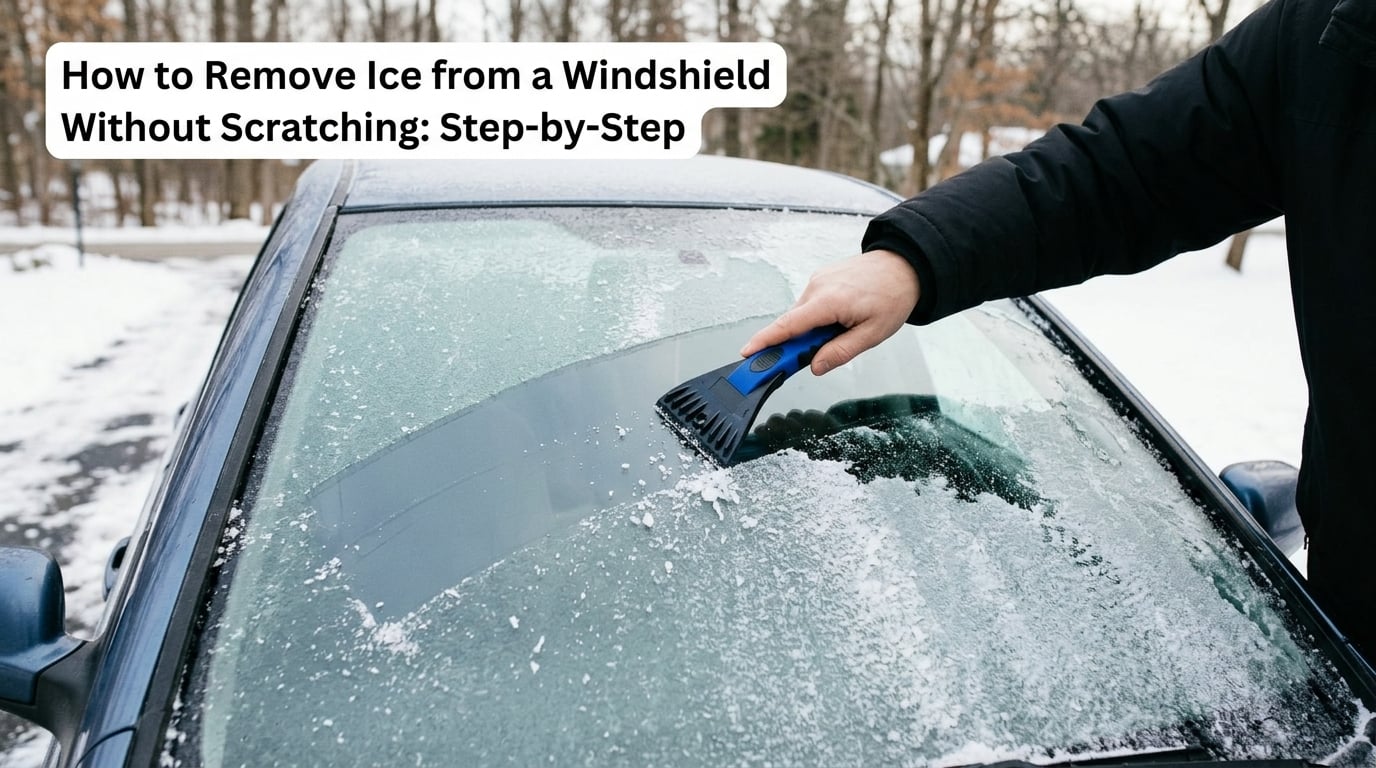
Most scratches happen because the blade is dragged horizontally while grit is trapped underneath. Change the angle and the damage disappears.
- Keep the blade wet. A dry blade on ice is a blade on sandpaper. Re-spray every few strokes.
- Score first. Many plastic scrapers have shallow concave ridges on the back. Run them across the ice in a crisscross pattern to break the bond before you use the edge.
- Work at a shallow angle. Hold the scraper so the edge is closer to flat than to vertical. You want to shear the ice off, not lever it up.
- Use long strokes in one direction. Short, overlapping circular motions are what grind particles in. Go across the top edge, then down, then across again.
- Work from the edges toward the middle. Corners and the lower edge collect the thickest ice and give you a working surface to push from.
- Stop when you feel resistance change. A jump means grit or a chip under the edge. Spray, wipe the blade on your coat, and start again.
Thick bonded ice defeats a light scraper because it flexes and skids. Score it heavily, spray it again, wait another minute, and take the layer off in sheets. If the plastic blade starts to bend or creak, put it down rather than forcing it.
Owners on r/cars and r/AskAMechanic consistently report that a plastic scraper in good condition has never marked their glass. Several also describe a credit card as their emergency stand-in when the scraper is not in the car. That matches what you would expect, because the card is flat, plastic and unlikely to pick up a metal edge.
Step 4: Remove the Melted Ice and Check the Glass
Wipe the slush off with the microfiber cloth or a soft towel before it refreezes, working from the top down. Then check the glass in flat daylight if you can, looking for trapped grit, streaks from the de-icer, chips near the edges and any new scratches. A haze you can feel with a fingernail near an edge or around the frit band is a starting point for a repair kit.
Clear the mirrors and side windows too, and the rear window if you have to reverse. A windshield with a cleared porthole and a frosted surround is still dangerous, and in most places it is also unlawful.
If the wipers are frozen down, do not force them. Turning the ignition on briefly and moving the stalk lightly sometimes frees them; owners report that forcing stuck blades is what burns out wiper motors and tears the rubber, not the ice itself. Run the defroster until the glass is warm and wet underneath, then ease the blades free.
Common Mistakes
These are the moves that scratch glass or crack it, with a better option for each.
- Metal blade, shovel edge or metal pan. A single pass across grit and you have scratches, sometimes deep enough to see in a headlight beam. Use a plastic scraper or, for deeper snow, a plastic shovel used side to side so the edge never touches glass.
- Boiling or very hot water. This is the fast way to crack a windshield from the inside out, and the crack often starts at an existing chip. Use lukewarm water and a de-icer instead.
- Keys, coins, butter knives, screwdrivers. The classic gift-wrapped car mistake. A plastic card does the same job without the risk.
- Credit card flat against the glass in tight circles. The card is plastic and fairly safe, but circular scrubbing still works grit into the surface. Use long sweeps and keep it wet.
- Magic Eraser. It is an abrasive melamine sponge. On glass it leaves a permanent haze that looks like scratches and cannot be polished out. The r/AutoDetailing threads on windshield haze mostly describe polish wear, which is the same kind of surface damage, and the fix is a glass polish rather than more scrubbing.
- Dawn or any dish soap. Dish detergent leaves a fat, greasy film that catches headlights and makes the glass hazy. Glass cleaner and alcohol do the opposite.
- Scraping before the ice has softened. Rigid ice stuck to glass means the blade is a chisel. Warm it, wet it, score it, then scrape.
- Forcing frozen wiper blades. Expect torn rubber and a burned-out motor. Thaw the base of the blade first.
- Leaving de-icer residue on the glass. The film that looks fine in daylight is a glare source after dark. Wipe it off with the microfiber cloth.
One more thing worth doing before 2026‘s cold settles in: park under cover or in a garage, spray the windshield lightly the night before, or put a cover on. Owners consistently rate that as the biggest reduction in morning scraping. Fix existing chips too, because water that gets into a chip freezes, expands and turns a small nick into a running crack.
Frequently Asked Questions
Is it bad to scrape ice off your windshield?
No. Scraping ice with a clean, undamaged plastic scraper does not scratch glass, and it is faster than waiting for the defroster. The scratching comes from grit trapped under the blade, a cracked or ragged plastic edge, or dry scraping across bonded ice. Keep the blade wet, use long strokes in one direction at a shallow angle, and wipe the blade clean whenever you feel it catch.
Does Magic Eraser scratch windshields?
It hazes them rather than scratching them, but the result is just as annoying. Magic Eraser is a melamine abrasive sponge designed for kitchen stains, and it leaves a fine matte haze across automotive glass that catches light and cannot be polished away easily. Use a glass polish or a detailing clay bar for haze instead, and keep melamine sponges for the sink.
Is it safe to pour hot water on an icy windshield?
Warm or lukewarm water is safe. Boiling water is not. A sudden temperature difference makes one part of the glass expand while the neighbouring part stays frozen and cold, and that uneven stress, called thermal shock, cracks the windshield, often starting from an existing chip. If you use water at all, keep it lukewarm, use a small amount, and wipe the glass dry afterward.
Can I use a credit card to scrape ice off the glass?
Yes, it works reasonably well as an emergency substitute. A plastic card is flat, soft and unlikely to pick up a metal edge, so it will not gouge the glass. The problems are shape and control: the card bends, the corner digs in, and small circular scrubbing can still work grit into the surface. Use long sweeps, keep the glass wet, and treat a card as a backup rather than a daily tool.
How can I remove ice from my windshield with no scraper and no supplies?
Turn the defroster to maximum with the air conditioning on, aim the vents at the glass and give it five to fifteen minutes, longer in a heat-pump vehicle. Spray the windshield with warm water or winter-rated washer fluid from a bottle to soften the ice, then push the slush off with a palm, a soft plastic card or the edge of a credit card. Cover the glass with a coat or blanket to hold the warmth, then wipe it dry with a paper towel.
How do I fix small scratches on my windshield?
Very light marks that do not catch a fingernail can be improved with a glass polish used on a clean microfiber pad, working in small circles with light pressure. Many hazed windshields are not scratched at all but worn by glass polish and dried wiper residue, and those respond well to the same polish or to a detailing clay bar. Anything you can feel with a fingernail, especially near the edge frit, belongs with a glass shop.
Conclusion
Soften the ice first, then scrape it. That is the whole method: warm the cabin with the defroster and air conditioning, spray a de-icer rated well below freezing, and push a clean plastic scraper across the wet glass in long strokes at a shallow angle, top edge down.
Everything else is variation on the theme. Skip boiling water, metal, keys and Magic Eraser, keep the blade wet and free of grit, wipe the de-icer film away before you drive, and park under cover overnight so you have less to remove in the morning.