
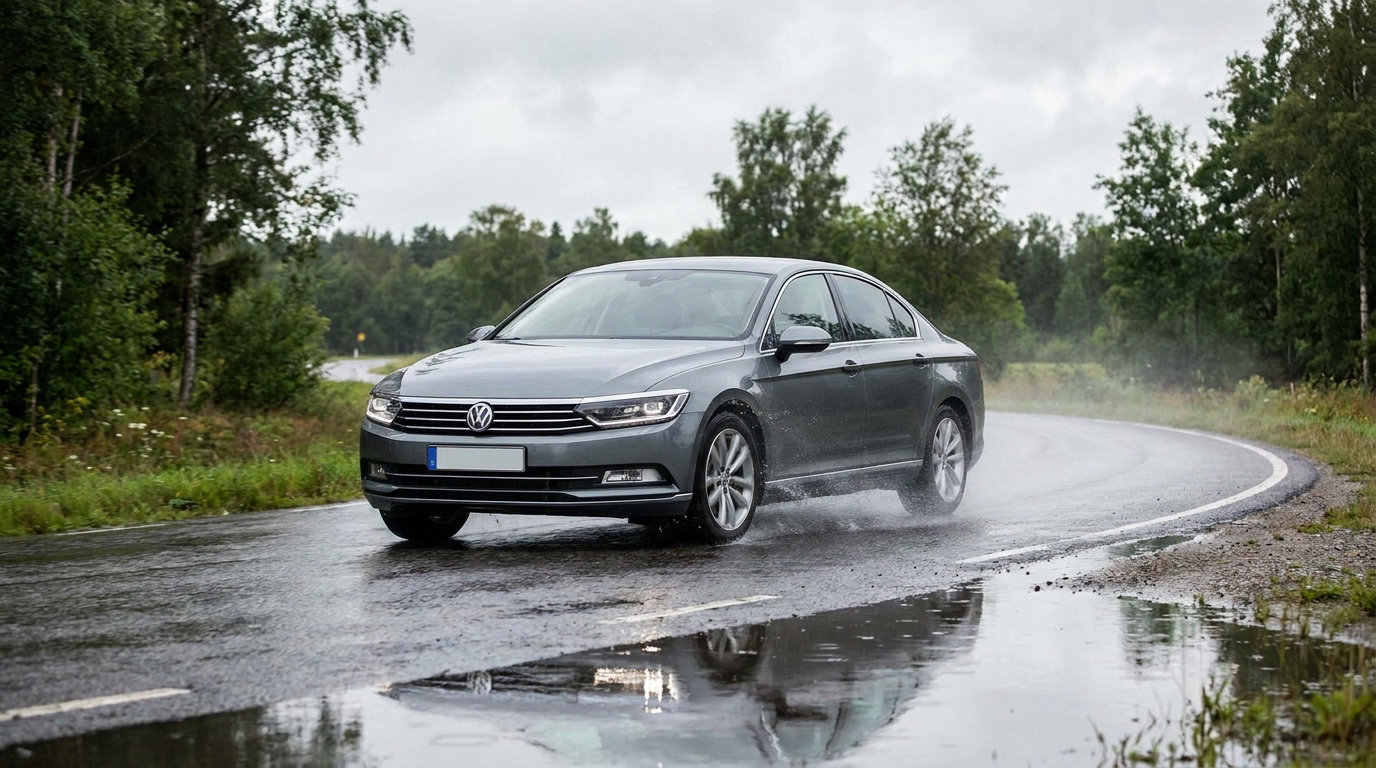
To recover from a skid on wet roads, stay calm, lift off the accelerator gradually, and steer the front wheels into the direction the car is sliding. Add only the braking you actually need, then straighten the wheel the moment the front tires bite again. A skid is a temporary loss of grip, not a failure of control, and most are recoverable in under three seconds if your inputs stay small and smooth.
Most of the trouble comes from two reflexes: stamping the brake pedal, and turning the wheel toward where you want to end up. Both feel right and both make it worse. This guide covers what you need before you try it, the recovery sequence step by step, the difference between a front and rear skid, and the handful of mistakes that turn a slide into a spin.
Reviewed for October 2026. Every car handles a low-grip surface differently, so treat the sequence as a starting point and follow your owner’s manual where it says otherwise.
Table of Contents
What You Need
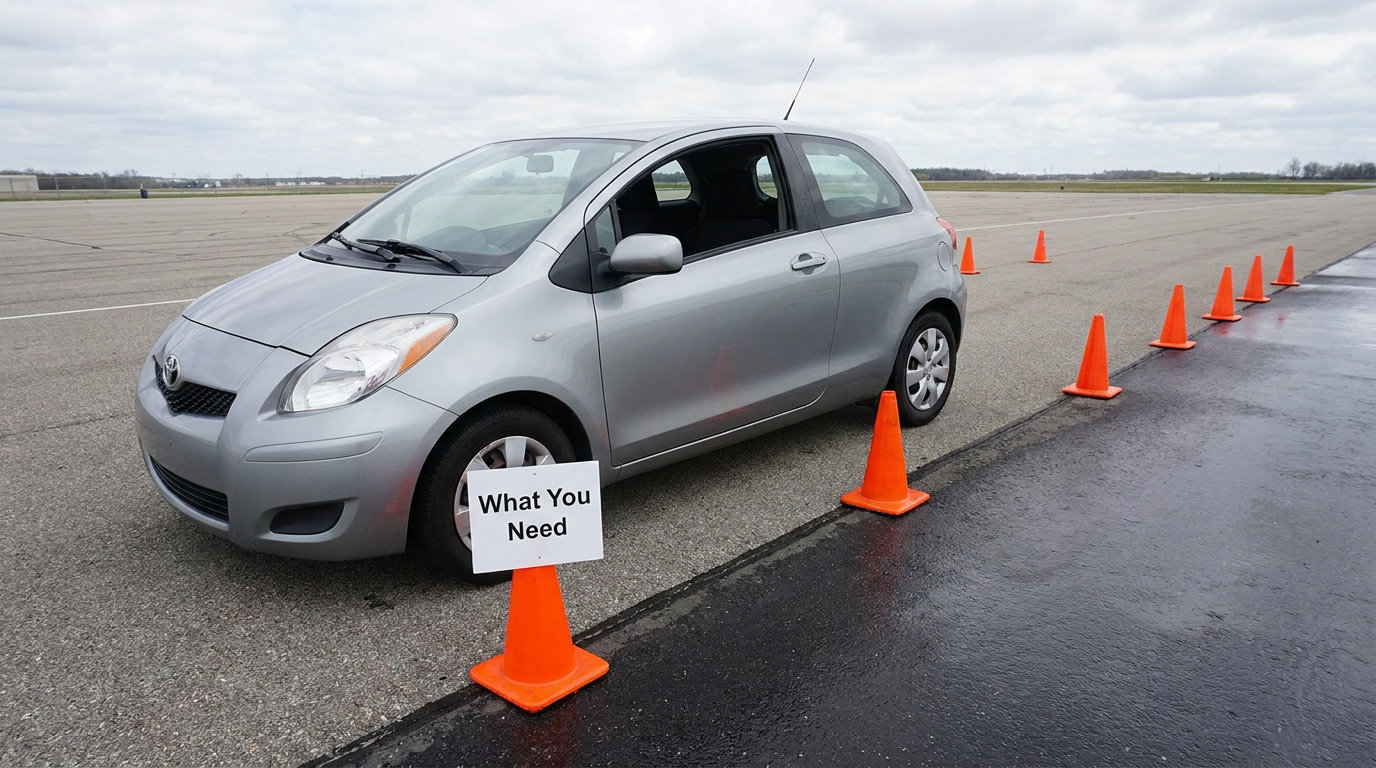
You do not need equipment. You need conditions, a car, and a clear area. The technique only works if you have somewhere to practice it before the moment you need it in traffic.
- A car with tread left. Stand outside and look at the four tires. Water sitting in the grooves that should be visible from a coin’s depth is a warning. A tire worn to the wear bars on the inner edge of the rib is done, regardless of how the tread looks from the road.
- Cold tire pressure as the tire placard specifies. Pressure rises as the tire heats up, so check before you drive rather than after, and check all five if you have a spare worth looking at.
- Clear, sweepable glass. Wiper blades that streak or skip leave you driving into a smeared view at the exact moment you need a hazard 60 meters ahead.
- Flat, open pavement away from traffic. A wide, flat, slightly damp lot is ideal. Cones or a chalk mark give you a reference line so you can feel the correction without staring at the wheel.
- Shoes with a flat, grippy sole. Pedal feel is a large part of this skill, and a slick-soled shoe or a thin sock removes most of it. Flip-flops are worse than nothing.
Know what your car has before you need it. Look at the instrument cluster: an ABS lamp that lights briefly at key-on and then goes out means the system is fitted and active. Stability control or traction control generally leaves an icon in the same cluster, and the manual tells you which model years have it.
One weather note before anything else. The first ten to fifteen minutes of rain are usually the most slippery part of a storm, because accumulated oil, brake dust and fuel residue have been sitting on the pavement in dry weather and get lifted into a film at once. If it has not rained for a while, treat the start of a shower as the riskiest window.
And never practice a skid on a public road, in traffic, or where anyone else is in the road with you. Practice on a closed, flat surface or in a formal course.
Step-by-Step: How to Recover From a Skid on Wet Roads
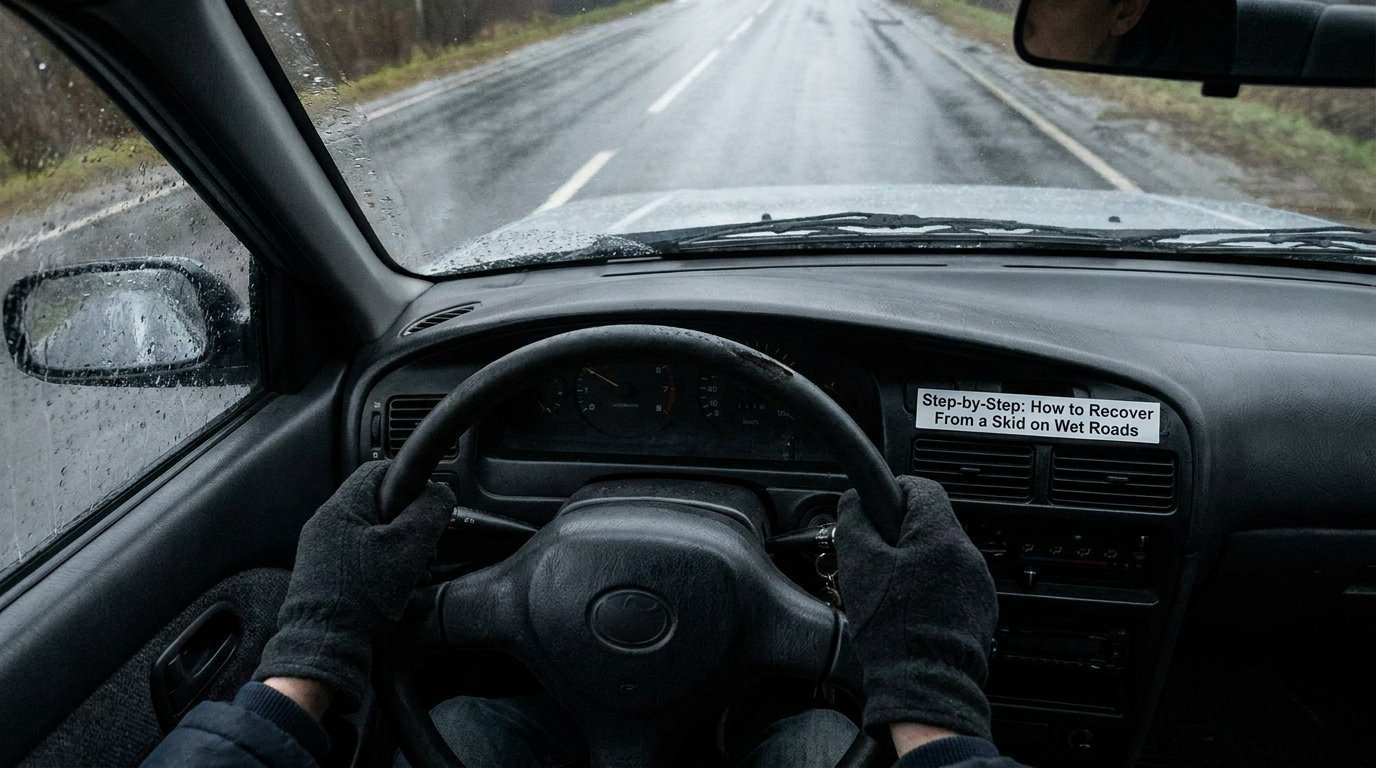
Step 1: Stay Calm and Identify What Is Happening
Two seconds of recognition saves the whole recovery. Ask one question: where is the car pointing compared to where it is going?
A rear skid, or oversteer, is the rear stepping out so the car rotates more than it travels. The tail swings toward the outside of a curve and the nose points into the corner. Most wet-road skids are this type, and they need countersteering.
A front skid, or understeer, is the front running wide. The car goes straighter than you steered, pushes toward the outside of the corner, and never rotates. This one needs the opposite input, and that difference is where a lot of near-misses happen.
Keep your eyes up and far ahead the entire time. Scan past the vehicle in front to the next hazard: an oncoming car, a parked truck, a wall, a person. Where your gaze lands is where the car tends to go, and looking at your own front tires guarantees you steer at nothing useful.
Step 2: Ease Off the Accelerator Gradually
Throttle is the biggest lever you have over rear grip, which is why how to recover from a skid on wet roads starts with your right foot. Drive torque to the rear tires, and hard acceleration can break them loose even on a straight, dry-feeling road.
Roll the accelerator up rather than snapping your foot off it. A sudden lift shifts weight forward, loads the front tires and unloads the rear, which can start a slide that had not begun yet. A gradual release keeps the car balanced and lets the rear tire’s slip angle drop below the point where it lets go.
In an automatic, put it in a lower gear as the car straightens. In a manual, the equivalent is a smooth upshift or neutral while the slide is still in progress. Either way the rule holds: take the corner too fast in the wet, steer in the direction of the slide, and keep the car away from a fishtail.
Step 3: Steer Into the Skid, Not Away From It
Countersteer means turning the front wheels in the same direction the rear of the car is sliding, which is the direction the car is currently traveling. It is a real skill and it is not intuitive, because every instinct says to point the wheel where you want the car to go.
The mechanics are worth understanding. A sliding tire follows the car’s momentum, not the wheel’s angle. The reason a turn works at all is that the front tires are pointed slightly off the direction of travel, creating a slip angle that generates a sideways force. Point the front wheels along the direction of travel and that force goes to nearly zero, which is why a wheel turned the wrong way has no authority.
To countersteer, turn smoothly and modestly. The correction you need is usually smaller than instinct tells you to give, so start small and let the car rotate back rather than sawing at the wheel. Hold the correction instead of chasing the tail, and add more only as the angle shrinks. Overcorrecting, then correcting the overcorrection, is the single most common way a saved slide becomes a spin.
For a front skid or understeer, do not countersteer at all. The front wheels are already pointed roughly where you want to go, so hold a light grip, lift off the throttle completely, and let the car decelerate straight. Adding steering angle on top of a slide that will not respond just feeds the front tires into the same loss of grip. A trail brake, a small amount of brake applied with the wheel still turned into the corner, can tighten the line, but it is a small input, not a stamp.
A quick reference for the three cases:
| What you feel | Skid type | Steering | Pedal |
|---|---|---|---|
| Rear swings out, tail steps to the outside of the corner, car rotates | Rear / oversteer | Turn the front wheels toward the direction of travel (countersteer), smoothly and slightly | Lift off the throttle progressively; brake only if needed |
| Car pushes wide, nose refuses to follow the wheel, no rotation | Front / understeer | Hold the wheel steady, do not add steering angle | Fully off the throttle; gentle braking in a straight line |
| Steering goes light, car floats over a film of water, no steering response | Aquaplaning | Hold a firm but steady grip, no sudden inputs | Off the throttle completely, no hard braking, ease off the gas before the surface changes |
Step 4: Apply Braking Carefully If You Need It
Brake only if speed is genuinely the problem. Standing on the pedal in a rear skid loads the front tires, unloads the rear further and intensifies the rotation, which is the mechanism behind most skids that become spins.
With ABS fitted, keep your foot firmly on the pedal and let the system work. The pedal will pulse or judder under your foot, and that is the ABS cycling to keep a wheel from locking. If you lift off because of the pulsation, you have undone it. The system detects lock-up and releases pressure faster than any person can react, and it does not shorten stopping distance on a slippery surface the way it does on dry pavement.
Without ABS, or in a car where the light is not working, braking is different. You cannot brake and steer at full force at the same time without locking a wheel, so on a front skid, ease off the brake and let the wheel roll again. On a rear skid, brake lightly, release, and brake again. Pumping the brake hard in a panic is wrong, but a slow, controlled rhythm of partial pressure is the correct tool when the wheels will lock.
On a car with electronic stability control, the system may cut torque and apply individual brakes before you do. If the light flashes, let it work. Do not fight it with more steering or more throttle.
Step 5: Regain Control and Return to a Safe Speed
You know grip is back when the steering responds to small inputs again, the car stops rotating, and the slip angle at the rear settles. The correction to the wheel also gets smaller as this happens, so straighten progressively rather than snapping it back to center, which can start a second, opposite slide.
Once you are straight, get the tires rolling smoothly again at a low gear and rebuild speed gradually. Most of the damage in a wet-weather crash happens in the two seconds after the driver believes the car is fine and floors it in a straight line.
Then slow to a speed the conditions actually support. Allow two to three times your normal dry stopping distance in the rain, and roughly a four- to five-second gap to the car ahead, more if you are towing. A speed that felt fine ten minutes ago may not suit standing water, road spray off a truck, or a surface that has not dried at the shaded end of a curve.
If you hydroplaned and the car went off the road, slow to a safe stop before assessing anything. Being on a closed, dry surface with the vehicle still running is the right place to work through the recovery slowly and learn the feel.
Common Mistakes and How to Fix Them
Each of these is a different failure with a different correction. They are not interchangeable.
Slamming the brake pedal. It feels like the fastest way to stop and it is what turns a recoverable slide into a spin. Fix: lift off the throttle first, and brake only after the car is already straightening.
Turning the wheel toward where you want to go. On a rear skid this points the front tires along the direction of travel and removes their ability to grip. Fix: watch the road, not the nose, and steer toward where the car is actually going.
Overcorrecting the countersteer. You catch the slide, feel the wheel go light as it straightens, and throw it the other way. Fix: unwind the steering smoothly with the car, never past center and then back.
Staring at the front of your own car. Fix: pick a target at least 60 meters ahead and hold your gaze there through the entire recovery.
Grabbing the handbrake. On a rear skid it locks the rear axle and makes the rotation much faster. Fix: leave it alone, except for a genuine downhill emergency stop on a very low-grip surface.
Trying to learn this in traffic on a rainy road. The reaction time is gone before you have processed the input. Fix: learn the feel on a closed lot or a formal course, where a slide costs nothing.
Assuming aquaplaning means a mechanical fault. Usually it does not. Fix: check cold tire pressure against the placard before you start blaming a puncture, and if the tires are holding pressure, the cause was water depth rather than a leak. That check costs nothing and saves you replacing tires that were never the problem.
Frequently Asked Questions
Should I press the brake or the gas when my car skids?
Neither, at first. Lift your foot off the accelerator gradually, which restores rear grip, and steer the front wheels toward the direction the car is sliding. Brake only if speed is the real problem, and lightly. Standing on the gas while the rear is already sliding makes the rotation worse.
What should I do when braking in a skid with ABS?
Keep your foot firmly on the pedal and do not lift off when it pulses. The juddering sensation is the system releasing and reapplying pressure to prevent lock-up, and it stops the car from rotating. Lifting off because of the pulsation is the most common error, and it costs you most of the benefit ABS provides.
Why do I hydroplane on a straight road with no visible water?
You do not need visible standing water for a tire to lose contact. A film a few millimeters deep can be enough at speed, especially with worn tread that cannot channel it away. You also lose grip without a full hydroplane: a change in the engine note, a steering wheel that feels lighter, and windscreen water that stops clearing evenly are all early cues.
How do I get more grip when driving on wet roads?
Slow down first, since grip scales with speed, and widen your following gap to four or five seconds. Tread depth and correct cold tire pressure matter most, and worn tires hydroplane earlier at a lower speed. Switch off cruise control in the rain, keep the wipers fast in heavy precipitation, and avoid hard steering or braking inputs on a surface that is already near the limit.
What countersteering is and when do I need it?
Countersteer means turning the front wheels in the same direction the car is currently sliding, not toward the corner you want. A sliding tire follows the car’s momentum rather than the wheel’s angle, so a countersteer puts the front tires back at a useful slip angle. You need it in a rear-wheel skid, and never in a front-wheel understeer.
What to Do First
Stay calm, lift your foot off the accelerator gradually, keep your eyes on the road far ahead, and make one small smooth steering correction toward the direction the car is sliding. Hold it until the steering goes quiet and the car stops rotating, then straighten and build speed back up slowly.
That is the whole technique. Everything else, the tires, the ABS, the practice, the weather, is about making those few seconds easier to give.