
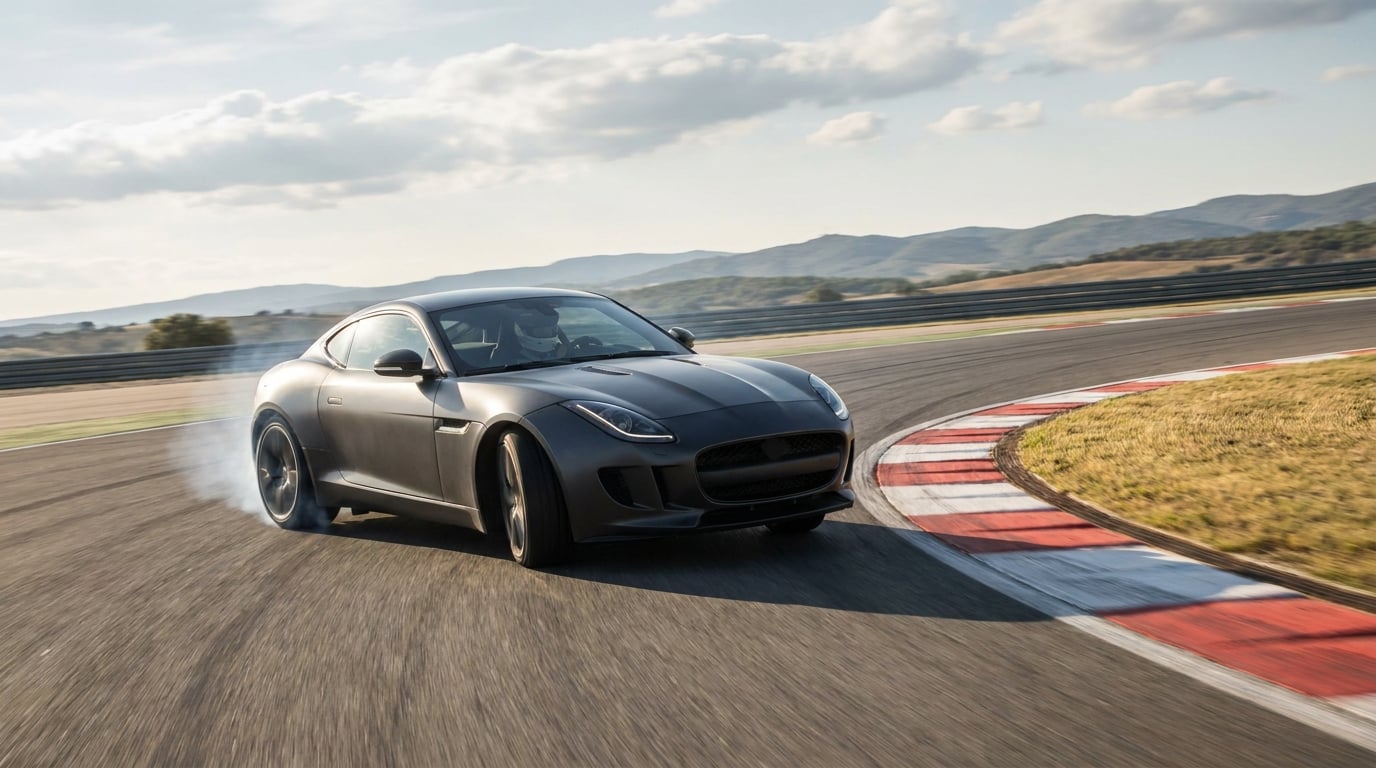
Trail braking is releasing brake pressure gradually and in proportion to your steering input as you turn into a corner, instead of finishing all the braking in a straight line and turning in as a separate action. It keeps weight on the front tires while the car rotates, which is the whole point.
Trail braking explained for street and track reads as one topic, but in practice it is one technique with two very different margins. On a circuit you have a known braking board, a flat surface and thousands of feet of run-off. On a public road you have oncoming traffic, gravel washed into the shoulder, and a corner exit you may never see.
I have driven both sides of that line, and the failure almost always comes from the same place: drivers treat trail braking as a way to brake later, when it is really a way to brake smoother and place the car. Get the definition right and the rest follows. Get it wrong and you get an early apex, a mid-corner slide, or a car that simply runs wide.
Table of Contents
- What Is Trail Braking?
- How Does Trail Braking Work in a Modern Car?
- Why Drivers Use Trail Braking on the Track
- Trail Braking Explained for Street Driving
- How to Trail Brake Step by Step
- How Much Steering and Brake Input Is Safe?
- Common Trail Braking Mistakes
- How Does ABS Change Trail Braking?
- How to Practice Trail Braking Safely
- Frequently Asked Questions
- Conclusion
What Is Trail Braking?
Trail braking is one overlapping input instead of two separate ones. Most driving is brake, then brake again, then steering, then throttle. Trail braking merges the last part of the brake with the first part of the steering so the front axle is still doing work while the car starts to rotate.
What is trail braking, in one sentence
You brake in a straight line, begin to release pressure as you add steering angle, and let the release continue until the car is pointed where you want it to go.
That release is proportional. Add a small amount of steering and you give up a small amount of pressure. Add a lot of steering because the corner is tightening and you release more. The skill is matching how fast you give up braking to how much the car needs to turn, not hitting a fixed pressure number.
What it is not: stabbing the brake in the middle of a corner, standing on the pedal while the car is sliding, or braking so late that you turn in and hope. All three get called trail braking. None of them are.
Trail braking vs threshold braking, trail-off braking and engine braking
Four terms get mixed up constantly, so here they are separated:
- Threshold braking is braking as hard as possible right up to the point where the tires start to slip, then easing a touch. It is about finding the maximum of a straight-line stop, not about corner entry.
- Trail braking is the overlap described above, where the brake release and the steering input happen together through turn-in.
- Trail-off braking is the exit half: pressure already gone, car on the throttle, and the same progressive left foot just modulating the wheel. A lot of the advantage people attribute to trail braking is really this.
- Engine braking is engine drag through a downshift with no brake pedal involved. It trims speed on long descents and it settles a car before turn-in, but it does not load a tire. On a hybrid the same job is often done by regenerative braking explained for beginners, which is worth understanding if your car has it.
They stack rather than compete. Most track technique is threshold braking to the marker, trail braking through the turn-in, then trail-off braking and a downshift on exit.
How Does Trail Braking Work in a Modern Car?
The whole technique runs on one idea: a tire with more vertical load on it can put more force through its contact patch before it slides. Braking is what moves that load forward.
Under straight-line braking, the front suspension compresses and the rear extends. Mass that was distributed across all four corners moves toward the front axle, and the front tires gain vertical load while the rear tires lose it. Grip available at the front rises, grip at the rear falls.
Then you turn in. The front tires are being asked for cornering force at the same time as braking force, and both come out of the same finite budget. That budget is usually drawn as a friction circle: braking force uses one axis, cornering force the other, and the total cannot exceed the tire’s limit. Spend it all on braking and you have nothing left to turn with. That is why lifting off mid-corner mid-slide is so effective and so easy to misuse.
The grip budget analogy that stuck with me came from motoDNA’s motorcycle explainer, which frames it as a purse full of dollars. Braking and cornering draw from the same wallet. The trick is not having more money, it is being deliberate about what you spend and when.
Here is the important part: trail braking does not make a car stop harder. Deceleration comes from the brake torque and the load on the tires. What trail braking changes is that the load stays where you need it during the turn-in, so the front axle can generate cornering force while it is still generating braking force. On a race car that shaves real time. On a road car in traffic, it mostly just makes the corner look tidier.
Why Drivers Use Trail Braking on the Track
Track-day regulars describe trail braking as the single biggest gap between an intermediate and an advanced driver, worth several tenths a lap. The reason is that corner entry is where lap time is won or lost, and trail braking is the technique that controls it.
Braking zones are usually marked or memorised, and the pressure you apply inside one is simple: as much as the surface allows, in a straight line. The trail-braking zone is the short window between the last of that straight-line braking and the moment the car is pointed down the racing line. In that window the driver is doing three things at once: releasing the brake, adding steering, and adjusting the line.
A good description of the mechanism comes from the r/Trackdays thread on corner entry, where users describe it as loading the front suspension and the tire’s contact patch rather than a steering trick. The loaded front tire tells you where the grip is through the steering wheel, so the release rate becomes the steering rate.
The second reason is positioning. A car that rotates early can take a late apex and a wide exit. A car that never rotates takes an early apex and drags its speed. MR2OC forum members make the point bluntly: trail braking tends to force an early apex which kills exit speed, and you end up fast in and slow out. Corner exit is the key, and trail braking is only worth doing if you use the rotation it gives you.
It also helps on decreasing-radius corners, blind entries and double-apex corners, where the corner keeps asking for more steering than you expected. Being able to add steering and give up brake pressure at the same time is how you absorb that surprise without a panic input.
Trail Braking Explained for Street Driving
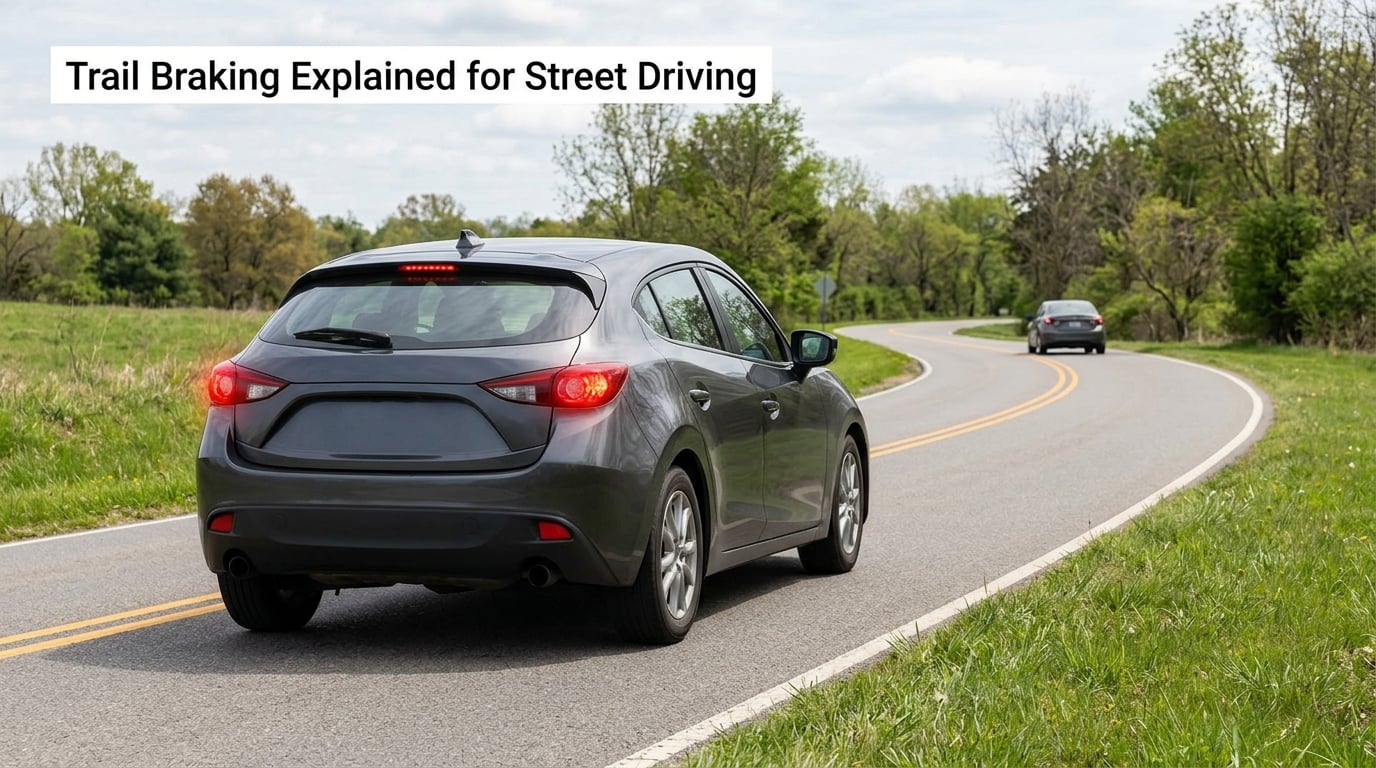
On a public road, trail braking is a smoothness tool and nothing more. The honest version of the technique is: brake in a straight line, release progressively as you turn in, and be fully off the pedal before the car is at any meaningful angle. That is a clean, low-effort corner entry that most cars barely notice.
What you should not take to the street is late braking, threshold braking under load, or any attempt to use the road as a braking zone. The margin for error on a public road is measured in other people’s reaction time, and gravel, wet patches and an unexpected stopped vehicle do not negotiate.
Where it is genuinely useful on the road: tight or blind corners where a sudden stab of the pedal upsets the car, tight low-speed hairpins, and any corner taken at moderate speed where you want the nose to follow your hands. Used that way it is really just good progressive braking, and it is worth practising because it is the same habit you need at the track.
Two street-specific cautions. On a low-grip surface, any brake input mid-corner changes the balance fast, so keep the technique to a very light release or skip it. And never trail brake in traffic at all; keep both inputs, brake hard in a straight line, and let the ABS work for you.
Street and track: the same technique with very different margins
| Factor | Street | Track |
|---|---|---|
| Braking point | Early, before the corner, with a clear view | Late, right up to a board or reference marker |
| How much pressure at turn-in | Release fully and quickly, treat it as a trail-off | Taper to roughly 85% and hold a light pressure through the turn-in |
| Surface | Unknown grip, possible water, gravel, debris | Consistent grip unless it has rained |
| Margin for error | Seconds, shared with oncoming traffic | Seconds plus run-off and a safety car |
| Consequence of a mistake | Injury, a spun car in traffic, a spun bike | A slow lap and a trip to the pits |
| Front vs rear | Front does the stopping, rear is only a stabiliser | Front brakes and modulates, rear is still only a stabiliser |
| Corner exit | Keep it legal and predictable, check it early | Drive it out; exit speed is the whole point |
How to Trail Brake Step by Step
This is the sequence to practise, and it works identically in a car on a circuit or a car on a quiet road. The numbers are guideposts, not targets; the surface and the corner set the limit.
- Set the car up straight. Brake in a straight line and stay in the braking zone. The car should be tracking straight and the pedal should be doing real work before any steering input appears. A common track prescription is to reach full pressure in a straight line, then taper toward roughly 85% as the turn-in arrives.
- Turn in and start the release together. Add steering angle while you begin to come off the pedal. Not turn in, wait, then release. The overlap is the technique, and the release should begin as the wheel starts to move.
- Match the release to the steering. Small steering, small release. More steering because the corner is tightening, more release. On track, drivers often keep 10 to 20% of pressure on through the early part of the turn-in to control pitch; on the street, take it to zero much sooner.
- Be fully off the pedal by the apex. No brake pressure while the car is at maximum angle. The moment the pedal goes hard again mid-corner, the front tires lose the load and the car understeers or steps out.
- Drive it out of the corner. Throttle on, trail-off modulation if you have it, and steer to the exit. Pick the apex late enough that the corner does not close on you, because an early apex is what turns a good entry into a slow exit.
How you know it is working: the car rotates on command rather than on a gamble, the front end feels connected instead of vague, and the exit is stable. If the entry feels like you are steering a plank, you are carrying too much pressure into the turn.
How Much Steering and Brake Input Is Safe?
There is no safe universal number, and any source that gives you one is describing their car on their day. Grip changes with tyre wear, temperature, surface, downforce and the load in the car, so the limit moves while you are driving.
What you can control is the shape of the input. Pressure should rise smoothly and fall smoothly, never step. Steering should be continuous, never a sudden addition at the moment the front goes light. And the release should be a decision tied to the corner, not to a percentage.
Users on r/Trackdays describe releasing when they can see the corner exit rather than at a fixed apex, which is the right instinct. Situational release beats a rule. The driver who releases because the road ahead opened up is reacting to grip; the driver who releases at 60% because a video said so is reacting to a number.
Two limits are worth naming. One is the threshold: the point past which the front tire is sliding rather than gripping, which you cannot see and should not search for deliberately. The other is the steering angle, because a rear axle carries very little grip once the car is at a big angle and a light rear pedal at that moment is how a slide starts.
On the street, the safe answer is simpler. The further into the corner you are, the closer to zero the pressure should be. If you find yourself still on the pedal past the point where the car is turning, you are doing it wrong.
Common Trail Braking Mistakes
Every trail braking failure traces back to one of a handful of inputs, and each has a specific correction. The order matters: fix the cause before adjusting the amount.
Sudden steering at turn-in
Adding a large amount of steering in one movement overwhelms the front tires before the load has transferred. The correction is to build the steering over a longer, smoother movement and to start releasing pressure as the wheel first moves, not a fraction after it.
Too much brake pressure held into the corner
This is the most common error. The pedal feels light, the nose does not come in, and the car runs wide with the fronts scrubbing. The correction is to release earlier and further than feels necessary, and to judge the technique on the exit rather than on how much brake you kept on.
Locking or nearly locking the fronts
Past the threshold, the tire stops generating the cornering force you are asking for, and steering input goes into understeer. Ease the pressure until the front feels connected again, and on a car without ABS shorten the braking zone rather than relying on the pedal to save you.
Brake again mid-corner
The classic mistake. A stab of brake pressure at angle unloads the front, the car understeers wide, and any correction is made on a tire that has nothing left. Keep the pedal off once the car is turning and manage speed with vision and line instead.
Poor body position and an early apex
Sit back and you lock the rear, and you will understeer. Sit forward and centred, look as far through the corner as you can, and turn in late enough to leave room for the exit. MR2OC users treat exit speed as the real skill to fix first, and that is the right order.
Confusing trail braking with drifting
Trail braking is a control technique for a car that is gripping. A slide is a loss of grip that needs less steering and less brake, not more. If the car is already rotating past your intended line, take the pressure off completely and let the throttle and steering settle it.
| Symptom | Likely cause | Fix |
|---|---|---|
| Front pushes wide on entry | Too much pressure held past turn-in | Release earlier and further; judge the corner on the exit |
| Rear steps out on entry | Sudden steering, or a stab of rear pedal at angle | Smooth the steering; keep the rear pedal out of the corner |
| Brake pedal goes light mid-corner | Threshold reached on the front tires | Reduce pressure until the front feels connected again |
| Turn-in feels vague | Car under-loaded, suspension not compressed | Brake harder for longer in the straight line before the corner |
| Fast in, slow out | Early apex, exit not planned at turn-in | Delay turn-in, aim the steering at the corner exit |
How Does ABS Change Trail Braking?
On a modern car with ABS, the pedal is a request rather than a direct link to the calipers. The system releases, re-applies and pulses the brakes many times a second to keep a wheel from locking.
That changes the feel of the technique more than its logic. On a locked wheel the contact patch is sliding, and a sliding tire generates much less force than a rolling one, which is why brake force does not keep rising as you press harder past the threshold. ABS exists precisely to stop you getting there, and it does so by managing pressure for you.
Two practical consequences. First, an ABS car will often brake harder in a straight line than a car without it, so the braking point moves earlier and the trail-braking zone shrinks. Second, the pedal pulse on an aggressive application makes the release rate harder to feel, so it takes practice to read where the front actually is.
Track technique therefore adapts. The full-pressure-then-taper pattern works with ABS because the system is happy to modulate, but the pressure figures that circulate online assume a car that can lock its wheels. On the street, the system is doing more of the work than you think, and the right response to a locked-wheel feeling is to trust it and steer the car, not to fight the pedal.
How to Practice Trail Braking Safely
The honest answer is that this is a track technique with a street-friendly subset, and you should build the habit in the order that keeps you out of trouble. Most r/Touge threads are a roll call of drivers who learned the theory and then met gravel on the way out of a corner.
- Master the fundamentals first. Consistent apexes, smooth brake release, and a corner exit you can rely on. Backwards progression is the standard advice from coaches: exit, then mid-corner, then entry. Trail braking is the last thing to add, not the first.
- Empty parking lot, very low speed. Drive a figure of eight at walking pace with a cone as the apex. Turn in and release the pedal smoothly. At this speed you are practising the sequence, not the technique.
- Skidpad or a flat open area. Add speed gradually and start to feel the weight transfer. A damp skidpad is better than a dry one because the limits arrive before your speed does.
- Instructor-led track session. A qualified instructor can see the release rate from the passenger seat and tell you the difference between a car that is understeering and a car you are steering badly. This is where most people get the single biggest gain.
- Track, then a quiet road. Build road use into the trail-off end, with the pressure fully released before any real angle. Stay on roads you know, in daylight, in dry conditions.
Stop and go back a step if the car starts pushing wide, if the pedal is doing nothing at a big angle, or if you need more than about a quarter of the wheel to get round. Those are grip limits, not skill limits, and the fix is less speed rather than more input.
Two things worth checking before you drive this way at all. Brake condition and fluid matter more at the limit than people expect, and a firm or spongy pedal is worth sorting first. Tyre age and pressure affect grip just as directly, and they cost far less to fix than a suspension problem. If the pedal work turns into a caliper or hardware job, getting metric vs SAE sockets explained saves an afternoon of guessing.
Frequently Asked Questions
Can you explain trail braking in a simple way?
Trail braking is slowing the car while turning into a corner. You brake in a straight line, then as you start turning you gradually let the brake pedal go. The braking and the steering overlap for a moment, which keeps weight on the front tires so the car turns in cleanly. Then you are fully off the pedal and back on the throttle.
Do you trail brake with the front or the rear brake?
The front brake does essentially all of the braking, and the release you feel is the front brake coming off. The rear brake stays out of the corner entirely on most cars, because once the car is at an angle the rear tires have little grip left to give. On a motorcycle the front brake still leads, with the rear used only for stabilisation at low speed.
What are the disadvantages of trail braking?
The main risks are a car that pushes wide if too much pressure is held into the corner, a rear slide if steering is added too suddenly, and an early apex that wrecks exit speed. It also takes a lot of practice to read the release rate. On public roads the margin for error is tiny, so late or aggressive versions of the technique have no place there.
What are the four braking techniques?
They are threshold braking, which is the hardest braking just short of a lock-up in a straight line; trail braking, where the brake release overlaps the turn-in; trail-off braking, which is progressive modulation on exit once the pedal is otherwise clear; and engine braking, which uses engine drag through a downshift rather than the brake pedal at all.
Is trail braking safe for street driving?
The smooth, conservative version is safe and is worth learning, because it simply makes a car enter a corner more predictably. The aggressive version is not, and you should keep it off public roads. Use it only on clear, dry, low-speed corners you can see through, release the pedal fully before any real steering angle, and never use it in traffic or on a low-grip surface.
What is the 70/30 brake rule?
The 70/30 rule is an informal convention, most often quoted for braking technique and sometimes for brake bias on a car, meaning roughly 70% of the braking effort at the front and 30% at the rear. It is a coaching heuristic rather than a manufacturer specification, so check your owner manual for the intended brake balance, and treat any car with ABS or a rear brake proportioning valve as a special case.
Conclusion
Trail braking explained for street and track comes down to one habit: release brake pressure in step with steering angle, and be off the pedal before the car is at real angle. That habit is worth learning whether you never leave a public road or you run a track day every month.
Start with the parts that are free. Get your corner exit right, get your brake release smooth, and learn what the loaded front end feels like in an empty parking lot. Then pay for instruction before you try it with a car that matters, and keep the aggressive version of the technique on the circuit where the run-off is. If you can only do one thing first, make it smoother braking than you currently do, because that part helps everywhere.