
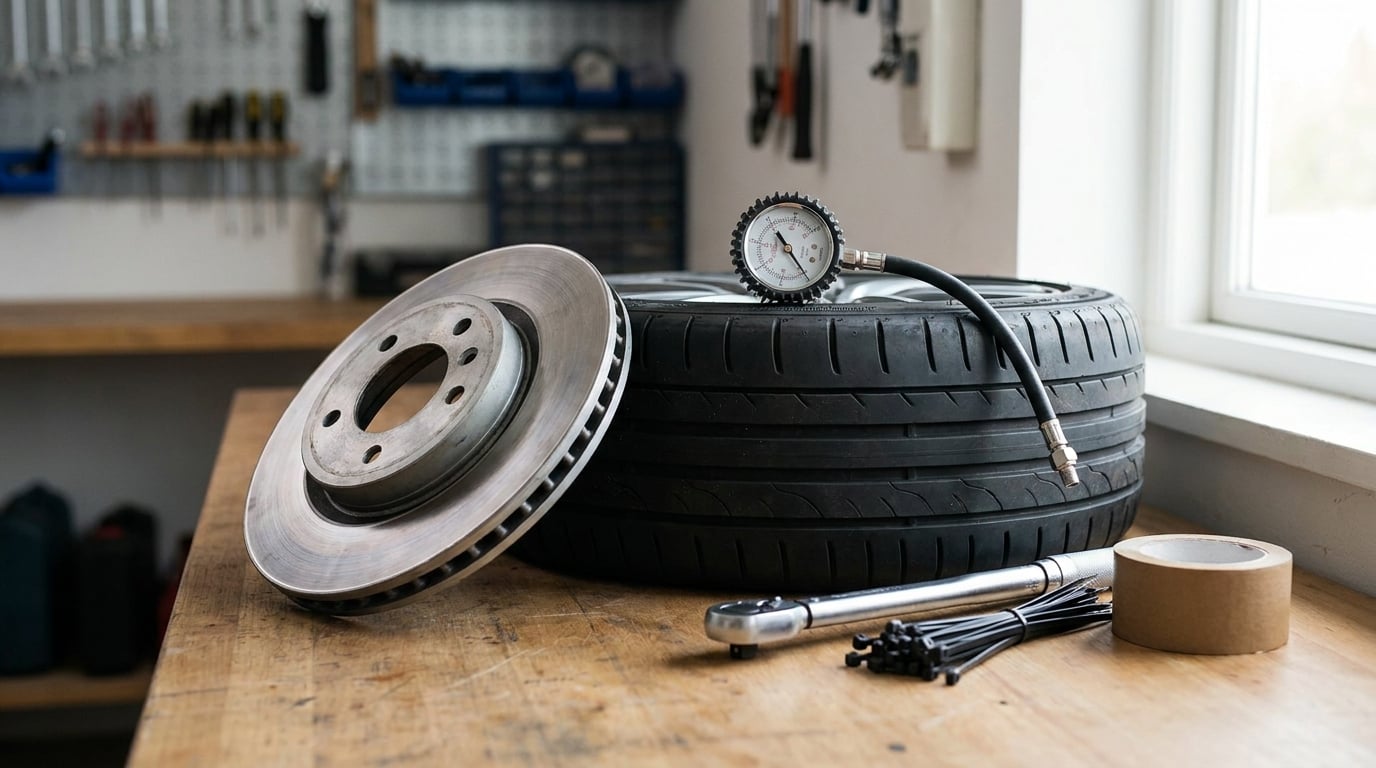
Learning how to prepare your car for a track day comes down to one idea: add margin before the session starts. A road car that has been checked end to end, running correct cold tire pressure, fresh brake fluid, real pad material and tight wheel fasteners, gives you a car you can trust when the limit arrives. Work through the sequence below in order, and you will either pass technical inspection or know exactly which item to fix before the event date.
Most first-timers underestimate the load. Twenty minutes of hard lapping generates brake temperatures and tire temperatures that your car never sees commuting to work, and the components that give way first are usually the ones that were already tired. Start your work a few weeks ahead so that anything you find has time to be replaced properly.
Table of Contents
What You Need
Preparation needs a handful of things, and none of them are expensive. You need the car’s own documentation, the event’s rule book, a proper tire pressure gauge, a torque wrench, jack stands or lift access, the fluids your car specifies, and enough gear to handle a small failure without borrowing everything from a neighbour in the paddock.
- Documentation: the owner’s manual for the car, plus the event’s technical requirements and noise limits. The manual sets the specs; the organizer sets the rules. Where they disagree, the organizer wins.
- Inspection tools: a quality tire pressure gauge rated well beyond street pressures, a torque wrench covering your wheel fastener size, a flashlight, a tire tread depth gauge, jack stands rated for the car’s weight, and a wheel brace or breaker bar.
- Fluids and consumables: the correct engine oil, coolant, brake fluid specification for your car, and any fluid your car uses that you intend to top up between sessions.
- Basic repair tools: a socket and spanner set, screwdrivers, a trim removal tool, a utility knife, cable ties, gaffer tape, a small jack, and a wheel-nut socket that matches your car.
- Emergency equipment: a fire extinguisher if your car lacks one, a spare key, a tire repair kit or spare wheel if the car has room for one, a tow strap, and reflective markers.
- Sundries: gloves, a hat, sunscreen, earplugs, spare clothes, water, food, and a way to safety-wire your key fob. Track driving is far more physically demanding than most people expect, and you will be glad of the dry shirt on the drive home.
Bring a smaller kit than you think. GP Days, a UK track operator, points out that other participants will help you when something goes wrong, so a mobile workshop in the boot is unnecessary weight. A gauge, a torque wrench, cable ties and gaffer tape cover the overwhelming majority of real problems.
Step-by-Step: How to Prepare Your Car for a Track Day
The sequence below runs from paperwork and visible faults through to a road test, because each stage only makes sense once the earlier ones are settled. Do not skip ahead to the fun parts.
1. Review the track requirements and inspect the car
Read the event rules first, before you touch a spanner. They tell you which safety equipment is mandatory, whether noise limits restrict your car, what tire condition the organizer accepts, whether a technical inspection is required, and how early the paddock opens.
Then walk around the car. Look under it on the ground for fresh fluid, check the tire sidewalls for bulges or cuts, confirm the battery is secure, and look for anything loose under the bonnet. Start the engine and note every warning light, unusual noise or smell. A warning light you have never seen before is a reason to stop and diagnose, not a reason to drive to the event and hope it clears.
If a car requires an inspection, the term tech inspection means a person checks specific items and signs a form before you are allowed on track. It is a mechanical and safety check, not a judgement of your lap times.
2. Check and service the braking system
Brakes take the single hardest abuse in track driving, and brake fade — the loss of stopping power when fluid and pads get too hot — is the failure most likely to end your day. Look at pad thickness through the caliper opening, check the rotor surface for deep scoring, cracking or a lip at the edge, and confirm the fluid level sits between the minimum and maximum marks in the reservoir.
Track use heats fluid well past what daily driving does. Specify the fluid your car requires, commonly DOT 4 or DOT 5.1, and replace it if it is more than about two years old or if you do not know when it was last changed. Old fluid absorbs moisture, and moist fluid boils at a lower temperature. Never mix incompatible fluid types, and never top up a reservoir with a different specification without draining it first.
Check the lines and hoses for weeping, and confirm the caliper hardware is present and tight. A sensible pre-track baseline is pads with roughly half their material left and fluid under two years old. If pad condition is unclear to you, have a qualified technician inspect it rather than guessing.
3. Inspect tires, wheels, and suspension
Tire pressure is the number most often quoted badly, so use a real starting range and verify it against your own car’s placard. Here is the consensus range for a typical road-going car at a beginner or intermediate event, stated in both unit systems:
| Car class | Starting cold pressure | PSI equivalent | Notes |
|---|---|---|---|
| Standard road car | 2.0 to 2.3 bar | 29 to 33 PSI | Where most first-timers should start |
| High-output road car | 2.3 to 2.4 bar | 33 to 35 PSI | Owners of cars like the Mercedes-AMG C63 cite around 34 PSI |
| Track-prepared car | 2.4 to 2.6 bar | 35 to 38 PSI | Set by tire compound and track temperature |
Why lower at all? Tire pressure climbs as the air inside heats under hard driving, and a tire that starts at a soft street pressure ends up over-inflated and hot at the limit, where grip is worst. Set the pressure cold, before the car moves, and log it.
Now check the tires themselves. Look for cracking in the sidewalls, bulges, exposed cords, and any object still lodged in the tread. If the tires are older than about six years, replace them regardless of remaining tread, because rubber hardens with age. Use the same tire and compound on all four, or at minimum the same on each axle, and never mix a very worn tire with a nearly new one on the same axle.
Check the wheels for curb rash and cracks, and torque each one to your car’s specification with a torque wrench. Over-tightening stretches the studs and can damage the wheel, so the wrench matters as much as the number. Then load the suspension: rock the car and listen for clunks, rattles or knocks over the dampers.
4. Check fluids, cooling, and engine condition
Confirm engine oil sits between the marks on the dipstick with the car on level ground, and check whether the interval is close to due. Note the mileage so you can change it after the event. Check coolant level in the radiator or expansion tank, look at the fluid’s color, and inspect the hoses and radiator for weeping or damage. If the car has a power steering fluid reservoir, check that too, along with transmission and differential oil where fitted.
Look underneath again for damp patches, and remember that a small oil weeper on a high-mileage BMW is worth knowing about. Our guide to how to check for engine oil sludge in your BMW covers the signs and the check itself.
Heat soak is what gets cars in trouble late in a session, so a restricted radiator or weak fan shows up as rising temperature rather than a dramatic failure. Note any overheating clues from the gauge, and never open a cooling system that is hot.
5. Protect the car and prepare the driving area
Track use means debris: rubber marbles, stone chips, a bottle that has escaped its cage. Fit radiator and grille protection if your car uses a removable mesh, and make sure anything you add is securely fastened so it cannot become a projectile itself.
Inside the car, remove the loose items. Take out the floor mats or secure them so they cannot slide, empty the door pockets, clear the passenger seat, pull sunglasses and a phone mount off the dash, and check under and behind the seats. A water bottle in the footwell under heavy braking becomes shrapnel, and this is the single most common piece of advice repeated across every forum thread on the topic.
Keep the battery secure, and follow the practice described on the N2 forum of safety-wiring the key fob so it stays put in the paddock. Strap your spare key and any loose equipment in the car so it cannot move during braking.
6. Perform a final shakedown and document the setup
Take the car on a proper road drive before the event and feel everything: the brake pedal, the steering, the throttle response, the gear selector, the lights, the gauges, and the cooling fans. A hot check on the driveway catches almost nothing; a 30 minute drive with varied speeds catches plenty.
Then write it down. Record the cold tire pressures per corner, the torque value you used and whether the wrench clicked or needed a second pull, the fluid levels, the mileage, and anything you replaced. That record turns the next event into a five-minute comparison instead of a fresh guess.
Between sessions, repeat the checks. A Porsche Club GB track day guide puts it plainly: fluids, tire pressures and wheel nuts must be re-checked, because they will not be what they were several hard driving hours ago. The FerrariChat prep thread gives the same advice from the other direction, bring a gauge and a torque wrench and check the wheels before every session. Nobody in the blog guides covers this habit, and it is the one that saves a session.
Common Mistakes
Most track day problems trace back to one of a handful of avoidable errors. Here they are, with the correction.
- Ignoring the event rules until the paddock. Noise limits, mandatory equipment and inspection requirements are set by the organizer, and a car that fails the rules is a car that does not get a session. Read the rule book a week ahead.
- Running worn or mismatched tires. A tire old enough to show age cracking or down to the wear bars will not survive a track session. Fit four tires of the same type and compound, and respect the minimum tread the organizer specifies.
- Judging brakes by eye alone. Appearance says nothing about fluid condition or the pad compound’s heat tolerance. Check thickness properly, and treat brake fluid age as a hard limit.
- Over-tightening wheel fasteners. More is not safer. Torque to the car manufacturer’s specification and stop.
- Neglecting fluids. Low coolant or old brake fluid has no second chance when the car is already at speed. Top up before the event, not during it.
- Driving to the event with a warning light on. A car that arrives with a fault may be refused, and a fault that appears at speed is a far worse place to diagnose it.
- Leaving the gear at home. A gauge, torque wrench, basic sockets, cable ties and gaffer tape cover almost everything. People borrow from neighbours in the paddock, but do not plan on it.
- Changing the handling setup days before the event. New dampers, alignment changes or tire changes at the last minute mean you meet the car for the first time at speed. Any setup change deserves its own shakedown drive, ideally a week clear of the event.
Two more things worth knowing. Road insurance is generally not valid once the car is on a circuit, so most organizers require separate track-day cover, and a lot of first-timers only discover this at registration. And for a beginner event, a sound road car in good mechanical order is enough. You do not need a roll cage, a race harness, a firewall, fire suppression or a wind-tunnel setup to take your first session; those belong to competition, not to a day at the track.
Frequently Asked Questions
How early should I arrive for a track day?
Arrive when the organizer opens the paddock, which is usually one to two hours before the first session. That gives you time to register, complete a technical inspection if one is required, set tire pressures cold, walk the track and find the braking boards. Arriving during the first session usually means sitting in the car park until the following group, or missing your group entirely if registration queues are long.
Are street tires safe to use at a track day?
For most beginner and intermediate events, yes, provided they meet the event minimum tread and have no sidewall damage, bulges or age cracking. Use them with cold pressures set for the hot condition, around 2.0 to 2.3 bar (29 to 33 PSI) for a typical road car. Confirm the organizer’s stated minimum, since some venues set a higher bar for insurance or noise reasons.
What condition must my brake pads and rotors be in?
Pads should have roughly half their material remaining, be free of glazing and uneven wear, and sit well clear of the minimum thickness mark. Rotors should show no deep scoring, cracks or a pronounced lip at the edge, and should measure above the minimum thickness stamped on them. Fluid should be the specification your car requires and under about two years old.
What tools and spare parts should I bring?
A good tire pressure gauge, a torque wrench with the correct socket, a small socket and spanner set, a wheel nut tool, cable ties, gaffer tape, gloves, a flashlight, a tire repair kit, a spare key, a fire extinguisher if the car has none, and a small amount of water and food. Add sunscreen, a hat, earplugs and spare clothes. Other participants in the paddock will usually help if something fails.
Should I inspect my BMW with a mechanic before the event?
If you are not confident judging pad thickness, rotor condition or fluid age yourself, have a qualified technician look at the car first. It is a modest cost against replacing a damaged suspension component after an off. Bring the technician’s notes to the event, since they also help you answer questions during the technical inspection.
What should I do if a warning light comes on at the track?
Stop driving, switch the ignition off and let the car sit for a few minutes, then note which light appeared and when. Tell the event staff or a track marshal rather than moving the car yourself. If the car cannot be diagnosed on site, most organizers will let you collect it and take it home, but a car with an unresolved fault should not rejoin a session.
Conclusion
There is a safe order of operations: read the event rules, inspect the car early enough to replace anything worn, treat the brakes and tires as the priority, top up every fluid, torque the wheels to spec, clear the cabin, then shakedown and record the setup. Arrive with the equipment the organizer requires and a toolkit that covers the common failures.
None of the pressure figures or fluid ages in this guide override what your car manufacturer specifies. Follow the manual and the event’s technical rules, and where a measurement is beyond your judgement, pay a qualified technician to look. That is a far better weekend than finding out at speed.