
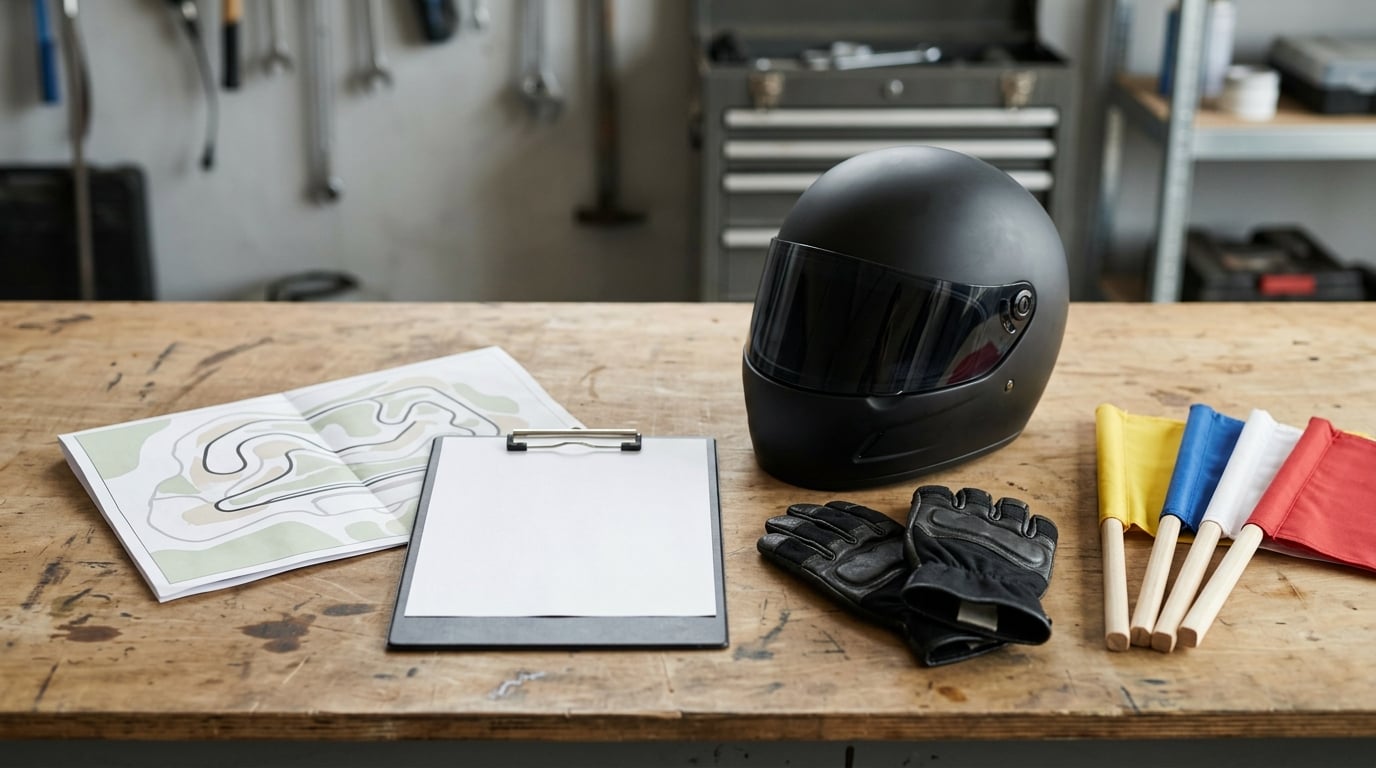
Learning how to read flags at a track day takes about twenty minutes of study and saves you from a long afternoon in the pits. Marshals hold colored flags that tell you the track is clear, warn you about a hazard ahead, order you back to the pit lane, or end the session. Every signal has one correct response, and the response is a command, not a suggestion.
The part most guides skip is where to look and what to do in the three seconds after the flag appears. That’s the difference between a driver who reacts and a driver who guesses. The rest of this guide walks through the flag set, the decision sequence, and the recovery when you miss a signal entirely.
Flags are the only reliable way to know about a stopped car, fluid on the racing surface, or a session stop when you can’t see the problem yourself. Ignoring one is the fastest way to cause a collision or get removed from the event.
What You Need
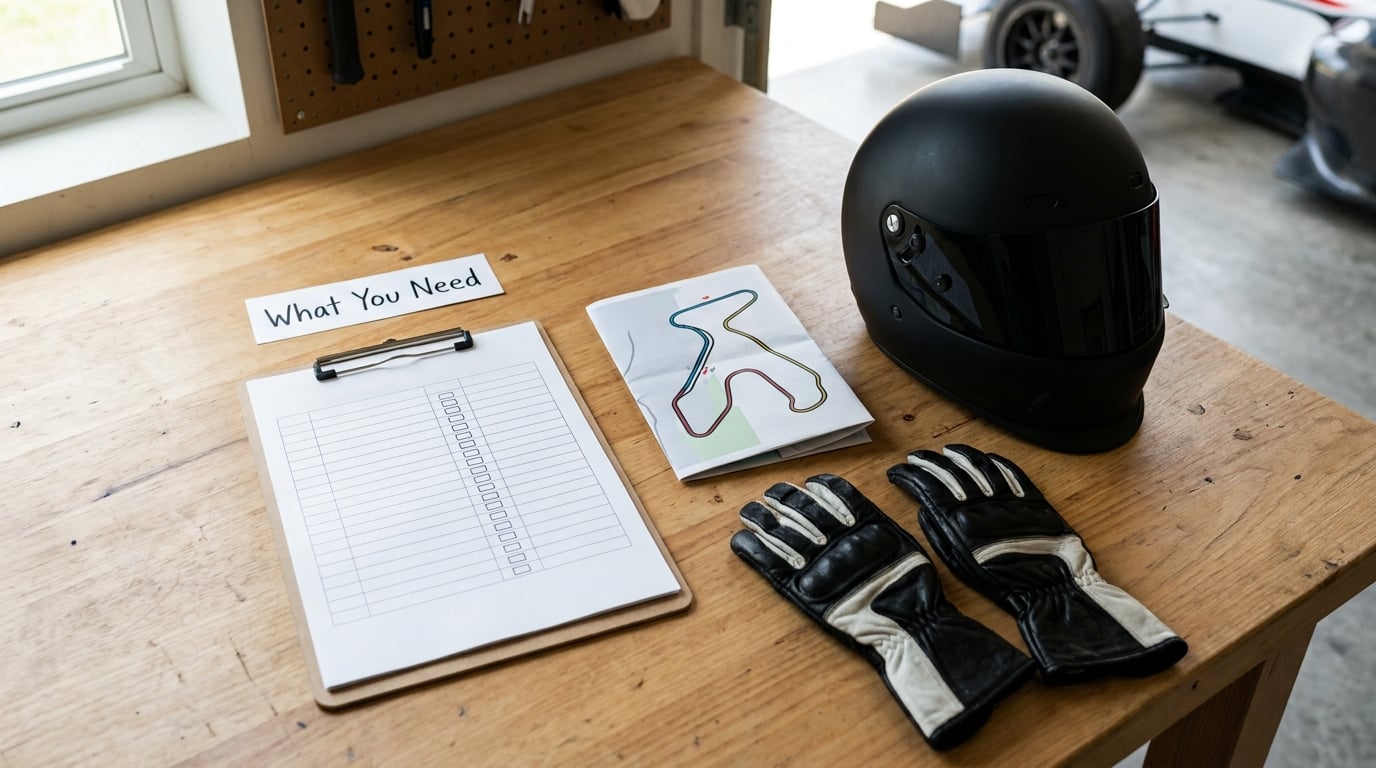
You don’t need equipment to read flags. You need preparation, and most of it happens before you ever turn a wheel.
The mandatory drivers’ briefing
Every event runs a briefing, and it is not optional. Organizers cover the local flag set, run group structure, pit lane speed limit, and any track-specific variation such as a black flag used for a session stop instead of red. If a track does something differently from the rulebook, the briefing is the version that applies.
A track map with the flag stations marked
Ask the organizer for a map, or walk the pit lane and look for the flag posts. Flag stations sit just before the corner they protect, which means a flag goes up early enough for you to act on it before the hazard. Knowing the layout tells you which post controls which part of the lap.
A printed cheat sheet for the car
Print the table below and keep it in the glove box, or set your phone lock screen to a photo of it. Reading a reference at pit exit is far better than learning a flag system mid-corner. This is the single most useful thing you can bring to a track day.
A helmet, gloves, and a car worth sending out
Standard safety gear, and a car that has been checked over. Most black flags at a track day are mechanical, and the usual culprits are brakes, tires, and fluid levels. If you want to avoid learning the black flag on your first outing, walk through how to read a torque spec chart for your wheel fasteners and have a look at how to read oil bottle labels and certifications so you know the fluid spec before the day rather than in the garage queue.
Step-by-Step
Here is the sequence: find the flag station, identify the color, translate it into a move, then verify the track before you speed back up. Rushing step four is how a green flag turns into a meeting with an instructor.
Step 1: Know Where the Flags Are Used
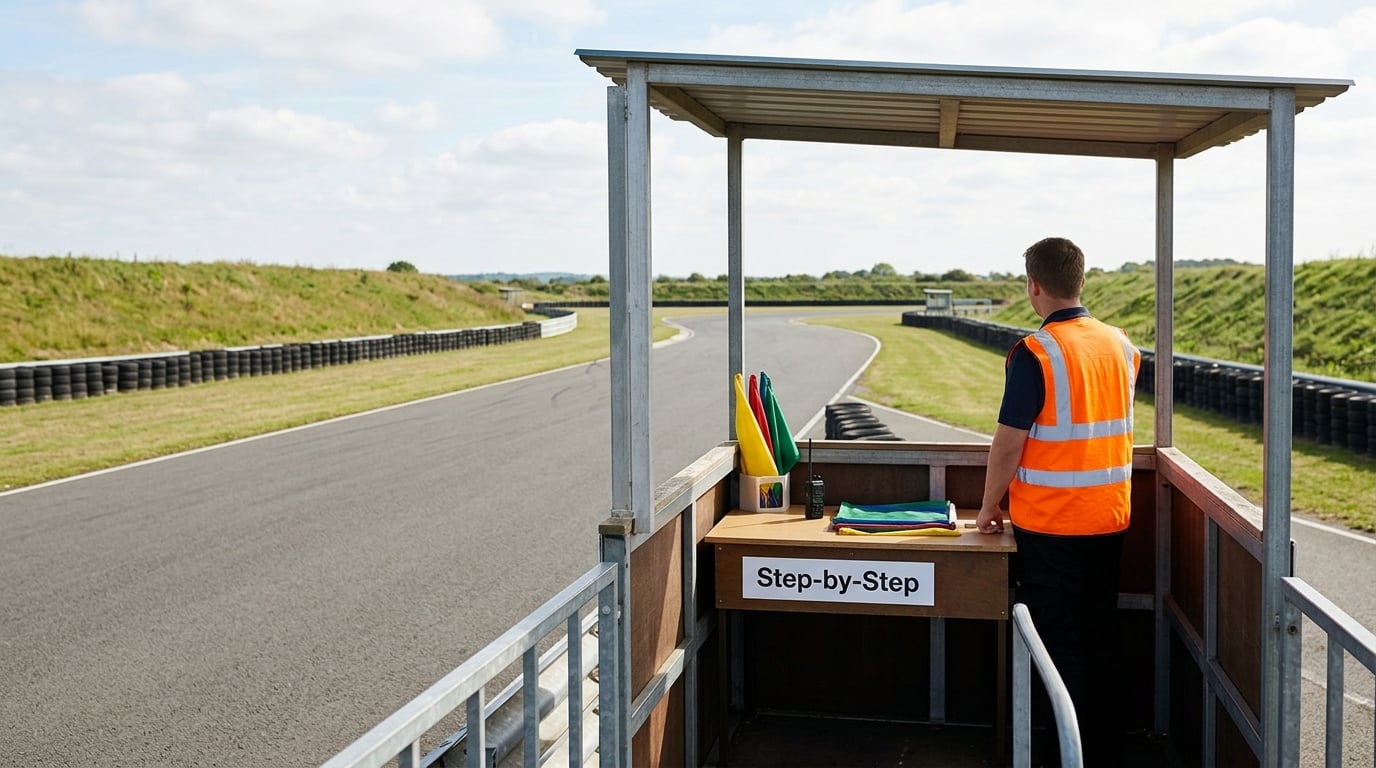
Track marshals, also called corner workers or flagmen, stand at fixed posts around the circuit. Most tracks have a flag stand at start and finish, a starter who handles the session start, and marshals posted at corner exits and entries. A separate control tower or race control issues the session-wide instructions, sometimes through a trackside light panel instead of a physical flag.
Incident response vehicles work the same way. If a car stops between two posts, the nearest marshal shows the warning and control repeats it so the whole lap gets the message. That repetition is why a yellow can still be up at the next corner after you passed the hazard.
Step 2: Recognize the Most Common Color Flags
This is the reference table. Every flag a beginner is likely to see, what it means, and the specific action it requires.
| Flag | What it means | What you do |
|---|---|---|
| Green | Track is clear and running | Resume normal speed; the caution has ended |
| Yellow | Caution, hazard ahead on this part of the track | Slow to a safe speed, do not overtake, be ready to stop |
| Double yellow | Serious or extended hazard ahead | Reduce speed significantly and prepare to leave the track |
| Red | Session stopped, danger to drivers | Stop at the first safe place and follow marshal directions |
| Blue | Faster car approaching from behind | Let the faster driver pass at your earliest safe opportunity |
| Black | Return to the pit lane, stop and await instructions | Reduce speed, enter the pit lane without going past the pit exit |
| Meatball (black flag with orange circle) | Mechanical problem or unsportsmanlike conduct | Enter the pit lane immediately and park where instructed |
| Checkered (black and white) | Session is over | Complete a slow cool-down lap and return to the pits |
| White | Slow vehicle, ambulance, or service vehicle on track | Slow down and be prepared to let it pass |
| Red and yellow striped | Slippery surface, oil, fluid, or debris | Reduce grip expectations, smooth inputs, avoid the racing line |
A standing yellow and a waved yellow are the same hazard with different urgency. Waved means the problem is closer and you should be off the throttle sooner. Double-waved is worse again. Treat motion as urgency, not as a different instruction.
Step 3: Respond According to the Flag’s Instruction
Each flag maps to one concrete action. Green means accelerate back to normal through the corner, not at the next corner. Yellow means reduce speed, hold your line off the racing line, and do not pass. Red means stop where you are safely, pull to the edge if the marshal points you there, and stay put until the session restarts. Blue means yield, using the track day point-by system. Black and meatball mean the pit lane, and red and yellow striped means a slippery surface.
For blue flags in a point-by run group, the responsibility is shared. The passing car initiates with the left arm out of the window and holds it there. The car being passed keeps a steady line, does not move toward the racing line, and does not accelerate to defend. Waving the passing car through when there’s a gap is optional courtesy; waving when there is no gap is dangerous.
Step 4: Check for a Repeated or Changed Signal
A flag is held until the situation changes, so the first signal is rarely the last one. Keep watching the flag posts as you drive away from a hazard, because the yellow can follow you around the lap and control may keep it up until the recovery vehicle has cleared the scene.
Two flags at once are common, and the order of priority is simple. Red beats everything. Then caution flags like yellow and double yellow, because a hazard near you outranks a car further away. Then blue, which is only ever about a car behind you. Drivers ask about this constantly, and the honest answer is that if red and anything else are up at the same time, you stop.
Step 5: Use the Track’s Rules for Sport and Formation Flags
A few signals belong to organized racing rather than a normal track day: the full course yellow, the safety car and virtual safety car boards, and Code 60 pace notes. Most public track days run without a safety car, so you probably won’t see them. Pace notes, formation boards, and final-lap signals are the ones that do turn up, and they vary by track.
Treat every one of these as track-specific. A club that uses black to stop a session instead of red is not wrong, and a flag waved with a different rhythm than you’re used to might mean something local. The briefing and the posted instructions beat anything you read online, including this guide.
Step 6: Confirm the Situation Before Resuming Speed
A green flag at one post clears the hazard that post knows about, not the whole lap. Look ahead for more flags, check the mirrors for cars still bunched up, and make sure the car that stopped is genuinely gone before you get back on the throttle. On a cool-down lap, stay below session speed the whole way back.
If you genuinely missed a flag, don’t guess and don’t rejoin mid-corner. Complete the lap, enter the pit lane, and tell the marshal or your instructor what you saw and where. Marshals respond well to a driver who self-reports, and it takes ten seconds. A driver who lies about it or argues about it costs far more of the session.
Common Mistakes
Overtaking under a yellow. This is the big one. Passing on a caution is how a stopped car gets hit. Fix: lift, move off the racing line, and rejoin only when the track is clear or the session is under green.
Stopping in the middle of the racing surface. If a red flag appears, drivers panic-stop where they are. A stopped car in the middle of the corner is itself the hazard. Fix: brake in a straight line toward the outside edge, follow the marshal’s pointing, and set the hazards on.
Treating a waved flag as a standing flag. Motion is information. A waved yellow means the hazard is imminent, so the appropriate response is earlier, more braking, and more distance. Drivers who read a waved flag as a standing one arrive at the hazard too fast.
Forgetting to acknowledge a black flag. Wave at the flagman or raise a hand briefly so they know you’ve seen it, then take the next opportunity to come in. Not acknowledging a black or meatball flag is a fast track to a missed session.
Deferring to another driver’s read on a flag. The person in front of you may have seen a different post, or missed it. The marshal is the authority, not the car ahead. Fix: read the flags yourself and make your own call.
Skipping the briefing and learning flags from a list online. Flags are close to universal, but not identical everywhere, and a briefing costs twenty minutes. Skipping it to get into the queue first is a bad trade.
Frequently Asked Questions
What do the different flags on a racetrack mean?
Green means the track is clear. Yellow and double yellow warn of a hazard ahead, so slow down, do not overtake, and be ready to stop. Red stops the session. Blue means a faster car is behind you. Black or the meatball flag orders you to the pit lane. Chequered ends the session and starts a cool-down lap.
What is a black flag on a track day?
A black flag tells you to leave the track and return to the pit lane at pit lane speed, without passing the pit exit. Once you arrive, park where instructed and wait for the track official. A black flag with an orange circle, called the meatball, means a mechanical problem or unsportsmanlike conduct, and requires the same immediate pit entry.
How many laps do you have to respond to a black flag?
Most events allow one or two laps, which is enough time to complete your current lap and enter the pits. Some tracks set a specific limit and display it in the briefing or on a pit board. Because the limit varies, acknowledge the flag with a wave and take the first safe opportunity to come in rather than counting laps.
What should I do if I miss a yellow flag?
Do not brake suddenly or swerve on track. Finish the lap at a reduced speed, enter the pit lane, and tell the marshal or your instructor what you saw and where. A self-report takes a moment and is treated far more lightly than a flag you ignored on purpose, and it tells the officials the flag may need re-signalling.
Are track day flags the same as race flags?
The color meanings are the same, but the set in use is smaller. Most track days have no safety car, so full course yellow, virtual safety car, and Code 60 pace notes do not appear. Race weekends also use more boards, light panels, and timed penalties. A few clubs use a black flag where a race would use red, which is why the briefing matters.
What are the people holding the flags called?
They are flag marshals, also known as corner workers, flagmen, or marshals, and the post they stand at is a flag station or marshalling post. A race official at the start and finish line is the starter. At a track day, the people in orange or green vests are volunteers, and listening to what they tell you matters as much as reading the flag.
Conclusion
Attending the drivers’ briefing, memorizing the local flag rules, and identifying where each flag station sits are the three things to do before you ever join a run group. From there, treat every marshal signal as a command: a flag means slow, don’t pass, stop, or come in, and the correct response is immediate and calm.
Print the table above, keep it in the car, and check your brakes, tires, and fluids so a mechanical black flag is the one you only read about. That’s track etiquette in practice, and it’s the difference between a driver people will give room to and one they’ll black flag.