
The new driver mistakes to avoid come down to a short list of habits: sitting badly, staring only at the road ahead, following too closely, braking late, skipping blind-spot checks, and driving while tired or distracted. Fix those and most of the risk in your first year disappears.
I have watched a lot of new drivers get into trouble in the first few months, and the pattern is almost always the same. The car is quiet, smooth and full of assistance systems, so it feels far more capable than the person behind the wheel. Skills like judging a gap, reading a corner or spotting a hazard three seconds early are still unbuilt, and the car gives no feedback at all until something goes wrong.
That gap between how capable the car feels and how experienced the driver is produces every common driving mistake beginners make. Some come from a skill deficit, some from overconfidence, and some from simply not knowing how a car behaves. Naming which is which is the first step to correcting them.
Table of Contents
- 12 New Driver Mistakes to Avoid at a Glance
- 1. Driving With an Improperly Adjusted Seat
- 2. Looking Only at the Road Directly Ahead
- 3. Following Too Closely
- 4. Speeding Up in Unfamiliar Conditions
- 5. Braking Too Late or Too Hard
- 6. Taking Corners at the Speed Limit
- 7. Failing to Check Blind Spots
- 8. Shifting Gears Abruptly or in the Wrong Order
- 9. Ignoring Tyre and Brake Condition
- 10. Driving While Distracted
- 11. Not Using the Safety Features and Equipment Correctly
- 12. Continuing When Conditions or Visibility Deteriorate
- Frequently Asked Questions
- Conclusion: Practice One Habit at a Time
12 New Driver Mistakes to Avoid at a Glance
This table pairs each mistake with the risk it creates and the correction you can practise on your next low-risk drive.
| Mistake | Risk it creates | Quick fix |
|---|---|---|
| Seat not adjusted before moving off | No pedal reach, poor visibility, belt sitting on the neck | Set seat, then belts, then mirrors, then controls |
| Looking only straight ahead | Late detection of a hazard in the next lane or at an intersection | Scan forward, mirrors, blind spot, forward, every 5 to 8 seconds |
| Following too closely | Rear-end collision when the car ahead stops harder than expected | Two seconds in the dry, four in the wet |
| Matching traffic speed blindly | No time to react or stop when conditions change | Set your speed to what you can see, not what the car beside you does |
| Braking late or stomping the pedal | Lost control, no steering, abrupt load on tyres and pads | Lift off early, brake smoothly, save emergency braking for real emergencies |
| Taking corners at the limit | Understeer wide or spin, both of which end badly | Slow before the turn, accelerate only once the car is straight |
| Skipping blind-spot and shoulder checks | Changing lanes into an occupied space | Mirror, signal, shoulder check over the shoulder, then move |
| Rough gear changes and idle throttle | Jerks that unsettle passengers, wear on clutch and gearbox | Feed the throttle in, brake to a stop, select gear only when stationary |
| Ignoring tyre or brake warning signs | Blowout, loss of braking, aquaplaning in rain | Check tread and pressure monthly, get a soft pedal or grind looked at |
| Driving while distracted or drowsy | Micro-sleep and missed hazards, often at motorway speed | Phone away and out of reach, break every two hours |
| Misusing safety equipment | Assistance features mask a real hazard; illegal light use | Understand what each system does before you rely on it |
| Driving on when visibility is gone | Stopping far beyond the distance you can see | Slow down, increase the gap, use the right lights, stop if it is unsafe |
1. Driving With an Improperly Adjusted Seat
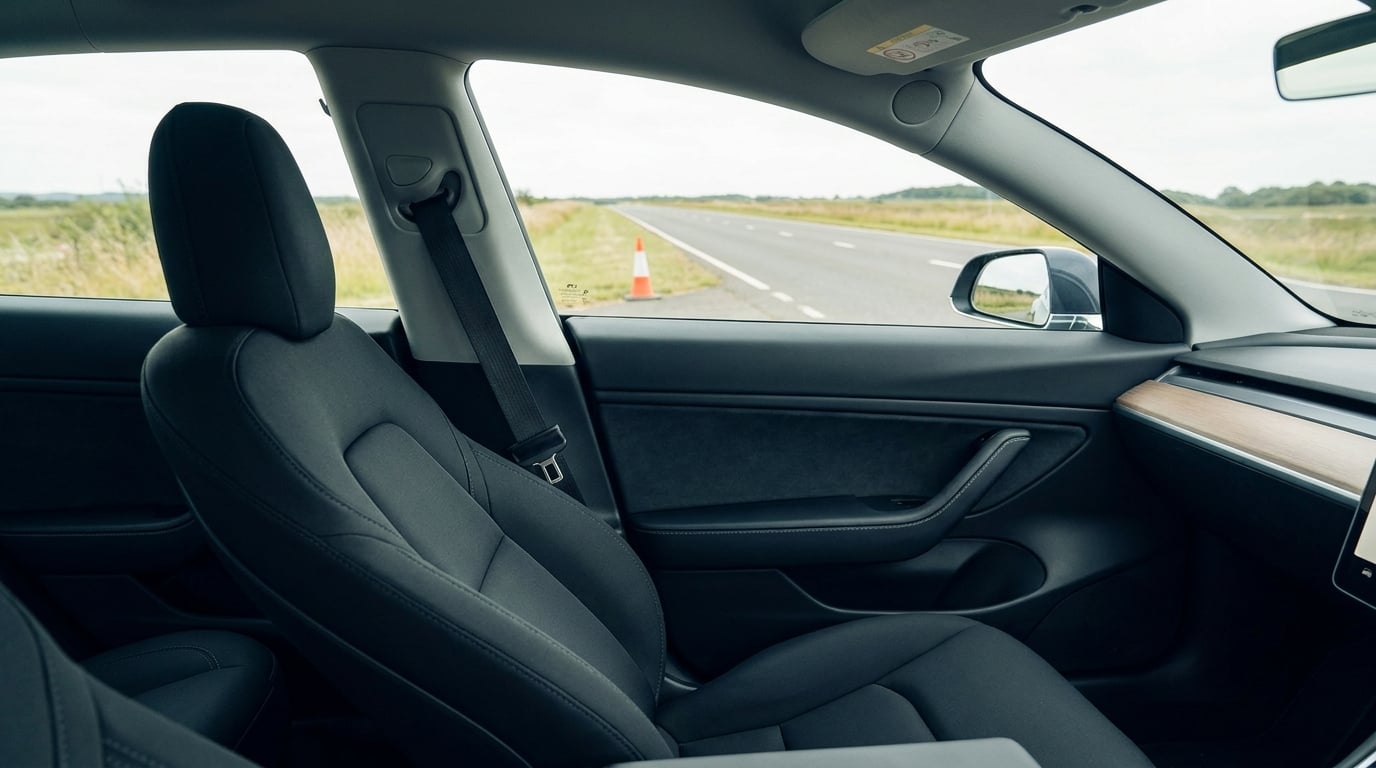
An unadjusted seat is the cheapest mistake on this list and the one that quietly ruins everything else. If your legs are too long, your knee locks near the pedal but your foot is not bent, and you brake with your leg instead of your ankle. If you are too close, you cannot slide back to look over your shoulder without leaning.
Set the seat first, then the belt, then the mirrors. With the seat right, your back should touch the seat back with room for your knees to be slightly bent when fully pressed, your arms bent when your hands sit at nine and three, and your head comfortably supported without tilting forward.
Check the belt next. The lap section sits low on the hip bone, not across the stomach, and the shoulder section runs through the middle of your collarbone and your shoulder, never against the side of your neck. If the belt cannot reach that position, the seat is wrong, not the belt.
Only then adjust the mirrors, which is section two.
2. Looking Only at the Road Directly Ahead
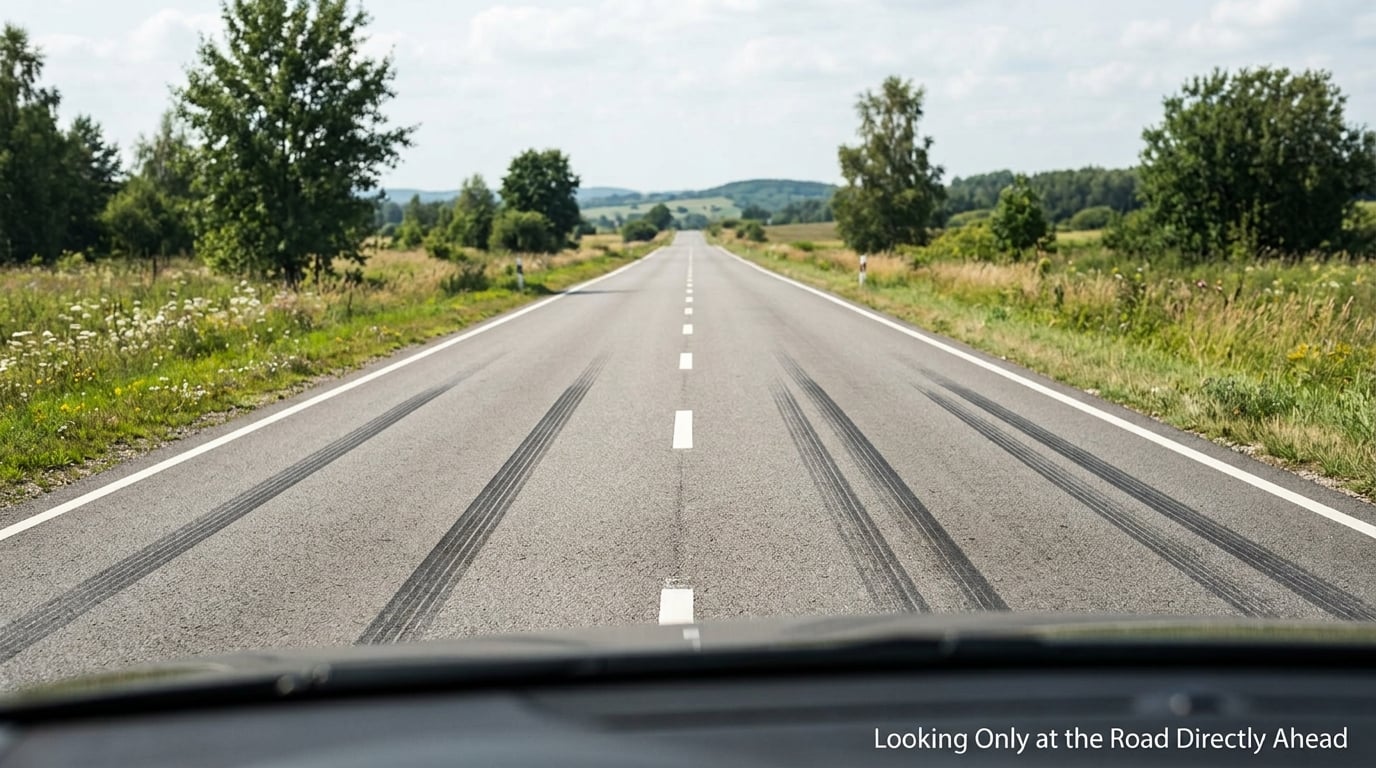
New drivers stare at the road about ten feet ahead of the bonnet because early on, that is the only place they can process anything. The problem is that everything dangerous happens outside that narrow cone, and it happens while you are looking elsewhere.
Build a scanning pattern instead. Look well down the road, then the interior mirror, then the side mirrors, then forward again, and repeat it every five to eight seconds. It becomes automatic after a few hours of conscious effort.
That pattern pays off at intersections, where you need each approaching direction rather than the one you are stopped in. It also pays off when a car in the lane ahead starts to move or a wheel comes loose, both of which are visible in a mirror long before they are visible directly.
Veteran drivers on driving forums put it bluntly: stay in the lane people expect you to be in, and use your mirrors to build the picture you cannot see by looking.
3. Following Too Closely
Tailgating is the single most common new driver error, and it usually comes from a good intention. Beginners are anxious about being rear-ended, so they park themselves as close to the car in front as possible, where any impact is trivial, instead of keeping enough space to escape one entirely.
Use the two-second rule as a minimum in the dry. Pick a fixed point on the road, a bridge or a sign, and count the seconds until the car ahead passes it. Two seconds gives you room to react and stop. In rain, double that to four seconds, and use more in fog, darkness or anything that reduces how far you can see.
Scaling matters too. A gap that is comfortable at town speeds is nowhere near enough on a faster road, where the same two seconds covers a much greater distance and stopping takes longer. If you cannot see the road surface beyond a car’s rear wheels in bad conditions, you are too close.
4. Speeding Up in Unfamiliar Conditions
The pressure to keep pace with the traffic around you is real, especially as a new driver. The car in the lane beside you is doing 60 in the rain, so matching it feels like the safe choice. It is not.
Speed decides how much distance you need. Double your speed and your reaction distance roughly doubles, braking distance grows faster than that, and a road surface that felt solid at 30 can be slick at 50. Set your speed to what you can actually see and what the road will hold, then let the other driver go.
New drivers also tend to carry too much speed into the unfamiliar and carry too little into the familiar. A road you have driven twice is not yet a familiar road. Reduce speed for rain, standing water, darkness, roadworks, narrow streets, and any junction where you cannot see far enough to stop within what you can see.
5. Braking Too Late or Too Hard
There are two braking errors and beginners swap between them. The first is braking late, which happens because you are still looking at the car ahead rather than at the road beyond it. The second is braking hard, which happens when braking late turns into braking late and hard.
Scan ahead and release the accelerator early. As your speed drops, press the brake progressively rather than immediately, and keep the pressure steady until you are at the speed you want. That loads the front tyres in a controlled way and leaves the steering responsive. An emergency stop will still lock the front wheels under braking, and the pedal will feel like a pulse rather than a hard stop.
Smoothness also protects the car. Repeated heavy stops chew through pads and discs, and slamming the brake at every junction is a good way to find out what your pads sound like before anyone warns you.
6. Taking Corners at the Speed Limit
A corner is a negotiation between speed and grip, and tyre grip is not the same on every corner. Damp patches, painted markings, drainage ironwork, gravel and fallen leaves all change the surface, and a bend that held fine yesterday can be a different corner today.
Slow before the turn rather than during it. Brake while the road is still straight, down to a speed at which you could take the corner on a surface slightly worse than the one you see. Turn in, hold a steady steering angle, and only start adding throttle as the car comes straight.
Coming out too fast is the more common version of this mistake, because the corner has already been survived and attention moves on. Aim to leave the bend slower than you would want to, and treat a corner you cannot see through as a corner you take slower still.
7. Failing to Check Blind Spots
Mirrors tell you what is behind you. They do not tell you what is in the space beside your shoulder, and that is exactly where a cyclist, a motorcyclist or a car overtaking on the inside will be when you move across.
The sequence is the same for a lane change, a turn, a merge, pulling away from the kerb or reversing. Mirror, signal, shoulder check over the actual shoulder, then move. The shoulder check is not optional and it is not a quick glance at the mirror; you have to turn your head far enough that you would see your own door if something were alongside it.
Do it every time, even when the mirror showed nothing. A motorcycle can occupy that blind spot in under a second, and the whole point of the check is that the mirror cleared a moment ago. The same applies at junctions, where a shoulder check before turning is what stops you cutting across a cyclist who filtered up the inside.
8. Shifting Gears Abruptly or in the Wrong Order
On an automatic, the gearbox is doing the hard part, but the footwork is still yours. The classic errors are carrying your foot partway onto the throttle while you coast, which creeps the car forward, and selecting reverse while still rolling, which jolts the car and can shock the drivetrain.
Put the car in park only once it is fully stopped, use the brake to hold it on a slope, and let the transmission settle before selecting drive. Give the throttle to the car gradually rather than pressing it and waiting for something to happen, and release it entirely when you are stopped rather than resting your foot on it.
On a manual, the errors are different but the lesson is the same. A sudden full-throttle change in a low gear spins the wheels and unloads the front, a late change bogs the engine, and riding the clutch at a junction stalls the car in front of everybody. Practise clutch control in a quiet car park before you practise anything else, and get each change done in one smooth movement.
9. Ignoring Tyre and Brake Condition
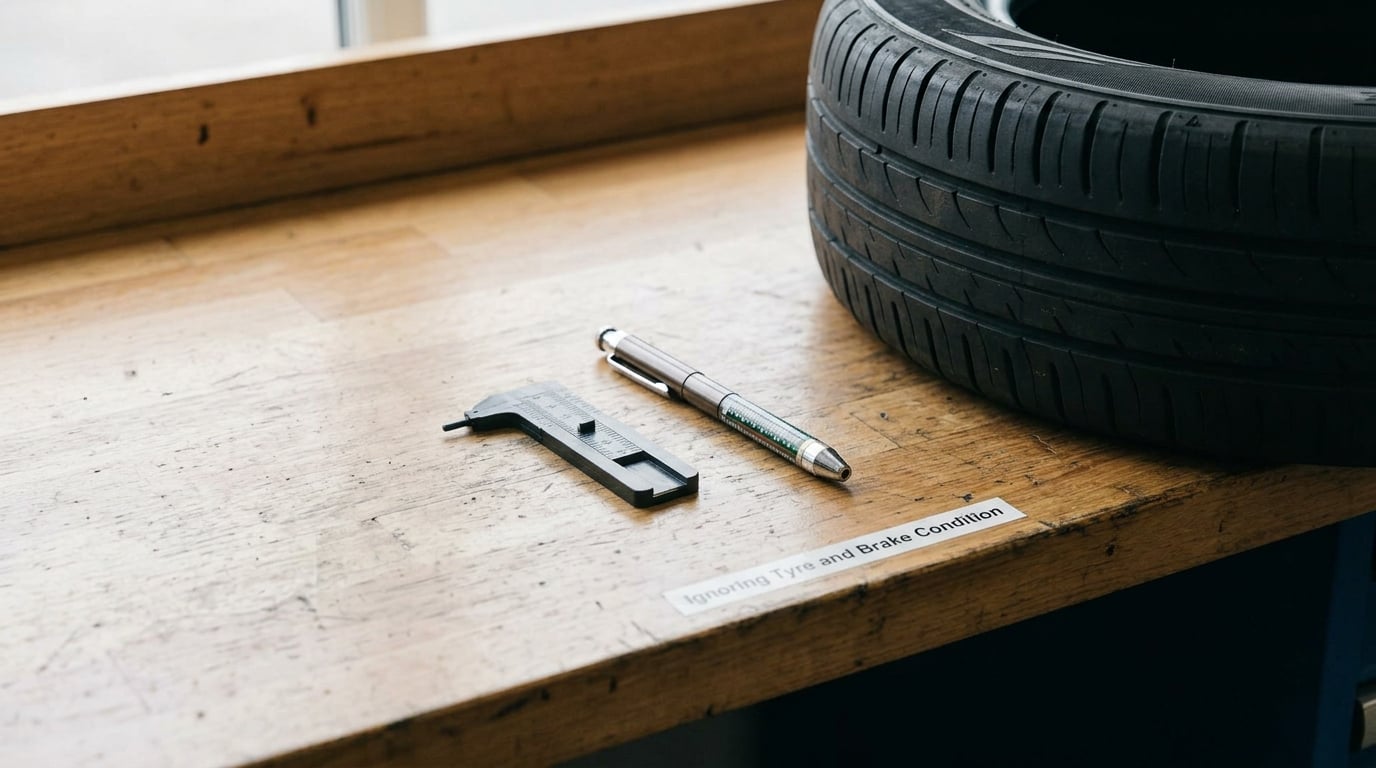
New drivers tend to treat the car as something that will simply keep working, which is exactly the assumption a used first car punishes. A handful of quick checks each month catches nearly everything that matters, and if you are comparing new tyres against worn ones, we have a guide on how much tread new tyres should have.
Look for worn tread, uneven wear across the wheels, and any sidewall damage. Feel for a soft pedal, which usually means air in the brake lines, and listen for grinding under braking, which is pad wear that needs attention before it becomes a bill. A vibration through the steering wheel or a car that pulls to one side under braking usually points at the tyres or the brake balance rather than anything you are doing.
Check cold tyre pressure monthly against the figure on the door jamb, not the sidewall maximum, and look at the oil level and the lights while you are out there. If you want to know which tool suits the job, the difference between an impact wrench and impact driver is worth five minutes before you borrow one.
10. Driving While Distracted
A phone is the obvious one, but the real threat is anything that pulls your eyes off the road for longer than a glance can be justified. Passengers, a music playlist, a satnav prompting a turn, and a rattling parcel on the back seat all count.
Put the phone out of reach and out of sight before you set off, not when you are already moving. Mount navigation before driving and set the route while stationary. Give passengers one clear instruction rather than a stream of nervous ones, and treat music as something you tolerate rather than something that competes for attention.
Fatigue is the distraction nobody plans for. A driver who is tired does not feel sleepy, they feel fine right up until attention lapses for a second or two, which is all a micro-sleep is. Take a break every two hours, and if you are yawning, drifting between lanes or repeatedly missing exits, pull over and sleep instead of pushing on.
11. Not Using the Safety Features and Equipment Correctly
Belts, mirrors, signals, lights and the assistance systems in a modern car all do specific jobs, and beginners often either ignore them or trust them too much. Seat belts should be worn every trip, even a two-minute one, because most fatal injuries happen on short journeys close to home.
Use your indicators before a turn, a lane change or pulling away, and keep using them through the manoeuvre. Headlights go on when visibility drops or when others cannot see you, not just at night. Hazard lights are for a stationary vehicle that is a hazard to traffic, not for a difficult junction.
Understand the driver assistance features your car actually has. Electronic stability control, traction control and adaptive cruise control are aids, not drivers, and each has limits. Stability control will not save you from too much speed for the corner, and adaptive cruise will happily hold a gap that is too short for the weather. Know what the car does not do as well as what it does.
12. Continuing When Conditions or Visibility Deteriorate
New drivers tend to treat rain, fog and darkness as small annoyances rather than changes in driving conditions. Rain reduces grip and adds stopping distance, fog cuts visibility to whatever you can see through it, and glare off wet tarmac or a low sun erases objects that are still there.
The response is always the same four steps. Slow down, because speed is what you can most easily give back. Increase the gap, because the road surface now needs more of it. Use the right lights, since dipped headlights in poor visibility help you be seen as well as helping you see. And if the visibility is genuinely bad enough that you cannot stop within what you can see, stop safely and wait for it to change.
Standing water is the one to avoid rather than manage. If the water is deep enough to hide the surface, back off the throttle to avoid aquaplaning, keep the steering straight and light, and let the tyres find a patch with grip before you try to change direction.
Frequently Asked Questions
What are the 10 most common mistakes new drivers make?
The ten most common mistakes new drivers make are: following too closely, driving faster than the conditions allow, braking late or hard, skipping blind-spot and shoulder checks, looking only at the road ahead, using a phone, sitting badly at the wheel, taking corners at the speed limit, driving while tired, and driving on when visibility has gone. Almost all of them are habit errors rather than knowledge gaps, which is why they are also the easiest to fix.
Is it normal for new drivers to make a lot of mistakes?
Yes. A lot of small errors is normal in the first few months, because the coordination between seeing a hazard and acting on it is still being built. The concern is not that you make mistakes, it is how you respond to one. Panicking, over-correcting the steering or driving faster out of embarrassment turns a small error into a large one.
How do I get over making driving mistakes?
Treat the error as information, not as a verdict. Note what happened, decide on one change, and practise that specific thing on a quiet route. Keep following distance slightly longer than feels necessary for a few weeks until the habit sets. Confidence usually follows repetition, so the fix is repetition in low-risk conditions rather than thinking harder while you are moving.
How far behind the car should I drive as a new driver?
At least two seconds in dry conditions, measured by counting the seconds until the car ahead passes a fixed point on the road. In rain, double that to four seconds, and use more again in fog, darkness or when the road is wet and the vehicle ahead is a van or a truck that throws up spray. If you can feel the brake lights of the car in front, you are too close.
What are the 5 C’s of driving?
The five C’s are condition, convenience, courtesy, concentration and confidence. Condition means checking the car and the weather before you set off. Convenience means planning the route so you are not rushing. Courtesy means leaving other drivers room and not punishing them for their errors. Concentration means staying with the driving. Confidence means trusting your preparation and your own judgement.
Conclusion: Practice One Habit at a Time
If you only fix four things before anything else, make them these: adjust the seat, belts and mirrors before you move off, keep a two-second gap that becomes four in the wet, look over your shoulder before every lane change, and release the accelerator early so you brake smoothly rather than hard. Those four cover more of what goes wrong in the first year than the other eight combined.
Practise them one at a time on a quiet route, and do not try to change all of them in the same week. A new habit needs a few hundred repetitions before it stops needing your attention, and the car park is the cheapest place to build them.
Nobody expects a new driver to be perfect. They expect a new driver who leaves room, checks what they cannot see, and stays calm when something unexpected happens.