
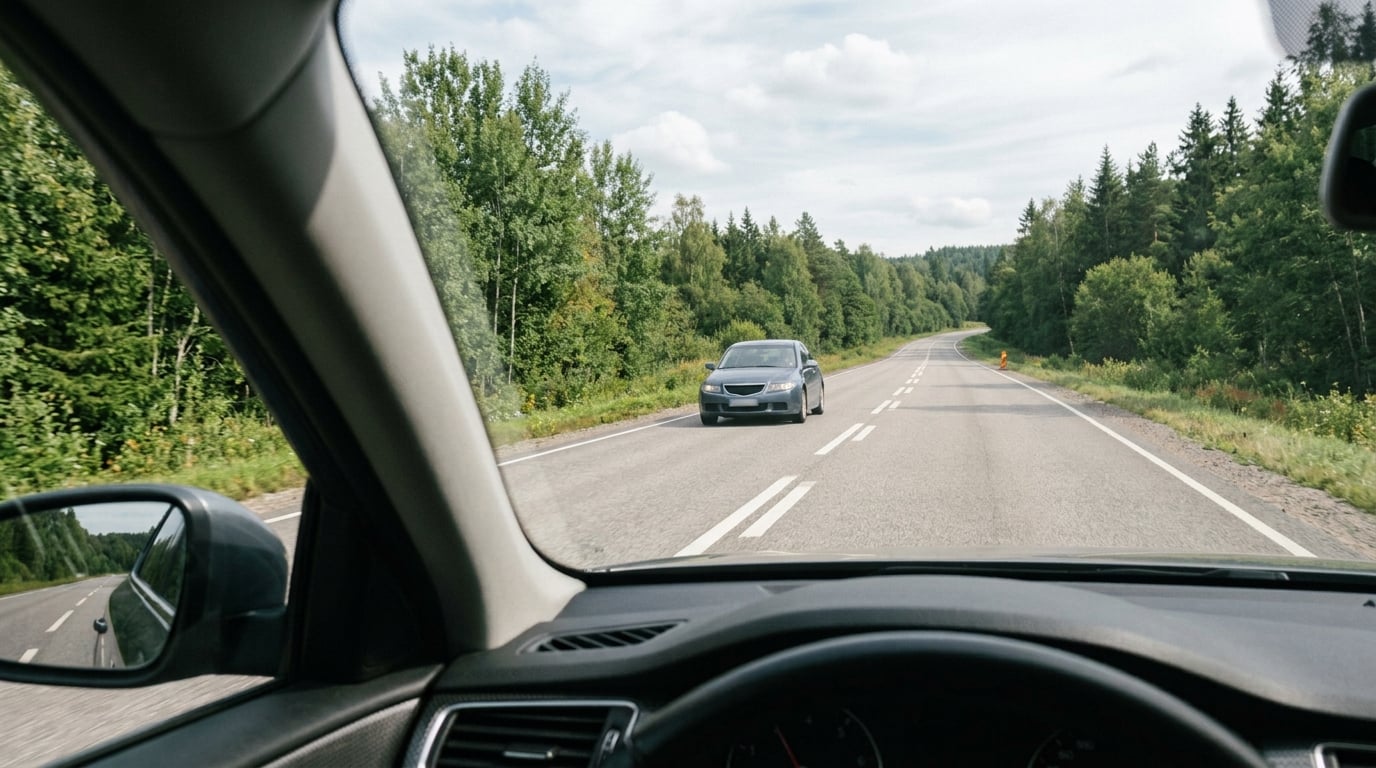
Defensive driving is a set of habits — scanning ahead, keeping space, managing speed, staying out of blind spots and anticipating what other road users might do — that put you in a position to handle a hazard before it becomes an emergency. This guide covers defensive driving techniques explained plainly, with the braking, handling and road conditions BMW owners actually run into.
Most of us learn defensive driving as a set of rules: keep a three-second gap, signal your turns, stay out of blind spots. Those rules are the floor, not the ceiling. The techniques that actually keep you out of trouble are the ones that buy you time and information, and on a car with a lot of performance on tap you need those more than the average driver does.
Table of Contents
- What Defensive Driving Techniques Are and Why They Matter
- How to Scan the Road and Build a Hazard Picture
- How to Manage Following Distance and Safe Speed
- How to Handle Braking, Lane Changes, and Intersections
- How to Respond to Common Hazards
- How Defensive Driving Changes in Bad Weather and on BMW Roads
- Common Defensive Driving Mistakes to Avoid
- A Simple Defensive Driving Routine for Every Drive
- Frequently Asked Questions
- Start With One Change
What Defensive Driving Techniques Are and Why They Matter
Defensive driving means driving so that you always have time to react. A defensive driver is not slower than everyone else; they are smoother, earlier and better informed about what is about to happen.
It is worth separating three styles that all look like “driving” from the driver’s seat. Aggressive driving uses speed, gaps and lane position to get somewhere faster and treats others as obstacles. Passive driving obeys the rules but never looks past the car in front, so the first sign of trouble is already too late. Defensive driving is the middle path: you stay within the law, you keep a cushion of space, and you are already reacting to a hazard while most drivers are still admiring the scenery.
The reason anticipation beats reaction is arithmetic. At 60 mph you cover about 90 feet in a single second, and an alert driver needs roughly one and a half seconds to see a hazard, understand it and start to respond. Add the distance your car needs to actually stop and you are looking at several car lengths before anything has happened yet. That is why the NHTSA and the Insurance Institute for Highway Safety both frame hazard anticipation, not reaction, as the core driver skill.
How to Scan the Road and Build a Hazard Picture
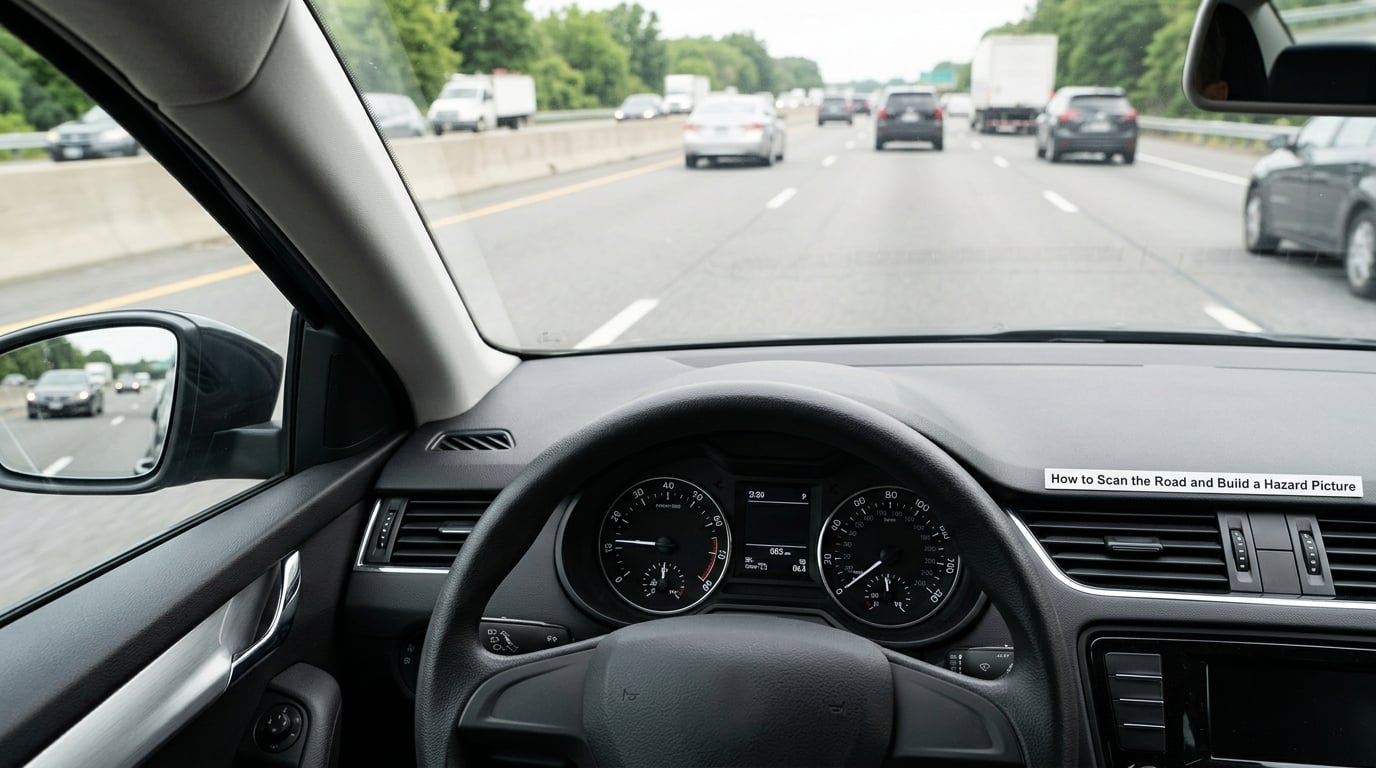
The scan is the engine room of every other technique. A good scan answers two questions at once: what is changing in front of me, and what could change in the next ten seconds?
Look 12 to 15 seconds down the road
Fix your attention far ahead rather than on the bumper in front of you. At highway speed, 12 to 15 seconds puts your focus about a quarter mile out, which is roughly where you would need to be if the car ahead stopped instantly. Look a little further when visibility is good, less when it is not — the point is that you are reading the far lane, not staring at the near one.
Work a front-rear-front-side pattern
A repeatable cycle beats random glances. Check the mirror and the road far ahead, then the instrument panel and the road immediately around you, then the side mirrors. A practical rhythm is a mirror check every five to eight seconds, and a full cycle roughly every ten seconds. That rhythm is what keeps you from drifting into tunnel vision on a long, uneventful highway stretch.
Check the two spots mirrors cannot cover
Before you change lanes, signal, check the mirrors, then do a 90-degree head check over the shoulder toward the blind spot. A mirror shows you a slice of what is beside you; it does not show you the car sitting one lane over and slightly behind your door mirror. On a fast-moving Autobahn, that is exactly where the overtake is coming from.
Approach intersections expecting them to surprise you
Before entering or crossing an intersection, look across the road at the far corner and then to each approach in turn, even when you have right of way. Scan far enough that you are not reading the last two metres of a car that is still hidden behind a parked truck. Cover the brake, check that nobody in the pedestrian line is stepping off the kerb, and commit once you are sure. Hesitating halfway into a junction is a hazard of its own.
How to Manage Following Distance and Safe Speed
Space is the single most useful thing you can control on the road. It buys reaction time, it gives you somewhere to go when the car in front stops suddenly, and it means a merge or a lane change ahead is your problem for a second longer rather than your problem now.
How to calculate a safe following distance
Pick a fixed point — a sign, a lamp post, a bridge — as the vehicle ahead passes it. When that point reaches your windscreen, count the seconds until you reach it. One second is roughly correct in ideal conditions, but the number climbs fast when conditions get worse. The “two-second rule” and the “three-second rule” are the same tool with different weather settings, and the disagreement you will find online is really a disagreement about which condition you are in.
| Condition | Minimum gap | Why |
|---|---|---|
| Dry daylight, light traffic | 2 to 3 seconds | Good visibility, good braking, predictable traffic |
| Rain, wet road, moderate traffic | 4 seconds | Longer braking, spray, less contrast |
| Night, fog, or heavy rain | 5 to 6 seconds | Reduced detection distance and slower response |
| Snow, ice, or standing water | 8 seconds or more | Braking distance can multiply several times over |
| Towing, or driving a large or heavy vehicle | 8 to 9 seconds | Extra mass means far longer stopping distances |
Professional truck drivers rarely go below eight or nine seconds, and owners’ clubs often recommend six car lengths at higher speeds. Those figures look inflated next to a two-second rule until you remember they are quoted for the heaviest, longest-braking vehicle in the lane. The rule is not a number, it is the calculation: a gap big enough that your car can stop inside the gap you left.
Stopping distance and reaction time
Total stopping distance is the sum of reaction distance and braking distance, and both grow with speed. These figures assume dry pavement, good tires and an alert driver; add roughly double for wet roads.
| Speed | Reaction distance (about 1.5 seconds) | Braking distance | Total stopping distance |
|---|---|---|---|
| 30 mph | 66 ft | 45 ft | about 110 ft |
| 45 mph | 99 ft | 101 ft | about 200 ft |
| 60 mph | 132 ft | 180 ft | about 310 ft |
| 70 mph | 154 ft | 245 ft | about 400 ft |
At 70 mph, a safe following distance is at least three seconds, and most defensive instructors would say four on anything other than a dry, clear day. That is a gap of about 200 feet on a dry road, which is roughly six car lengths — and much more once you account for the reaction gap. If you cannot see that much road through your windscreen, the speed is wrong for the conditions, not the gap.
Choose a speed you can abandon
Speed management is not about picking a number. It is about picking a speed that leaves you an option: a clear lane beside you, a shoulder or verge you could use, and enough stopping distance for the surface you are on. Slow down for visibility, not just for signs. If you cannot read a plate on the car in front, you have lost the information you need to drive defensively, and speed is the cheapest thing you can give back.
How to Handle Braking, Lane Changes, and Intersections
Everything above exists so that your inputs stay gentle. A defensive driver brakes early, once, and progressively, and never makes a sudden change of direction that the car behind cannot predict.
Why Braking Technique Preserves Control on a BMW
Modern BMWs have strong brakes, a firm pedal and, on many models, an electronic stability control system that will intervene if the car begins to rotate. None of that helps if you stamp on the pedal mid-corner and load the front tires enough to wash out the steering. Brake in a straight line, before the corner, and let the car turn while the weight is still transferring gently. This is the same logic behind how regenerative braking works on everyday cars — recovering energy smoothly rather than dragging the vehicle down hard.
Lane changes that other drivers can read
Move over only when you can see your destination lane is clear, with a real gap rather than a moving one. Signal early, check the mirror, do the shoulder check, then move. If a vehicle holds its position alongside you, that is a signal to add space, not to squeeze in front and cut it off. Cutting someone off in a fast lane is how a non-crash becomes a crash.
Crossing and turning
At a four-way stop, the vehicle that stopped first usually goes first, but the exception is anyone blocking the intersection — do not enter if you cannot clear it. For a turn, look at what you are crossing, not only at the lane you are joining, and turn at a pace that lets you stop within your visible space.
How to Respond to Common Hazards
Every hazard response follows the same five moves: scan, create space, slow or stop, communicate, and never make a move another driver cannot predict. What changes is which of those you reach for first.
- A vehicle cuts into your lane. Take your foot off the gas, let it coast, keep the wheel straight, and do not stamp the brakes or swerve into the next lane. A cut-off is usually a momentary panic by someone else, and the fastest recovery is absorbing it.
- A stalled car or debris in your lane. Scan well in advance, ease off the throttle early to avoid the need for a sudden correction, signal, and steer around with plenty of room. Never swerve for something you only just noticed.
- An emergency vehicle with lights and sirens. Pull over and stop clear of the intersection, follow local direction, and keep your attention on the vehicle ahead of you — other drivers are often the real hazard here.
- A pothole or raised surface. Ease off the gas rather than braking hard, avoid a sudden steering input, and check your tires and pressures afterwards. Damage to a wheel is far more likely than damage to the bodywork.
- A slick patch, standing water or a diesel spill. Ease off the accelerator, avoid hard steering or braking, and let the car pass over it straight. If the rear steps out, catch it with a small, smooth correction and do not add more input.
- A pedestrian stepping into the road. Cover the brake, slow to a stop if you can do it smoothly, and be ready to steer around. Do not rely on them seeing you.
- A driver who will not drop back. Do not speed up to escape them. Maintain your own safe speed, move out of their lane where it is safe to do so, and never turn your attention on them.
How Defensive Driving Changes in Bad Weather and on BMW Roads
Bad weather does not change the techniques, it changes the numbers. More gap, less speed, earlier braking, and a bigger margin for the other driver’s mistake.
Rain is the most commonly underestimated hazard. The first ten to fifteen minutes of a downpour, oil and grime on the road combine with water and grip is at its worst, which is when the surface looks deceptively dark and fine. Ease the speed off early rather than after the car starts to wander, and leave more distance. The same goes for spray from trucks, which can cut visibility to almost nothing at highway speed.
Snow and black ice need a different mindset entirely. Bridge sections, shaded bends and the strips either side of a cleared lane are where grip disappears. If the temperature is near freezing, assume any surface that looks wet is ice, and if you find yourself braking and steering at once, ease both off. Tire choice matters more than technique in these conditions; our guide to all terrain versus highway tires for daily driving explains the trade-off if your car spends its life in the cold.
At night, your detection distance drops before your speed does. Clean, correctly aimed headlights and a clear windscreen are defensive equipment — several drivers on driving forums make the point that slowing down at night is a bigger win than any gadget. Keep your speed within your headlight range and avoid the classic mistake of looking straight into oncoming high beams.
On unrestricted Autobahns, the discipline is in lane choice and joining. Pick a lane and its speed before you enter, match the flow, use the acceleration lane properly, and never sit in an overtaking lane below the traffic speed. Watch for the constant small speed differential between lanes — it is where most European highway incidents happen.
Track days and club drives deserve their own briefing. Warm tires need warm laps, the flag person controls the session, everyone uses the same signals, and you stay behind until the instructor says otherwise. Off track, a car with a low ride height and a stiff setup is exactly the car you do not want to put into a roadside incident with.
Common Defensive Driving Mistakes to Avoid
Most people who read about this topic still make the same handful of errors. The fix in each case is small, but it changes the outcome.
- Treating the two-second rule as universal. Two seconds assumes good light, a dry surface and light traffic. The correction is to make the number conditional: four in rain, eight in ice or with a heavy load.
- Overfollowing in dense traffic. Nobody wants to be hit from behind, so drivers squeeze in. The correction is to accept the smaller gap in the jam and restore the full gap the moment it opens up.
- Tunnel vision on long roads. A steady empty lane is hypnotic. The correction is a fixed scan rhythm, so you are looking far ahead, then beside, then behind, on a schedule rather than on interest.
- Delayed hazard perception. The hazard was visible ten seconds ago. The correction is to move your attention much further down the road than feels necessary.
- Sudden braking. Panic braking is what turns a near miss into a collision. The correction is to release the accelerator early and brake progressively, keeping the wheel straight.
- Unsafe lane changes. Mirrors alone are not enough. The correction is the 90-degree head check every time, without exception.
- Assuming the other driver will do the expected thing. Assume the other driver is wrong. That habit alone prevents most merging and reversing incidents.
What Most Explanations of Defensive Driving Techniques Get Wrong
They list rules and call it a technique. A rule tells you what to do in a situation you have already recognised; a technique is what you do in the two seconds before you recognised anything. That is the difference between a driver who brakes and a driver who never had to.
A Simple Defensive Driving Routine for Every Drive
Before you start the engine, walk the car or at least scan it: tires and pressures, visible fluid leaks, lights and brake glow after the last drive, glass and mirrors. On a club drive or a long trip, add fuel and washer fluid. Drivers on owner forums treat this pre-trip check as part of safe driving rather than separate maintenance, and they have a point — no technique works on a bald tire or a smeared windscreen.
Once moving, keep the loop short and identical: mirrors, far ahead, immediate surroundings, side mirrors, repeat. Every time a gap opens, reset your following distance to the condition. Every time you see a hazard, run the five moves — scan, create space, slow or stop, communicate, stay predictable. Every time something changes that you did not expect, rebuild the picture from scratch rather than patching the old one.
For a short commute the routine is the same, only tighter. Long trips add a break roughly every two hours, which is the single most repeated fix for the drowsiness drivers complain about on r/driving and r/roadtrip. If you are tired, the answer is a stop, not more coffee and louder music.
Frequently Asked Questions
What are the five steps of defensive driving?
The five steps are usually taught as SIPDE: Scan the road ahead and around you, Identify hazards, Predict what each one is about to do, Decide on the smoothest response, and Execute it early. Most driving schools use the same cycle in slightly different wording, but SIPDE is the version most people recognise. The order matters, because the prediction step is where a hazard stops being a surprise.
What are the three C’s of defensive driving?
Care, Caution and Courtesy. Care means keeping your car roadworthy and yourself fit to drive. Caution means anticipating hazards and managing speed, following distance and visibility. Courtesy means signalling early, letting people merge, and behaving predictably even when the other driver has not earned it. Put the three together and the whole approach fits in one breath.
What is the best single defensive driving technique?
Most experienced instructors will name the 12-to-15-second look-ahead. Everything else follows from it: the hazard is seen early, the prediction is made with time to spare, and the response is a smooth adjustment rather than an emergency. A decent scan habit will keep you out of trouble in situations where perfect speed control or perfect car control would not have helped.
How do I calculate a safe following distance?
Use a fixed object as a marker. When the vehicle ahead passes it, count the seconds until you pass the same point, and treat that as your gap. Double the baseline in rain and quadruple it in snow or ice, and go to eight or nine seconds when towing. On a highway you will cover roughly 22 feet per second, so a three-second gap is about 65 feet and a four-second gap about 90 feet.
What is a safe following distance at 70 mph?
At least three seconds on a dry, clear day, and four to six when it is raining, dark or busy. A four-second gap at 70 mph is roughly 200 feet, or about six car lengths. Remember that a car at that speed needs close to 400 feet to stop from a reaction, so the gap needs to be bigger than the space in front of you looks like it requires.
What should I do when a car cuts me off or merges into my lane?
Take your foot off the accelerator, let the car coast, keep the wheel straight and avoid stamping the brakes. The other driver is usually reacting to their own panic, and heavy braking invites a rear-end collision. Once the situation is stable, re-establish your safe gap, check your mirrors, and put the phone away. Steering around the car is only reasonable if there is clear, verified space behind you.
Start With One Change
Pick the look-ahead distance and hold it for the next week. Fifteen seconds of focus down the road changes how you brake, how you choose a gap and how you read a merge, and it costs nothing but attention. The rest of the habit stack — the scan rhythm, the shoulder check, the pre-trip walkaround — attaches to it quickly once that first one sticks.