
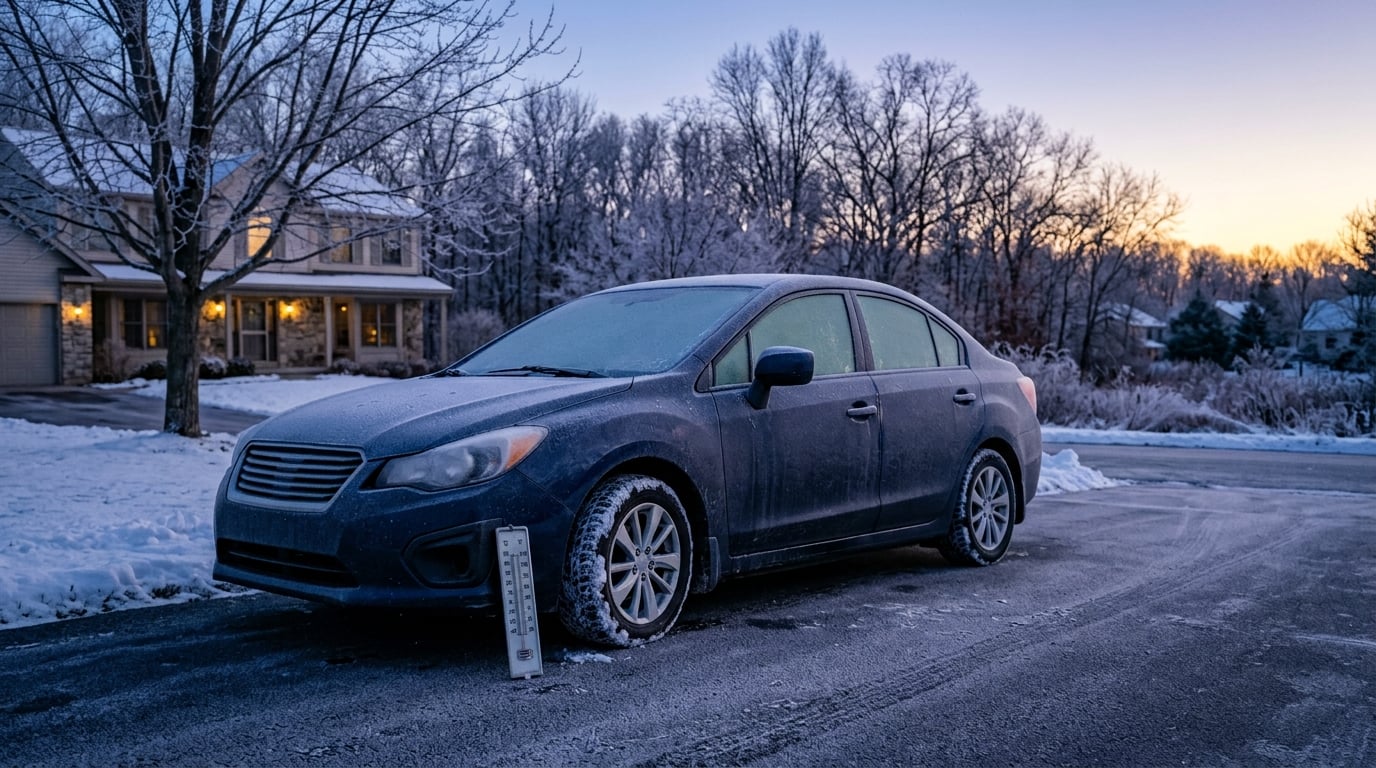
Most modern gasoline cars can technically start at temperatures near -40°F (-40°C), but real cold-weather no-starts usually begin somewhere between -15°F and -25°F (-26°C to -32°C). There is no magic number behind that range, though. Your battery’s condition, the oil in the pan and the fuel you run decide where your car gives up, which is why the answer to how cold does it have to be for a car not to start depends on the car.
That gap between the theoretical limit and the practical limit is where most owner frustration sits. People park a healthy ten-year-old car outside all night, it fails at -12°F, and they assume something fundamental about winter broke. Usually something smaller did, months earlier.
Table of Contents
- How Cold Does It Have to Be for a Car Not to Start?
- Why Does Cold Weather Make a Car Hard to Start?
- Why Does the Temperature Threshold Vary Between Cars?
- What Are the Most Common Reasons a Car Will Not Start in the Cold?
- How Can You Safely Check Your Car Before the Temperature Drops?
- What Should You Do If Your Car Will Not Start When It Is Cold?
- Frequently Asked Questions
- Can it be too cold for a car to start?
- Why won’t my car start in cold weather even though the battery is good?
- What temperature kills a car battery?
- Will my car start once it warms up later in the day?
- At what temperature does diesel fuel stop working?
- Should I idle my car in the cold to keep the battery charged?
- Conclusion
How Cold Does It Have to Be for a Car Not to Start?
There is no universal temperature, because a no-start happens when the cranking current the engine demands exceeds what the battery can deliver. A healthy gasoline car with fresh synthetic oil and a strong battery often cranks without complaint at 0°F (-18°C) and below.
An older car with a four-year-old battery, worn starter and 5W-30 can fail on a mild 25°F morning with nothing unusual about the weather. The temperature is the trigger, not the cause.
The three things behind most cold no-starts, in order:
- A weakened 12-volt battery. It gives up about 35% of its strength at 32°F (0°C) and roughly 60% at 0°F (-18°C).
- Thickened engine oil. Cold oil raises friction, so the starter has to pull roughly twice the current it needs on a warm day.
- Fuel delivery problems. Gasoline vaporizes poorly when it is very cold, and diesel waxes up in the tank and lines.
Put those two curves together and you get the whole story: cranking demand climbs as the oil thickens while battery output falls. A no-start is where the lines cross, and that crossing point moves up or down depending on how healthy the car is.
Why Does Cold Weather Make a Car Hard to Start?
So when a driver asks how cold does it have to be for a car not to start, the useful answer points at five separate systems that all get harder at once.
Battery chemistry slows down. A lead-acid battery’s internal resistance climbs as it gets cold, and its chemical reactions slow. Capacity drops with it, which is why a battery that cranks fine on a mild October morning does nothing in January.
Oil thickens. Viscosity is graded for temperature, and 5W-30 turns syrupy well before 0W-20 does. That extra drag means the starter needs roughly double the current to turn the engine over.
Metal contracts. Engines, wiring and connectors shrink slightly. Tolerances that worked in July can be tighter in January, and a marginal connection on a corroded battery terminal gets marginal faster.
Fuel behaves differently. Gasoline needs to vaporize to burn, and it is reluctant to do so in very cold air. Diesel is worse: wax crystals start forming in the fuel as it drops toward its gel point, usually around 10°F to 15°F (-12°C to -9°C) depending on the blend and how much ethanol it contains.
Moisture freezes where it sits. Moisture in a fuel line, a frozen door lock, or ice around a wiper can stop a car cold that would happily crank in the same weather on a dry, garaged driveway.
There is also a line between normal and broken. A slow, heavy crank that turns over within a second or two is normal cold-soak behavior, especially with a big engine or thick oil. A crank that never catches its own rhythm, a rapid-fire click, or absolute silence means a fault, not just the cold.
What Temperature Is Usually Too Cold to Start a Car?
The table below maps typical air temperatures to what actually happens. Treat these as reference points for a generally healthy gasoline car, not guaranteed failure thresholds, because battery age moves every number in it.
| Air temperature | What happens to the battery and oil | Likelihood of a no-start (healthy car) | Likelihood of a no-start (older car, 4+ year-old battery) |
|---|---|---|---|
| 32°F to 20°F (0°C to -7°C) | Battery down about 35% of strength; oil noticeably thicker | Very low | Moderate if the battery is weak |
| 20°F to 10°F (-7°C to -12°C) | Starter draw climbing sharply; fuel delivery marginal on some vehicles | Low | Moderate to high |
| 10°F to 0°F (-12°C to -18°C) | Battery down roughly 60%; diesel begins to gel | Low to moderate | High |
| 0°F to -15°F (-18°C to -26°C) | Common failure band begins; weak batteries quit here | Moderate | Very high |
| -15°F to -25°F (-26°C to -32°C) | Most cold-weather breakdown calls happen in this range | Moderate to high | Very high |
| -25°F to -40°F (-32°C to -40°C) | Approaching the practical floor; only a block heater and a strong battery get here reliably | High for ungaraged cars | Near certain |
Real-world reports line up with those bands. A two-year-old 580 CCA replacement battery in a Toyota RAV4 failed to start at -10°F in Wisconsin, which is a reminder that new does not mean immune. Around -23°C in Montreal, forum users reported that almost nothing started one morning, including a late-60s Ford.
Wind chill is worth clearing up, because it comes up in almost every cold-start thread and it is not the number your car cares about. Your battery, your oil and your fuel respond to actual air temperature, not to how cold it feels on exposed skin.
Why Does the Temperature Threshold Vary Between Cars?
Fuel type changes the answer more than anything else, and diesel owners in cold regions get a lot of advice written for gasoline cars that simply does not apply.
| Type | Realistic cold-start limit | What gives out first |
|---|---|---|
| Gasoline (modern) | Down to roughly -40°F (-40°C) in theory; -15°F to -25°F (-26°C to -32°C) in practice for a tired battery | 12-volt battery, then starter |
| Gasoline (older, high mileage) | Often only around 0°F (-18°C) | Battery and starter together |
| Diesel | Fuel gel point around 10°F to 15°F (-12°C to -9°C); below that, heating fuel or using winter blend is required | Fuel delivery, then glow plugs and battery |
| Hybrid | Starts reliably, since the high-voltage battery handles cranking and the engine gets a warm start | 12-volt battery for electronics, as in any car |
| EV | No engine cranking at all; cold affects charging speed and range, not starting | Traction battery thermal management |
Beyond fuel type, four variables shift the threshold noticeably:
- Battery age and rating. A battery’s cold cranking amps, the amps it can deliver for 30 seconds at 0°F, decline as the battery ages even though its resting voltage still reads a healthy 12.6V. That voltage-versus-amps gap is the single biggest trap for do-it-yourself diagnosis.
- Engine displacement and load. A V8 with thick oil demands more cranking current than a small four-cylinder with 0W-20.
- Oil viscosity installed. Follow the owner’s manual spec, not the bottle in the trunk. A high-viscosity oil can become extremely viscous near -30°C (-22°F) and make a marginal battery look dead.
- How long it sat. A car driven daily keeps its alternator and fuel system topped up. A second vehicle parked for months often fails on the first hard snap of the year, with no warning at all.
What Are the Most Common Reasons a Car Will Not Start in the Cold?
Describe the sound, and you are most of the way to the cause. Owners on the CarTalk forum keep asking for this distinction, because “it won’t start” covers at least three unrelated faults.
| What you hear | What it usually means | What to do |
|---|---|---|
| Nothing at all, no sound | Open or high-resistance connection, dead battery, or a failed safety interlock | Turn headlights on, then crank and watch them dim; check terminal tightness and clean corrosion |
| Rapid clicking | Battery has voltage but not enough cold cranking amps | Test the battery under load; expect a replacement, not a charge |
| One click, then silence | Battery voltage collapsed the moment load was applied | Same as above, plus check the ground cable |
| Slow, heavy cranking that never catches | Weak battery plus thick oil, or a tired starter drawing too much | Switch off accessories, prime the fuel pump, crank again once; if still slow, stop |
| Cranks normally but never fires | Fuel delivery, a flooded engine, or ignition | Prime the pump, check for a fuel smell, verify fuel and spark before assuming the battery |
| Grinding or whining | Starter motor or ring gear wear | Do not keep cranking; this is a tow or a shop visit |
Two more common culprits sit behind those symptoms. Corroded terminals add resistance that a warm engine shrugs off and a cold engine cannot, and parasitic drain from an aftermarket alarm, phone charger or stereo can leave a battery too low to crank after a few weeks sitting. And the battery is usually a summer victim revealed in winter: heat damage boils off the water in the cells, plates corrode, and cold weather just exposes the loss.
How Can You Safely Check Your Car Before the Temperature Drops?
An hour of preparation in autumn beats an hour of frozen fingers in January. Work through this list before the first hard freeze.
- Load test the battery. A resting voltage of 12.6V means charged, not capable. A load test or conductance test at an auto parts store is the only honest answer, and it is quick.
- Clean and protect the terminals. Disconnect the negative cable first, scrape corrosion off, and refit with a terminal protector. This is cheap and it fixes a surprising share of no-crank cases.
- Check the oil spec. Confirm the viscosity your manual calls for, and switch to a winter-grade synthetic if the car is due for an oil change anyway.
- Know your starting current requirement. Compare the battery’s cold cranking amps with what the engine needs; the manual lists it. Never run a battery below the engine’s requirement.
- Fit a block heater or a battery maintainer, and know which one you need. These solve different halves of the problem. A block heater warms the engine and oil, and forum users in Grand Forks, ND report starting reliably at about -46°F (-43°C) with one. It does nothing for the battery, which is why a separate battery blanket warmer exists.
- Keep the fuel tank above half. That reduces condensation and gives the pump something to work with. For a diesel, keep it full through a storage period and use winter-grade fuel when the temperature drops.
- Park in a garage or under a cover if you can. Even a sheltered driveway buys 10°F or more of effective temperature, and that margin is often the difference between a start and a phone call.
- Keep an emergency kit in the vehicle. Jumper cables or a jump pack, a heavy-duty blanket or cover, a flashlight, and a bottle of water.
Two safety notes. Never work around a battery with an open flame, and never charge a visibly swollen, cracked or leaking battery. A professional is the right call for any of those, and for anything involving a high-voltage hybrid system.
What Should You Do If Your Car Will Not Start When It Is Cold?
Work the sequence in order, and stop after a couple of attempts. Repeated cranking to convince the engine is the fastest way to damage a starter that is already working hard.
- Turn off everything else first. Headlights, radio, heated seats, phone charger. Every amp matters when the battery is already short.
- Cycle the key. Ten cycles of off-to-start, about a minute apart, gives the fuel pump prime time and lets the battery rest between attempts. Some cars will fire on the fourth or fifth try.
- Prime the fuel pump deliberately. With the key in the On position and the engine off, hold it there for 15 to 30 seconds. You may hear a hum from the tank. Then crank.
- Check the lights while you crank. Headlights that dim hard to brown point at the battery and connections. Headlights that stay bright with no crank point at the starter or a safety interlock.
- Let it warm naturally if it cranks but will not fire. Many cold-soaked cars start on their own once the fuel and battery warm a little, often by midday. This is common with a weak-battery-plus-thick-oil combination rather than a dead part.
- Jump start if the battery is simply flat. With both engines off, connect positive to positive, then negative to a grounded point away from the battery. Start the donor vehicle, give it a minute, then try yours. A jump gets you going; it does not fix a worn battery, so follow up with a load test.
- Stop and call for help when there is no crank, there is a grinding noise, a dashboard warning light is on, or the battery is visibly damaged. Do not touch a terminal that is badly corroded, and do not remove corroded battery in the cold without gloves.
If it starts once the temperature climbs, treat that as a diagnosis rather than a cure. A car that reliably waits until mid-afternoon has a battery, oil or fuel problem that will eventually leave you stranded at the worst possible time.
Frequently Asked Questions
Can it be too cold for a car to start?
Yes, but not for the reason most people expect. A modern gasoline car can crank at roughly -40°F (-40°C) in good conditions. Real failures begin far higher, around -15°F to -25°F (-26°C to -32°C), and almost always trace back to the 12-volt battery, thickened oil, or fuel delivery rather than a hard limit set by the cold itself.
Why won’t my car start in cold weather even though the battery is good?
Because a battery can read 12.6V at rest and still lack the cold cranking amps to turn the engine over. Voltage shows charge, not capability. Other causes of a good-battery cold no-start include thick engine oil, moisture in the fuel lines, a flooded engine, a worn starter drawing too much current, or a parasitic drain from an alarm or accessory left plugged in.
What temperature kills a car battery?
No single temperature kills it, because heat does most of the damage months earlier. A battery loses about 35% of its strength at 32°F (0°C) and roughly 60% at 0°F (-18°C), so failures cluster between roughly -15°F and -25°F (-26°C to -32°C). A four-year-old battery can quit there while a new one shrugs it off.
Will my car start once it warms up later in the day?
Often yes, and that is exactly why the problem gets missed. Owners report cars that crank but will not fire until mid-afternoon, which fits a weak battery plus thick oil rather than a dead component. Treat a warm-weather start as proof the battery, charging system, or oil spec needs attention rather than as good news.
At what temperature does diesel fuel stop working?
Diesel typically starts gelling, with wax crystals forming in the tank and lines, around 10°F to 15°F (-12°C to -9°C). The exact point depends on the blend and its ethanol content, and winter-grade fuel or a fuel heater is the fix. Once gelled, a diesel may crank but never fire, which looks exactly like a battery problem to an owner who does not know better.
Should I idle my car in the cold to keep the battery charged?
Rarely, and it is less effective than it sounds. Idling burns fuel faster than the alternator puts back, and it does not maintain charge. A maintenance charger, or driving the car long enough to fully recharge after a short trip, is the better answer. If you have no outlet on a long driveway, drive the vehicle on warmer days instead of trying to trickle it in the cold.
Conclusion
There is no universal temperature at which every car stops starting, so the honest answer to how cold does it have to be for a car not to start is a range: roughly -15°F to -25°F (-26°C to -32°C) for a tired battery, and far colder for a healthy one. A car that refuses to crank above -20°F usually has a battery, a starter, or the wrong oil viscosity, not a fundamental cold limitation.
Test the battery under load and check the charging system before severe weather arrives in 2026, keep the tank above half full, and park under cover if you have the option. If it does not start, work the short sequence above and call roadside assistance rather than forcing a no-start.