
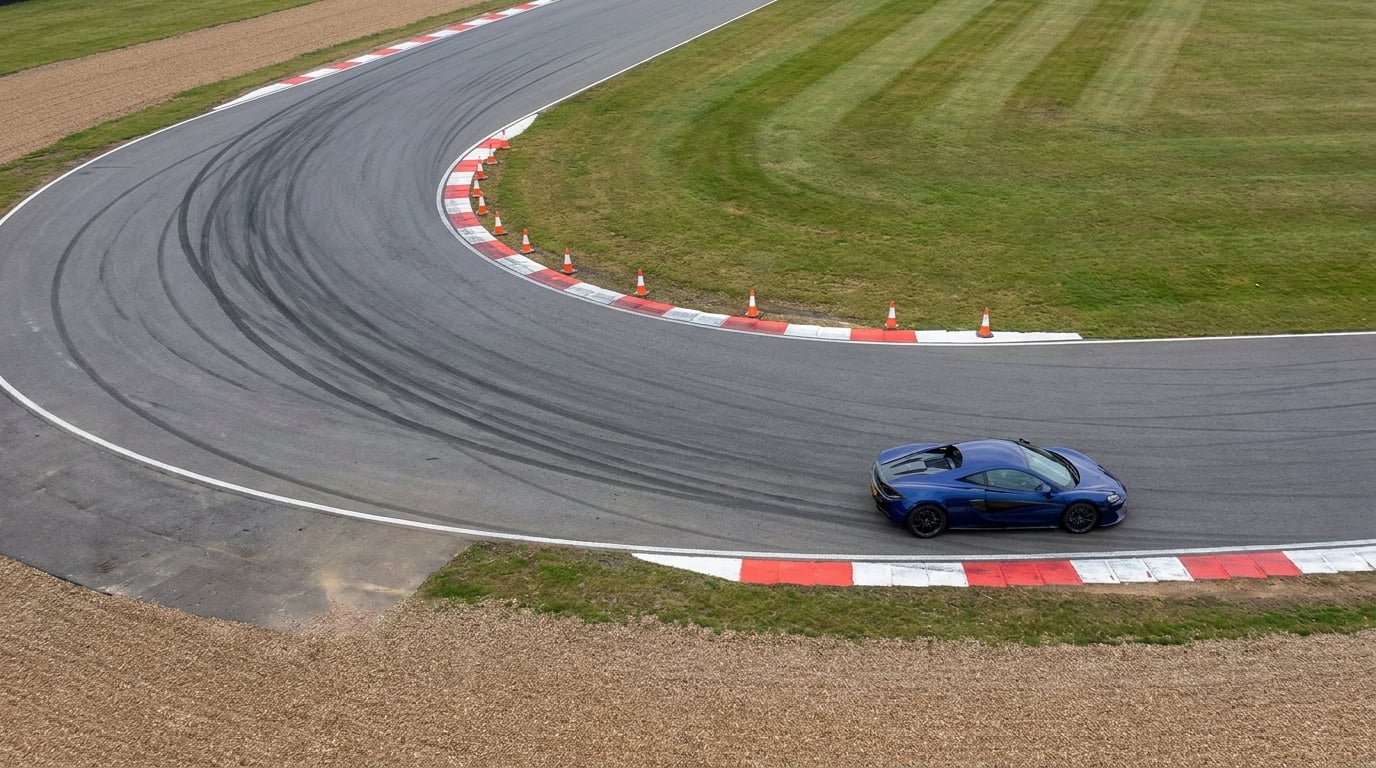
To find the racing line on a track, walk the circuit first and read the surface: the rubbered-in skid marks already show where faster cars turn in, which kerb they clip, and where they head on exit. Then pick four fixed reference points, braking, turn-in, apex and exit, and drive the same line at controlled speed until it becomes repeatable. That is the whole method, and it works on a circuit you have never seen.
It takes most people a full session day to stop guessing and start repeating. The first ten laps are reconnaissance: you are learning the corners and feeling the grip, not chasing a time. By the afternoon you should be able to name the reference point you use in three or four corners and hit them twice in a row.
Before the long version, the short version.
- Read the asphalt. Rubber, skid marks and worn-in lines show the path quicker than any map.
- Mark four points per corner. Braking, turn-in, apex, exit. Same points, same names, every lap.
- Let corner speed pick the apex. Fast corners want a geometric line, slow corners want a late one.
- Drive the exit first. A wide, straight exit is worth more than mid-corner heroics.
- Change one thing per lap block. Aiming at a line you cannot steer is not a plan, it is a wish.
None of this needs telemetry or a data logger. It needs a track walk, a helmet and the patience to do the same corner properly five times before moving on.
Table of Contents
- What You Need to Find the Racing Line
- Step-by-Step: How to Find the Racing Line on an Unfamiliar Track
- 1. Study the Track Before You Drive It
- 2. Use Fixed Outside-Inside-Outside Reference Points to Find the Racing Line
- 3. Choose an Apex You Can Explain
- 4. Connect the Corner to the Next Straight
- 5. Set Braking and Throttle Reference Points
- 6. Drive the Line in Progressively Faster Passes
- 7. Refine the Line With Video and Track Data
- Common Mistakes That Mean You Have Not Found the Line Yet
- Frequently Asked Questions
- How do I find a good racing line on an unfamiliar track?
- Should I use an early or late apex in every corner?
- What should I use as reference points for the racing line?
- How do I find the racing line on a track with other cars?
- How do I know whether my racing line is improving?
- Does the fastest racing line always use the smallest possible radius?
- Conclusion
What You Need to Find the Racing Line
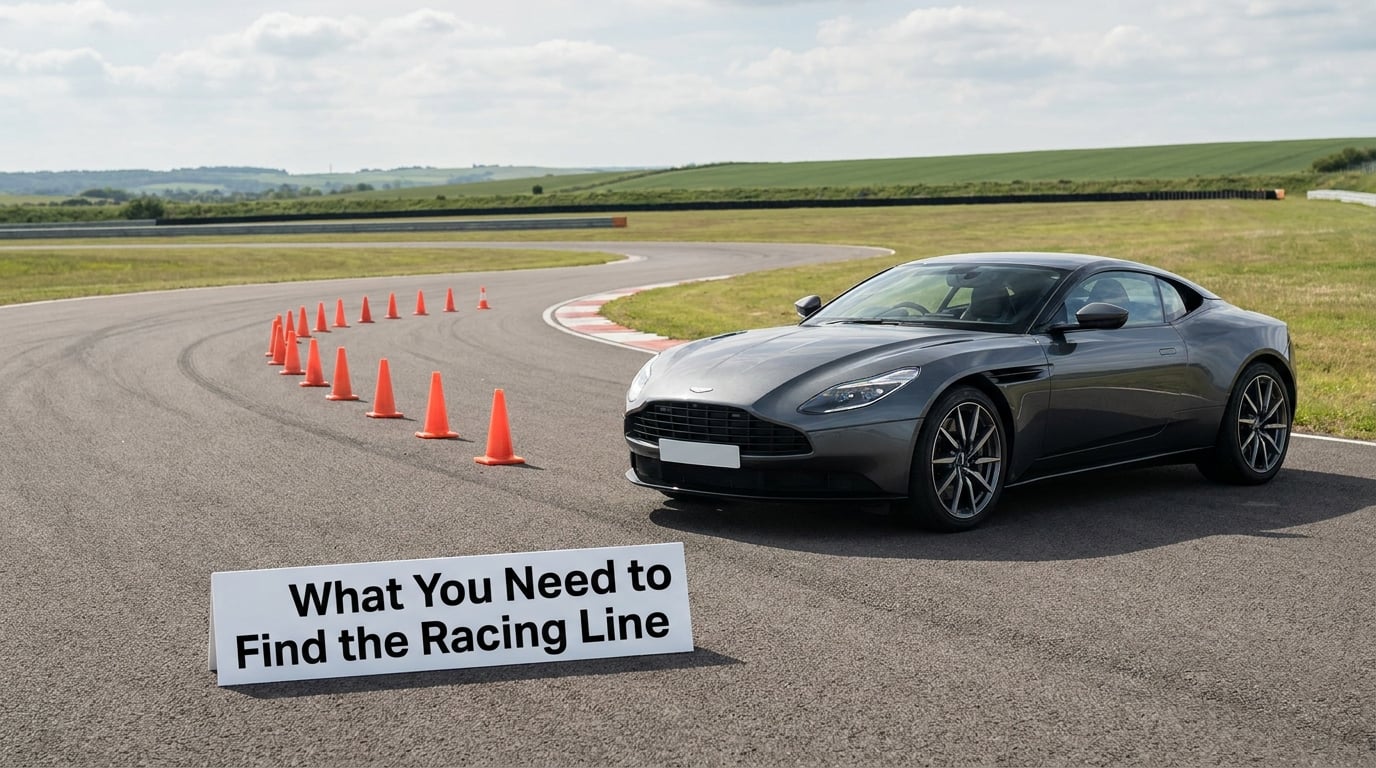
You need less equipment than most beginners assume, but two things are non-negotiable: a walk of the circuit and a car you trust.
A track walk. Twenty minutes on foot before the session tells you more than three slow laps. Walk the racing direction if the circuit allows it. Note where the track changes width, where the surface changes colour, where the kerbs sit and which corners have gravel or grass directly behind them.
Fixed reference features. You cannot steer to a feeling. You steer to a board, a marshal post, a bridge, a tree line, a distance marker or the far kerb. Every corner needs something visible early enough that you can set up for it while still straight.
Marking tools. A notebook or your phone, a track map with corner numbers, and ideally a pen. Write the braking board number next to each corner. Your memory of corner three in hour eight will be wrong.
A car in good order. Tyres with usable tread and correct pressure, brake pads and fluid checked, fluid levels topped up, nothing loose in the cabin. Grip is your limit everywhere on this page, so a sorted car is the cheapest lap time you will ever find.
An instructor or a faster reference car. For a first session, an instructor in the passenger seat is worth more than any article. Failing that, an instructor-led out lap sets a target you can copy corner by corner for the rest of the day.
Safety kit and a run-off plan. Helmets, whatever else the circuit requires, and a mental answer to one question before every session: if it all goes wrong, where does the car end up. If you cannot answer that for a corner, drive that corner at half pace.
One more thing people underestimate: knowing how the kerbs behave. The red and white strips are for clipping an apex and the exit of a hairpin, not for riding through a fast kink. Straddling one mid-corner unsettles the car and rarely makes you faster.
Step-by-Step: How to Find the Racing Line on an Unfamiliar Track
1. Study the Track Before You Drive It
From the walkway, work out what each corner actually asks of you. Is it a decreasing radius, where the corner tightens as you go through it? Is it a fast sweeper where you can carry speed all the way? Is it a hairpin that drops you to walking pace and then fires you onto a long straight?
Look for the things that break your assumptions. Banking that leans the car into the corner means you can carry more speed than the shape suggests. A crest hides the exit. A surface that changes from dark rubber to grey concrete will change grip by more than most drivers expect.
For each corner, find three things: where the runoff starts, how much width you actually have, and what you will be aiming at when you come out. That last one is the one people skip, and it is the reason they run wide on exit three laps in.
2. Use Fixed Outside-Inside-Outside Reference Points to Find the Racing Line
The racing line is a shape, not a place: enter wide at the outside edge, touch the inside at the apex, and return to the outside on exit. The difficulty for a beginner is that the outside edge is a moving target in your peripheral vision, so convert it into objects.
Pick three references per corner and give them names. Entry: the board number or the marshal post where you intend to be fully on the brakes. Apex: the kerb, the cone, the apex-marker post or the painted apex on the kerb. Exit: a specific point on the far side, usually the far kerb or a gap in the barriers, that the car should be pointing at once the steering unwinds.
Named corners help enormously. The Maggots and Becketts sequence at Silverstone is famous because the first right opens into a second left, so the exit of the first is part of the entry to the second. Brands Hatch is the other one every instructor will mention, usually because a long slide at the first corner catches out people who have never seen rubber laid down on the exit.
Kerb paint is the best apex reference most circuits have, and it is hard to miss. Use it.
3. Choose an Apex You Can Explain
Apex choice follows from corner speed, not preference. There are three useful shapes, and the table below is worth reading twice because most beginner lap times are lost by picking the wrong one.
| Line type | Turn-in | Apex | Exit | Best suited to | Trade-off |
|---|---|---|---|---|---|
| Geometric line | Early | Middle of the corner | Moderate | Fast, open corners and long sweepers | Highest mid-corner speed, slowest exit |
| Late apex line | Late | Late, near corner exit | Fastest | Slow corners, hairpins, anything onto a straight | Lower mid-corner speed, fastest exit |
| Early apex line | Earliest | Early, near corner entry | Slowest | Rarely right; a linked corner at best | Quick entry, slow exit, car runs wide |
Ross Bentley of Speed Secrets put it as the rule most drivers learn last: the faster the corner, the closer to the geometric line you should drive. The slower the corner, the more you need a later apex.
Why acceleration decides it. A car with strong acceleration relative to its cornering ability wants a tight, late, small-radius line because the payoff from hard acceleration out of a slow corner is huge. A car that corners hard but pulls weakly needs a wider, faster arc, because there is no reward for being slow in the middle.
For your first sessions, the honest test is simple: can you say why you picked the apex? If the answer is that the kerb is there, you picked a reference point instead of a line.
4. Connect the Corner to the Next Straight
The apex is halfway. What you do in the second half of the corner decides the next straight, and the next straight is usually where the time is.
Think of the exit as a drag race between two identical cars leaving the same corner side by side. The one pointing straighter down the road wins by a car length, every time. That is the whole argument for a wide exit, and it is why a smooth-looking lap with a slow exit is a slow lap.
Practically, that means: if you clip the apex and immediately look at the next corner, you have already given the time away. Look down the road, let the car straighten itself as the radius opens up, and get back to full throttle before the apex is fully behind you.
Watch for the two exit errors. Running wide at exit means you turned in too early, apexed too early, or arrived too fast. Pointing at the inside wall on exit means you turned in too late and are scrubbing speed sideways. Both are visible from the walkway, so check them there.
5. Set Braking and Throttle Reference Points
Braking boards are there for exactly this. The 3 board is three hundred metres from the marker, and so on, and the sequence of numbers tells you the corner is coming even when a rise hides it.
Find your braking point, then add a margin on the first pass of the session. The reason for the margin is not timidity, it is cold tyres and a road surface that has not been swept yet. A board reference plus a foot of margin will not cost you time, because the difference between a good stop and a slightly early one is far smaller than the cost of one off.
Then connect the whole corner: braking point, turn-in point, apex, exit. The gap between braking and turn-in should look like a straight line in your head, not a curve. Once you are turning, the throttle is either on progressively as the car rotates, or off, and lifting mid-corner unloads the rear and unsettles a car that was otherwise fine.
Treat reference points as guides, not commands. They tell you where you were last lap. They do not tell you what the surface or the tyre is doing right now, and on the lap when the car is not behaving, judgment wins.
6. Drive the Line in Progressively Faster Passes
The pattern that works for a first session is simple enough to remember: walk it, then drive it slowly, then build it.
- Out lap. Follow the instructor or the pace car. Note where the reference points are. Do not try to be fast.
- Second lap. Drive 60 to 70 percent. Hit the reference points deliberately, even if it feels like crawling. Consistency first.
- Third lap. Stay at the same speed but remove one crutch at a time: later turn-in, earlier throttle, a cleaner exit.
- Lap four onward. Raise speed in small steps of about 5 to 10 percent per corner per lap, and stop raising the moment the car stops telling you clearly that it is happy.
- Every few laps. Write down one line: what you tried, what it did. Two words is enough. The point is to notice, not to journal.
On how long it takes before the line clicks, drivers on beginner track-day threads generally say three laps to get comfortable and a full session to stop thinking about it. One r/BRZ_ZD8 reply put the order of priorities well: get used to the track, learn the lines and braking points, and learn the limits of your tyre.
A useful rule from the same communities: build one corner at a time rather than trying to memorise the whole circuit. Pick the corner before the one you are about to drive, decide the line for it, execute it, and only then think about what comes next.
7. Refine the Line With Video and Track Data
Onboard video is the cheapest feedback tool in motorsport and it catches line errors that you physically cannot feel. Mount the camera, do five laps, and watch one corner.
The signature of each error is unmistakable on camera. Late turn-in shows as the car running out of track on entry. An early apex shows the car suddenly pointing at the infield on exit. Over-rotation through the middle shows the car crossing the corner in a straight line instead of an arc. A missed apex shows the car crossing the exit kerb sideways. A slow exit shows the driver unwinding the wheel and then still needing to add steering correction.
Phone apps that log speed, braking and throttle traces will do the same job in numbers. Watch the shape of the throttle trace: an early peak and a long taper means you are accelerating before the car has finished rotating, which is how a car ends up wide at exit.
Overlay your lap on a reference lap if the circuit or your instructor provides one. Follow the reference driver’s line, not their speed, and only try to match the throttle trace a few laps later.
Common Mistakes That Mean You Have Not Found the Line Yet
Almost every beginner corner error comes down to one of these. Work down the list and each one has a fix you can use on your next session.
- Staring at the apex. You arrive already too late, brake hard, and miss the turn-in point. Fix: pick your exit reference, not your apex, as the thing you look at first, and move your gaze earlier on entry.
- Only planning the corner ahead. You optimise one corner and arrive at the next one with the car sideways. Fix: plan two corners at a time, since the exit of one is the entry of the next.
- Braking too early and too hard. You crawl through the entry and then run wide on exit trying to make up time. Fix: use the board, brake in a straight line, and let the corner do the slowing.
- Changing the line every lap. No two laps match, so nothing can be improved. Fix: commit to one set of reference points for a block of five laps and change only one of them.
- Copying a line that does not suit the car. A fast, flowing line from a car with more grip leaves you stranded mid-corner. Fix: take the shape, not the speed, and adjust the radius to what your car will hold.
- Confusing the racing line with the geometric line. You apex in the middle of every corner because that is the shortest path on paper, then run wide. Fix: the shortest path is only correct in fast corners. Slow corners need the late apex.
- Lifting mid-corner. Coasting through the apex feels safe and unloads the rear tyres. Fix: either brake in and commit, or use progressive throttle through the turn. Half-and-half is what unsettles the car.
- Over-focus on mid-corner speed. The lap looks smooth and is three seconds off. Fix: judge the corner by the distance you gain on the following straight, not by the speedo in the apex.
A few practices worth building in.
One corner per session block. Note one corner each time out and compare laps at that corner only. It is the fastest way to see progress and it stops you from making six changes at once and learning nothing.
Let faster cars go, and use them. Watch your mirrors, and when someone quicker is behind, stay left on straights and let them have the racing line. When you are following a faster car, pick two corners and copy their reference points rather than trying to match their speed all the way round.
Know the limits before you meet them. Run off is not a line error, it is a session-ending moment. Learn where the gravel and the walls are first.
On a wet track or with cold tyres, the line moves and slowing down is correct. The dry racing line runs over the painted kerbs and the dry apex, which is exactly where standing water hides. On a wet surface most drivers add a few degrees of extra steering to stay off the shiny parts, take a later apex, and carry less entry speed. Tyres that have not reached working temperature give you a fraction of the grip that lets you clip a kerb safely in the warm, so leave the kerb alone and finish the session. If you would be uncomfortable with a friend behind the wheel, do not do it.
Frequently Asked Questions
How do I find a good racing line on an unfamiliar track?
Walk the circuit first and read the surface. The rubbered-in skid marks show where cars before you braked, turned in, clipped the apex and headed out, so follow that path rather than guessing. Then name four fixed reference points per corner: braking, turn-in, apex and exit. Drive those same points at about 60 percent pace for several laps before adding any speed.
Should I use an early or late apex in every corner?
No, and choosing the same one every time is the most common beginner mistake. Fast open corners work best on the geometric line with an apex near the middle. Slow corners and hairpins need a late apex, because the exit onto a straight is where the time is won. An early apex is rarely correct and usually ends with the car running wide on exit.
What should I use as reference points for the racing line?
Use fixed, visible objects you can name: braking boards, marshal posts, distance markers, bridges, the apex kerb paint, or a distinct feature on the far side of the corner. Aiming at the apex alone gives you nothing to set up for, and aiming at a feeling gives you nothing to compare against. Write the reference names in your notes so you can use the same ones all session.
How do I find the racing line on a track with other cars?
Learn it in clear air first. Follow a faster car once per session and copy its line at two corners rather than trying to match its speed. In traffic, keep left on straights, check mirrors before braking zones, and leave the racing line when a quicker car is behind you. Position yourself for the pass rather than defending a line, and never change direction twice in one corner to hold your place.
How do I know whether my racing line is improving?
Stop looking at lap times early on and compare one corner across a block of laps. Note whether you hit the same apex, whether the car pointed down the following straight sooner, and whether you stopped running wide at exit. If the same corner is cleaner and the exit is faster three laps later, the line is improving even if the lap time has not moved much.
Does the fastest racing line always use the smallest possible radius?
No. The shortest radius produces the highest mid-corner speed, but the line that matters is the one that lets the car accelerate away fastest toward the next corner. That is why slow corners use a late apex and fast sweepers use the geometric line. Chasing a small radius in a slow corner feels impressive and gives up all the time on exit.
Conclusion
Walk the circuit before you drive it. Note the corner names, mark four reference points in each one, and find the rubber that shows the way. Then drive that same line slowly enough to hit the points, five laps in a row, before you ask it to go any faster.
Speed comes later, and it comes from the exit anyway. Get the shape right first and the lap time usually follows on its own.