
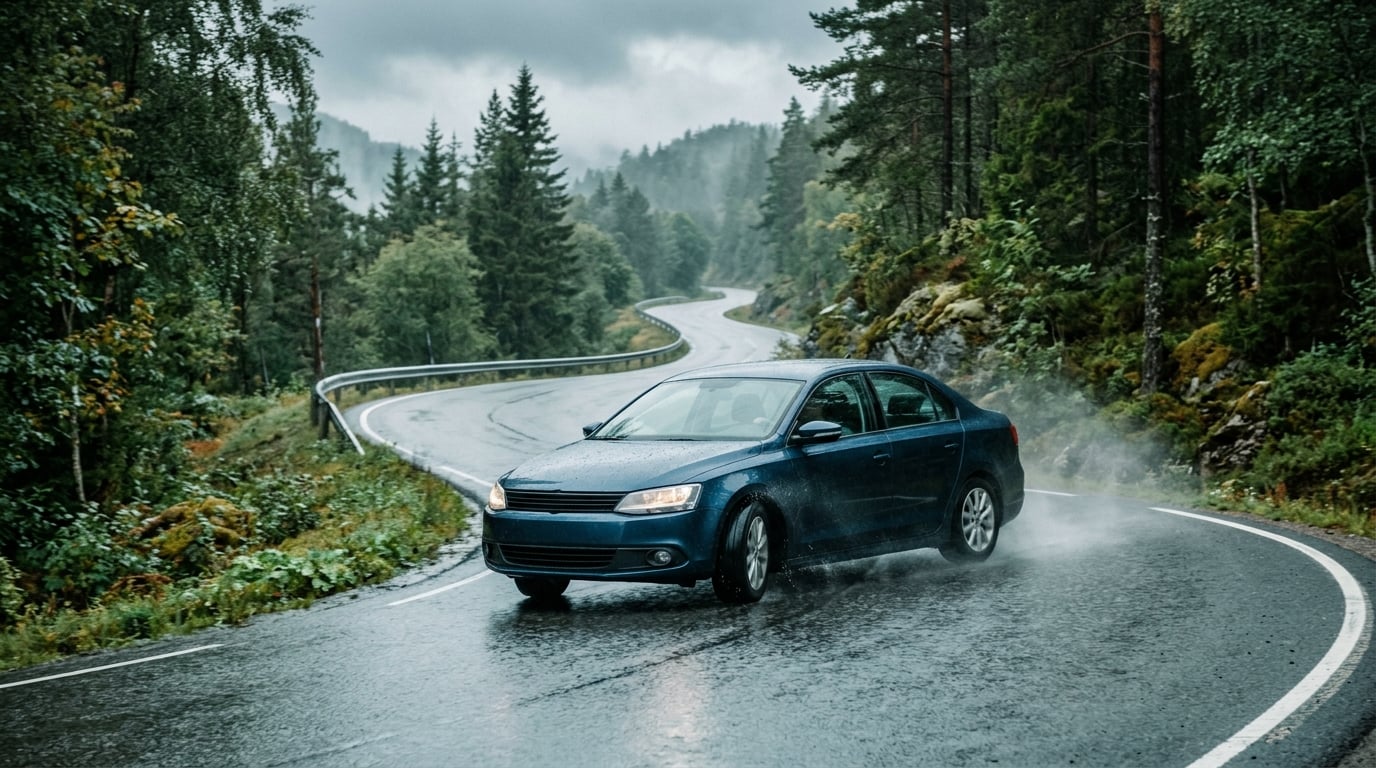
Learning how to correct oversteer and understeer comes down to one idea: take the load off the tires that have lost grip and put it back on the end that still has some. Understeer is the front axle letting go first, so the car turns less than you asked and pushes wide. Oversteer is the rear axle letting go first, so the tail steps out and the car rotates more than you steered. Everything else is detail.
Both corrections happen in the same handful of seconds, and neither one requires heroics. You lift, you look, and you make one small steering change at a time. The reason this matters is that a car at its grip limit is still recoverable; add a sudden input and a saveable slide becomes a spin or an excursion into a ditch.
Manufacturers set most street cars up to understeer on purpose, so feeling the front wash out on a wet roundabout is a car behaving as designed, not a fault. A little practice on a dry, empty surface is enough to feel the difference between the two. Updated for 2026, and framed for US roads, speeds and tire specs.
Table of Contents
- What You Need
- Step-by-Step: How to Correct Oversteer and Understeer
- Step 1: Identify Whether the Car Is Oversteering or Understeering
- Step 2: Reduce Speed and Reset Your Grip
- Step 3: How to Correct Understeer (Front-End Push)
- Step 4: How to Correct Oversteer Without Adding Too Much Lock
- Step 5: Use Weight Transfer and Steering Technique
- Step 6: Practice Until the Correction Feels Predictable
- Common Mistakes
- Frequently Asked Questions
- What is the most common cause of oversteering?
- Is it better to have oversteer or understeer?
- Why is my car swerving so much?
- Should I steer into an oversteer slide?
- Does electronic stability control help, and will it save me on ice?
- Do the same corrections work in a front-wheel-drive car and a rear-wheel-drive car?
- Conclusion
What You Need
You need a car you trust enough to practice in, a surface with room to be wrong, and roughly an hour. You do not need a track, an instructor, or any special equipment to learn the sequence. You do need pavement with grip, because learning a correction on ice teaches you nothing but adrenaline.
A roadworthy car. Working brakes, steering that does not clunk over bumps, a suspension that sits level, and four tires with usable tread. Grab the steering wheel and rock the car a little; if you hear a knock, or if the wheel feels vague, fix that before you practice handling. A worn ball joint, tie rod or strut changes everything the steps below assume.
Correct cold tire pressure. Check it with a pencil-type gauge in the morning, before you drive, while the tires are cold. Use the number on the door-jamb placard or in the owner’s manual, never the maximum printed on the tire sidewall, which is not a target. Add air while the car is cold and check again a week later; a tire that loses air is telling you something.
A tread check. Federal law requires 2/32 inch of tread on the whole circumference, and most tire makers and driving organizations recommend at least 4/32 inch before you expect real grip in rain. A quarter or a nickel in the groove is a decent stand-in. Tires wearing faster on one side, or the outside of a front tire feathering badly, point at alignment or a worn component rather than at your technique.
A safe practice area. A flat, dry, empty parking lot with room to drive in a wide circle, or a skid pad at a track on a quiet day. Start on a straight, then a circle, then a figure-eight, then gentle corner entry with some braking. Avoid public roads, avoid the first attempt in the rain, and keep a couple of cones as mental markers if it helps you judge the line.
The owner’s manual. Look up what stability control does in your car, whether it can be turned off, and what the tire placard says. Some systems cut throttle on their own during a slide; knowing that stops you from fighting the car.
If you plan to drive near the limit regularly, a professional instructor at a track day is worth the day. Coaches there use a cue worth stealing: initiate slowly, react quickly. Set the car up calmly, then move the wheel fast once the car is moving.
Step-by-Step: How to Correct Oversteer and Understeer
Step 1: Identify Whether the Car Is Oversteering or Understeering
Understeer means the front tires have exceeded their grip and the car will not follow your steering. The steering goes light or vague, the nose runs wide of the corner, and adding more lock does almost nothing.
Oversteer means the rear tires have let go, the rear axle steps out, and the car rotates more than you asked. The steering loads up and feels like it wants more from you, and the tail swings toward the outside of the corner.
Three things tell you which one you have: the path the car takes, how the wheel feels, and which end of the car moves first. Understeer pushes the whole car wide from the front. Oversteer rotates it around the middle, with the nose pointing slightly into the corner while the body keeps going straight.
Also note the phase. Understeer on the brakes is common and mostly a speed or entry problem. Oversteer on the throttle mid-corner, or the snap that happens the instant you lift off at high cornering load, is a rear grip problem and needs a different response.
Step 2: Reduce Speed and Reset Your Grip
Lift the throttle first, in every case. The reason is simple: power goes to the driven wheels, and if the driven end is the part that broke loose, more of it is the last thing you want.
Then take load off the tires that are sliding. In a corner, weight is already transferring to the outside tires; straightening the wheel slightly unloads the front or rear pair and lets them regain lateral grip.
Look at the corner exit, not at the front tires. Where the tire is pointed is a symptom; where the road goes is what steers the car.
How do you know it worked? The tire noise comes back, the body motion settles, and the car holds a line without you fighting the wheel. If the steering stays light, the tire is still on the limit, so slow down further.
Step 3: How to Correct Understeer (Front-End Push)
Understeer is usually forgiving. The car is still going roughly where you pointed it, just too wide, so the fix is mostly about patience and pressure.
- Lift off the accelerator. Coast or brake gently, and do not stamp on anything.
- Unwind the steering a little. A small reduction in steering angle reduces the front slip angle and lets the front tires bite again.
- Release or ease the brake pressure. On the brakes, a front-heavy car pushes wide because the front is carrying the load and the friction is fighting you. Rolling off the brake a touch before turn-in sharpens turn-in. On a manual car, a clutch dab works the same way.
- Let the car rotate, then wait. The nose will come around as grip returns. Do not add lock to hurry it; extra lock on a sliding front tire is the classic cause of a plowing car running into the shoulder.
- Reapply power gently and aim for the exit. Once the car is pointing where you want it, add throttle smoothly and let the rear follow.
On a wet or icy road, add more caution: earlier braking, a gentler entry, and more steering angle overall, because the front will hit its limit at a much lower speed. If it understeers on a dry road in the same corner every time, that is a setup problem, not a technique problem.
Step 4: How to Correct Oversteer Without Adding Too Much Lock
Oversteer is the one to respect. The rear has already let go, and every input that transfers load abruptly makes it worse.
- Ease off the throttle progressively. A gradual lift, not a snap. Slamming the pedal off at high cornering load is what causes lift-off oversteer, and sudden clutch or accelerator inputs in a manual car make it worse again.
- Look where you want the car to go. Your eyes drive the steering more than your hands do.
- Countersteer: steer into the slide. That means turning the front wheels in the direction the rear is sliding, so the front axle regains a usable slip angle and helps pull the car around. Add lock smoothly, in the amount the slide needs, not in the amount panic asks for.
- Modulate, do not grab, the brake. Light brake pressure can settle a slide, but grabbing the brakes locks the rears and takes away the steering you were counting on. On a manual car, stay in gear and feed the clutch rather than stabbing it.
- Catch it as it comes back. As the rear regains grip, unwind the countersteer and the car straightens. Unwinding too early spins you; unwinding too late snaps the car the other way.
A useful cue from the coaching world: initiate slowly, react quickly. Set the car up calmly, then move your hands fast. If the steering wheel goes light in your hands during the slide, you have added too much lock and are about to make it worse.
Step 5: Use Weight Transfer and Steering Technique
Weight transfer is why the correction works. Braking loads the front, throttle loads the rear, and cornering loads the outside tires. Grip is limited, so a tire cannot brake, corner and drive at full strength at the same time.
Brake in a straight line, then turn. Trying to brake and turn at maximum at the same time puts the front near its friction limit before it has even begun to turn, which is understeer written in physics. Lifting early and trailing the brake gently into turn-in loads the front progressively instead.
The same idea works with the throttle. A mid-corner stab of power asks the rear tires to drive while they are also carrying lateral load and trying to follow the corner, and the rear lets go. A rolling, measured throttle input keeps the rear inside its limit.
Trail braking is the same balance applied deliberately, and it is where a lot of forum advice about fixing understeer comes from. On r/driving, the useful description is to modulate the brake pedal out as the car comes up to turn-in, which lets the car turn while it slows. The same thread shows how quickly a hardware change can move the balance: one owner removed persistent understeer across turn-in, mid-corner and exit just by slowing down, then changed the feel completely by fitting a different front sway bar.
Step 6: Practice Until the Correction Feels Predictable
Progressive practice is the part most people skip. Do it in this order, and stop at each stage until it feels boring.
- Straight line, low speed: get the car to settle with a small lift, then return to throttle smoothly.
- Wide circle, steady throttle: feel weight move onto the outside tires and notice the steering load up.
- Figure-eight: small steering changes, constant speed, no brake. This is where you learn the car, not where you learn the limit.
- Corner entry with light braking: trail in, turn in, drive out.
- Progressively faster: only add speed when a stage is clean, and never in the rain first.
Speed Secrets coaches point to a skid pad rather than autocross for a reason: autocross corners are too short to hold a slide long enough to feel the correction come back. If you want to feel a rear step out and catch it, you need a wide, steady circle.
Success looks boring. Stable tire noise, controlled body rotation, no sudden correction, and the ability to hold a line without sawing at the wheel. If you are making constant small steering adjustments to keep the car straight, you are at the limit of the surface, and the answer is less speed.
Common Mistakes
These are the responses that turn a recoverable moment into a real problem. Most of them are reflexes, which is why they survive practice aimed at the wrong target.
Adding more lock when the car is understeering. The front tires are already sliding, so more steering angle just makes them slide more. Correction: lift, ease the steering back a touch, and let the nose come to you.
Over-countersteering in a rear slide. Adding a big stab of lock in the direction of the slide can spin the car. Correction: add lock smoothly, in small amounts, and watch the wheel for feedback; a steering wheel that suddenly goes light means you have passed the useful angle.
Stamping the brakes mid-corner. Locking the rears removes the steering you were relying on and makes a spin far more likely. Correction: either do not brake, or use light pressure you can modulate. Safety note: on ice, a locked wheel has almost no steering effect at all, so braking hard and turning is the worst possible combination.
Slamming the throttle back in. Mid-corner power or a sudden stab re-loads the rear exactly when it is weakest. Correction: return to throttle in a smooth rolling input, or stay off it entirely while the car recovers.
Looking at the front tires. Chasing the front wheels destroys your view of the corner exit, and the exit is where the car ends up. Correction: eyes up and out of the corner.
Ignoring tire pressure and tread. Underinflation flexes the sidewall and overheats the tire; overinflation shrinks the contact patch and makes it harsher. Tires below the legal 2/32 inch have no business in a rainstorm, and around 4/32 inch is a more realistic floor for real grip in the wet. Correction: check cold pressures against the door sticker and check tread before the season changes, not after a slide. NHTSA’s TireWise page is a good free reference.
Practicing on public roads. An empty parking lot at 15 mph teaches the same reflex at 15 mph. Correction: pick a legal, empty, flat space, or book a track day.
Treating a mechanical fault as a driving habit. A wandering car, a steering wheel that does not self-center, a tire wearing to a feathered edge, or a knock over bumps points at alignment, worn suspension parts or a bent rim, not at your technique. Correction: check free play at the wheel, compare tire wear across the axle, and have alignment checked before blaming yourself. Owners on r/MechanicAdvice and r/AskMechanics make the same point from the shop side, and a tech declining a tire rotation is how you end up with a front-heavy car that understeers by default.
One more that shows up constantly in forum threads: assuming alignment or a sway bar change is a substitute for slowing down. Setup work is worthwhile, and miata.net regulars are right that raising rear tire pressure can shift the balance. It is still the second move, not the first. Slow down, then see what the car is telling you.
Frequently Asked Questions
What is the most common cause of oversteering?
The most common cause is grip loss at the rear axle, and in ordinary driving it is usually a tire condition rather than a broken car. Worn or underinflated rear tires, a tire that has lost its alignment, or a sudden throttle input in a corner all reduce rear grip. On forum.miata.net, owners point to rear tire pressure and driving style as the two levers they actually control. If oversteer appears suddenly on a car that used to be fine, have tires, pressure and alignment checked before anything else.
Is it better to have oversteer or understeer?
Understeer is safer for everyday driving, and manufacturers design most street cars that way on purpose. A car that pushes wide gives you a warning and keeps sliding in roughly the direction you were already travelling, so the car stays where you expect. Oversteer rotates the car, which means a spin or a change of direction you did not ask for. Track drivers deliberately chase oversteer because a car that rotates can be balanced with throttle and steering, but that is a skill built on a skid pad.
Why is my car swerving so much?
Run this list in order. Check cold tire pressure against the door sticker. Compare tread depth across the axle, since a heavily worn inside edge points at alignment. Feel for steering free play, which suggests a worn tie rod or ball joint. Listen for knocks over bumps, which point at a strut or sway bar link. Watch the car on a straight level road: a pull that gets worse with speed or that returns after alignment is a bent rim or a worn component. Slowing down fixes the symptom, not the cause.
Should I steer into an oversteer slide?
Yes. Countersteering means turning the front wheels toward the direction the rear is sliding, so the front axle regains a usable slip angle and helps pull the car around. Add lock smoothly and in small amounts rather than stabbing at it, keep your eyes on where you want the car to go, and unwind as the rear grips again. Unwinding too early spins the car, and adding too much lock oversteers it further.
Does electronic stability control help, and will it save me on ice?
Stability control helps a lot on good tires and normal roads. It uses sensors to detect unintended rotation and applies brakes to individual wheels to keep the car pointed where you want it, and the rule it enforces under federal standard FMVSS 126 is essentially no excessive yaw. Its limit is grip: on worn tires or ice there is nothing to transfer, so it can only make a slide shorter, not prevent it. Tire quality still decides the outcome.
Do the same corrections work in a front-wheel-drive car and a rear-wheel-drive car?
The sequence is the same in both, but the balance is not. Front-wheel-drive cars are set up to understeer because drive and steering share the front tires, so the usual problem is front-end push. Rear-wheel-drive cars are more prone to power oversteer, where throttle opens the slide. All-wheel drive sits between them. Either way, the first move is the same: lift the throttle, look at the exit, and make one small steering change.
Conclusion
When the car starts to go, do four things in order. Lower the speed. Work out whether the front or the rear is the end that lost grip. Make one input at a time, and make it smooth. Then let the car come back to you rather than chasing it with more lock.
Slow down first, always. If the same corner keeps producing the same limit every time, that is tires, pressure, alignment or a worn component, and it is worth a shop visit rather than more courage. If you want to go faster than the road allows on purpose, learn it on a skid pad with an instructor, where a slide is a lesson instead of an incident.