
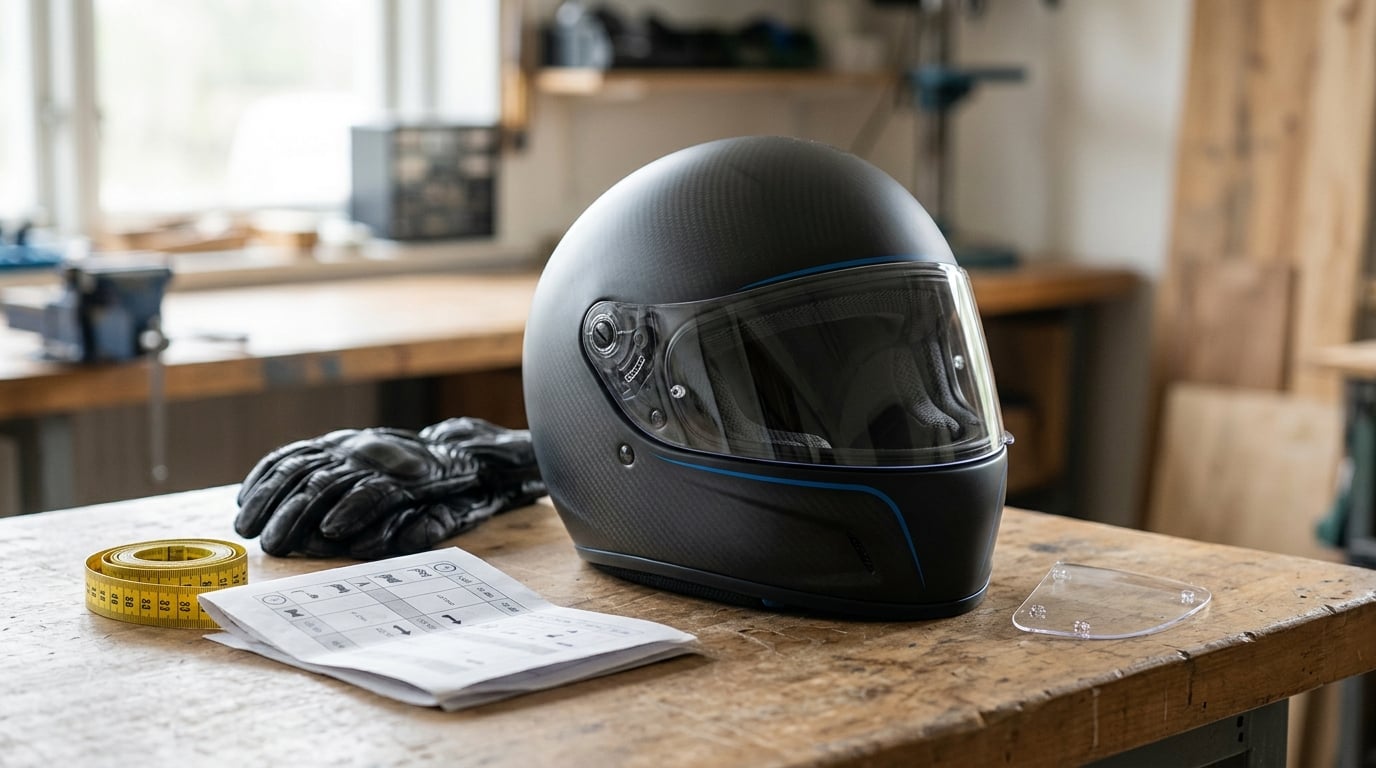
Most people buy a track-day helmet backwards. They pick the color, then the brand, then try to argue that whatever is in the garage will do. Work in the opposite direction and the decision gets easy: read the rulebook of the event you want to enter, match the certification label sewn inside the helmet to that rulebook, measure your head, then try the helmet on and keep it on for half an hour. The whole process takes an afternoon and it removes almost every expensive mistake.
The reason this matters is that the crash does not care which standard you shopped to. A barrier impact at 120 mph puts forces through your head that a helmet was never tested for, and a helmet that has been dropped once may never protect you properly again even if it looks perfect. Here is the seven-step process experienced track drivers use, starting with the rulebook and ending with the purchase itself.
Table of Contents
What You Need to Find the Right Helmet for Track Days
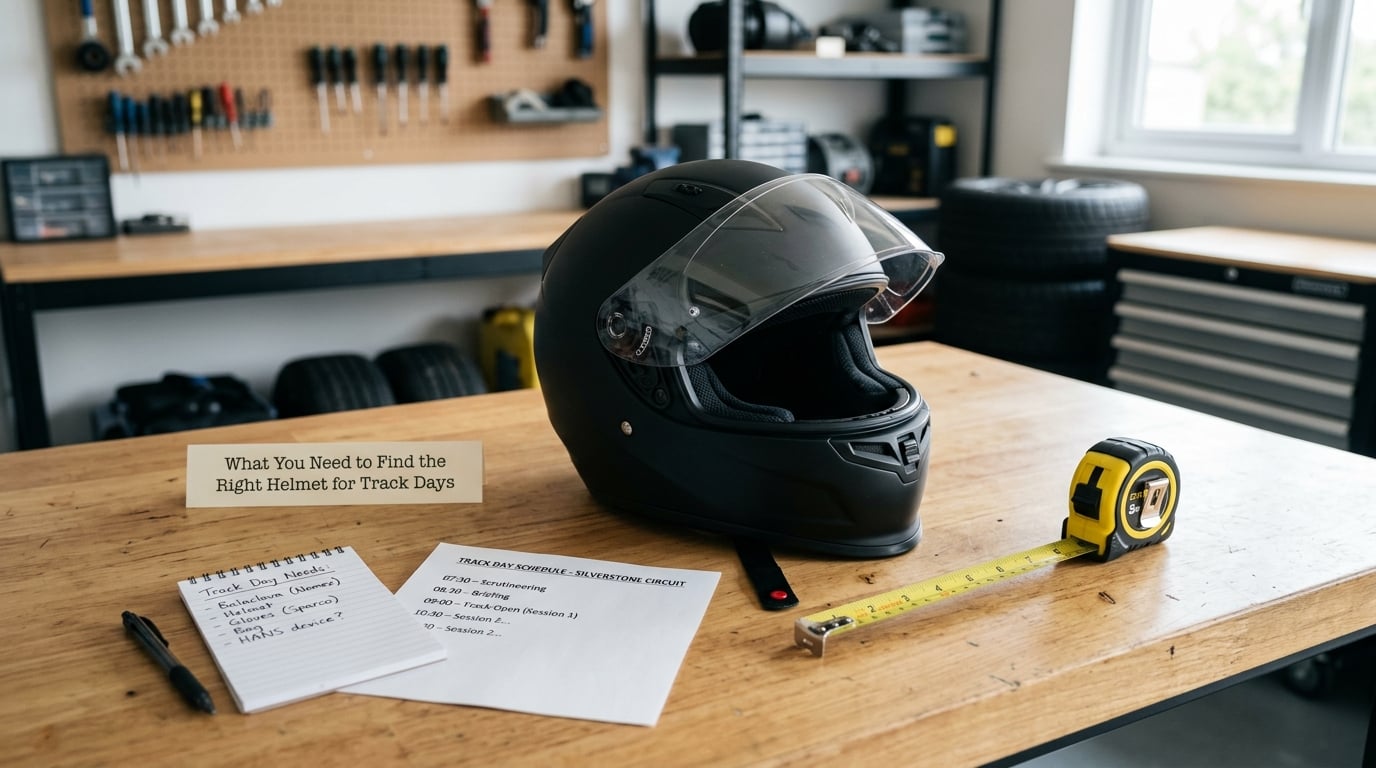
Before you open a single product page, gather five things. First, the rulebook of the event: the track operator or the club that runs the night publishes the minimum standard, and that document outranks anything a shop employee tells you. Second, your head measurement in centimeters. Third, the kind of day you are buying for, which ranges from a one-off introduction lap to a full season of club racing.
Fourth, the rest of your gear. A helmet with HANS or FHR posts is only useful if you also own the restraint, and a helmet with tear-off posts is useless if you plan to run the street car without a windshield. Fifth, your climate. A track in Phoenix in July and a track in Ohio in April punish the same helmet in completely different ways.
Two optional items are worth having with you when you shop. A soft tape measure rather than a rigid one, because you will be measuring around your head, and your event’s rules page saved on your phone so you can check a certification claim in the parking lot.
Decide the budget too, but frame it as a range for the whole kit rather than a single number for the helmet. Helmet, restraint, gloves, suit, balaclava and shoes together decide whether you can afford the season or just the first weekend. Guides from racing retailers cover the supporting kit separately, and it is the part first-timers forget until the morning of the event.
Step-by-Step: How to Find the Right Helmet for Track Days
1. Define Your Track-Day Use
Write down what you will actually be doing, because it changes the answer more than any other single factor. A first-time introduction lap in a street car on an open paddock circuit is a gentle day. A high-performance driver education session with an instructor in a passenger seat, mixed with two other cars, is not.
Club racing and time attack add requirements most track-day newcomers never hear about: a valid certification with a specific year, a restraint for the shoulders, a fire-resistant balaclava and suit, and sometimes a medical card. Autocross, by contrast, is much closer to a street event, and the SCCA accepts Snell-certified helmets of M or SA classification for it.
Karting has its own standard and its own scale. A karting helmet is built for a different impact profile and will not satisfy a road-course organizer, so never plan to buy one helmet for both disciplines.
2. Check Safety Certification
This is the step people skip, and it is the only one track staff actually check. The label is stitched into the liner, usually behind the ear or under the crown padding, and it names the standard the model passed as a complete unit. If the label is missing, the helmet fails, no matter how good it looks or how well-known the brand is.
| Standard | What it covers | Who accepts it | Typical use |
|---|---|---|---|
| Snell SA2020 | Auto racing, Special Applications; tested for impact, penetration and roll-bar use | Most US track events and road-racing sanctioning bodies | Road course, HPDE, club racing |
| Snell SA2025 | Current Snell auto standard, in force since October 2025 | The same bodies that accept SA2020 | Same uses; see the transition note below |
| Snell M2020 | Motorcycle standard | Some events accept it, many do not | Street and motorcycle riding |
| Snell K2025 | Karting standard | Karting bodies only | Karting |
| FIA 8859-2015 or 8859-2024 | FIA road standard with added testing | International FIA and FIA-affiliated events | Club and national competition worldwide |
| FIA 8860-2018 | Advanced FIA standard; shell-strength and mass testing | FIA championship and professional series | Pro racing, and the safe default for serious amateurs |
| FIA 8860-2018 ABP | 8860-2018 plus advanced ballistic forehead protection | FIA events in open-cockpit cars | Formula cars and open wheelers |
| ECE 22.06 | European road and motorcycle standard, more impact points and rotational testing than 22.05 | Europe; US tracks only by written exception | European road use |
| DOT FMVSS 218 | US minimum for motorcycle and bicycle helmets sold in the US | US law for road use; almost never accepted on track | Street riding only |
Notice the pattern. Snell standards dominate the US club and track-day scene, FIA standards dominate international and professional competition, ECE 22.06 is a European road standard, and DOT FMVSS 218 is a street standard that carries no track meaning at all. ECE 22.06 is a genuinely good helmet standard, but it is not accepted on most US circuits, so do not assume a European import will pass inspection.
To verify anything beyond the sticker, look the model up on the Snell Foundation’s published list of certified models or in the FIA homologation database. If the model number is not there, it was not certified under that name. That check takes a minute and it catches mislabelled and grey-market copies.
3. Measure Your Head Correctly
Measure your head circumference in centimeters, because the racing sizing charts are built on metric measurements and converting back and forth causes errors. Wrap a soft tape just above your eyebrows, level across the forehead and around the widest point at the back, keeping it snug without pinching.
Then measure front to back, from the most forward point of your brow to the back of your skull. Two people with the same circumference can have different front-to-back depth, which is why the width alone never settles the choice.
Head shapes also run wider or longer within one nominal size, and brands differ about how loose they intend a helmet to be. Treat the manufacturer chart as the starting point, then trust what the shell does around your cheeks and temples when you wear it. Most fitting problems are not sizing errors; they are someone forcing a chart instead of the shell.
4. Compare Helmet Types
Full-face is the default for track days, and the reason is the chin bar. Most racing impacts in closed-cockpit cars hit the front or side of the head, and a full-face shell spreads that energy across the strongest part of the structure. Open-face helmets are legal in many disciplines and lighter to wear, but they leave the chin and jaw to the headrest, which does not protect them.
| Type | Protection | Visibility and noise | Track-day fit |
|---|---|---|---|
| Full-face | Chin bar, full shell coverage; the usual track choice | Wide eyeport, quietest when sealed, best for visor seals and comms | Best default, especially for a street car or an open car with no cage |
| Open-face | Crown and sides only; chin depends on the harness | Maximum airflow, no ear cup, highest noise | Common in older karting and entry-level stock-car fields |
| Modular | Full coverage with a hinged chin bar | Heavier, more mechanism to wear | Convenient on the road, rarely seen on track |
If your car has a roll cage, a full-face helmet is more practical because there is no windshield to worry about, and the shell geometry suits the cage rather than the road. If you drive a street car, keep in mind that a visor left open at speed makes noise that turns a 45-minute session into a headache, so plan on either a good sealing visor or a dark internal sun shield.
Whatever type you choose, check the eyeport. You need to see the apex, the mirrors and your instructor’s hand signals. A narrow eyeport feels claustrophobic in the shop and unusable at 100 mph.
5. Test Fit and Comfort
Put the helmet on and keep it on for around 30 minutes before deciding anything. This is the single most repeated piece of advice across the BMW M3 and M4 forum and Rennlist track-day threads, and it works because the cheek pads compress and mould to your face over time, so a helmet that feels slightly tight at minute two often feels right at minute twenty-five.
Use the 2-2-2 check while you wait. Put two fingers above each eyebrow, two fingers on the cheek pads, and you should feel firm contact there with no gaps. Then do the shake test: grab the shell and shake your head, and the helmet should stay planted with no noticeable lift.
Now check the details that show up during a session rather than in the shop. Can you reach the visor’s release with a gloved hand? Does the chin curtain stay put or does it flap into your eyes? Can you hear your instructor and your spotter? Do the ear pockets rub? Is there any pressure point at the brow or the back of the skull that you can already feel pulsing?
Noise deserves more weight than it gets. Wind noise at track speed is loud enough to fatigue you, and a helmet you can hear through is a helmet you will keep wearing on session four. If you can, try a model with ear cups rather than deciding on looks.
6. Choose Features That Add Value
Work down this list and be honest about what you will use. A visor that seals well and pivots clear of the shell beats a fancier mechanism every time. A clear visor for day sessions, a dark one for glare, and a tear-off stack for dusty or smeared-visor sessions, each with posts on the helmet to hold them.
Anti-fog matters more than buyers expect. Perspiration is constant on track, and the standard fix is a pinlock-type insert plus a good airflow setting rather than a chemical coating that fades. Check whether the vents actually move air across the brow, because a helmet can have four vents and still be stuffy.
Next, the liner. Removable, washable cheek pads and crown padding matter most if you share a car, wear glasses, or expect the helmet to last several seasons. A replaceable liner also turns a used helmet from a gamble into a reasonable option.
HANS or FHR compatibility is worth checking before you buy, not after. Two small tether posts on either side of the shell let the helmet work with a head and neck restraint, and a restraint is close to mandatory once you move into club racing. Plenty of budget helmets simply lack the posts, and adding them later is not possible.
Communications are a real feature in 2026. Instructors often run full-face helmets with integrated comms so they can talk to every car in the run group, and a helmet without a comms pocket or a place to route an earpiece forces an external microphone stuck to the shell. Check whether the ear pockets are sized for ear cups before you commit.
Aerodynamic pieces such as spoiler kits and rear wings matter only at higher speed and mostly for stability and reduced neck fatigue on straights. They are not a safety feature, and they are the first thing to skip when the budget is tight.
7. Set the Budget and Make the Final Check
Split your spending into three tiers rather than picking one number. At the entry tier, you are buying a certified composite or polycarbonate full-face shell with the correct Snell or FIA label, a sealed visor and tear-off posts, and that is genuinely enough for most track days. At the middle tier you add lighter shell material, better ventilation and noise control, a better anti-fog insert and comms integration. At the upper tier you are paying for carbon construction, lower mass, advanced aerodynamics and the newest homologation, which buys comfort and headroom in a long season rather than basic compliance.
Buying to the racing standard when your track only asks for something less is the safer default, because track-day rules are often looser than the crashes justify. Do not do the opposite, though, and overspend chasing carbon when you drive two sessions a year.
One standards note that is confusing people right now. Snell introduced SA2025 in October 2025 and lowered the peak G transmitted limit to 275g for every shell size, where earlier versions allowed a higher figure for smaller helmets. The Snell Foundation’s own guidance has been not to discard working SA2020 helmets simply because the newer standard exists, so an existing SA2020 helmet is not suddenly illegal or unsafe at an event that accepts SA certification. Buy new when your old helmet reaches the end of its service life or its condition declines, not because a date on a website changed.
| Point | SA2020 | SA2025 |
|---|---|---|
| Peak G transmitted limit | Higher allowance for smaller shell sizes | 275g across all sizes |
| In force since | 2020 cycle | October 2025 |
| Still valid at events accepting SA helmets | Yes | Yes |
| Should you replace a good SA2020 helmet now | No, not on standard change alone | Not applicable |
Buying used needs three checks. Read the manufacture date from the label, since most standards expect a shell to be retired after roughly five years and far fewer after a hard impact. Ask directly whether the helmet has ever been dropped or hit hard, because composite shells and liners can be structurally damaged while still looking perfect, and any credible seller will answer. Then confirm the liner and cheek pads can be replaced, or replace them.
Final checks before you pay: confirm the exact model number appears on the certification body’s published list, confirm the liner and padding come out and go back in, confirm the retailer will accept a return or exchange for fit, and confirm the event accepts that standard in the version you are buying. Ask for the rulebook page if the shop cannot answer the last one.
Common Mistakes When Choosing a Track-Day Helmet
Buying on appearance or color. Graphics are the last thing in the decision and the first thing most people look at. The shell that matters is the one with a legible certification label inside it. Judge the label first, then judge the fit, then buy the color you like.
Assuming a road standard is enough. DOT FMVSS 218 is a legal street standard and nothing more. Many US tracks will turn you away with one, and ECE 22.06, while a strong standard, is not automatically accepted outside Europe. The track’s own rules page decides.
Buying online and hoping the return policy saves you. Fit is the highest-influence decision in this whole process and the one most often delegated to a return window. Two people can measure identically and still need different shells. Try first, then order.
Choosing a loose fit to be comfortable. A helmet that shifts when you shake your head lets the liner move independently of your skull, which is exactly what it must never do. Snug is the goal; the 30-minute break-in exists so snug stops meaning painful.
Ignoring the event rules until the morning of the day. Organizers check at the gate, and a rejected helmet means a missed session and sometimes a missed day. Read the rules the week before, not in the paddock queue.
Overbuying or overspending early. First-timers often get steered toward carbon race helmets when a certified composite full-face would have covered a season perfectly. Conversely, people who set aside nothing for a restraint, gloves or a suit discover the budget on Saturday morning. Decide the split before you shop.
Forgetting maintenance. Keep the helmet away from heat, drop it nowhere near a garage floor, clean the liner when the sweat starts to smell, and inspect the visor and trim for cracks. A track day helmet lives or dies on care between events.
Frequently Asked Questions
What certification should a track-day helmet have?
Read the event rules first, because the organizer sets the minimum. Most US road-course events accept Snell SA2020 or SA2025 for cars and Snell M2020 for motorcycles, while FIA 8859-2015 or 8859-2024 covers international competition. The label sewn inside the liner tells you which standard the model passed, and checking the model number on the certification body’s published list takes a minute.
Should I buy a used track-day helmet?
Only with three checks completed. Read the manufacture date and expect roughly five years of service for a shell, fewer after any hard impact. Ask directly whether it has ever been dropped or hit hard, since hidden liner damage is common and invisible. Confirm that the cheek pads and liner can be replaced, and buy used only from a seller who answers all three questions without hesitating.
How often should a safety helmet be replaced?
Replace a full-face helmet about five years from the manufacture date as a sensible default, and replace it immediately after any significant impact regardless of date. A new certification standard is not on its own a reason to discard a good helmet: the Snell Foundation advises against throwing away working SA2020 helmets simply because SA2025 exists. Replace on condition and age, not on a website date change.
Is a full-face helmet better for track days?
For most drivers, yes. The chin bar is the strongest part of a helmet shell and closed-cockpit impacts hit the front or side of the head, so full-face coverage spreads the energy where the structure is strongest. It also seals quieter, keeps visors and comms simpler, and suits a car with a roll cage where no windshield is in the way.
Can I use a road helmet for a track day?
Sometimes, but confirm before you buy. Many US track organizers require Snell SA or M certification and will inspect the label at the gate, so a DOT FMVSS 218 helmet is usually refused. ECE 22.06 is a strong European road standard but is not automatically accepted on US circuits. Some street and sports car events allow a current road helmet with a full stock harness, so the rules page is the only reliable answer.
How do I choose the right helmet size?
Measure your head circumference in centimeters just above the eyebrows, then measure front to back from your brow to the back of your skull, and compare both against the brand’s racing sizing chart. Head shape varies within a nominal size, so try the shell and confirm with the 2-2-2 check: two fingers above each eyebrow and two on each cheek pad with firm contact. Keep it on for 30 minutes before deciding.
Conclusion
Find the right helmet for track days in this order. Read the event rulebook and learn who sets the rule. Match the certification label inside the helmet to it, and verify the model on the published list. Measure your head, try the shell on, and wear it for 30 minutes. Check comfort, noise and visibility once the pads have moulded. Pick features that earn their place, starting with HANS or FHR posts. Finally, confirm the condition, the manufacture date and the return policy before you pay.
Do the first two steps before you fall in love with anything, and the rest gets easier.