
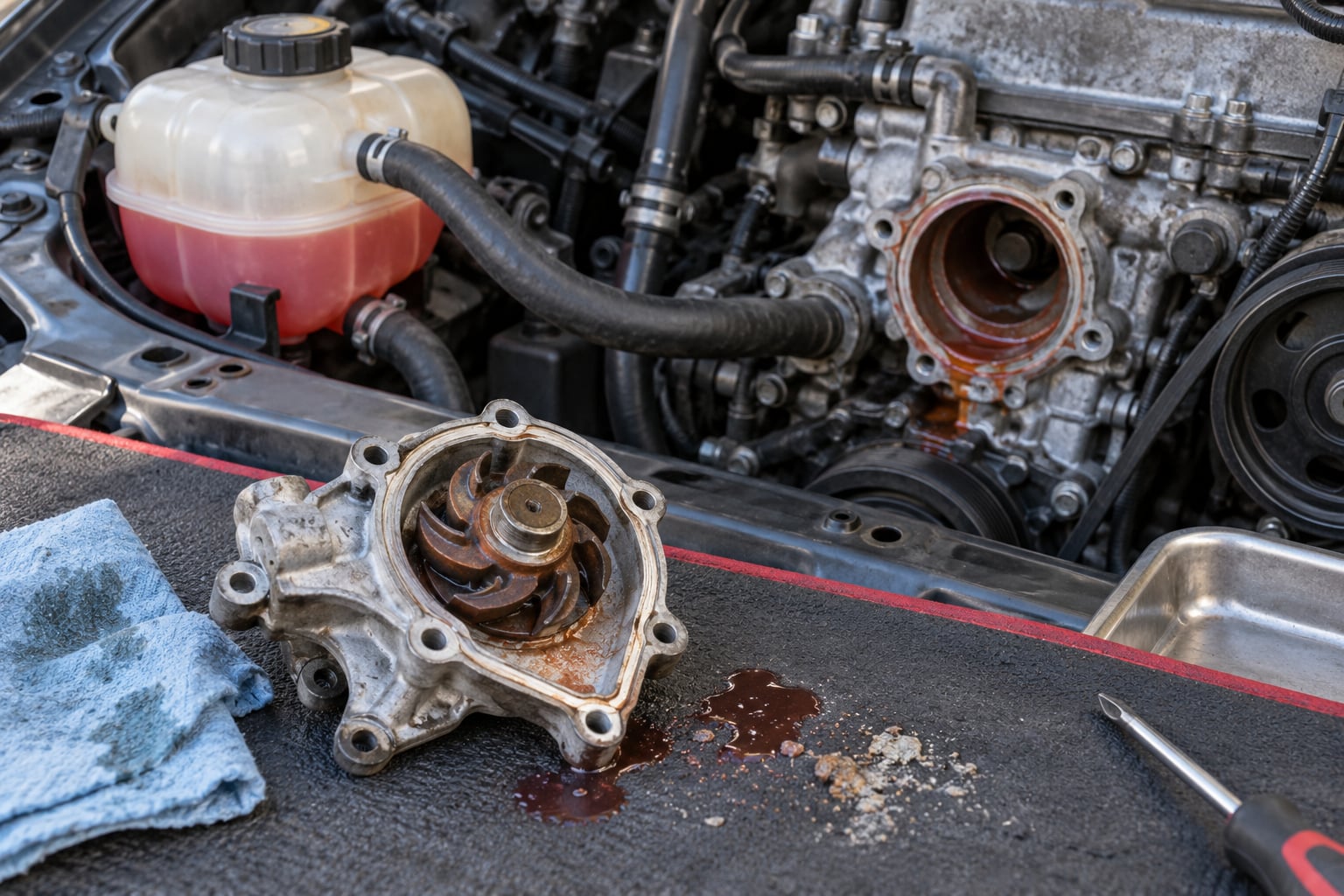
A failing water pump is one of those faults that gives you a warning long before it gives you a problem. The signs most owners notice first are a slow coolant loss at the front of the engine, a new whine from the timing area, and a temperature gauge that climbs in stop-and-go traffic but settles back down on the highway. Two symptoms mean stop driving now: the needle entering the red, or steam under the hood.
The pump is a simple part, but it is the only thing moving coolant through the engine, and BMWs are unforgiving when coolant stops circulating. Here is how the failure actually presents, where the fluid escapes, and how to separate a bad pump from the thermostat, radiator, fan clutch, and head gasket problems it gets blamed for constantly.
Table of Contents
- What Does a Failing Water Pump Do?
- Water Pump Failure Symptoms: 8 Signs to Watch For
- 1. Coolant Leaking Near the Water Pump or Front of the Engine
- 2. Engine Overheating or a Rising Temperature Gauge
- 3. Whining, Grinding, or Rattling From the Engine Area
- 4. Sweet or Strong Coolant Odor Under the Hood
- 5. Temperature Gauge Fluctuates Erratically
- 6. Cabin Heater Stops Producing Heat
- 7. Front of Engine Has Heat Damage, Staining, or Wet Residue
- 8. Coolant Level Keeps Dropping Without an Obvious External Leak
- Water Pump Failure Causes on BMWs
- How to Tell a Water Pump Problem from Other Cooling-System Problems
- What to Check Before Replacing a BMW Water Pump
- BMW Water Pump Replacement: What the Repair Involves
- Can You Drive With a Failing Water Pump?
- Frequently Asked Questions
- Conclusion: Check the Coolant System Before the Engine Overheats
What Does a Failing Water Pump Do?
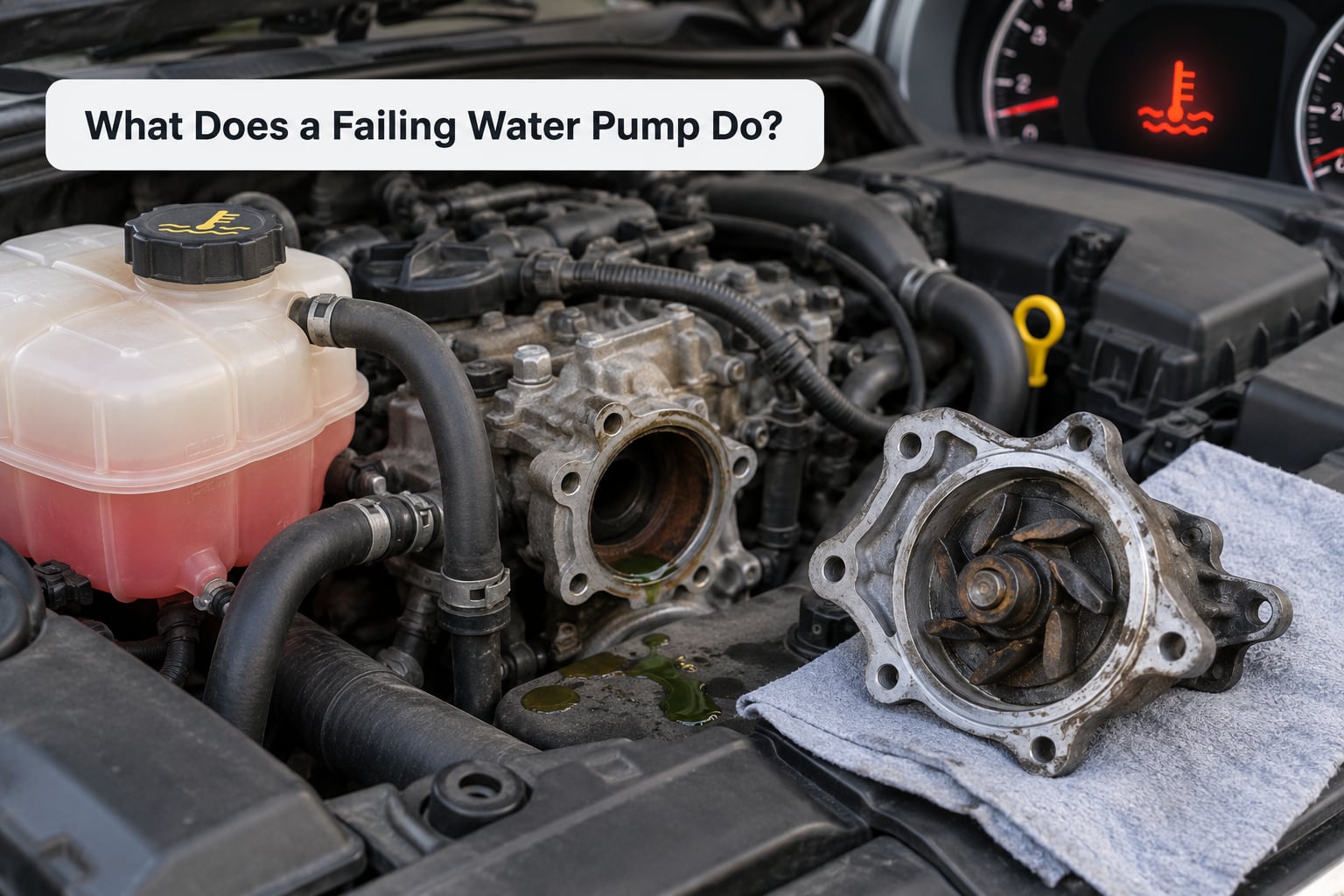
The water pump is the piece that keeps coolant moving. It spins an impeller that pushes coolant out of the block, through the radiator to shed heat, and back into the engine to pick heat up. It also drives the heater core and, on many layouts, recirculates coolant through the oil cooler. When the impeller, the shaft bearing, or the housing seal fails, flow drops and heat has nowhere to go.
That matters more than most people expect. Coolant does not boil away cleanly when the system is pressurized and moving, so the classic pump failure is not an instant boil-over. It is a gradual loss of circulation, a temperature that wanders, and coolant escaping wherever the seal has given up. On BMW inline engines the pump is usually at the front of the engine driven by the timing chain or belt; on newer models with electric pumps, the motor itself fails and the pump can stop with the engine off.
The practical point is this: a pump that is only weeping is a clock, not an emergency. A pump that has stopped moving coolant is an emergency, because a BMW cylinder head can warp or crack within minutes of running hot.
Water Pump Failure Symptoms: 8 Signs to Watch For
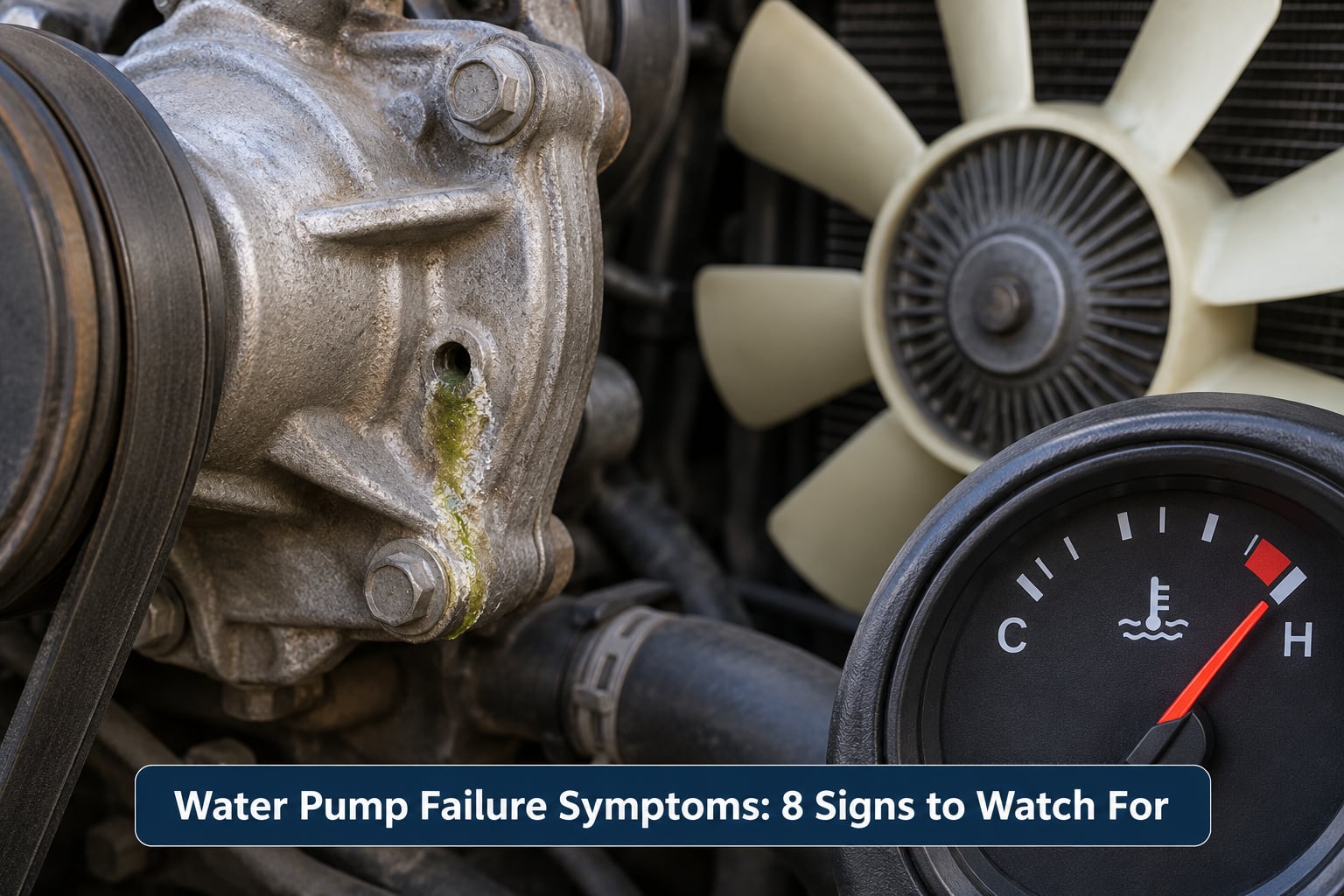
These eight symptoms are ordered roughly by how often they show up and how much they tell you.
1. Coolant Leaking Near the Water Pump or Front of the Engine
A stain or drip at the front of the engine is the most reliable visual clue you will get, and it usually appears long before the gauge moves. On many transverse-engine BMW layouts the pump sits toward the passenger side, so the drip shows up underneath that corner first.
Look for the weep hole at the housing or a wet ring around the pump bolts. Coolant is sticky, stains rust and concrete, and smells sweet or bitter. Condensation from the air conditioning drips from a different, higher point, is clear rather than colored, and appears after the car has been parked in humid weather with the air conditioning running.
Do this inspection on a cold engine. Pressing a hose clamp or touching a hot fitting can scald you, and opening anything on a hot system releases pressurized coolant.
2. Engine Overheating or a Rising Temperature Gauge
When the pump can no longer move coolant, the radiator cannot pull heat out of the engine no matter how clean it is or how fast the fans run. The gauge climbs, the coolant warning light comes on, and if you keep driving the head gasket or the head itself can fail.
The pattern is the useful part. Overheating only in traffic, and normal once you get up to highway speed, points hard at circulation. Overheating at every speed, including highway, more often points at the radiator, the fan, the cap, or the thermostat. Overheating under load on a highway drive usually means a radiator or head gasket problem instead.
3. Whining, Grinding, or Rattling From the Engine Area
A dry shaft bearing inside the pump sounds like a whine or a growl that rises and falls with engine speed, because the bearing is spinning faster every time you rev. A worn serpentine belt squeals steadily and does not always change pitch. A rougher, electrical-sounding whine that gets louder with load can be the alternator, and a flutter with a squeak at idle is often the belt tensioner or an idler pulley.
MBWorld owners describe the pump signature as a funny whining noise during acceleration that is clearly coming from the front of the engine. They also note that on some Mercedes engines a leaking pump sat for a long time before any bearing noise appeared, and that a clunking bearing could be present while the engine still ran perfectly.
4. Sweet or Strong Coolant Odor Under the Hood
Coolant smell is one of the earliest things drivers notice, and it usually means a small leak you cannot see yet. The odor comes from a mist of coolant aerosol that forms where fluid hits a hot metal surface, which is exactly what happens at a weep hole or a weeping housing seal.
Smell means go look at the front of the engine soon. A small weep handled today is a seal and a coolant top-up. The same weep handled in a month is a pump on a cold engine and a radiator that no longer reads at all.
5. Temperature Gauge Fluctuates Erratically
Unstable circulation produces an unstable reading. The needle hunts up and down, the fan cycles on and off oddly, and the car seems to run warm one minute and normal the next. Compare that against what the car used to do, because many BMWs sit slightly above the midpoint mark by design and always have.
A small temperature rise in the seconds right after you shut the engine off is heat soak, not a pump fault. The coolant is still circulating into a stopped engine and the sensor reads the hottest part of the cycle. Forgetting that costs people a lot of unnecessary worry and sometimes an unnecessary repair.
6. Cabin Heater Stops Producing Heat
The heater core is a small radiator fed by the same pump. If flow drops, the cabin heater goes weak or cold even though the engine is running normally, and the blower sounds fine while the air stays cool.
Cold cabin heat on its own does not mean a bad pump. A stuck heater control, a blend door, or a plugged heater core looks identical from the driver’s seat. It only becomes evidence when it shows up alongside overheating, coolant loss, or a new noise at the front of the engine.
7. Front of Engine Has Heat Damage, Staining, or Wet Residue
Pull the fan shroud aside and look at the pump face, the housing, and the bolts. Fresh coolant leaves a wet sheen and a colored stain. Older, slower leaks leave crusty white or green mineral deposits and rust staining on the aluminum. Pitting on the pump face means coolant has been sitting on the metal long enough to corrode it.
Heat discoloration on adjacent plastic or rubber, and residue on the underside of the radiator or the fan shroud, point the same direction. Anyone replacing a pump should look for this evidence, because it tells you the leak was there for a while rather than an hour.
8. Coolant Level Keeps Dropping Without an Obvious External Leak
If the reservoir is low every week and there is no puddle under the car, something is leaking internally or evaporating slowly enough that you never see it. Common internal candidates are a head gasket letting combustion gas into the coolant, a heater core weeping into the cabin where the A/C evaporator drains it away, and transmission cooler lines that share the same fluid circuit.
The system is pressurized, so it can hold coolant for a long time before it shows outside. Do not treat repeated top-offs as a fix. Note the mileage at each fill, keep track of whether you are adding coolant or plain water, and get it pressure tested. Drivers on the BMW forums ask this question constantly, and the answer is almost always diagnose it rather than keep pouring.
Water Pump Failure Causes on BMWs
Knowing why the pump died helps you judge how much life the replacement has and whether something else in the cooling system needs attention at the same time.
1. Seal and gasket failure: the housing seal, the O-ring, or the gasket between the pump and the block hardens and lets coolant out. Heat cycles do most of this damage.
2. Worn shaft bearing: the bearing runs dry, the noise gets louder, and eventually the pump seizes. A seized pump on a belt-driven setup can take the belt with it, and on some cars that also takes power steering with it.
3. Corrosion and mineral buildup: neglected coolant, the wrong coolant, or coolant mixed with plain water leaves deposits that eat at the impeller and the housing.
4. Damaged impeller: plastic blades crack or shear off, often from corrosion or from debris in the coolant. Flow drops and the pump can leak at the same time.
5. Incorrect installation: bolts torqued in the wrong order or too tight can distort the housing, and a dry or wrong coolant mix at installation shortens the new pump’s life immediately.
6. Age and service life: pumps are commonly expected to last somewhere around 100,000 miles, with neglected examples failing far earlier, in the 60,000 to 90,000 mile range.
One caveat: the failure pattern is not identical across BMW model years and engine layouts. Older engines with belt-driven pumps fail as seals and bearings. Newer BMWs increasingly use electric water pumps, which fail as motors and electronics, can run with the engine switched off, and store dedicated codes rather than announcing themselves with a puddle.
How to Tell a Water Pump Problem from Other Cooling-System Problems
Overheating has about six plausible causes and owners usually have no way to rank them. This is the comparison that ranks them, using the symptoms each fault actually produces.
| Symptom | Water pump | Thermostat | Radiator or fan fault | Head gasket |
|---|---|---|---|---|
| Coolant visible at front of engine | Yes, usual clue | Rare | Possible at cap or hose | Usually no |
| Hot at idle, normal at highway speed | Strong match | Weak match | Possible at low speed only | Unlikely |
| Hot at every speed, including highway | Less likely | Yes, classic | Yes | Yes |
| Heater blows cold air | Possible | Possible | Possible | Possible |
| Whine or growl with throttle | Yes | No | Fan clutch noise only | No |
| Sweet smell, no visible puddle | Possible | Possible | Possible | Often yes |
| Coolant loss with no puddle | Possible | Possible | Possible | Common |
| White exhaust smoke, bubble in radiator | No | No | No | Yes |
A few other faults mimic the pump more than people expect. A radiator cap that does not hold pressure looks like a pump leak. A cooling fan clutch that stops pulling air makes an idle-heavy car overheat and leaves the highway alone. A low system from an air pocket after a coolant change behaves like a leak. And if your BMW has electric pumps, a pump that runs with the ignition on and the engine off proves nothing about its health.
Before condemning the pump, run a block test. It is a chemical test for combustion gas in the cooling system, it takes minutes, and it is the cheapest way to rule out a head gasket before you start replacing parts.
What to Check Before Replacing a BMW Water Pump
Work through these in order, with the engine cold, using your owner’s manual as the reference for your model.
1. Coolant level and condition. Check the reservoir cold and note whether the coolant is clean or full of rust-colored sediment. Do not open the radiator cap on a hot engine; it is a pressurized system and the release scalds.
2. Visible leaks. Look at the pump housing, the bolts, the thermostat housing, both radiator hoses, the cap, and the underside of the radiator. Crusty deposits mean the leak is old, not new.
3. Warning lights and stored codes. The temperature warning light, the coolant level warning, and any stored cooling codes all narrow this down fast.
4. Pump noise with a stethoscope. A mechanic’s stethoscope on the housing isolates a clunking or growling bearing that is inaudible from the driver’s seat. Thread a stethoscope onto the radiator cap and listen to the hose instead if you do not have one.
5. Belt and pulley condition. A glazed, cracked, or frayed belt squeals on its own account. Check that the pulley spins freely and that no belt dust has collected on the housing.
6. System pressure. A pressure test on a cold system finds leaks that a visual inspection misses entirely.
7. Secondary damage. If the pump failed catastrophically, check the belt, tensioner, idler pulley, and the alternator. If the engine overheated, assume you also need a fresh coolant, a pressure test, and a look at the thermostat that may have been replaced as a knee-jerk reaction.
One home test worth knowing, from an experienced owner on MBWorld: bring the car to full operating temperature with the air conditioning running, idle about five minutes, shut the engine off, wait five minutes, then key on to read the gauge and restart. If the temperature does not fall back to normal within about a minute, the pump is probably not moving coolant.
Two more driveway checks are worth the two minutes they cost. Squeeze the upper radiator hose while the engine idles; a healthy pump pushes back hard and the hose bulges noticeably, while a dead one lets you crush it. And turn the cabin heater to full blast, which routes extra coolant through the heater core and can pull a climbing temperature down.
BMW Water Pump Replacement: What the Repair Involves
The replacement itself is mechanical work, not a diagnosis, and the difficulty depends almost entirely on how your engine lays out.
On belt-driven engines the pump comes off the front of the block behind the timing cover, so access is tight and the job goes faster bundled with a belt service. On chain-driven engines the pump is often behind the timing cover, which means removing the cover, the chain guides, and possibly the chain sprocket. On V engines it can sit down inside the valley, which is why some of these jobs take a full day. Newer models with electric pumps need the electrical connectors and sometimes a software step after installation.
A proper job includes draining the coolant, removing the fan and shroud, replacing the housing seal or gasket, cleaning the mounting surface, torquing the bolts in the specified pattern and order with a torque wrench, refilling with the coolant your manual specifies, bleeding the system properly, and pressure testing before the car goes back on the road. Sloppy installation is a leading cause of an early repeat failure, which is why the exact repair manual procedure matters more here than the brand of pump you fit.
On an electric pump job, expect the shop to scan for codes afterward and confirm the pump actually runs on command. Old coolant is toxic and has to be disposed of properly, never poured out or onto the ground.
Can You Drive With a Failing Water Pump?
Sometimes, and how long depends entirely on which symptom you have rather than on the part itself.
Stop driving now if the temperature gauge enters the red, the temperature warning light comes on, you see steam under the hood, the needle stays high at highway speed, or you pull over and find a puddle of coolant. Shut the engine off, wait for it to cool, and tow it. Do not open the radiator cap on a hot engine.
A pump that is only weeping, with normal temperature, normal cabin heat, and no noise, gives you a short window to get it diagnosed. Treat it as a clock rather than an emergency, keep the reservoir above the mark, and drive gently with the air conditioning off. A rising temperature changes that answer immediately.
Frequently Asked Questions
What are the most common early signs of a failing water pump?
The earliest signs are a slow coolant loss at the front of the engine, a new whine or growl from the timing area that changes with engine speed, and a temperature that climbs in stop-and-go traffic but settles at highway speed. All three typically appear long before the gauge reaches the red, which is your window to diagnose rather than an emergency.
Is a coolant leak always a sign that the water pump has failed?
No. Coolant also escapes at the radiator cap, the upper and lower hoses, the thermostat housing, the heater core, and shared transmission cooler lines, and air conditioning condensation can be mistaken for a leak. What matters is where the stain sits and whether the level keeps dropping. Top up cold, drive briefly, then recheck the level.
Can a bad water pump make the engine overheat immediately?
Yes, and that is the danger. A pump that seizes or loses its impeller can cut coolant flow to almost nothing, and a BMW can go from normal to overheating within a single drive. If the needle enters the red or you see steam, shut the engine off, let it cool fully, and never open the radiator cap while it is hot.
What does a failing water pump sound like?
Most often a whine or growl from the front of the engine that changes pitch with engine speed as the shaft bearing wears. A steady squeal that barely changes with revs points more at the serpentine belt, and a rougher electrical whine that gets louder under load points at the alternator or tensioner. A stethoscope on the housing settles the argument quickly.
How much does it cost to replace a water pump on a BMW?
The pump itself is the inexpensive part of the job; access and labor are where the money goes, especially where the pump sits behind the timing cover or down inside a V. Ask for a written estimate that includes coolant, the housing gasket or seals, and a pressure test. Bundling the pump with a timing chain or belt service usually cuts the labor substantially.
Conclusion: Check the Coolant System Before the Engine Overheats
If the engine is overheating, stop driving and let it cool before you open anything. If it is running normally and you have found a leak or a new noise, inspect the front of the engine cold, then get the cooling system diagnosed rather than topping off coolant every week.
A pump that is only making noise is urgent but manageable. An engine that is already running hot is not, and the difference between those two states is usually a few minutes of care. When the symptoms sit in the grey area, use the comparison table to rule out the thermostat, radiator, fan, and head gasket before parts start appearing on a bill.
Related reading for the rest of your cooling system: our BMW water pump replacement guide for common models, BMW thermostat failure symptoms, and BMW fuel pump failure symptoms.